
Overview
Founded in 2010 in South Korea by producer Kim Dae-il with a small team, Pearl Abyss was built around an unusual ambition for a young company: directly controlling a significant part of the technology needed for its games in order to develop large-scale worlds without relying entirely on external tools. This approach accompanied the creation of Black Desert, whose development remained the almost exclusive focus of the company for several years.
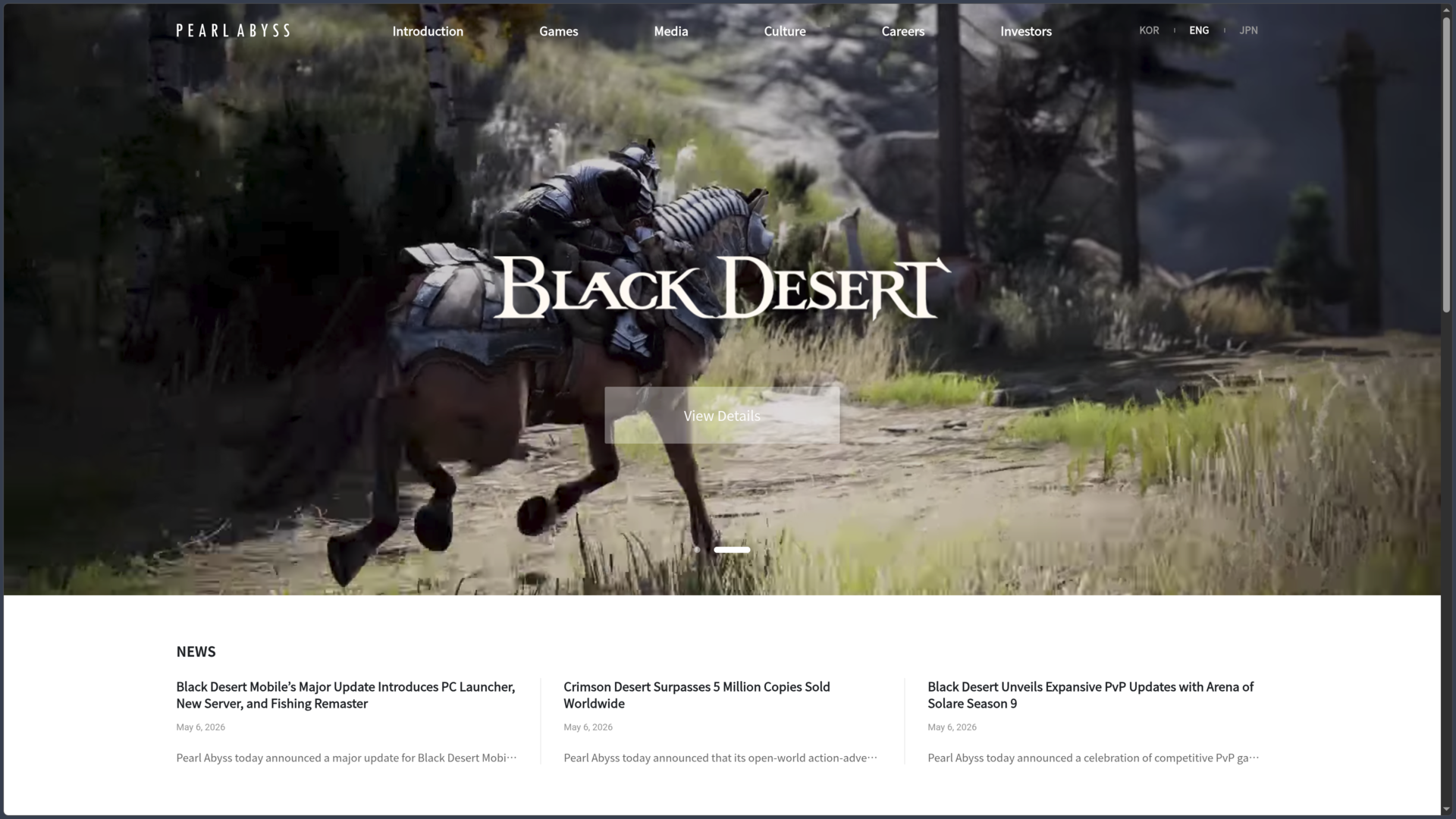
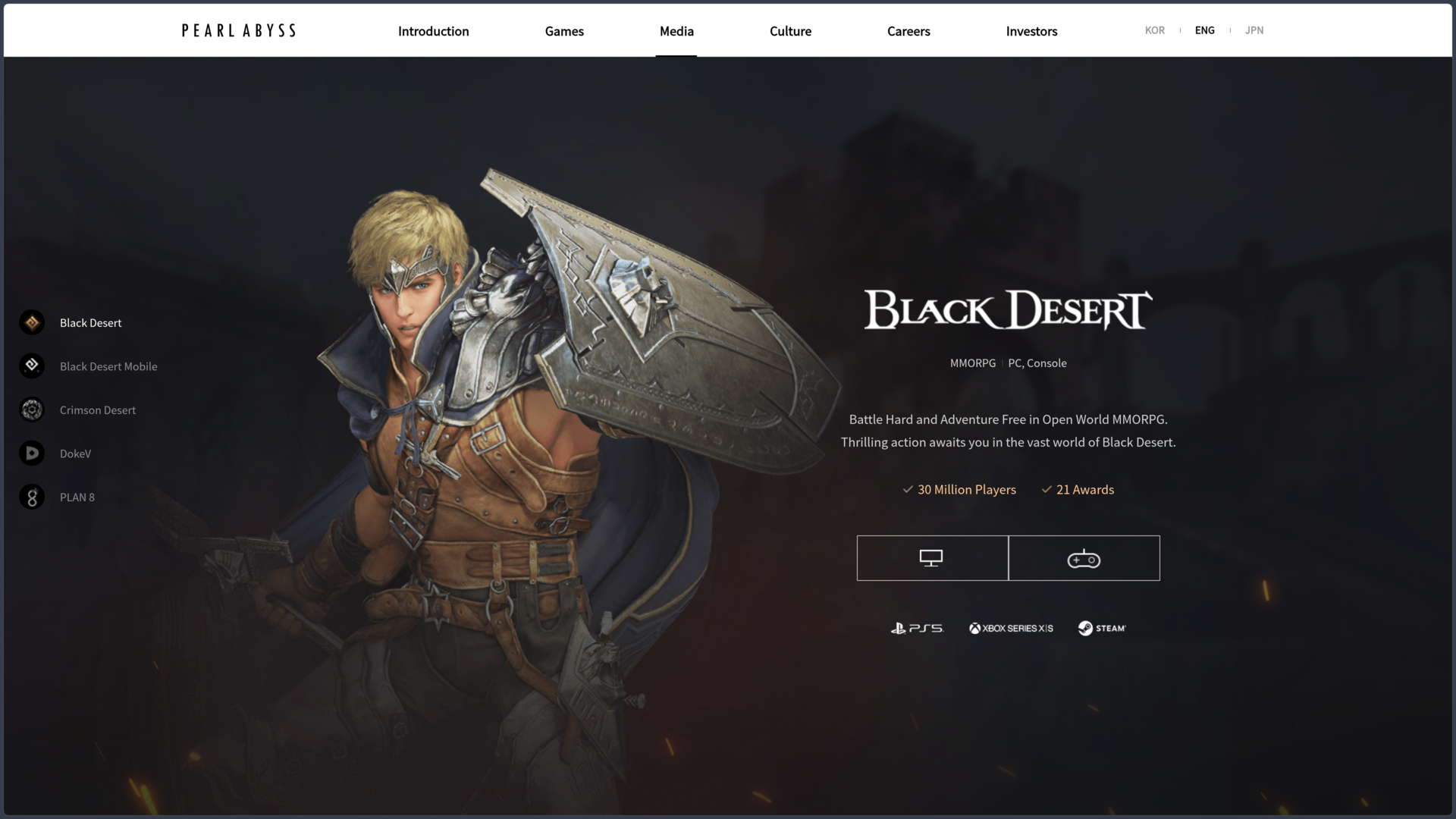
First launched in South Korea and then progressively across many regions of the world, Black Desert transformed Pearl Abyss into an international studio. The game combines an MMORPG structure, open world, real-time combat, economic systems, life activities and particularly extensive customization. But its importance in the studio’s history goes beyond its content: it became a technical and commercial platform that Pearl Abyss learned to adapt to multiple territories, multiple machines and multiple forms of service.
This evolution gradually took the company beyond the role of developer. The first international versions of Black Desert were operated with different local partners, but Pearl Abyss later took direct control of the service in several regions. Korea moved to direct operation in 2019, Japan in 2020, North America and Europe in 2021, then South America in 2022. The studio thus also became the global publisher and operator of its main franchise, with teams capable of managing infrastructure, localization, community and long-term updates.
Internal technology remains another defining element. Pearl Abyss has developed its own engines and tools since its beginnings, with the goal of being able to adapt technical features quickly to the needs of its teams. This philosophy notably led to the BlackSpace Engine, used for Crimson Desert. Publicly presented through its rendering, simulation and large-environment creation tools, it extends the idea that the engine should evolve directly alongside the game rather than be treated as separate infrastructure.
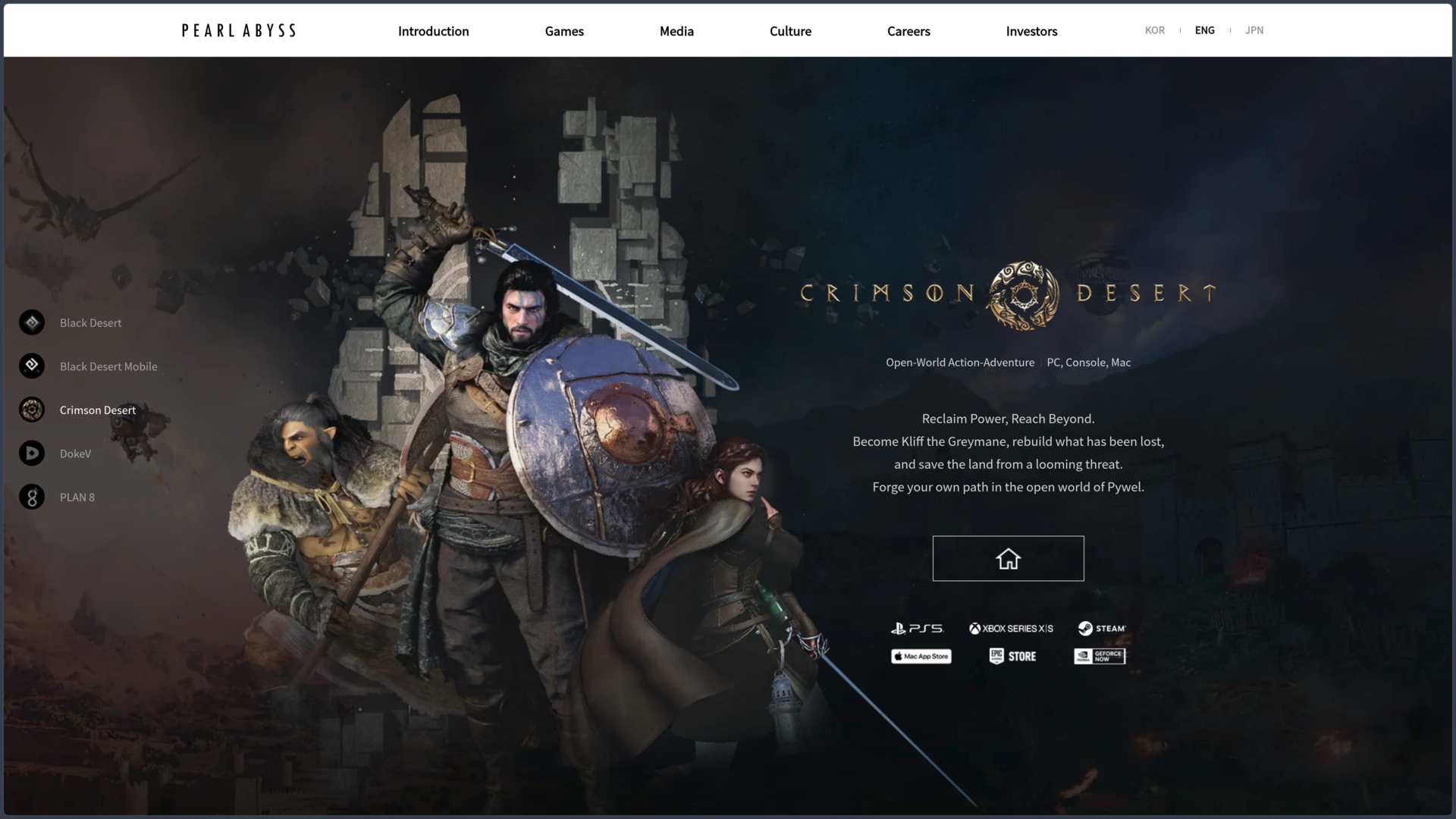
The worldwide release of Crimson Desert in March 2026 therefore represents an important milestone. Pearl Abyss is no longer limited to extending the structure of Black Desert or developing only MMO-centered experiences. Crimson Desert takes the form of an open-world action-adventure game and uses the technology accumulated by the studio to build an experience more focused on exploration, combat and progression within a self-contained universe.
The announced catalogue confirms this desire to broaden its scope. DokeV is presented as an open-world action adventure, while PLAN 8 explores an MMO shooter based notably around exoskeletons. Pearl Abyss therefore retains several elements from its history — large environments, real-time action, internal technology and connected dimensions — while seeking to use them in different forms of games.
History
2010: building the technology alongside the game
Pearl Abyss Corporation was established in September 2010. Kim Dae-il founded the company with a small initial team, with the goal of producing a game capable of standing out in a South Korean market already strongly associated with online experiences.
The project that would become Black Desert quickly emerged as the center of this ambition. To develop it, Pearl Abyss did not simply choose an existing commercial engine. The company built its own technology, which represented a significant investment for a still-young organization but gave it greater control over the systems, rendering and tools required for the project.
This decision had a lasting influence on how the studio operated. Technical teams did not work solely to provide a generic engine: they could adapt tools directly to problems encountered by artists, designers and programmers. This close relationship between game production and technological development would become one of Pearl Abyss’s constants.
Long before the game’s full release, the company also began organizing its international rollout. Publishing agreements for Black Desert were signed in Japan in 2012, in Korea the same year, in Russia in 2013, then in North America and Europe in 2014.
In December 2014, Black Desert entered open beta in South Korea. After four years during which the studio simultaneously built its game, technology and network of partners, Pearl Abyss finally had the foundation that would determine its trajectory over the following decade.
Black Desert: from a national launch to a global franchise
From 2015 onward, Black Desert began its international expansion. The game officially launched in Japan and then Russia before arriving in North America and Europe in 2016.
This rollout did not involve reproducing exactly the same operation everywhere. Pearl Abyss worked with several regional publishers capable of handling localization, operations and player relations. The studio remained primarily focused on developing and evolving the game.
The very nature of Black Desert, however, required a lasting relationship between developer and audience. The project continued to receive new classes, regions, activities, system changes and technical improvements after launch. The game became a permanent production rather than a title quickly replaced by a sequel.
This structure encouraged Pearl Abyss to develop expertise across several areas at once: regular content design, balancing a shared universe, international adaptation, technical maintenance and observation of player behavior.
In 2017, the company went public in South Korea. This new financial scale came as Black Desert continued expanding geographically and Pearl Abyss was already preparing to diversify across platforms.
From PC to mobile and consoles
One of the most important changes came with Black Desert Mobile, launched in South Korea in February 2018.
Pearl Abyss did not simply transfer the PC version directly to smartphones. The studio adapted the interface, progression and systems to the constraints of mobile while seeking to preserve the visual quality and action identity associated with the franchise.
The game was subsequently launched in other territories before receiving a global release in 2019. During the same period, the main version of Black Desert expanded to consoles: Xbox One in 2019, followed by PlayStation 4 the same year.
The franchise thus became a genuinely multiplatform property. For Pearl Abyss, this diversification also served as a large-scale test of its technology. The same visual and systemic identity had to be adapted to devices with very different capabilities, interfaces and uses.
In 2018, Black Desert also received a major visual and audio overhaul with Black Desert: Remastered. Once again, the studio treated its game as a foundation intended to keep evolving rather than as a production frozen in the technical state of its original launch.
2018: growing without absorbing the identity of other studios
The year 2018 also marked an important industrial development with the acquisition of CCP Games, the Icelandic developer of EVE Online.
This transaction significantly expanded Pearl Abyss’s scope, but the two organizations did not merge into a single studio. CCP Games continued to operate as an independent entity with its own teams, universe and production culture.
This distinction is important for understanding Pearl Abyss. EVE Online did not become a creation of the South Korean studio simply because its developer now belonged to the same group. The acquisition instead brought Pearl Abyss another form of experience with global MMOs, persistent services and communities capable of existing for many years.
It also showed that the company was no longer merely the developer of a successful franchise. Pearl Abyss gradually became a group capable of acquiring and maintaining other organizations without necessarily erasing their autonomy.
From developer to global publisher
Alongside this growth, Pearl Abyss began taking direct control of Black Desert operations in several regions.
The movement notably began in Russia in 2018, followed by South Korea in 2019 and Japan in 2020. In 2021, the company took direct control of Black Desert Online services in North America and Europe, previously operated with Kakao Games.
This transition was structural. Until then, Pearl Abyss still depended heavily on regional partners to market and operate its game. By handling these functions itself, the studio now controlled a greater part of the relationship between the creation of content and its arrival to players.
South America also moved to direct service in 2022, giving Pearl Abyss control over global publishing for the Black Desert franchise.
This evolution profoundly changed the nature of the company. Development, technology, operations and publishing gradually became skills brought together within the same organization.
This integration does not mean that Pearl Abyss abandoned all external collaboration, but it reduced the distance between the team building the game and those observing its daily operation in different regions.
Home One and the construction of a creative infrastructure
In 2022, Pearl Abyss moved its headquarters to Gwacheon, south of Seoul, into a new complex called Home One.
The building was designed around game production and brings together various internal facilities. This centralization reflects an important aspect of the studio’s strategy: keeping in-house skills that might normally be distributed among many different service providers.
Pearl Abyss notably has its own motion capture, 3D scanning and audio production facilities. The company also presents its motion capture team as a first among South Korean game companies.
These resources complement engine development. Technological control is therefore not limited to rendering code: motion capture, asset creation, sound and production tools also form part of a pipeline intended to allow teams to experiment quickly.
This infrastructure became especially important as Pearl Abyss began developing several projects no longer directly based on the Black Desert formula.
Crimson Desert: moving beyond the established framework
Crimson Desert represents the most significant break since the creation of Black Desert.
The project uses the studio’s experience in building large environments, real-time combat and internal technology, but does not simply reproduce the model of its historic MMORPG. Pearl Abyss develops it as an open-world action adventure, centered on the continent of Pywel and the journey of Kliff.
The structural change also required the studio to evolve its tools. Crimson Desert runs on the BlackSpace Engine, an internal engine developed to meet the new ambitions of the studio’s productions.
Pearl Abyss has publicly presented several of its technical capabilities: lighting, rendering of large environments, water simulations, volumetric fog, GPU-calculated cloth and hair, as well as management of different physics systems. These technologies are not, however, an end in themselves; they serve to make the world more responsive and to multiply visible interactions during exploration.
After several years of development and public presentations, Crimson Desert launched worldwide on March 19, 2026 on PC, Mac, PlayStation 5 and Xbox Series X|S.
Its release gave Pearl Abyss a second major property capable of existing independently of Black Desert. Above all, it illustrates the studio’s transformation: technology and expertise developed around an MMORPG can now support a different kind of open-world adventure.
What sets it apart
Developing its own tools to stay close to creative needs
Proprietary technology is probably the clearest continuity throughout Pearl Abyss’s history.
From Black Desert onward, the studio chose to build its own engine. This decision allows it to adapt tools directly to the needs of the project, but also requires maintaining teams capable of continuously evolving that infrastructure.
Pearl Abyss presents this proximity between engine developers and production teams as an important advantage. When a feature is needed, it can be designed directly around the game rather than waiting for the evolution of an external solution.
The BlackSpace Engine now continues this philosophy. It is not simply a visually improved version of the historic Black Desert technology; it supports a new generation of projects and requirements, particularly those of Crimson Desert.
This internal control gives technology a very concrete role: allowing the studio to experiment with worlds, simulations and interactions without completely separating creative design from tool development.
Building worlds through an accumulation of systems
Black Desert reveals another persistent characteristic of Pearl Abyss: its worlds are built from many layers of activities and systems.
Combat, exploration, economy, trade, crafting, gathering, navigation, mounts and social activities do not necessarily function as separate experiences. Their accumulation gives the world a density that allows players to construct different ways of engaging with it.
This approach is not reproduced identically in Crimson Desert, but the same desire to make the environment usable remains visible. Movement, climbing, gliding, combat, physical interactions and exploration turn the world into something more than a simple space connecting objectives.
Pearl Abyss therefore appears less interested in simply building a gigantic setting than in layering enough systems within it for the environment to retain usefulness beyond its visual representation.
Evolving a production over many years
The experience gained with Black Desert has also transformed the studio’s relationship with time.
The game launched in Korea in 2014 continues, more than a decade later, to receive content and transformations. Several generations of machines, technologies and communities must therefore coexist with the same foundation.
Maintaining this kind of production requires a different type of work from that of a game quickly replaced by its successor. The studio must be able to add content without making existing systems inconsistent, improve technology without unnecessarily disrupting the experience and adapt its services to changes in platforms.
The 2018 remaster provides a particularly visible example of this logic: instead of treating the original appearance as final, Pearl Abyss extensively reworked the graphics and sound of a game already in operation.
Duration thus becomes a dimension of design. Productions must not only work at launch; they must be able to accommodate years of additions, corrections and sometimes significant transformations.
Bringing development, technology and operations together
Pearl Abyss has finally distinguished itself through the gradual integration of several stages traditionally divided among different companies.
In its early years, the studio developed Black Desert but relied heavily on regional partners for publishing. From 2018 onward, it progressively took direct control of operations in these territories until becoming the global publisher of its franchise.
This broader control brings production and community closer together. The teams building the game belong to the same organization as those operating the services and supporting players across different markets.
Home One and the internal facilities reinforce this integration further: engine technology, capture, sound, creation and operations all belong to a production ecosystem that Pearl Abyss seeks to control directly.
This organization does not prevent partnerships or the existence of independent subsidiaries such as CCP Games. It instead reflects a desire to retain in-house the skills considered essential to developing and evolving its own games.
Good to know
- Pearl Abyss was founded in September 2010 in South Korea by Kim Dae-il with a small initial team.
- Black Desert entered open beta in South Korea in December 2014 before gradually expanding into many regions around the world.
- Pearl Abyss went public in 2017.
- Black Desert Mobile launched in South Korea in 2018 before its international rollout.
- Pearl Abyss acquired CCP Games in 2018, but the studio behind EVE Online continues to operate as an independent entity.
- Black Desert expanded to consoles in 2019, first on Xbox One and then PlayStation 4.
- Pearl Abyss gradually took direct control of Black Desert operations and became its global publisher in 2022.
- The company moved its headquarters in 2022 to Home One in Gwacheon, a complex designed around game production.
- The BlackSpace Engine is the proprietary technology used notably for Crimson Desert.
- Crimson Desert launched worldwide on March 19, 2026 and marks Pearl Abyss’s major expansion beyond the MMO formula of Black Desert.
- DokeV and PLAN 8 are among the other projects currently presented by Pearl Abyss.