
Presentation
Founded in Copenhagen in 1998, IO Interactive occupies a distinctive position among European studios that have managed to span several generations of games while maintaining a recognizable technological and creative continuity. Its history remains closely tied to Hitman, which began with Hitman: Codename 47 in 2000, but the studio cannot be reduced to Agent 47 alone. Freedom Fighters, Kane & Lynch, and Mini Ninjas demonstrated early on its willingness to explore other universes, while its more recent projects mark a new phase of diversification.
Much of this continuity rests on Glacier, an engine developed internally from the studio's earliest years. IO Interactive has continued to evolve it alongside its games rather than regularly replacing its technological foundation. This choice has supported a way of working in which environments, behaviors, rules, and tools are designed as systems capable of interacting with one another. Hitman remains the best-known expression of this philosophy, with spaces offering several ways to observe a situation, understand its rules, and then act upon them.
The studio's organizational evolution has been just as important. After several years within Eidos and later Square Enix, IO Interactive became independent again in 2017. This separation allowed it to continue Hitman under its own control and gradually marked its transition from a studio primarily focused on development to an independent developer and publisher. The company subsequently expanded beyond Copenhagen, began working on several universes in parallel, and strengthened its publishing capabilities. IO Interactive can now be understood as a studio attempting to transfer the experience accumulated through Hitman into other properties and forms of production without abandoning the tools that helped shape its identity.
History
From Copenhagen to Hitman
IO Interactive was founded in 1998 in Copenhagen. The studio emerged at a time when the widespread adoption of 3D was creating new possibilities, while the engines available to developers did not necessarily meet the technical ambitions of every project. The team therefore chose to build its own technology. Glacier supported its first commercial game and subsequently became a long-term infrastructure for the studio's productions.
In 2000, Hitman: Codename 47 introduced Agent 47 and established the foundations of the property that would remain most closely associated with IO Interactive. The following games allowed the studio to refine this formula over the years. Hitman 2: Silent Assassin, Hitman: Contracts, and later Hitman: Blood Money placed the series at the center of its catalogue and firmly established the idea of environments designed to give players room for observation, preparation, and improvisation.
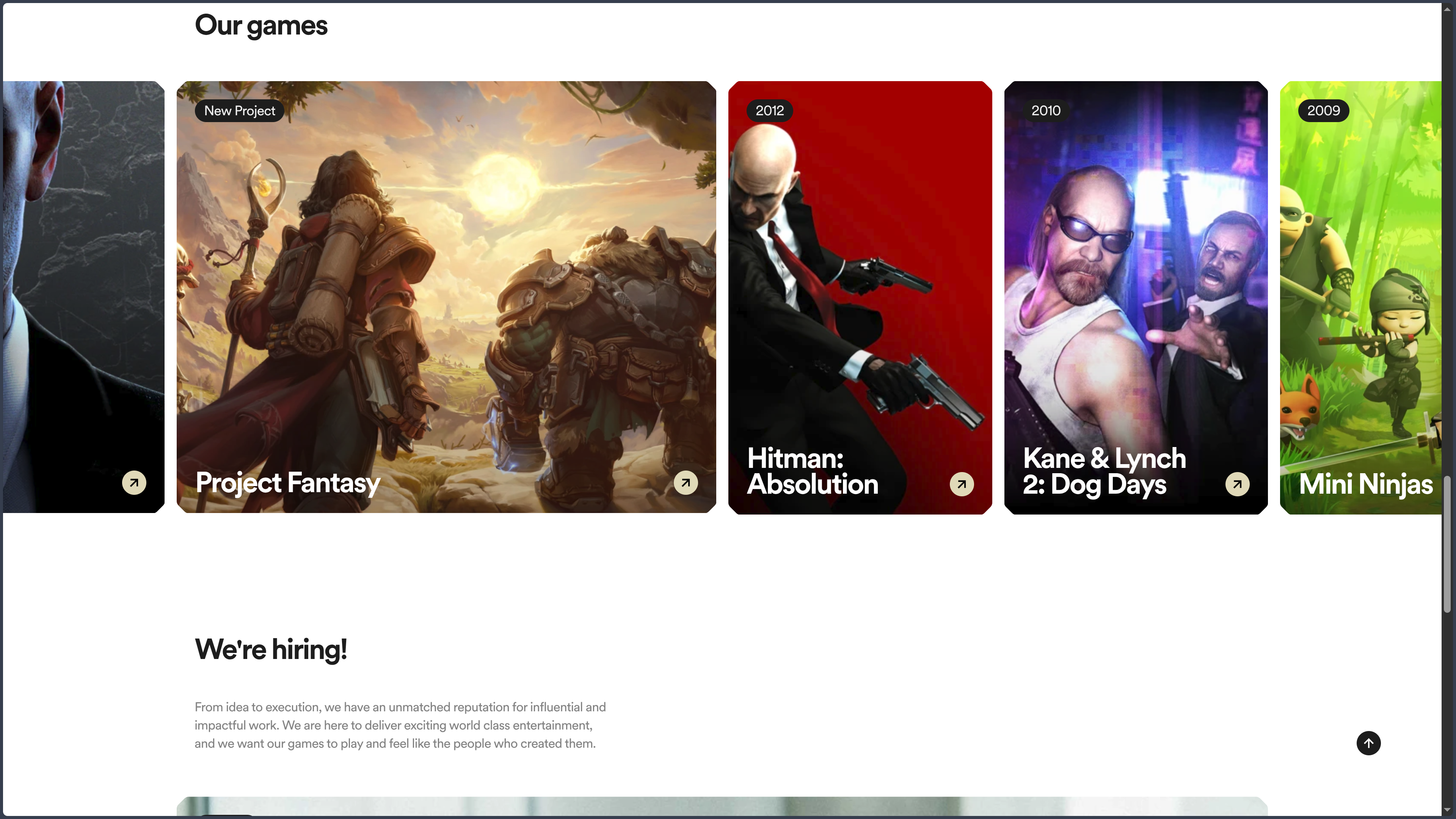
This specialization did not prevent IO Interactive from moving beyond Hitman. Freedom Fighters in 2003 explored squad-based tactical action, while Kane & Lynch, beginning in 2007, developed a more direct criminal universe and expanded the studio's experience with multiplayer modes. Mini Ninjas, released in 2009, represented an even clearer shift in tone with an adventure aimed at a broader audience. None of these projects established a second franchise as enduring as Hitman, but they broadened the studio's production experience and demonstrated that its technology was not designed for a single type of game.
A period within major publishers
In 2004, IO Interactive was acquired by Eidos Interactive, its long-standing publishing partner for Hitman. When Square Enix took control of Eidos in 2009, the Danish studio also became part of the Japanese group. This period gave it access to the resources of a major international publisher while also placing its productions within an organization extending far beyond the studio itself.
Hitman: Absolution was released in 2012 before IO Interactive once again redirected the series. The project launched in 2016 simply as HITMAN adopted a different publishing structure and became the starting point of what would later be known as the World of Assassination trilogy. The studio returned to large environments supporting different approaches while developing an architecture intended to be extended rather than replaced with every new installment.
This period became decisive, however, for reasons extending beyond game design. In 2017, Square Enix decided to part ways with IO Interactive. A management-led buyout ultimately allowed the studio to become independent again and retain control of the Hitman property. For a team whose identity had developed around the series for almost two decades, independence directly changed the conditions under which it could determine its own future.
Independence as a new stage
IO Interactive continued the cycle begun in 2016 with HITMAN 2 in 2018 and HITMAN 3 in 2021. The three games were eventually brought together under the name HITMAN World of Assassination, forming a shared platform that the studio continued to evolve years after the release of the third installment. This continuity created a framework in which accumulated locations, systems, and content could coexist rather than remain confined within three entirely separate products.
The studio's stabilization also allowed it to expand its scale. A location opened in Malmö in 2019, followed by Barcelona in 2021. Brighton and Istanbul joined the network in 2023. The teams are not simply distributed across a succession of isolated projects: IO Interactive develops Glacier as shared technology whose improvements can circulate between its studios and productions.
At the same time, the company strengthened its own publishing capabilities. This transformation took another step with the creation of IOI Partners, a division intended to support and publish games developed by external teams. Its first publishing partnership involved MindsEye from Build A Rocket Boy. This activity does not turn those external productions into games developed by IO Interactive, but it expands the company's role within the production chain.
Beyond Hitman, new universes
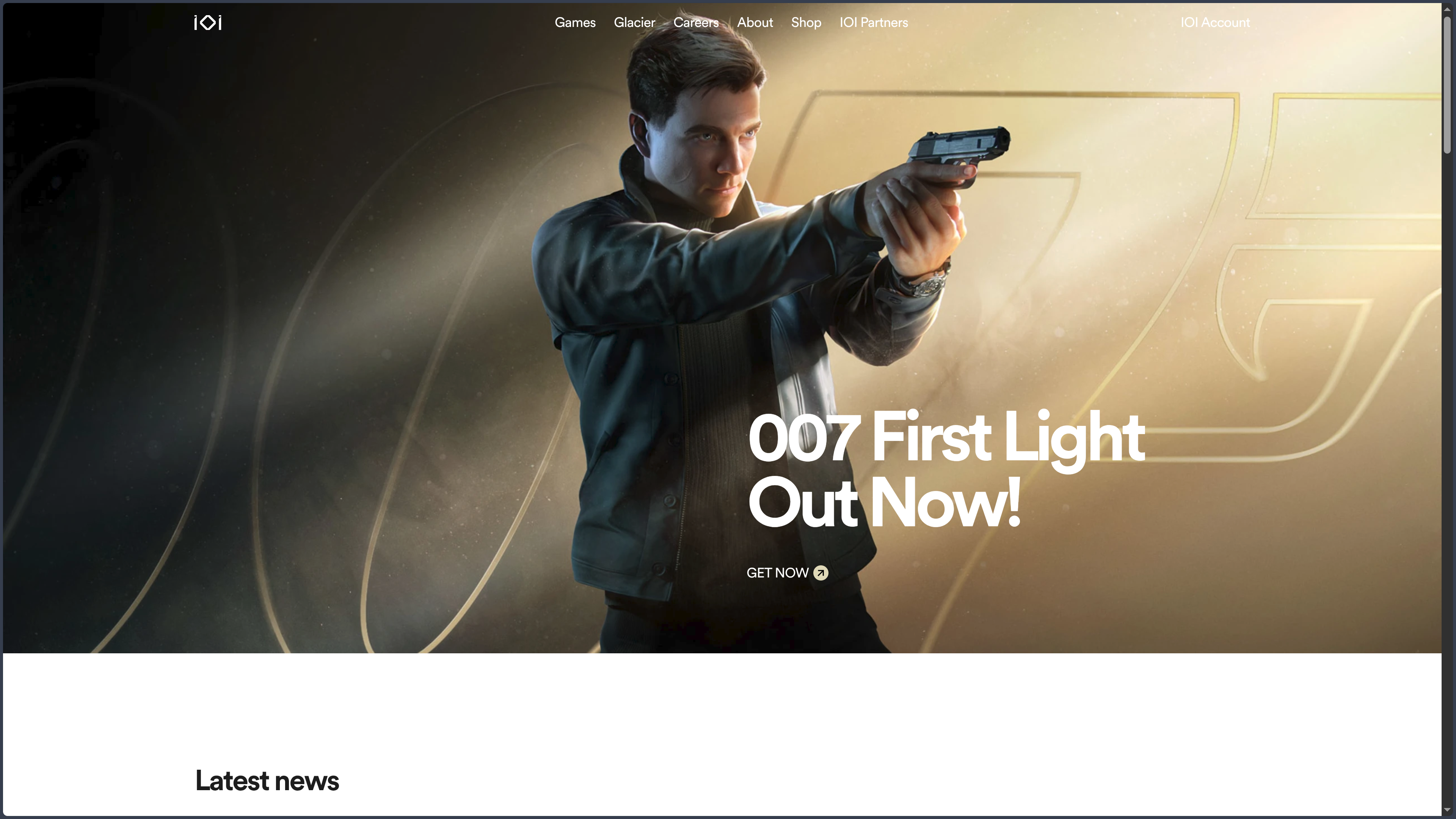
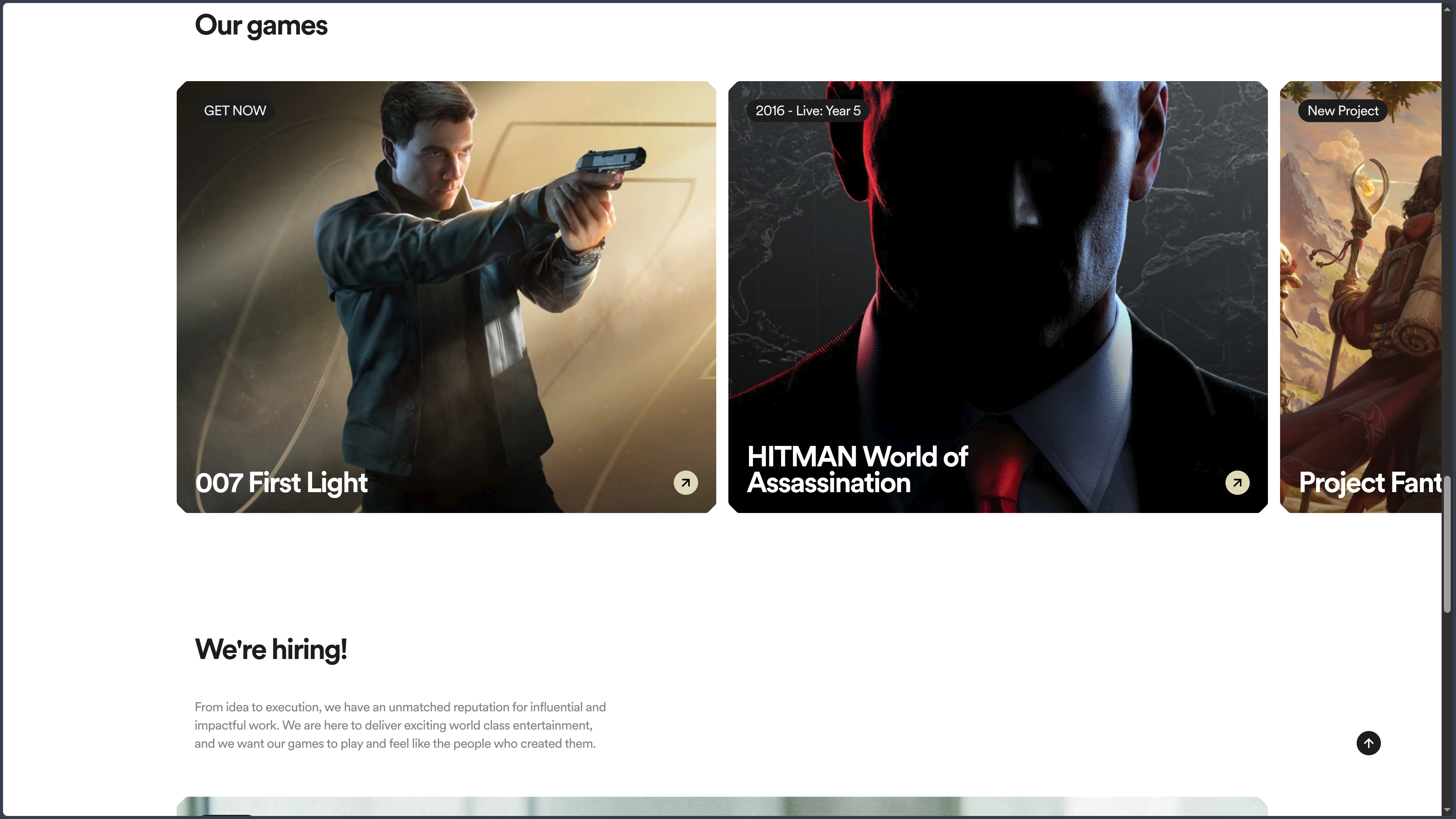
Independence has above all allowed IO Interactive to prepare a diversification that no longer depends exclusively on Hitman. The studio obtained the opportunity to develop a game based on James Bond and gradually transformed the project initially announced as Project 007 into 007 First Light, released in May 2026. The project represents an important step: IO Interactive is working with an especially recognizable external property while reusing part of the experience accumulated in espionage environments, infiltration, and situations offering several possible approaches.
At the same time, Project Fantasy represents a different direction, as it is a new property developed by IO Interactive. In 2026, the end of an external funding partnership led the studio to regain full ownership of the project and continue development using its own resources. This reorganization was accompanied by the announced closure of the Istanbul studio and a refocusing of the organization. The locations currently presented by IO Interactive are Copenhagen, Malmö, Barcelona, and Brighton.
This situation reflects both the ambition and the constraints of its current model. IO Interactive retains control of its main productions, owns its technology, develops and publishes its games, and seeks to sustain several universes in parallel. This independence gives the studio greater control while also requiring it to carry a larger share of the risks associated with large-scale productions.
What sets it apart
Environments designed as systems
One of IO Interactive's most enduring creative characteristics is the way it designs spaces in which numerous elements can interact. This approach is especially visible in Hitman, whose missions rely on locations populated by characters, routines, access zones, objects, and events capable of combining with one another.
The appeal therefore does not come solely from the scale or level of detail of these environments. Players must be able to understand how they function and then exploit that knowledge. The same situation can produce different solutions depending on the route chosen, the behavior observed, or the way several systems are used together. Across successive installments, this logic has given the studio a particularly strong foundation for exploring player autonomy and the consequences produced by individual decisions.
Glacier as technological continuity
Glacier is one of the most unusual elements in IO Interactive's trajectory. Developed from the studio's earliest years, the engine has been maintained and transformed for more than two decades rather than being abandoned in favor of an external solution.
This continuity directly connects technological evolution with the development of the teams themselves. Tools are created according to needs encountered during production, while improvements made for one project can be shared with others. Glacier has therefore supported very different games, from the earliest Hitman titles to Kane & Lynch, before powering the considerably more complex environments of World of Assassination and continuing to evolve for 007 First Light.
The engine is therefore more than a technical choice. It provides a shared language across the studio's projects and locations while allowing IO Interactive to retain a significant part of its expertise internally.
Independence tied to control of its works
The return to independence in 2017 represented more than a change of ownership. IO Interactive regained the ability to directly determine the evolution of Hitman and gradually developed the skills required to handle a larger part of the publishing process for its own productions.
This control changes how the studio can think about its games over time. World of Assassination offers a clear example: the three installments of the modern trilogy were progressively brought together into a shared experience maintained and expanded beyond the traditional cycle in which one game launches before eventually being replaced by the next.
The creation of IOI Partners extends this publishing expertise to productions designed by other studios. Internal development and external publishing remain distinct activities, but their coexistence illustrates how far IO Interactive has expanded its field of activity since becoming independent.
Turning specialization into transferable experience
The close association between IO Interactive and Hitman could make any lasting move beyond the franchise difficult. The studio has nevertheless begun transforming what it learned through the series into expertise applicable to other projects.
007 First Light represents the first major test of this transition. The espionage setting retains certain connections with IO Interactive's historical strengths, but the James Bond property demands a different identity, different staging, and a different scale of action. Project Fantasy is intended to push this diversification further by building an original property in a universe even further removed from Agent 47's territory.
The studio's current identity therefore rests less on one particular franchise than on a coherent set of accumulated capabilities: systemic design, proprietary technology, large-scale game production, and increasing control over publishing and exploitation. The projects developed beyond Hitman now provide a way to assess whether this culture can remain recognizable when the studio moves into entirely different universes.
Good to know
- IO Interactive was founded in Copenhagen in 1998.
- Its first commercial game, Hitman: Codename 47, was released in 2000.
- Since its earliest years, the studio has developed its own engine, Glacier, which remains in use and is continually modernized.
- Eidos Interactive acquired IO Interactive in 2004; the studio later joined Square Enix when the company acquired Eidos in 2009.
- IO Interactive became independent again in 2017 and retained control of the Hitman property.
- The studio expanded beyond Denmark with Malmö in 2019, Barcelona in 2021, and Brighton in 2023. Istanbul, also opened in 2023, was announced for closure in 2026.
- 007 First Light, developed and published by IO Interactive, was released in May 2026.
- IOI Partners, created as a publishing division, allows the company to publish productions developed by third-party studios; MindsEye from Build A Rocket Boy was its first project.
- Project Fantasy is a new IO Interactive property currently in development; the studio announced full ownership of the project in July 2026 following the end of an external funding partnership.