



Overview
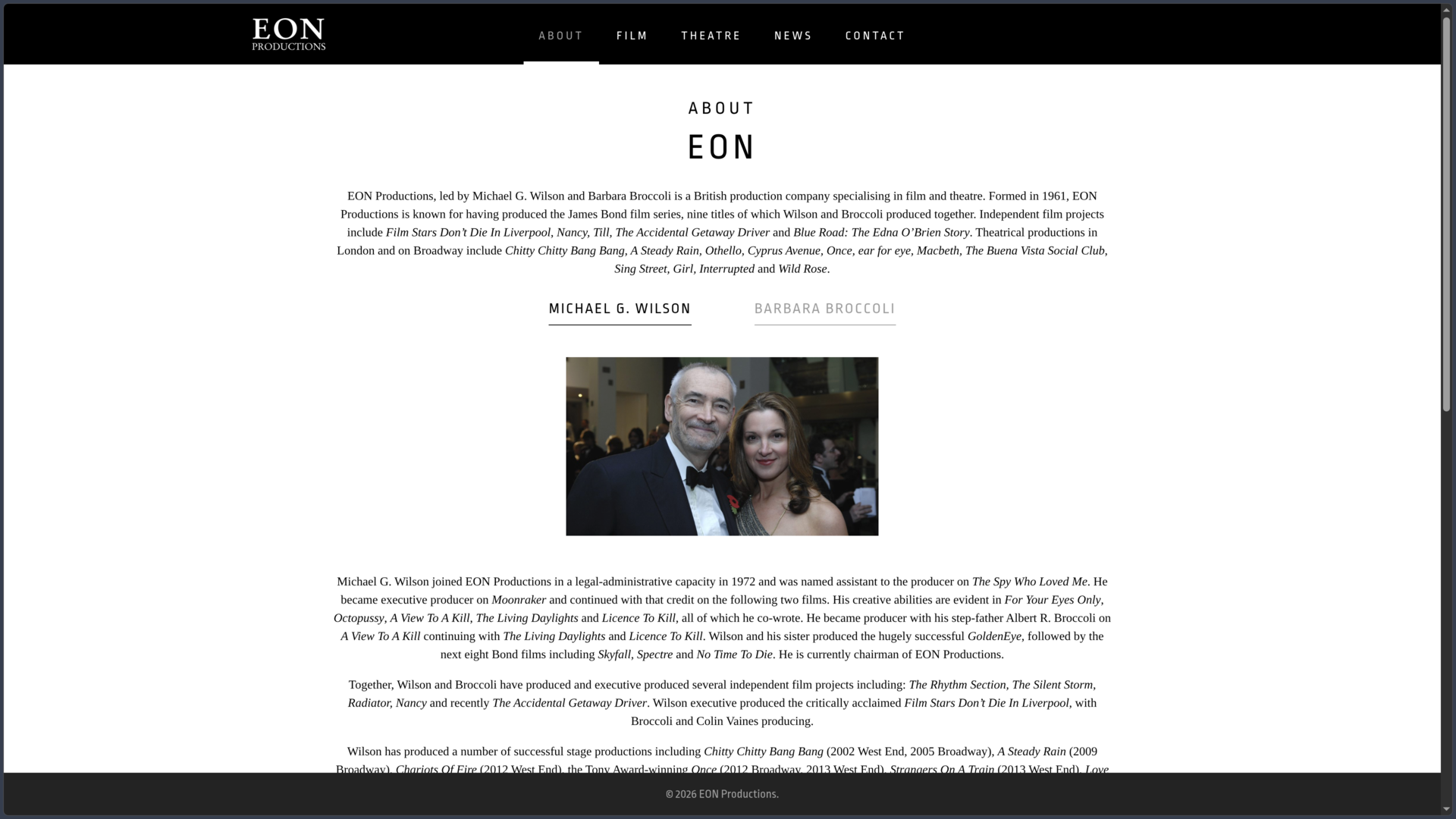
EON Productions is a British film and theatre production company founded in 1961 by producers Albert R. “Cubby” Broccoli and Harry Saltzman.
Its history is inseparable from that of James Bond on screen.
When Broccoli met Saltzman, the latter held an option on the adaptation rights to Ian Fleming’s novels. The two producers joined forces, secured financial backing from United Artists and set out to transform Agent 007 into a film hero.
The result was Dr. No, directed by Terence Young and released in 1962 with Sean Connery.
The film’s success launched one of the longest-running film series in history.
For more than six decades, EON guided James Bond through several generations of actors, directors and screenwriters, from Sean Connery to Daniel Craig, including George Lazenby, Roger Moore, Timothy Dalton and Pierce Brosnan.
Throughout this period, the company remained closely controlled by the Broccoli family.
After Harry Saltzman’s departure in the mid-1970s, Albert R. Broccoli took sole charge of producing the Bond films before gradually passing responsibility for the series to his stepson Michael G. Wilson and his daughter Barbara Broccoli.
Wilson and Broccoli produced nine Bond films together, from GoldenEye to No Time to Die.
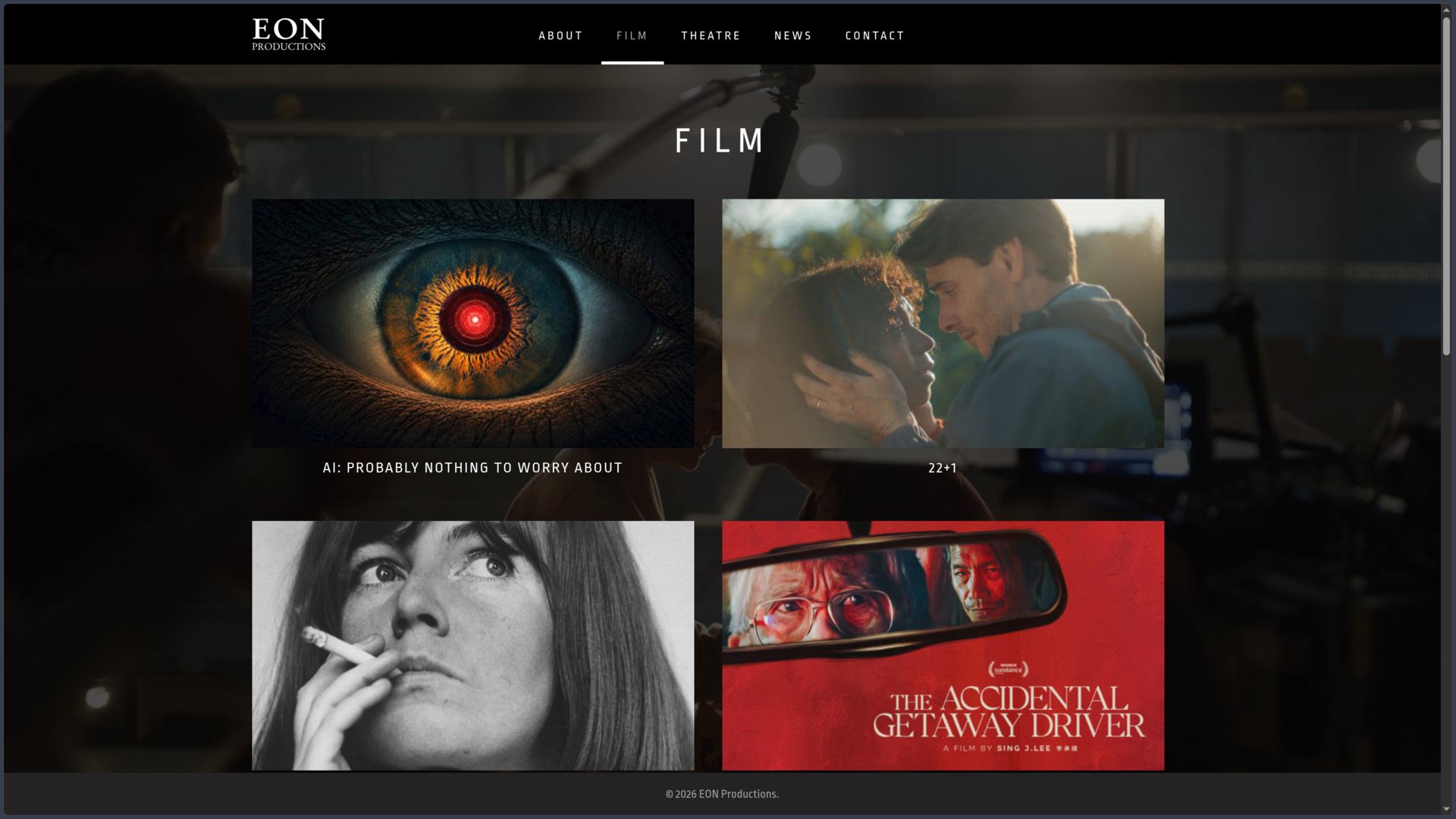
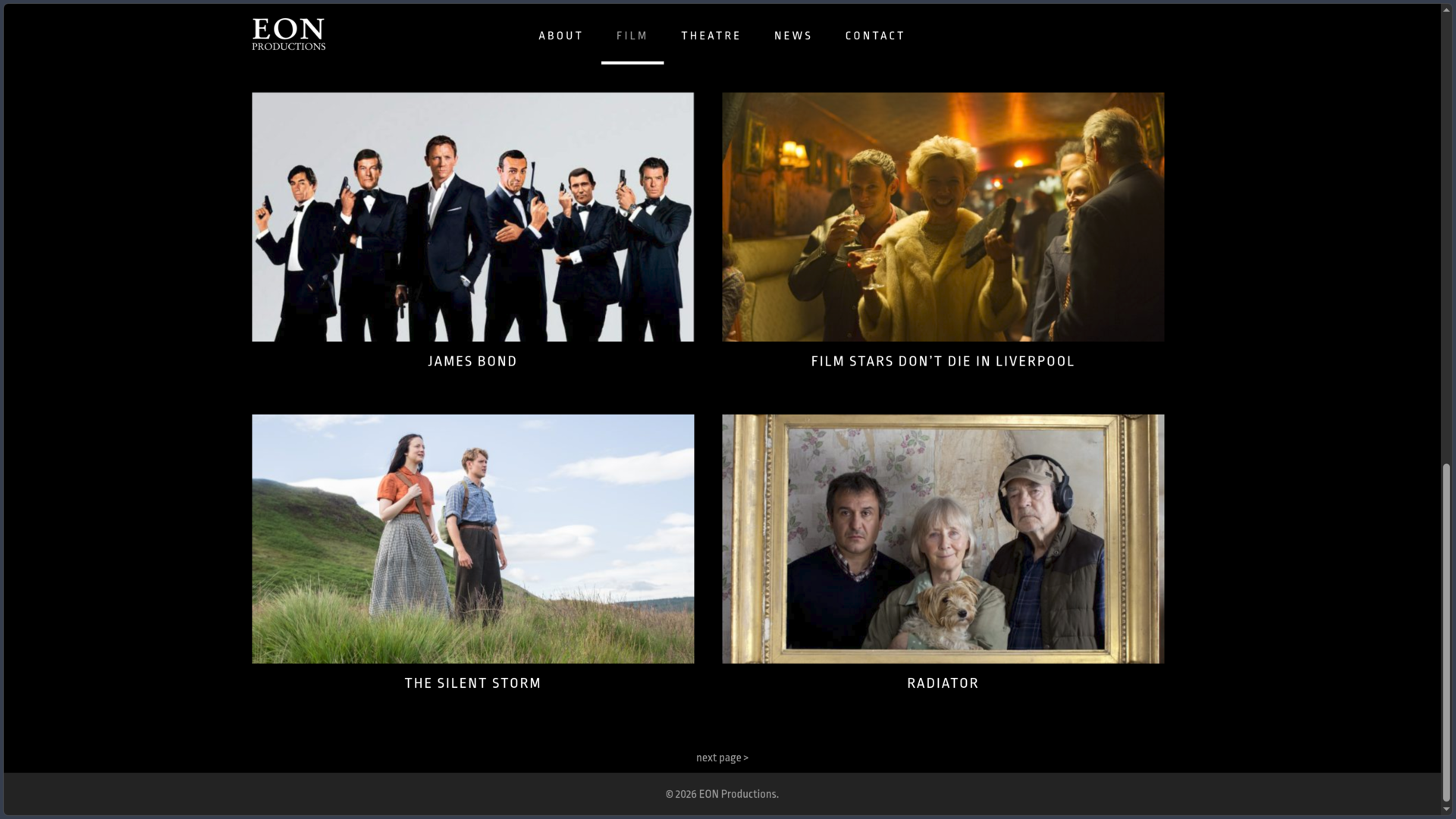
EON has also developed independent projects such as Film Stars Don’t Die in Liverpool, The Rhythm Section, Till, The Accidental Getaway Driver and the documentary Blue Road: The Edna O’Brien Story, alongside a substantial theatre business in London and on Broadway.
In 2025, a new chapter opened for James Bond: Amazon MGM Studios, Michael G. Wilson and Barbara Broccoli created a joint structure around the franchise rights, with Amazon MGM taking creative control of future productions.
EON Productions nevertheless continues to exist as an independent company active in film and theatre.
History
1961 — Broccoli and Saltzman join forces
In the early 1960s, Albert R. Broccoli wanted to adapt Ian Fleming’s James Bond novels.
The relevant film rights were then controlled by Canadian producer Harry Saltzman.
Rather than compete, the two men decided to work together.
In 1961, they founded EON Productions as well as Danjaq, a company connected to the management of the Bond rights.
EON was officially incorporated in the United Kingdom on July 6, 1961.
Broccoli and Saltzman then secured the backing of United Artists, which agreed to finance and distribute the first film.
The initial budget remained relatively modest, but the ambition was clear: to transform Fleming’s literary character into an international screen hero.
1962 — Dr. No
To launch the series, Broccoli and Saltzman chose Dr. No.
The film was directed by Terence Young.
After an extensive search, Sean Connery was chosen to play James Bond.
His combination of elegance, danger, irony and confidence played a crucial role in defining the character on screen.
Released in 1962, Dr. No was successful enough to allow a second film to enter production quickly.
EON had laid the foundations of a franchise that would far exceed the original ambitions of its founders.
From Russia with Love and Goldfinger
From Russia with Love followed in 1963.
The film further developed the espionage world surrounding Bond and strengthened several elements that would become recurring features.
But it was Goldfinger, released in 1964, that truly established James Bond as a global popular-culture phenomenon.
The gadget-equipped car, spectacular sets, title sequence, theme song, memorable villains and balance between action, humor and sophistication permanently shaped the Bond formula.
The series quickly became one of United Artists’ most important properties.
Thunderball and the Bond phenomenon
In 1965, Thunderball confirmed the scale of the phenomenon.
Production became increasingly spectacular and 007 adventures turned into international events.
EON gradually increased both budgets and production scale.
Travel, vehicles, stunts, huge sets and large action sequences became essential components of the franchise’s identity.
Its success also inspired numerous espionage films and television series.
You Only Live Twice
With You Only Live Twice in 1967, EON pushed the spectacle even further.
The film, shot partly in Japan, culminates in the enormous volcano set designed by Ken Adam.
This approach already illustrates a major characteristic of Bond productions: whenever possible, relying on real sets, stunts and environments capable of giving the films a tangible sense of scale.
That commitment would remain central to the series for generations.
1969 — George Lazenby becomes Bond
After Sean Connery temporarily left the role, Australian model and actor George Lazenby was chosen to succeed him.
He played Bond in On Her Majesty’s Secret Service, released in 1969.
The film introduced a more romantic and tragic dimension than many previous entries.
Lazenby did not return for a second film.
Sean Connery then resumed the role in Diamonds Are Forever in 1971.
This first transition already demonstrated that EON could treat James Bond as a character capable of surviving a change of actor.
1973 — The Roger Moore era
In 1973, Roger Moore became the third actor to play Bond in the EON series with Live and Let Die.
His approach differed from Connery’s: lighter, more ironic and more strongly based on his natural elegance.
This evolution allowed the franchise to refresh its tone rather than simply imitate the earlier films.
Moore ultimately became the Bond of an entire generation.
He played the character in seven films between 1973 and 1985.
1975 — Harry Saltzman leaves
By the mid-1970s, Harry Saltzman was facing major personal financial difficulties.
In 1975, he sold his interest connected to the franchise to United Artists.
His departure marked the end of the partnership that had launched Bond on screen fourteen years earlier.
The Spy Who Loved Me, released in 1977, became the first Bond film produced by Albert R. Broccoli without Saltzman.
Cubby Broccoli now carried almost sole responsibility for the series.
The Spy Who Loved Me
The Spy Who Loved Me represents a particularly important moment for EON.
After a period of transition, the film reaffirmed Bond’s spectacular scale.
It includes the opening ski jump with the Union Jack parachute, the Lotus Esprit transformed into an underwater vehicle and the enormous supertanker belonging to villain Karl Stromberg.
To build the necessary sets, the production developed the 007 Stage at Pinewood, a huge soundstage that would remain closely associated with the franchise.
The film’s success strengthened Albert R. Broccoli’s role as the guardian of Bond.
Michael G. Wilson gradually joins production
Michael G. Wilson, Albert R. Broccoli’s stepson, joined EON in 1972 in legal and administrative roles.
He later became assistant to the producer on The Spy Who Loved Me and executive producer on Moonraker.
Wilson also contributed to the screenplays of several films: For Your Eyes Only, Octopussy, A View to a Kill, The Living Daylights and Licence to Kill.
Beginning with A View to a Kill in 1985, he became a producer alongside Cubby Broccoli.
The family transition therefore began long before the founder’s final retirement.
1987 — Timothy Dalton
After Roger Moore’s departure, Timothy Dalton took over the role in The Living Daylights in 1987.
His interpretation returned to a more serious Bond, closer to several aspects of Fleming’s literary character.
Dalton returned in Licence to Kill in 1989.
This second film adopted an especially dark and personal tone, showing Bond acting outside his official mission in order to avenge a friend.
Several years would then pass before another Bond film was produced.
The years of interruption
After Licence to Kill, industrial and legal disputes involving MGM, United Artists and distribution rights caused a lengthy interruption.
For the first time since 1962, Bond disappeared from cinemas for several years.
The period could have permanently weakened the franchise.
Instead, it allowed EON to prepare a genuine relaunch suited to 1990s cinema.
1995 — GoldenEye and the transition
GoldenEye was released in 1995 with Pierce Brosnan as James Bond.
The film had to prove that 007 still had a place in a world radically changed by the end of the Cold War.
Its success answered that question.
GoldenEye introduced a new generation of viewers to Bond while preserving the franchise’s essential elements.
It also marked a decisive transition.
Barbara Broccoli and Michael G. Wilson now took charge of producing the series.
Albert R. Broccoli remained associated with the film but gradually passed on the legacy he had built since 1961.
1996 — The death of Albert R. Broccoli
Albert R. Broccoli died in 1996.
For more than thirty years, he had devoted most of his career to James Bond.
His influence extended beyond the franchise itself.
The films he produced helped establish the model of the large-scale international action-adventure film built around spectacular sets, exotic locations, ambitious stunts and worldwide promotion.
After his death, Barbara Broccoli and Michael G. Wilson continued this philosophy while allowing Bond to evolve with the times.
The Pierce Brosnan era
Pierce Brosnan returned in Tomorrow Never Dies in 1997, The World Is Not Enough in 1999 and Die Another Day in 2002.
These films placed Bond in the technological and geopolitical environment of the post-Cold War period.
They also gradually expanded the scale of the action.
Die Another Day marked Bond’s fortieth cinematic anniversary and included numerous references to the history of the series.
After the film, EON nevertheless decided that a deeper transformation was necessary.
2006 — Casino Royale reinvents Bond
In 2006, Daniel Craig became James Bond in Casino Royale.
Rather than directly continuing the previous films, EON returned to the beginning of Agent 007’s career.
The film adapts Ian Fleming’s first novel and shows a Bond who has only recently earned his “00” status.
The character is more vulnerable, physical and emotional.
His relationship with Vesper Lynd becomes central to his development.
The critical and commercial success of Casino Royale allowed EON to renew the franchise profoundly without abandoning its identity.
Quantum of Solace
Quantum of Solace followed in 2008.
The film directly continues the emotional consequences of Casino Royale, something unusual for a series historically built around largely self-contained adventures.
The Craig era therefore developed stronger narrative continuity.
Decisions made in one film could have consequences several installments later.
This approach reached its fullest expression in the films that followed.
2012 — Skyfall
For the franchise’s fiftieth anniversary, EON produced Skyfall, directed by Sam Mendes.
The film explores Bond’s personal history and his relationship with M, played by Judi Dench.
It combines introspection, ambitious cinematography and large-scale spectacle.
Skyfall became one of the biggest successes in the history of the franchise.
The film also received numerous awards and helped bring renewed critical recognition to Bond.
Spectre
Sam Mendes returned for Spectre in 2015.
The film reintroduced the criminal organization SPECTRE and its leader Ernst Stavro Blofeld into the official EON continuity.
It also attempted to connect several events from Daniel Craig’s previous adventures.
The production continued Bond’s tradition of major practical stunt work, notably with a large opening sequence filmed in Mexico City.
No Time to Die
No Time to Die, directed by Cary Joji Fukunaga, marked Daniel Craig’s fifth and final appearance as Bond.
After several delays linked to the pandemic, the film was released in 2021.
The story concludes the continuity that began with Casino Royale fifteen years earlier.
It makes a decision long considered almost unthinkable for the franchise by giving this incarnation of James Bond a definitive ending.
For EON, the film also marked the end of a particularly long production cycle led by Barbara Broccoli and Michael G. Wilson.
A company not limited to James Bond
Although Bond is by far its most famous activity, EON has also developed other projects.
Barbara Broccoli and Michael G. Wilson have produced or supported titles including The Silent Storm, Radiator, Film Stars Don’t Die in Liverpool, Nancy, The Rhythm Section, Till and The Accidental Getaway Driver.
The documentary Blue Road: The Edna O’Brien Story also joined the company’s catalog.
These productions allow EON to support smaller and more personal films far removed from the international spectacle of James Bond.
Expansion into theatre
EON also has a significant theatre business.
Michael G. Wilson and Barbara Broccoli have been involved in productions presented both in London’s West End and on Broadway.
Their work includes Chitty Chitty Bang Bang, A Steady Rain, Once, Othello, The Band’s Visit, Macbeth and Buena Vista Social Club, among other productions.
Once and The Band’s Visit notably won the Tony Award for Best Musical.
Theatre has become a genuine second creative branch for EON’s leadership.
Industry recognition
Over the years, Michael G. Wilson and Barbara Broccoli have received numerous honors for their contribution to British and international cinema.
They were appointed Officers of the Order of the British Empire in 2008 and later Commanders of the Order of the British Empire in 2022.
The British Film Institute also awarded them Fellowships in 2022.
In 2024, they received the Irving G. Thalberg Memorial Award, an honorary distinction presented by the Academy of Motion Picture Arts and Sciences to producers whose work demonstrates consistently high quality.
The award echoes the same honor received by Albert R. Broccoli in 1982.
2025 — A historic change for James Bond
In February 2025, Amazon MGM Studios, Michael G. Wilson and Barbara Broccoli announced a major transformation in the governance of James Bond.
A new joint venture was created to hold the intellectual-property rights connected to the franchise.
The different parties remain co-owners of James Bond, but Amazon MGM Studios gained creative control over future productions.
The transaction was completed on March 24, 2025.
Michael G. Wilson announced at the time that he wanted to step back from producing Bond films in order to focus more on art and charitable activities.
Barbara Broccoli also indicated that she wanted to concentrate on other projects.
After more than sixty years in which the Broccoli family had directly controlled the creative direction of every new Bond film, an era came to an end.
A new generation of James Bond
Following Amazon MGM Studios’ assumption of creative control, development of the next Bond film began under a new structure.
Amy Pascal and David Heyman were selected to produce the next film.
Heyman is involved through Heyday Films.
The decision marks a major break from the franchise’s historic organization, as the next film will no longer be produced directly under the leadership of Barbara Broccoli and Michael G. Wilson.
The legacy built by EON since 1961 nevertheless remains central to James Bond’s cinematic identity.
2026 — EON continues its story
In 2026, EON Productions remains an active British company.
Michael G. Wilson serves as chairman and Barbara Broccoli remains one of its principal executives.
The company continues its activities in independent film and theatre, with projects extending far beyond the world of 007.
Its history is therefore entering a new phase.
James Bond will always remain the work that defined EON, but after more than six decades spent directly guiding the franchise, the company can now further develop the other aspects of its identity as a producer.
What sets it apart
Exceptional family continuity
Few major film franchises have benefited from production continuity comparable to that of James Bond.
Albert R. Broccoli began the adventure in 1961.
His stepson Michael G. Wilson later joined the production progressively.
His daughter Barbara Broccoli also began working on the films early in her career before becoming a producer herself.
This succession allowed EON to preserve a direct institutional memory of the franchise across several generations.
James Bond as its historic core
EON and James Bond are almost inseparable.
From Dr. No in 1962 to No Time to Die in 2021, the company guided the character through more than half a century of cultural and cinematic change.
The franchise repeatedly changed leading actor, tone, visual style and geopolitical context without losing its principal defining features.
This ability to adapt is one of the main reasons for its longevity.
A tradition of practical spectacle
Bond productions have historically emphasized practical stunts, constructed sets, vehicles and international location shooting.
From Ken Adam’s monumental sets to the automotive and aerial stunts of the modern films, EON developed a culture of spectacle that often favors practical execution whenever possible.
Digital effects supplement this approach rather than systematically replacing it.
This tradition helps give the Bond films an identity distinct from many other large action franchises.
Control over tone and character
For several decades, EON exercised especially close control over the evolution of James Bond.
Each new actor had to offer a distinct interpretation while remaining recognizable as 007.
Sean Connery established the formula.
Roger Moore emphasized humor and spectacle.
Timothy Dalton developed a darker approach.
Pierce Brosnan combined several qualities of earlier incarnations.
Daniel Craig greatly deepened the character’s emotional and narrative dimension.
This ability to evolve Bond without completely rebuilding him for every generation became one of EON’s greatest strengths.
Recurring creative collaborators
Bond’s history also relies on numerous long-term collaborations.
Screenwriters, production designers, stunt coordinators, effects specialists, casting directors and technicians regularly returned from one film to another.
This continuity created a genuine internal production culture.
It also allowed new directors to enter an environment that already possessed extensive technical and artistic memory.
Activity beyond 007
EON is no longer defined only by the James Bond films.
Its independent projects cover very different subjects, from Film Stars Don’t Die in Liverpool to Till.
The company has also developed a significant presence in British and American theatre.
This diversification became particularly visible under the leadership of Michael G. Wilson and Barbara Broccoli.
Good to know
- EON Productions was founded in 1961 by Albert R. “Cubby” Broccoli and Harry Saltzman.
- The company was officially incorporated in the United Kingdom on July 6, 1961.
- Broccoli and Saltzman also founded Danjaq, connected to the management of James Bond rights.
- Dr. No, released in 1962, was the first James Bond film produced by EON.
- Sean Connery was the first actor to play Bond in the EON film series.
- Goldfinger, released in 1964, played a crucial role in establishing the Bond formula.
- George Lazenby played 007 in On Her Majesty’s Secret Service in 1969.
- Roger Moore took over the role in 1973 and appeared in seven Bond films.
- Harry Saltzman sold his interest in 1975.
- Beginning with The Spy Who Loved Me, Albert R. Broccoli became the principal producer of the series.
- Michael G. Wilson joined EON in 1972 before gradually taking on creative and production responsibilities.
- Wilson became a producer alongside Albert R. Broccoli on A View to a Kill.
- Timothy Dalton played Bond in The Living Daylights and Licence to Kill.
- After a six-year interruption, GoldenEye relaunched the franchise in 1995 with Pierce Brosnan.
- GoldenEye also marked the transition of production responsibilities to Barbara Broccoli and Michael G. Wilson.
- Albert R. Broccoli died in 1996.
- Pierce Brosnan played James Bond in four films released between 1995 and 2002.
- Daniel Craig became Bond with Casino Royale in 2006.
- Skyfall, released for the franchise’s fiftieth anniversary in 2012, became one of its greatest successes.
- No Time to Die, released in 2021, was Daniel Craig’s fifth and final Bond film.
- Barbara Broccoli and Michael G. Wilson produced nine James Bond films together, from GoldenEye to No Time to Die.
- EON also develops independent films such as Film Stars Don’t Die in Liverpool, The Rhythm Section, Till and The Accidental Getaway Driver.
- The company also produces stage productions in London and on Broadway.
- Michael G. Wilson and Barbara Broccoli received BFI Fellowships in 2022.
- In 2024, they received the Irving G. Thalberg Memorial Award for their careers as producers.
- In March 2025, a new joint structure between Amazon MGM Studios, Michael G. Wilson and Barbara Broccoli around the James Bond rights was completed.
- Amazon MGM Studios then gained creative control over future Bond productions.
- Michael G. Wilson and Barbara Broccoli remain co-owners of the franchise within the new structure.
- Amy Pascal and David Heyman were subsequently selected to produce the next James Bond film.
- In 2026, EON Productions remains an active British company led by Michael G. Wilson and Barbara Broccoli, working across film and theatre.