

Overview
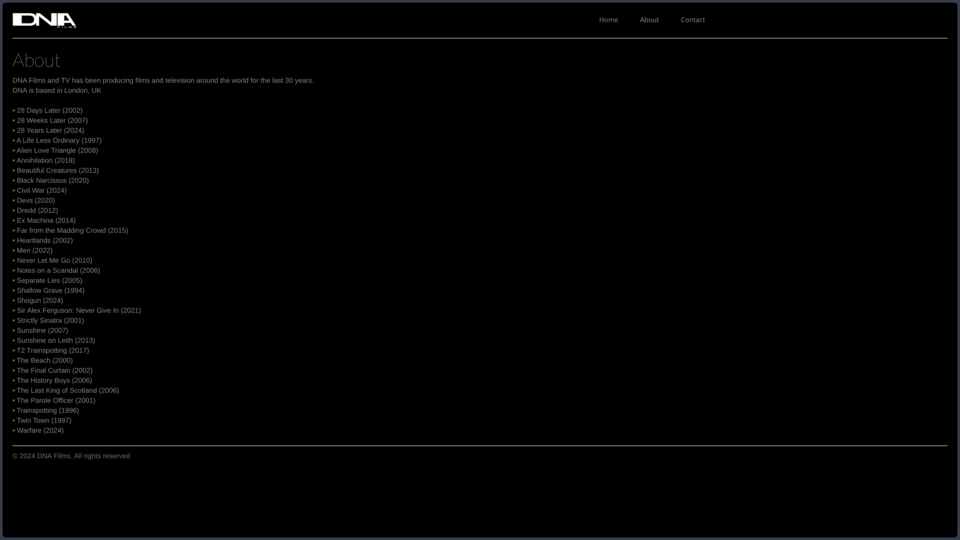
DNA Films is a British film production company founded in 1997 by producers Andrew Macdonald and Duncan Kenworthy. Based in London, it develops British and international films while regularly working with major studios, distributors and independent companies.
Its identity is closely tied to several long-standing creative collaborations. Andrew Macdonald had already produced Shallow Grave and Trainspotting by Danny Boyle before DNA was founded, establishing a relationship that would continue with 28 Days Later, Sunshine, The Beach, T2 Trainspotting and later 28 Years Later.
Its relationship with writer and director Alex Garland became equally important. After 28 Days Later, DNA supported several of his projects, including Sunshine, Dredd, Ex Machina, Annihilation, Devs, Men, Civil War and Warfare.
DNA’s catalog extends well beyond these collaborations. The company has also been involved in films such as The Last King of Scotland, Notes on a Scandal, Never Let Me Go, Far from the Madding Crowd and Sunshine on Leith.
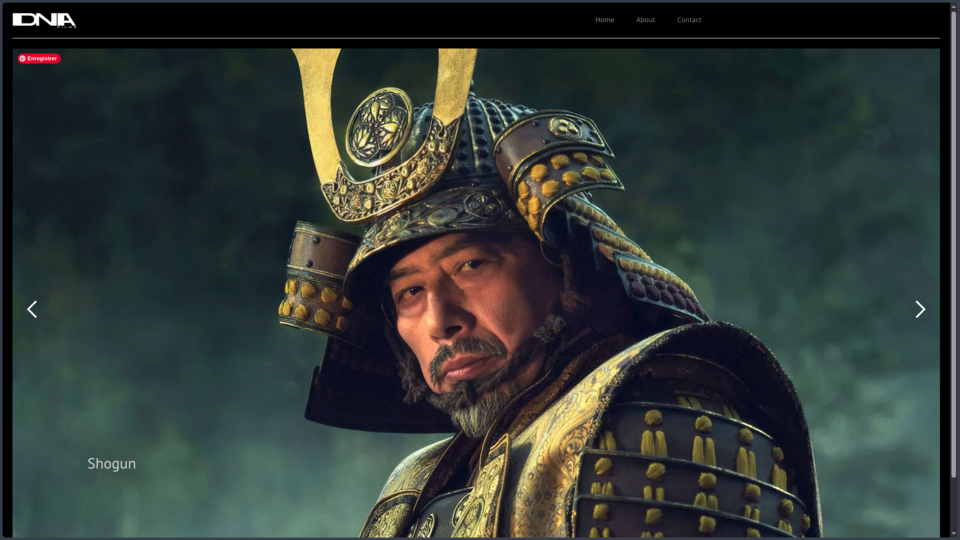
From the 2010s onward, its activities expanded more clearly into television under the DNA Films & TV identity, with projects including Devs, Black Narcissus and Shōgun.
Despite regular collaborations with Fox Searchlight, A24, Sony, Film4, FX and other international partners, DNA remains an independent production company.
History
1997 — Creation through the National Lottery
DNA Films was founded in February 1997 by Andrew Macdonald and Duncan Kenworthy.
The company was one of three British film production franchises selected to receive substantial support from the UK National Lottery. DNA obtained around £29 million to support film development and production over several years.
Both founders already had significant experience.
Duncan Kenworthy had notably produced Four Weddings and a Funeral, while Andrew Macdonald had become known through his collaboration with Danny Boyle on Shallow Grave and Trainspotting.
From the beginning, DNA was conceived as a company capable of developing British films with international potential.
The early years — Building a sustainable production company
The first years were devoted to building the catalog and developing projects supported through the franchise funding.
DNA notably produced Beautiful Creatures, Strictly Sinatra, The Parole Officer and The Final Curtain.
The company nevertheless had to find a balance between commercial ambition, public funding and the need to work with partners capable of ensuring international distribution.
This search for strong partners became a lasting feature of DNA’s operating model.
2002 — 28 Days Later changes the company’s trajectory
A major turning point came with 28 Days Later, directed by Danny Boyle, written by Alex Garland and produced by Andrew Macdonald.
The film imagines a Britain devastated by the Rage virus and follows a group of survivors through an abandoned London.
Beyond its success, 28 Days Later helped reshape post-apocalyptic horror through its digital aesthetic, pacing and extremely fast infected characters.
The film also became a crucial milestone for DNA: its international success strengthened the company’s credibility and reinforced its relationship with Fox Searchlight, which had acquired worldwide rights to the project.
The production also firmly established the creative trio of Macdonald – Boyle – Garland at the heart of DNA’s identity.
2002-2003 — Allon Reich joins DNA
In 2002, producer Allon Reich joined the company after working notably at Miramax and Film4.
At the same time, Duncan Kenworthy gradually reduced his involvement in DNA’s management in order to focus more heavily on his own productions.
He eventually left the structure, leaving Andrew Macdonald and Allon Reich as the duo who would lead DNA over the following decades.
This transition marked the beginning of the company’s modern configuration.
2003 — Partnership with Fox Searchlight
Following the success of 28 Days Later, DNA signed a major partnership with Fox Searchlight Pictures in 2003.
The agreement provided around $50 million to develop and produce British films over a five-year period, with Fox Searchlight acting as an international partner.
This cooperation allowed DNA to combine a relatively lean British structure with the distribution power of a major American studio.
Several important productions from the following years benefited directly or indirectly from this relationship.
The 2000s — An increasingly ambitious filmography
DNA then developed several projects that strengthened its international reputation.
The Last King of Scotland, released in 2006, combined fiction and political history around the regime of Idi Amin. Forest Whitaker’s performance notably earned him the Academy Award for Best Actor.
The same period saw the release of Notes on a Scandal and the adaptation of The History Boys.
In 2007, DNA reunited with Danny Boyle and Alex Garland for Sunshine, a science-fiction film in which a space mission attempts to save a dying Sun.
The company also produced 28 Weeks Later, continuing the universe introduced in 28 Days Later.
This period already demonstrated one of DNA’s lasting characteristics: alternating genre films, literary adaptations, dramas and more ambitious productions without locking itself into a single specialty.
The 2010s — Dredd, Ex Machina and Alex Garland
During the 2010s, DNA’s relationship with Alex Garland became increasingly important.
In 2012, the company was involved in Dredd, a new adaptation of the 2000 AD character. The film developed a brutal and tightly focused interpretation of the futuristic world of Mega-City One.
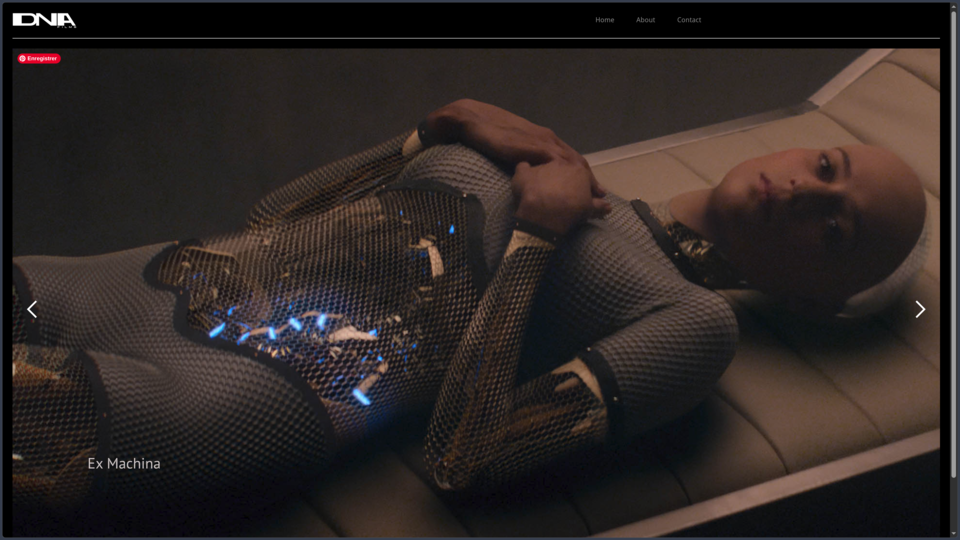
Two years later, Garland made his feature directorial debut with Ex Machina.
Produced by Andrew Macdonald and Allon Reich, the film explores artificial intelligence through the encounter between a programmer and Ava, an android developed by a technology entrepreneur.
With a relatively contained budget and minimalist direction, Ex Machina became a major critical success and notably won the Academy Award for Best Visual Effects.
Its success further strengthened the collaboration between DNA and Garland.
Annihilation and auteur science fiction
DNA continued this relationship with Annihilation, directed by Alex Garland and released in 2018.
Adapted from Jeff VanderMeer’s novel, the film combines science fiction, horror and reflections on biological and psychological transformation.
Like Ex Machina, it illustrates a form of filmmaking characteristic of DNA: using accessible genre concepts to develop more ambiguous and personal stories.
This ability to operate between independent cinema and Hollywood infrastructure became one of the company’s signatures.
2014 — Development of DNA TV
DNA also expanded its activities into television.
In 2014, the company developed DNA TV, in partnership with Fox Networks Group.
This branch made it possible to work on longer-form projects and international productions designed for broadcasters and platforms.
It notably participated in Devs, created and directed by Alex Garland, as well as Black Narcissus.
DNA TV also became a production partner on Shōgun, the new adaptation of James Clavell’s novel produced for FX.
This diversification gradually led the company to present itself under the DNA Films & TV identity.
The 2020s — Civil War, Shōgun and new ambitions
DNA continued its collaboration with Alex Garland throughout the 2020s.
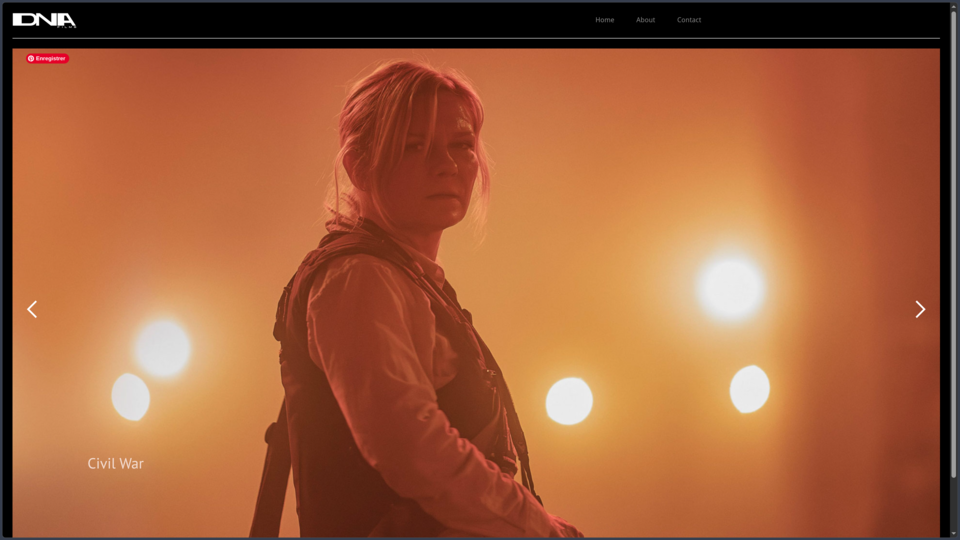
After Men, the company produced Civil War, released in 2024 with A24. The film follows journalists traveling through a United States plunged into a fictional internal war.
DNA then participated in Warfare, written and directed by Ray Mendoza and Alex Garland.
At the same time, Shōgun became one of the most acclaimed international television productions associated with DNA TV.
These projects demonstrate DNA’s gradual expansion: British cinema, American productions, international series and large-scale projects now coexist within the same structure.
Return to the 28 Days Later universe
More than twenty years after the first film, DNA returned to one of its foundational universes with 28 Years Later.
Released in 2025, the film reunited Danny Boyle as director and Alex Garland as writer, with Andrew Macdonald and several long-standing collaborators involved in production.
The project relaunched the franchise and continued with 28 Years Later: The Bone Temple, directed by Nia DaCosta and released in 2026.
This continuity particularly illustrates DNA’s way of working: rather than mechanically multiplying franchises, the company maintains long-term relationships with selected creators and fictional universes.
What sets it apart
Creative collaborations spanning several decades
One of DNA Films’ strongest characteristics is the longevity of its collaborations.
Andrew Macdonald and Danny Boyle had already worked together before DNA was founded, while the relationship with Alex Garland dates back to 28 Days Later.
These collaborations continued across many very different projects.
This continuity allows DNA to build its identity less around a specific genre than around a network of creators repeatedly brought together around new ideas.
Cinema between British independence and the international market
DNA is an independent British company, but its productions are rarely limited to national ambitions.
The company regularly works with major American and international partners for financing and distribution.
Fox Searchlight, A24, Sony, Film4, Universal and FX are among the companies DNA has collaborated with depending on the project.
This model allows it to retain an independent structure while developing films capable of circulating globally.
A strong place for genre filmmaking
Science fiction, horror, dystopia and thrillers occupy a particularly visible place in the catalog.
28 Days Later, Sunshine, Dredd, Ex Machina, Annihilation, Men and Civil War each use genre filmmaking to explore political, psychological, technological or social questions.
DNA is not limited to these genres, however: its catalog also includes historical dramas, literary adaptations, comedies and documentaries.
Production scaled to each project
DNA can work on a relatively contained film such as Ex Machina as well as on much larger international productions.
The company therefore does not rely on a single budget or production model.
This flexibility allows it to move from an auteur project to a franchise and then to a large-scale television series without abandoning its creator-focused production philosophy.
Independence maintained despite major partnerships
DNA has maintained close relationships with several major groups, particularly Fox, without becoming fully integrated into any of them.
More recently, the company has continued to present itself as fully independent, without a permanent overall financing or first-look agreement with a studio.
This independence allows DNA to select partners project by project and remains one of the defining features of its model.
Good to know
- DNA Films was founded in February 1997 by Andrew Macdonald and Duncan Kenworthy.
- The company was one of three British production franchises supported by the National Lottery in 1997.
- DNA initially received around £29 million in lottery funding.
- Andrew Macdonald’s collaborations with Danny Boyle on Shallow Grave and Trainspotting predate DNA’s creation but form an important part of its creative roots.
- 28 Days Later, written by Alex Garland and directed by Danny Boyle, became one of the defining films in DNA’s history in 2002.
- Allon Reich joined DNA in 2002 and later formed the company’s main producing partnership with Andrew Macdonald.
- In 2003, DNA signed an approximately $50 million five-year production partnership with Fox Searchlight.
- Its films include 28 Days Later, The Last King of Scotland, Sunshine, Dredd, Ex Machina, Annihilation, T2 Trainspotting, Men, Civil War and Warfare.
- DNA also develops television projects through DNA TV, including Devs, Black Narcissus and Shōgun.
- 28 Years Later relaunched the universe introduced by 28 Days Later in 2025, followed in 2026 by 28 Years Later: The Bone Temple.
- DNA is based in London and now presents itself under the DNA Films & TV identity.
- In 2026, the company remains active and independent under the leadership of Andrew Macdonald and Allon Reich.