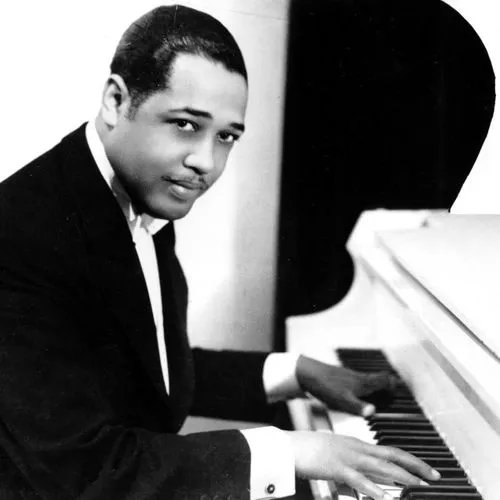
Duke Ellington was an American pianist, composer and bandleader who became a defining figure in jazz and swing. Leading his orchestra for several decades, he developed a musical language combining blues, improvisation and sophisticated orchestral arrangements. From Mood Indigo to Black, Brown and Beige and Far East Suite, his compositions expanded the possibilities of jazz. His collaboration with Billy Strayhorn, work with distinguished soloists and musical experimentation profoundly influenced the development of modern jazz.
Details
- Type
- Music
- Countries
- 🇺🇸 United States
- Genres
- Jazz, Blues, Swing
- Albums
- 15
Synopsis
Duke Ellington
Glossary terms: Arrangement, Blues, Brass, Composer, Composition, Crescendo, Ensemble, Fundamental, Harmony, Identity, Jazz, Large orchestra, Orchestration, Piano, Story, Suite, Swing, Timbre, Woodwinds
Trailer
Watch the trailer
Overview
Presentation
Duke Ellington, born Edward Kennedy Ellington on April 29, 1899, in Washington, D.C., was an American pianist, composer, arranger and bandleader. Introduced to the piano during childhood, he discovered ragtime and African-American popular music before moving to New York in 1923. He gradually took leadership of an ensemble emerging from the Washingtonians, which gained recognition through performances at Harlem's Cotton Club beginning in 1927. Compositions such as Mood Indigo (1930), It Don't Mean a Thing (If It Ain't Got That Swing) (1931) and Sophisticated Lady (1933) helped establish his distinctive musical identity, combining jazz, blues and orchestral arrangements.
During the 1930s and 1940s, Ellington developed an orchestra recognised for its unique sound and the importance given to individual soloists, including Johnny Hodges, Cootie Williams, Harry Carney and Ben Webster. His collaboration with composer and arranger Billy Strayhorn, beginning in the late 1930s, greatly expanded the orchestra's repertoire. Strayhorn composed Take the 'A' Train, which became the band's signature theme. In 1943, Ellington premiered Black, Brown and Beige at Carnegie Hall, an orchestral suite exploring African-American history and experience.
Following a difficult period for big bands, his performance at the 1956 Newport Jazz Festival attracted widespread attention, particularly through Paul Gonsalves' saxophone solo on Diminuendo and Crescendo in Blue. Ellington continued exploring new musical directions with Such Sweet Thunder (1957), inspired by Shakespeare, Anatomy of a Murder (1959), composed for film, and Far East Suite (1966), created with Strayhorn. He also recorded in smaller ensembles with Charles Mingus and Max Roach on Money Jungle, and with John Coltrane. His later years included several concerts of sacred music. He died on May 24, 1974, in New York City, aged 75.
Key Takeaways
Duke Ellington transformed the role of the jazz orchestra by treating its musicians as individual voices within a carefully constructed ensemble sound. His arrangements explored distinctive instrumental timbres, contrasts between brass and woodwinds, complex harmonies and expressive techniques rooted in the blues. His compositions extended beyond conventional swing formats through orchestral suites and large-scale works.
His partnership with Billy Strayhorn became one of the most significant creative collaborations in jazz history. Together, they explored the relationships between improvisation, composition and orchestration. Ellington also helped establish jazz as a musical form capable of addressing history, African-American culture and spiritual themes.
Conclusion
Duke Ellington holds a fundamental place in American jazz history. His work, spanning blues, swing and orchestral composition, transformed the language of jazz and influenced generations of composers, arrangers and instrumentalists.
Did You Know?
- Identity: Edward Kennedy Ellington, born April 29, 1899, in Washington, D.C., and died May 24, 1974, in New York City, United States.
- Nickname: "Duke", given to him during his youth.
- Instrument and roles: piano, composition, arranging and orchestra leadership.
- Orchestra: Duke Ellington Orchestra, developed from the Washingtonians during the 1920s.
- Major collaborators: Billy Strayhorn, Johnny Hodges, Cootie Williams, Harry Carney, Ben Webster, Paul Gonsalves and Charles Mingus.
- Signature compositions: Mood Indigo, It Don't Mean a Thing (If It Ain't Got That Swing), Sophisticated Lady, In a Sentimental Mood, Solitude and Black, Brown and Beige.
- Orchestra theme: Take the 'A' Train, composed by Billy Strayhorn.
- Notable recordings: Ellington at Newport (1956), Such Sweet Thunder (1957), Anatomy of a Murder (1959), Money Jungle (1963) and Far East Suite (1967).
- Historic performance: 1956 Newport Jazz Festival, featuring Paul Gonsalves' solo on Diminuendo and Crescendo in Blue.
- Recognition: Grammy Lifetime Achievement Award in 1966 and Presidential Medal of Freedom in 1969.
- Legacy: his orchestra continued performing after his death, notably under the direction of his son Mercer Ellington.
Link graph
Open in the full graphLoading the graph…
Only the strongest links are shown.
View the list ({count})
Discography
Discography (15)


