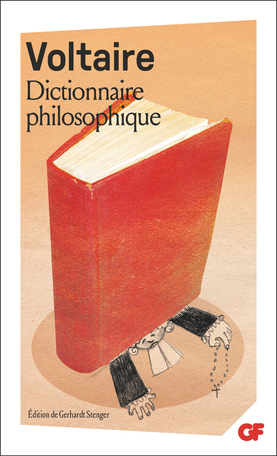
On February 28, 1766, the Chevalier de La Barre, an eighteen-year-old young man accused of having kept his hat on and singing impious songs as a procession passed, was condemned to have his tongue cut out, his hand cut off, and to be burned slowly. On his pyre, as a symbol, a copy of the Philosophical Dictionary is also burned. This shows the role of Voltaire and his “diabolical Dictionary” in the fight of the Enlightenment against the unleashing of fanaticism and the intolerance of the Churches. In the evening of his life, the Patriarch of Ferney drew up the most implacable indictment before Nietzsche's Antichrist against the Judeo-Christian religion and its founding book, the Bible. But, beyond the stated goal of “crushing the Infamous”, Voltaire also attacks the prejudices and vain systems of philosophers, both ancient and modern; convinced that we can know nothing, he raises his voice against those who kill and imprison in the name of a revealed truth. Two and a half centuries later, the 118 articles of the Philosophical Dictionary have lost none of their relevance. Each time the most retrograde customs and the most questionable traditions combine to silence critical reason and its free expression, it is urgent to resume with Voltaire the struggle for the emancipation of man and the progress of the human spirit.
Book
1764
Philosophy
Voltaire: Philosophical Dictionary
Dictionnaire philosophique
- Arvensa editions Publisher
- Voltaire Author
Details
- Type
- Book
- Release
- 1764
- Original title
- Dictionnaire philosophique
- Genres
- Philosophy
- ISBN
- 9782368417331
Synopsis