The Tao-Tê-king meditates on the Way, virtue, non-action and fruitfulness of the void. Its paradoxical formulas invite a flexible action, stripped of dominating will.
Details
- Type
- Book
- Release
- 1967-04-19
- Original title
- 道德經
- Countries
- Chine
- Original language
- Chinese
- Genres
- Poetry, Philosophy
- Platforms
- Volumes
- 1
- Status
- Completed
- ISBN
- 9782070237258
- Information verified on
- 14 octobre 2026
Synopsis
Tao Te Ching: The Way and its Virtue
Overview
Overview
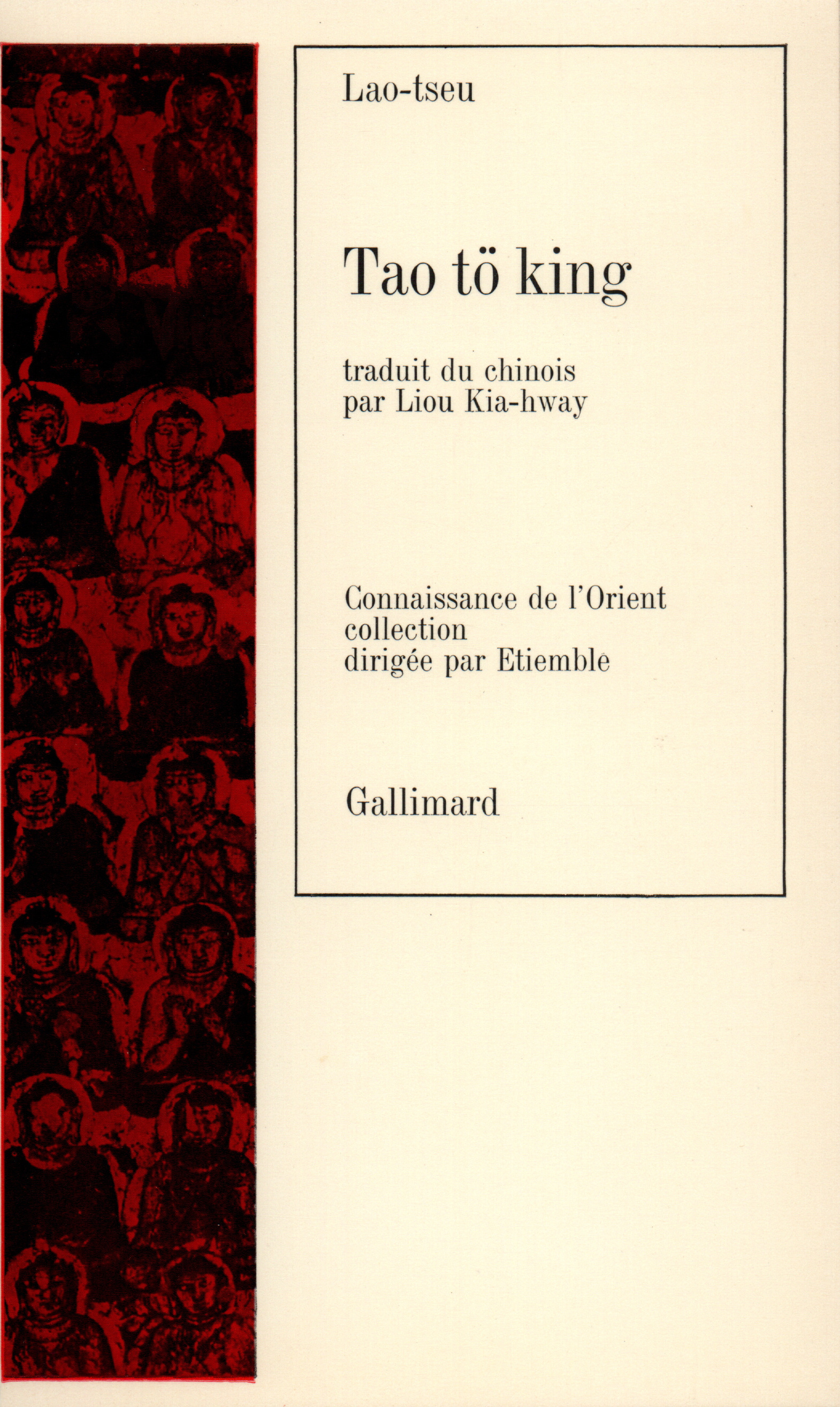
Published by Gallimard in 1967 in the Connaissance de l'Orient collection, the Tao-tö king is one of the foundational texts of Chinese philosophy and Taoism. Traditionally attributed to Lao Tseu, or Laozi, it is also known as the Dao de jing, generally translated as The Book of the Way and Virtue. Its composition dates back to ancient China, but its precise origins, authorship and the different stages of its transmission remain subjects of research.
In its traditional form, the work consists of 81 short chapters. Its writing relies on aphorisms, poetic imagery and paradoxes that challenge human certainties. At the heart of this philosophy lies the Tao, the Way, a fundamental principle that escapes ordinary definitions and from which the transformations of the world arise.
The text explores individual conduct, relationships between people and the exercise of power. It values simplicity, restraint and humility while giving particular importance to wu wei, generally translated as "non-action". This concept does not advocate inactivity, but rather a way of acting without forcing the course of events or multiplying unnecessary interventions.
This edition presents the French translation by Liou Kia-hway, accompanied by a foreword by René Étiemble. The foreword places the text within its intellectual context and addresses several essential questions: the historical existence of Lao Tseu, the dating of the work, the meaning of non-action and the difficulties involved in interpreting its opening passages.
Key Takeaways
The Tao-tö king is based on a conception of the world in which opposites are interdependent. Fullness and emptiness, strength and weakness, movement and rest acquire meaning through their relationships. This philosophy emphasises balance and transformation rather than fixed oppositions.
Water is one of the most characteristic images of this philosophy. Its flexibility allows it to flow around obstacles and occupy the lowest places, while possessing the power to transform even the most resistant materials. It illustrates a form of effectiveness that does not rely on direct confrontation and supports the text's reflections on modesty and self-control.
The text also addresses the question of government. It contrasts the effects of excessive intervention with those of measured authority, attentive to people's needs and the consequences of its decisions. Non-action thus becomes a political concept as much as a philosophical attitude.
The particular significance of this edition lies in Liou Kia-hway's translation and Étiemble's foreword. The translation provides access to a work whose apparent brevity conceals substantial linguistic and conceptual difficulties, while the critical introduction places its interpretations within the history of Taoist studies.
Conclusion
The Tao-tö king is a major reference in Chinese thought. Its reflections on the Way, virtue, simplicity and non-action present a conception of wisdom based on attention to the transformations of the world and the restraint of the desire to dominate. Gallimard's 1967 edition, translated by Liou Kia-hway and introduced by René Étiemble, presents this classical text within an editorial framework that connects its philosophical significance with the historical questions surrounding its origins and interpretation.
Good to Know
This edition was published by Gallimard on April 19, 1967, in the Connaissance de l'Orient collection, Chinese series, number 23. It contains 128 pages and carries the ISBN 9782070237258.
Liou Kia-hway also translated the Tchouang-tseu, another major classic of Taoist thought. René Étiemble, a French writer, academic and comparative literature scholar, played an important role in introducing Asian literature to French readers. He was notably responsible for establishing the Connaissance de l'Orient collection, launched by Gallimard in 1956.
The figure of Lao Tseu belongs partly to tradition. Historical research and ancient manuscripts discovered in China show that the Tao-tö king underwent several versions and stages of transmission. Its division into 81 chapters belongs to the canonical form of the work but does not necessarily reflect its earliest organisation.
The title has several romanised forms, including Tao-tö king, Tao te king, Tao Te Ching and Dao de jing. These names refer to the same classical text, whose translations can vary considerably depending on the translators' philosophical interpretations and linguistic choices.