How can we live in harmony with a universe undergoing constant transformation? In Treatise on the Perfect Void, Liezi explores the major questions of Daoist thought through stories, dialogues, parables, and philosophical reflections. The work examines the origins of the world, the nature of the Dao, the relationships between destiny and human freedom, and the boundaries between dreams and reality. It encourages readers to move beyond the certainties, ambitions, and attachments that distance human beings from the natural course of things. Stories featuring sages, rulers, and ordinary people illustrate spontaneity, self-mastery, and acceptance of change, while presenting sometimes divergent conceptions of pleasure and destiny. Across eight chapters, this Daoist classic offers a reflection on emptiness, transformation, and the possibility of an existence freed from artificial constraints.
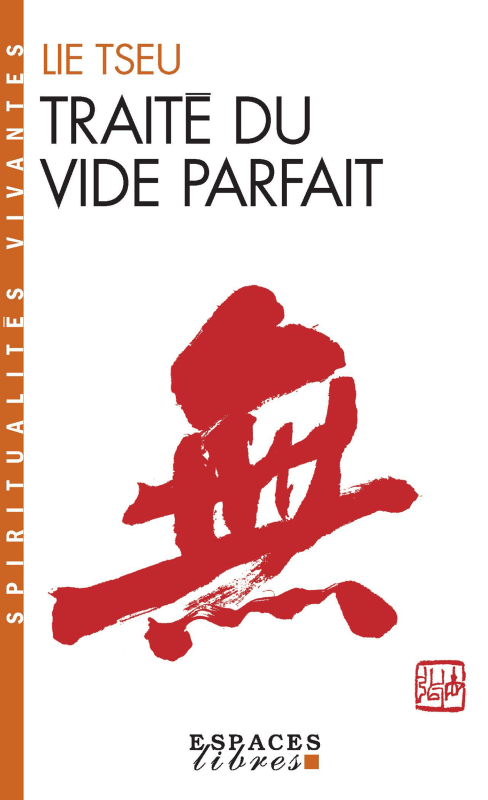
Liezi: Treatise on the Perfect Void
- Albin Michel Publisher
- Lie Tseu Author
How can we find freedom when everything around us is constantly changing?
Details
- Type
- Book
- Original language
- Chinese
- Genres
- Philosophy
- ISBN
- 9782226094261
- Information verified on
- October 14, 2026
Synopsis
Liezi: Treatise on the Perfect Void
Glossary terms: Certainty, Chapter, Character, Classical music, Dialogue, Dimension, Discourse, Existence, Interpretation, Knowledge, Marvelous, Movement, Narrative, Omen, Page, Parable, Part, Possibility, Publisher, Reflection, Story, Text, Title, Transformation, Treatise, Twist ending, Typesetting, VF / French version, Work, Wu wei
Overview
Overview
In Treatise on the Perfect Void, Liezi, also known as Lieh Tzu, occupies an important place in the philosophical tradition of Daoism, alongside Laozi and Zhuangzi. Published in French by Albin Michel, in a translation by Jean-Jacques Lafitte, the work brings together eight chapters composed of allegorical stories, dialogues, reflections on nature, and philosophical anecdotes. Rather than presenting a doctrine in systematic form, it introduces sages, rulers, and ordinary people confronting the contradictions of existence. These stories explore the relationships between human beings and the universe, knowledge and its limitations, and the possibilities of living in harmony with the natural course of things.
One of the text's central questions concerns the origins and transformations of the universe. The Dao appears as a fundamental principle preceding the particular forms of existence, one that cannot be fully grasped through conventional categories of thought. The emptiness evoked by the title does not simply refer to an absence or a meaningless void. It points toward a fundamental dimension of reality that precedes distinctions between beings and phenomena. Through various cosmological reflections, the treatise presents the world as a series of processes in which emergence, development, transformation, and disappearance follow one another continuously. Human beings belong to this movement and cannot regard themselves as its absolute masters.
This conception of the world leads to a reflection on spontaneity, detachment, and non-action. Several stories feature characters whose mastery no longer depends on forced effort but on a profound adaptation to circumstances. The figure of Liezi himself, traditionally described as capable of traveling while carried by the wind, symbolically expresses the pursuit of freedom from ordinary limitations. The Daoist principle of wu wei, generally translated as "non-action," does not mean abandoning all initiative. Rather, it encourages avoiding artificial interventions, unnecessary resistance, and actions that attempt to impose a rigid will on the course of events. Wisdom therefore consists in recognizing the possibilities inherent in each situation.
The treatise also devotes considerable attention to the relationships between perception, knowledge, and reality. Stories involving dreams and illusions question the confidence we place in our sensory experiences. Other narratives show how human anxieties can arise from imaginary representations or misguided reasoning. The anecdote of a man who fears that the sky might collapse notably illustrates how anxiety can develop without corresponding to any real danger. Yet the text does more than denounce errors of judgment: it explores the limitations of any knowledge that claims to define a changing reality once and for all. Observation, experience, and shifts in perspective thus become ways of moving beyond excessive certainty.
Another important dimension concerns destiny and the scope of human action. Certain stories question whether events can be predicted and whether individuals can control the consequences of their decisions. The relationship between personal effort and circumstances beyond human control occupies a central place in the chapter devoted to nature and destiny. This reflection cannot be reduced to an invitation to inactivity: it examines the limits of human control and the tensions between initiative, necessity, and acceptance of what occurs. The treatise consequently presents different ways of understanding freedom in a world where outcomes never depend entirely on our intentions.
Finally, the diversity of philosophical perspectives is an essential characteristic of the Liezi. The chapter devoted to Yang Zhu emphasizes pleasure, self-preservation, and the enjoyment of existence in ways that contrast with the detachment advocated elsewhere in the work. This difference reminds readers that the transmitted text emerged from a complex tradition influenced by several schools of thought. Its parables, fantastic stories, and dialogues therefore do not always express a perfectly consistent doctrine. Together, they form a collection of reflections on human life, the natural condition of beings, and the different ways of pursuing an existence free from unnecessary constraints.
Key Takeaways
Emptiness represents a fundamental dimension of Daoist thought. It is not simply an absence of matter or a meaningless nothingness. The treatise explores a reality that precedes particular forms and observable transformations, encouraging readers to move beyond conventional oppositions in order to understand the movement of the universe.
Wisdom requires conduct attuned to the natural course of things. Wu wei, or non-action, describes a way of acting without excessive intervention or artificial constraint. Freedom does not necessarily lie in dominating circumstances, but in recognizing their nature and responding to them appropriately.
Human knowledge remains limited by perception and judgment. Stories about dreams, illusions, and imaginary fears show that certainties may rest on fragile interpretations. The treatise encourages examining the representations that govern our experience and avoiding the automatic identification of our judgments with reality.
Destiny raises questions about the limits of individual will. Human actions unfold in a world shaped by events and transformations beyond personal control. Reflection on destiny encourages distinguishing what depends on our initiatives from what belongs to circumstances.
Transformation is an essential characteristic of existence. Birth, change, and disappearance belong to a continuous natural process. Attachment to permanence can become a source of anxiety, while acceptance of the movement of things opens another way of understanding the human condition.
The text brings together several philosophical orientations. Teachings concerning detachment, destiny, and pleasure are not always entirely consistent with one another. This diversity reflects the work's complex composition and the coexistence of different approaches within the Daoist tradition.
Conclusion
With Treatise on the Perfect Void, Daoist philosophy explores the relationships between human beings, the transformations of the universe, and the limitations of knowledge. Its stories and dialogues present a conception of wisdom in which spontaneity, discernment, and acceptance of change occupy a central place. Emptiness and the Dao provide the principal framework for a reflection that seeks to understand existence beyond conventional distinctions and concerns.
The work is also distinguished by the diversity of its perspectives, addressing cosmology, moral conduct, dreams, destiny, and pleasure. This richness reflects a textual tradition developed over an extended period, whose authorship and composition remain subjects of debate. The treatise therefore occupies a distinctive place among the Daoist classics, combining philosophical storytelling with an examination of human freedom in a constantly changing world.
Good to Know
- Liezi, also transcribed as Lieh Tzu or Lie Yukou, is a Chinese sage traditionally placed between the fifth and fourth centuries BCE. His historical existence remains uncertain, and the accounts associated with him combine biographical elements with legendary traditions.
- Treatise on the Perfect Void corresponds to the Liezi, one of the major texts of philosophical Daoism, generally studied alongside Laozi's Tao Te Ching and Zhuangzi's Zhuangzi.
- The work consists of eight chapters: Heavenly Omens, The Yellow Emperor, King Mu of Zhou, Confucius, Questions of Tang, Nature and Destiny, Yang Zhu, and On Agreements. This organization follows the traditional transmitted version.
- The French edition published by Albin Michel was translated directly from Chinese by Jean-Jacques Lafitte. The paperback edition, released on August 28, 1997, in the Espaces Libres collection, contains 240 pages, according to the publisher's catalog.
- The story of the man who feared that the sky would fall, found in the treatise, gave rise to the Chinese expression Qi ren you tian, referring to excessive or unfounded anxiety. It illustrates the frequent use of parables to question human behavior.
- The chapter "Yang Zhu" stands out for its reflections on pleasure and the preservation of individual life. Its perspective contrasts with teachings on detachment found elsewhere in the text and is one of the elements examined in research into the work's composition.
- The attribution of the text to Liezi remains debated. Although ancient traditions mention a work bearing his name, the surviving version is generally regarded as a compilation incorporating materials from different periods. Its most important early commentary is associated with Zhang Zhan, in the fourth century CE.
- During the Tang dynasty, the text received the honorific title Chongxu Zhenjing, generally rendered as "Classic of the Perfect Void." It was subsequently incorporated into the Daoist canonical tradition, reflecting its importance in Chinese intellectual and religious history.
Link graph
Open in the full graphLoading the graph…
Only the strongest links are shown.