Wealthy, intelligent and confident in her own judgement, Emma Woodhouse leads a comfortable life in the English village of Highbury. Convinced that she understands other people's feelings better than they do themselves, she becomes fascinated by the marriages she might arrange, particularly for her protégée Harriet Smith. But her interventions lead to misunderstandings and disappointments, while she remains unable to recognise certain romantic truths about herself. Amid social intrigues, friendships and illusions, Emma discovers the limits of her own insight.
Book
2015
Romance
Humour
Novel
Emma
- Gallimard Publisher
A young woman convinced she can arrange other people's marriages discovers that feelings defy even the cleverest plans.
Details
- Type
- Book
- Release
- November 20, 2015
- Original title
- Emma
- Countries
- 🇬🇧 United Kingdom
- Genres
- Romance, Humour, Novel
- Platforms
- Volumes
- 1
- Status
- Completed
- ISBN
- 9782070459834
- Information verified on
- November 22, 2026
Synopsis
Emma
Glossary terms: Actor / performer, Certainty, Character, Classical music, Comedy, Convention (manga convention), Desire, Folio, Free indirect speech, Humor, Inscription, Intention, Interpretation, Irony, ISBN, Literature, Narration, Narrative, Narrative voice, Novel, Observation, Page, Plot, Portrait, Preface, Publisher, Revelation, Story, Text, Title page
Overview
Overview
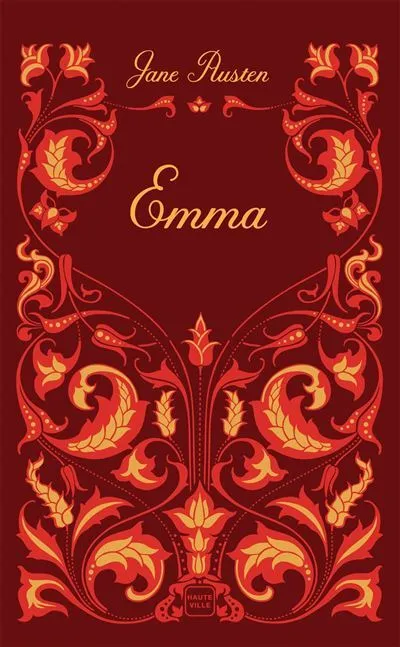
Published in Gallimard's Folio Classique collection in 2015, Emma is one of Jane Austen's major novels, first published in December 1815, with a title page dated 1816. Through the portrait of a young woman convinced that she perfectly understands the feelings of those around her, the British author develops a comedy of manners exploring romantic illusions, social conventions and errors of judgement. The novel stands out for its privileged, intelligent and deeply flawed heroine, whose certainties are the main driving force behind the plot.
Emma Woodhouse lives at Hartfield, a comfortable residence near the village of Highbury in Surrey. Born into a wealthy family, she enjoys a degree of financial independence that was exceptional for a young woman of her time. She claims never to have been in love and is quite willing to remain unmarried. Yet this confidence does not prevent her from taking an enthusiastic interest in other people's romantic lives, which she intends to organise according to her own intuitions.
Following the marriage of her former governess, Miss Taylor, now Mrs Weston, Emma convinces herself that she possesses a genuine talent for bringing couples together. She takes Harriet Smith, a young woman of more modest social standing, under her protection, hoping to help her rise in society through an advantageous marriage. Her interventions, however, lead to a succession of misunderstandings, as Emma interprets the behaviour and intentions of those around her through the lens of her own expectations.
Several important characters move within her social circle, including George Knightley, a family friend and perceptive observer of her mistakes, Mr Elton, the vicar of Highbury, and Frank Churchill and Jane Fairfax, whose relationships add further complexity to the romantic intrigues. Through their conversations, visits and social gatherings, Jane Austen constructs a story in which appearances often conceal feelings very different from those Emma imagines.
This edition features a French translation by Pierre Goubert, accompanied by a foreword by Dominique Barbéris. It allows readers to appreciate the psychological subtlety, irony and social nuances of a novel in which errors of interpretation are as important as the events themselves.
Key Takeaways
Emma stands apart within Jane Austen's work because of its heroine's privileged circumstances. Unlike several of the author's other female characters, Emma does not need to marry to secure her financial future. This freedom allows her to regard marriage as a subject of observation and amusement, without immediately recognising the consequences her interventions may have on other people's lives.
One of the novel's central devices is the gap between what Emma believes she understands and what is actually happening. Convinced of her own perceptiveness, she attributes intentions to those around her that reflect her own wishes more than their true feelings. Jane Austen thus constructs a narrative built around misunderstandings, conflicting interpretations and gradual revelations.
The novel also offers a precise critique of social hierarchies and matrimonial conventions. In Highbury, wealth, family background, reputation and economic prospects profoundly influence relationships between characters. Emma's plans for Harriet particularly reveal how differences in social standing can shape romantic choices and restrict certain marriage opportunities.
Humour is another essential dimension of the work. Jane Austen uses conversations, implications and the contradictions of her characters to expose their weaknesses. Mr Woodhouse, Emma's anxious father who is deeply attached to his routines, Miss Bates, whose endless chatter occupies a distinctive place in village life, and the various figures of polite society all contribute to a comedy based on meticulous observation of human behaviour.
Finally, the writing is characterised by a particularly sophisticated use of free indirect discourse, which brings readers close to Emma's thoughts while preserving the narrator's ironic distance. This technique allows readers to share the heroine's interpretations, sometimes without immediately recognising her mistakes. They gradually discover how individual perception can distort the understanding of others.
Conclusion
With Emma, Jane Austen creates a particularly subtle comedy of manners in which romantic intrigues become the setting for a reflection on judgement, pride and social conventions. Through a brilliant heroine who is often blinded by her own certainties, the novel shows how difficult it can be to understand other people's feelings when interpreting the world through one's own expectations. The 2015 Folio Classique edition, translated into French by Pierre Goubert, presents this major work of English literature, in which humour and irony accompany an in-depth analysis of human relationships.
Good to Know
This edition was published by Gallimard on November 20, 2015, in the Folio Classique collection, number 6040. It is listed as containing 688 pages and carries ISBN 9782070459834. The French translation is by Pierre Goubert, who also edited the text, while the foreword was written by Dominique Barbéris, a French novelist and academic.
Jane Austen began writing Emma in January 1814 and completed it in March 1815. The novel went on sale on December 23, 1815, through the London publisher John Murray, although the first edition, published in three volumes, bears the date 1816. It was the fourth of Jane Austen's novels to be published during her lifetime.
The original edition includes a dedication to the Prince Regent, the future George IV. This dedication followed exchanges between Jane Austen and members of the prince's household, who had expressed his interest in her novels. The author was still publishing her works anonymously, using a description that referred to her previous literary successes.
The narrative of Emma is particularly noted for its use of free indirect discourse, a technique that blends a character's perceptions with the narrative voice. It allows Jane Austen to create situations in which readers may share Emma's mistakes before understanding their causes.
The novel has inspired numerous adaptations, notably Emma (1996), directed by Douglas McGrath and starring Gwyneth Paltrow, and Emma. (2020), directed by Autumn de Wilde and starring Anya Taylor-Joy. Clueless (1995), directed by Amy Heckerling, loosely transposes its plot to a Beverly Hills high school, demonstrating the story's ability to cross historical periods and social environments.
Link graph
Open in the full graphLoading the graph…
Only the strongest links are shown.