Why do some ideas convince us through their logic, while others win our agreement because they appeal to us? In On the Art of Persuasion, Blaise Pascal examines the mechanisms through which human beings accept an opinion or recognize a truth. He distinguishes two paths to persuasion: the understanding, which responds to rational proofs, and the will, which is influenced by desires and inclinations. This investigation leads him to distinguish the art of convincing from the art of pleasing, before establishing the rules required for rigorous demonstration. By exploring the relationships between reason, language, and the passions, Pascal reveals why truth alone does not always secure agreement and what conditions make a convincing argument possible.

Blaise Pascal: On the Art of Persuasion
- Mille et une nuits Publisher
- Hachette Livre Publisher
- RIVAGES Publisher
- Blaise Pascal Author
Why are we sometimes more willing to accept what pleases us than what reason demonstrates?
Details
- Type
- Book
- Original language
- French
- Genres
- Philosophy
- ISBN
- 9782842056148
- Information verified on
- 14 octobre 2026
Synopsis
Blaise Pascal: On the Art of Persuasion
Overview
Overview
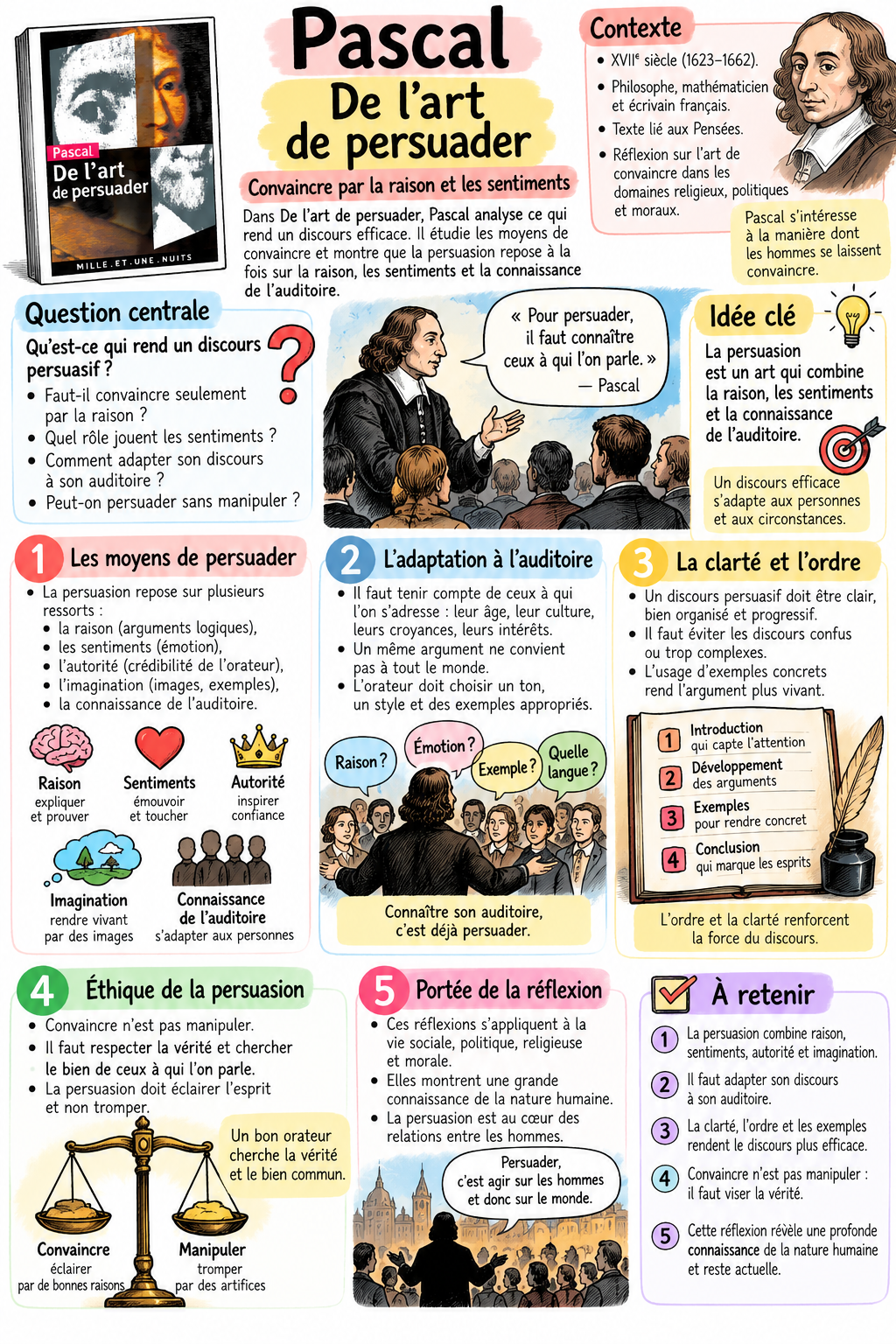
In On the Art of Persuasion, Blaise Pascal investigates the mechanisms that lead human beings to recognize a truth or accept an opinion. His purpose is not merely to explain how to construct an effective speech: he seeks to understand why a rational demonstration can sometimes fail to convince and how desires influence human judgment. This investigation connects the study of reasoning with an analysis of human dispositions.
Pascal distinguishes two paths through which opinions are accepted: the understanding and the will. The first rests on the recognition of demonstrated truths, while the second depends on inclinations, interests, and what gives pleasure. According to Pascal, individuals should ordinarily accept what their reason recognizes as true. Yet they are frequently guided by what corresponds to their desires, sometimes resisting arguments whose validity they are capable of understanding.
This observation leads to a distinction between the art of convincing and the art of pleasing. Convincing consists in establishing the truth of a proposition through recognized principles. Pleasing involves presenting an idea in a way that makes it desirable or acceptable to its recipient. Pascal emphasizes that these two approaches can operate simultaneously: an idea is more readily accepted when it accords with the beliefs and inclinations of the person receiving it.
However, Pascal acknowledges the particular difficulty of the art of pleasing. Human preferences are variable, sometimes contradictory, and depend on personal dispositions that are difficult to determine. He therefore refrains from establishing its rules and concentrates his analysis on the art of convincing, whose principles can be formulated with greater precision.
He takes the geometrical method as his model, founded on clear definitions, evident axioms, and rigorous demonstrations. The terms employed must be understood without ambiguity, the principles must be acceptable, and propositions must follow logically from preceding truths. Pascal also insists on the necessity of maintaining a consistent meaning for words throughout an argument, thereby avoiding misleading conclusions.
Finally, this investigation belongs to a philosophical outlook in which reason and the heart do not always play the same role. Pascal distinguishes truths accessible through human demonstration from religious truths, whose acceptance, according to his Christian understanding, belongs to another order. Persuasion thus emerges as a logical, psychological, and philosophical question.
Key Takeaways
The central idea of On the Art of Persuasion is that convincing and persuading are not exactly the same thing. A demonstration may establish the validity of a proposition without necessarily securing the agreement of its audience. Human beliefs and decisions also depend on the will, desires, and emotional dispositions.
The distinction between the understanding and the will is therefore fundamental to the treatise. The former recognizes logical relationships between propositions, while the latter can encourage or obstruct their acceptance. Pascal thus shows that knowing what is true and actually accepting the truth do not always coincide.
The work also establishes the requirements of the art of convincing. Pascal formulates rules concerning definitions, axioms, and demonstrations. He particularly emphasizes the need to define obscure terms, accept only evident propositions as first principles, and justify every conclusion through previously established truths. Precision of language becomes an essential condition of sound argumentation.
Finally, Pascal highlights the limits of a universal method of persuasion. Whereas demonstration can follow relatively stable rules, agreement based on pleasure or appeal depends on changing individual preferences. Knowledge of arguments alone is therefore insufficient to guarantee their effectiveness with every audience.
Conclusion
With On the Art of Persuasion, Blaise Pascal develops an investigation into the relationships between truth, reasoning, and assent. By distinguishing the logical requirements of demonstration from the influences exerted by the will, he shows that persuasion cannot be understood solely through the validity of arguments.
The text occupies an important place in Pascal's thought and in the history of reflection on argumentation. It establishes a connection between the geometrical method, the study of the passions, and an understanding of the mechanisms through which human beings adopt or reject ideas.
Good to Know
- On the Art of Persuasion is closely connected to On the Geometrical Spirit. The two texts are frequently published together under the title On the Geometrical Spirit and the Art of Persuasion.
- Pascal distinguishes the art of convincing, founded on rational proofs, from the art of pleasing, which concerns inclinations and desires. He primarily explains the rules of the former without claiming to provide a complete method for mastering the latter.
- The treatise presents eight rules concerning definitions, axioms, and demonstrations, five of which Pascal regards as absolutely indispensable to rigorous proof.
- The investigation belongs to Pascal's intellectual and religious context, particularly the debates associated with Jansenism and questions concerning the relationship between reason and faith.
- The French edition published in the Mille et une nuits collection accompanies De l'art de persuader with the first of the Provincial Letters, another work by Pascal in which argumentation and polemic play a central role.