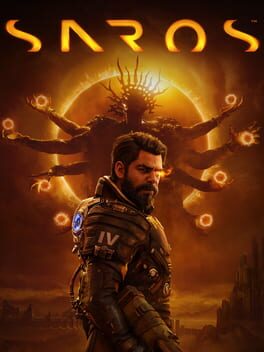
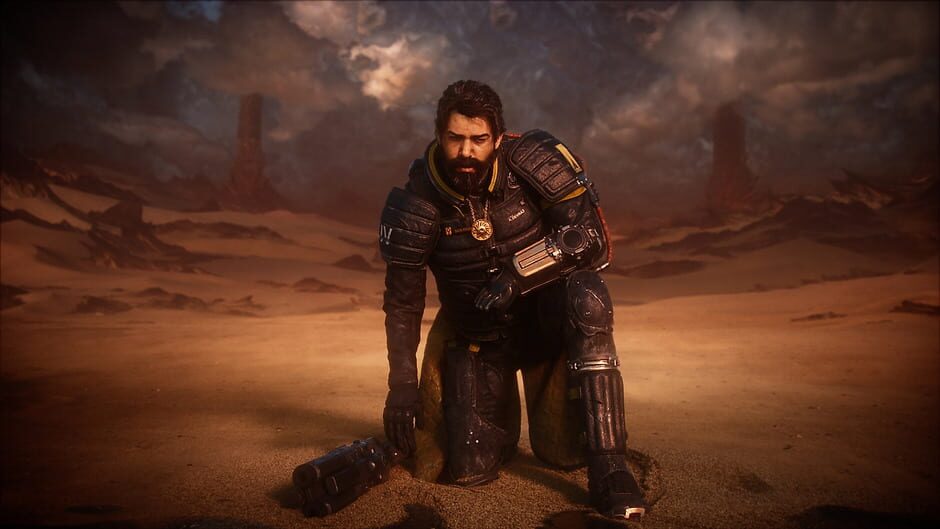
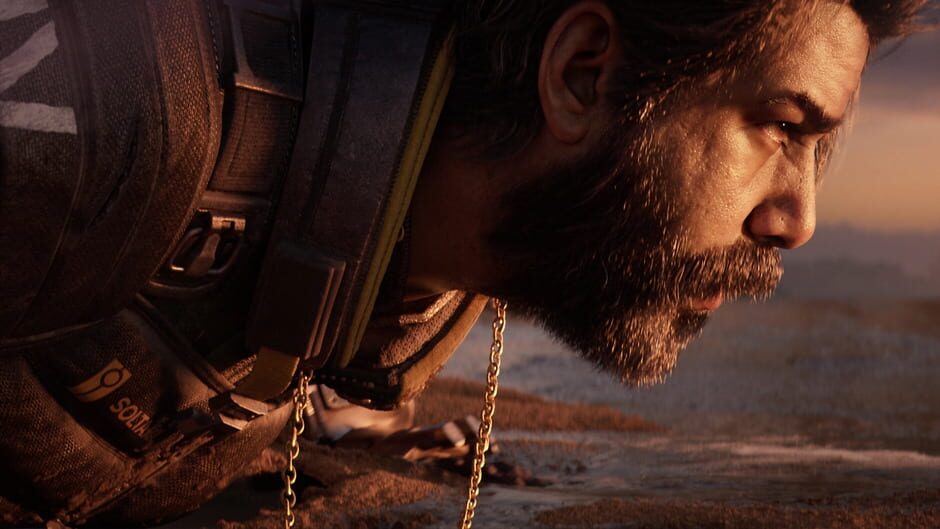
Beneath an unsettling eclipse, Arjun Devraj, a Soltari Enforcer, travels to Carcosa, a distant planet where a human colony has been lost. Searching for answers and for someone he refuses to abandon, he explores an unstable world whose environments change across successive cycles. The eclipse corrupts Carcosa, its inhabitants and even the memories of those who venture there. As Arjun progresses through the remains of the Echelon IV mission and the hostile forces occupying the planet, his investigation draws him deeper into the mysteries of Carcosa and the price he is willing to pay to change the future.
Video game
2026
Action
Horror
Science fiction
FPS
Saros
- Housemarque Developer
- Sony Interactive Entertainment Publisher
On Carcosa, death does not reset everything: every cycle changes the world and makes Arjun stronger.
Details
- Type
- Video game
- Release
- 2026-04-30
- Genres
- Action, Horror, Science fiction, FPS
- Platforms
- PlayStation 5
- Engine
- Unreal Engine 5
- Game modes
- Single player
Synopsis
Saros


Trailer
Watch the trailer
Overview
Presentation
Saros is a third-person action game centered on Arjun Devraj, a Soltari Enforcer sent to Carcosa, a distant planet transformed by a mysterious eclipse. The game carries forward Housemarque's philosophy of fast-paced action while developing its own structure built around successive cycles, a changing world and progression that does not disappear entirely when the character dies.
Combat is built around a mixture of shooting, mobility, dodging, parrying and shield management. Enemies regularly fill the battlefield with projectiles that must be read and navigated while maintaining offensive pressure. Movement and positioning therefore become just as important as accuracy: standing still against enemy attacks is rarely a viable option.
The Soltari Shield plays a central role in this dynamic. Arjun can use it to protect himself and parry certain attacks, then exploit the energy accumulated to counterattack. It complements the primary and energy weapons available and adds an active defensive dimension to the rhythm of combat.
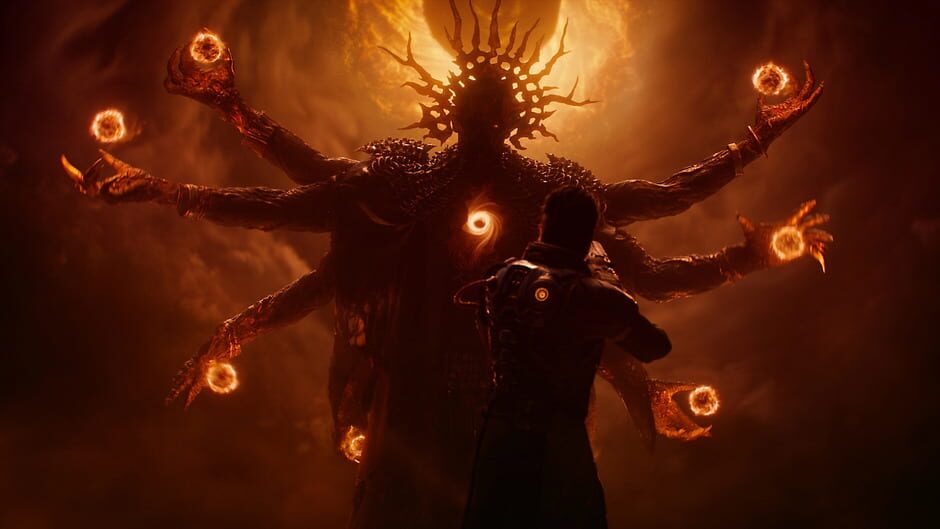
Weapons exist across several archetypes and variants that can change from one cycle to another. Arjun uses both Soltari technology and weapons of Carcosan origin, with different behaviors that allow his equipment to be adapted to the enemies encountered. Battles against the Sovereigns of Carcosa notably serve as major confrontations where reading attacks, mobility and mastery of the arsenal are particularly important.
Death does not mean a complete return to the starting point. Saros is built around a principle of permanent progression: certain resources recovered during cycles can be retained in order to improve Arjun permanently. Primary and energy weapons obtained can also be kept after death, allowing later attempts to begin from a stronger foundation.
Between cycles, Arjun returns to The Passage, an ancient Carcosan temple that serves as a central hub. There, he can reunite with members of the Echelon IV crew, uncover more information connected to Carcosa and use recovered resources to continue progressing.
The Suit Matrix notably allows Arjun's armor to be permanently developed. Its upgrades can increase maximum integrity, alter the effectiveness of certain resources or expand the energy capacity used by the shield. Progression also grants access to additional systems such as Second Chance, which can return Arjun immediately to combat after an initial death.
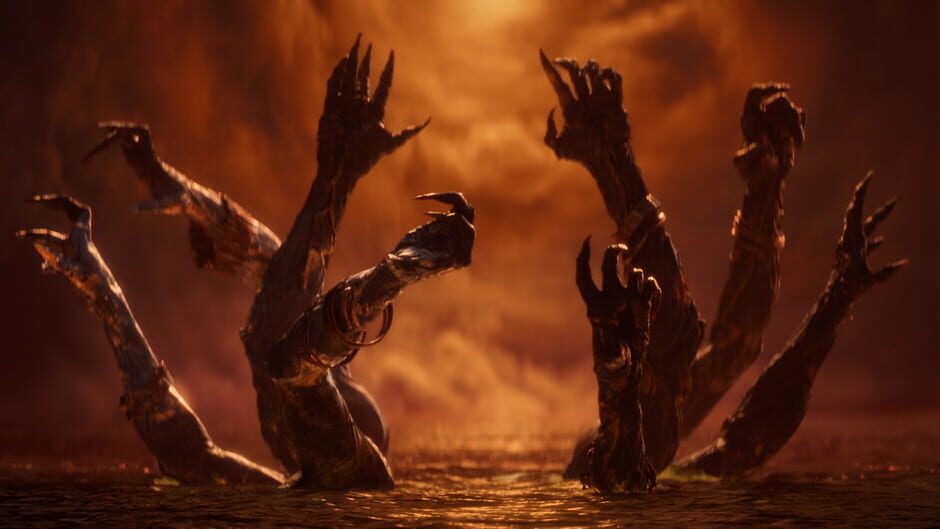
The world itself also changes from one cycle to another. Carcosa is a shapeshifting planet, and the eclipse can alter certain properties of its biomes, open new routes or make areas more dangerous. This corruption also affects enemies, weapons and various elements encountered during exploration.
An Eclipse Escalation mechanic allows this transformation to be intensified. Environments become more hostile and certain enemies then use corrupted projectiles capable of permanently reducing maximum suit integrity until their effects are neutralized. The planet therefore does not function as a fixed backdrop repeated identically on every attempt.
Carcosan modifiers also allow the level of challenge to be adjusted. Some reduce incoming damage, make the shield easier to use or make certain encounters more accessible; others instead increase enemy aggression or impose additional constraints. The system therefore allows difficulty to be modified while preserving the fundamental combat mechanics.
Exploration of Carcosa remains closely tied to the narrative. The Passage, the different biomes and certain stranger locations gradually reveal what happened to the Echelon IV mission and the people present on the planet. The cycles therefore serve both to strengthen Arjun and to advance his investigation while uncovering new aspects of the world.
Key points
- A third-person action game focused on fast combat and high mobility.
- Encounters combining shooting, dodging, parrying and the Soltari Shield.
- Large numbers of enemy projectiles that give combat a bullet ballet dimension.
- Several types and variants of Soltari and Carcosan weapons.
- Cycles in which Carcosa and certain elements of the world can change after death.
- Permanent progression that allows Arjun to return stronger after each attempt.
- A Suit Matrix used to permanently improve Arjun's capabilities.
- A Second Chance mechanic that can be unlocked through progression.
- The Passage serves as the central hub between cycles.
- The eclipse transforms certain environments, enemies and hazards across Carcosa.
- Carcosan modifiers can increase or reduce the level of difficulty.
- Major battles against the Sovereigns of Carcosa.
- An adventure designed exclusively for single-player.
Conclusion
Saros builds its action system around a loop in which death directly contributes to progression. Each new attempt allows players not only to better understand attacks and environments, but also to retain certain resources, weapons and upgrades that permanently strengthen Arjun.
This structure is accompanied by a world that refuses to remain static. The eclipse transforms Carcosa, changes certain biomes and progressively intensifies the dangers encountered. The cycles therefore do not consist solely of repeating the same route with better statistics: they evolve the character, the environment and the discovery of its story at the same time.
Combat nevertheless remains the main driving force of the experience. Mobility, projectile reading, shield use and weapon choice give encounters the fast pace associated with Housemarque, while permanent progression clearly distinguishes Saros from the structure of Returnal.
Good to know
Saros was developed by Housemarque, the Finnish studio belonging to PlayStation Studios, and published by Sony Interactive Entertainment.
The game was released on April 30, 2026 for PlayStation 5 and includes specific enhancements for PlayStation 5 Pro.
It uses Unreal Engine 5 and is designed as a single-player experience.
Arjun Devraj is portrayed by actor Rahul Kohli.
Saros is a new intellectual property from Housemarque. Despite certain gameplay similarities with Returnal, it is neither a sequel nor a new installment in that work.
Housemarque describes its progression philosophy through the idea of "come back stronger": unlike a complete reset after every death, resources, upgrades and pieces of equipment allow permanent progression between cycles.
The music is notably composed by Sam Slater, while writer and comic-book artist Ram V contributed to the narrative development of the world and its characters during pre-production.
A free update titled Saros: Zenith was announced for 2026 with new modes and options. It is a post-release addition and is not included here among the foundations of the main game.