Presentation
God of War III almost never attempts to reduce the scale established by the previous games. From its opening minutes, Kratos takes part in the ascent of Mount Olympus on Gaia’s body while gods and Titans battle around him.
That opening immediately sets the tone.
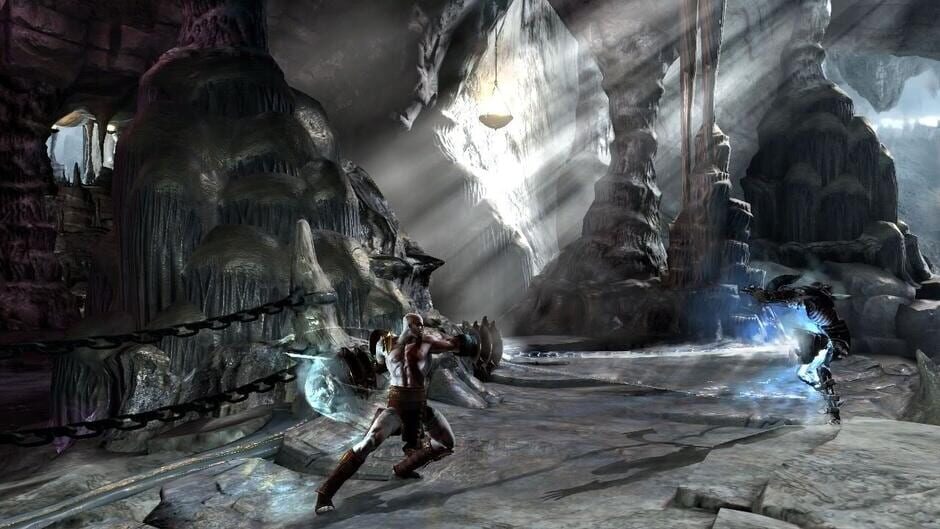
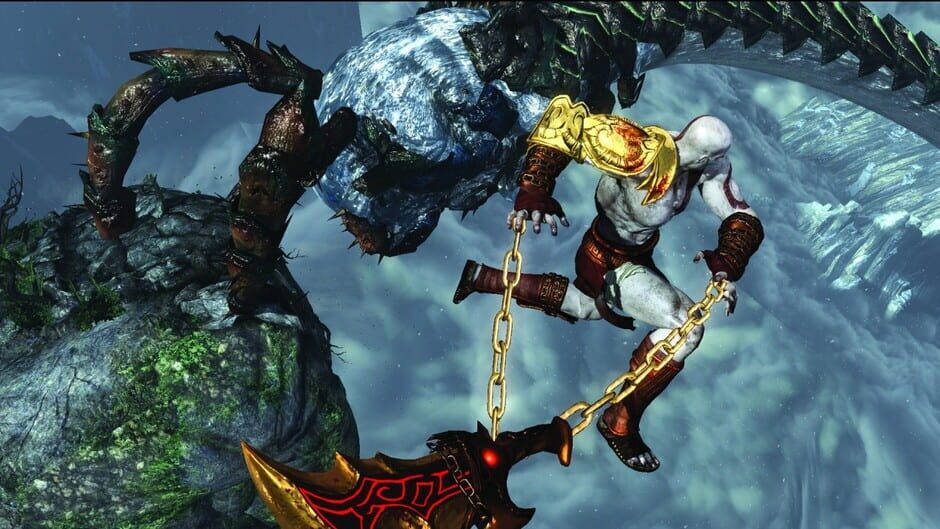
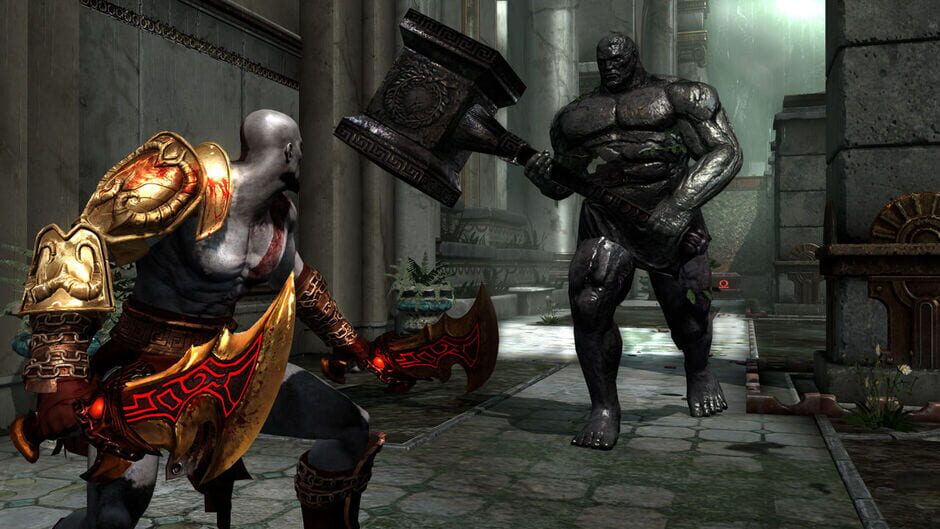
The game regularly uses spectacular changes of scale. Kratos may fight an enemy on a platform that turns out to be only a small part of a Titan’s body, cross monumental structures and then return to much tighter spaces devoted to combat or puzzles.
The spectacle does not, however, completely replace the series’ traditional structure. God of War III remains an action-adventure game built around relatively directed progression, alternating combat, platforming, light exploration and environmental puzzles.
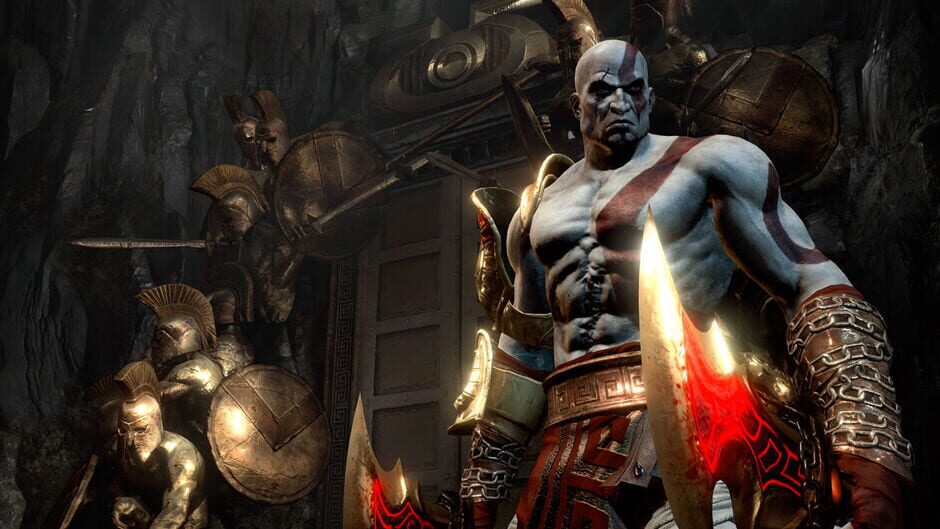
Combat still revolves around Kratos’s ability to control groups of enemies through long attack chains. His Blades of Exile continue the principle of the chained blades from earlier games: they allow him to strike around himself, keep opponents at a distance and maintain combos without remaining fixed on a single target.
Other weapons alter this rhythm. The Claws of Hades favor specific attack patterns and allow the use of certain creatures’ souls. The Nemean Cestus focuses on much heavier blows capable of breaking certain defenses, while the Nemesis Whip offers a different speed and other properties.
These weapons therefore do not function merely as successive increases in power. They provide specific moves and are sometimes used directly to progress through the environment.
Kratos also has access to several secondary items that expand his arsenal. The Bow of Apollo can attack from a distance or ignite certain elements, while other tools obtained during the journey provide new forms of interaction.
Magic is now tied to the different primary weapons. Changing equipment therefore also changes some supernatural options, encouraging more frequent switching during combat.
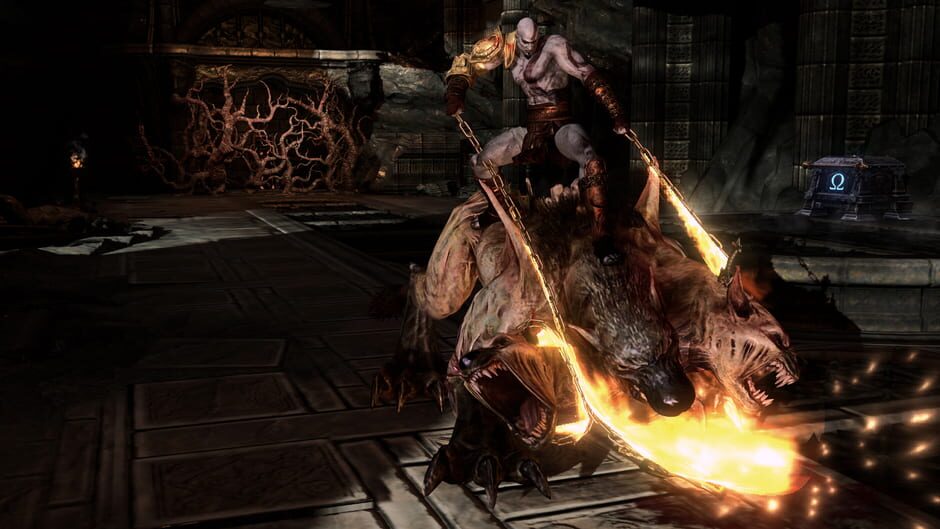
The most memorable encounters remain those where the staging completely changes the perception of space. God of War III multiplies battles against figures from Greek mythology and uses their size, powers or environment to prevent each encounter from feeling like little more than an enemy with a larger health bar.
Violence is an openly embraced part of this staging. Executions are particularly graphic, and some encounters deliberately emphasize Kratos’s brutality. The game no longer truly presents his rage as a heroic quality: it becomes a force capable of destroying anything standing between him and Zeus.
This evolution matters because the consequences appear directly in the world.
The gods of Olympus are not merely powerful enemies. They are tied to the functioning of the Greek universe represented by the series. When Kratos strikes at this divine order, the disasters that follow serve as reminders that his revenge has a cost far beyond his own suffering.
And yet Kratos keeps moving forward almost constantly.
That determination defines the rhythm of the game as much as its mechanics. Kratos no longer questions whether he should continue pursuing Zeus; he only looks for a way past the next obstacle. The player is therefore placed in a peculiar position, participating in a revenge whose destructive nature becomes increasingly difficult to ignore.
Pandora introduces a break in this trajectory.
Her presence forces Kratos to interact with someone who is neither a target, nor a god to challenge, nor an obvious tool for his revenge. Their relationship awakens a part of him that his anger had almost entirely buried and recalls the family he once lost.
The game does not suddenly transform Kratos into a peaceful man. The tension comes precisely from the conflict between his remaining ability to protect someone and his obsession with Zeus.
Puzzles and platforming sequences provide breathing room between confrontations. They ask the player to manipulate the environment, use certain items or understand spaces sometimes constructed on a gigantic scale. The fixed or semi-directed camera allows Santa Monica Studio to precisely compose what the player sees and emphasize the size of the locations being crossed.
This control of perspective is one of the episode’s visual signatures. Kratos can appear tiny before a monumental structure only seconds before the camera moves brutally closer for an execution. The scale changes, but the progression almost never stops.
God of War III therefore works as one long escalation. Gods who were once distant figures become direct opponents, Titans cease to be mere elements of mythological scenery, and the family conflict between Kratos and Zeus gradually pulls the entire pantheon into its collapse.
What to remember
- The third main entry in the original Greek trilogy, continuing directly from the ending of God of War II.
- An open war between Kratos, the Titans and the gods of Olympus, with Zeus as the Spartan’s primary target.
- Fast action combat built around combos, dodges, grapples and several weapons with their own abilities.
- Large-scale battles directly exploiting the gods, Titans and creatures of Greek mythology.
- Directed progression combining combat, platforming, mechanisms and puzzles rather than an open world.
- A particularly brutal presentation where the consequences of Kratos’s revenge become visible in the state of the world itself.
- A story that pushes the character’s rage to its conclusion while revealing, notably through Pandora, what still remains beneath that obsession.
Conclusion
God of War III begins almost where another game might place its final act: on Mount Olympus, in the middle of a war between gods and Titans.
Yet it still has something to say beyond the spectacle.
Across several games, Kratos has justified his path through everything that was taken from him. His family, his freedom, his trust in the gods and then his own power have fueled a rage that always seems to find another reason to continue.
In this third entry, he finally gains the means to see it through.
The result is not presented as a clean and orderly victory. Every destroyed obstacle brings Kratos closer to Zeus while increasing the scale of the consequences. Revenge gradually stops being only a matter between a son and his father: an entire world is dragged down with them.
This makes the visual excess particularly coherent. The gigantic Titans, monumental palaces and battles against the gods are not there solely to create impressive images. They give physical form to a rage that has become too large to remain contained within a personal conflict.
The combat system may now feel more rigid than the one adopted by the later Norse games, and the imposed camera gives the player less control. But that directed presentation gives the game a spectacular precision that remains central to its identity.
Pandora above all creates a welcome crack in this machinery of destruction. Her relationship with Kratos reminds us that there is still something inside him beyond the ability to kill whatever stands in front of him.
That may be where God of War III ultimately finds its destination.
Kratos spends the adventure trying to work out how to destroy Zeus.
The game, meanwhile, eventually asks what will remain of Kratos when there is no one left for him to hate.
Good to know
- God of War III was developed by Santa Monica Studio and published by Sony Computer Entertainment.
- The game was originally released in March 2010 exclusively for PlayStation 3.
- It directly continues the events of God of War II and serves as the final chapter of the original main Greek trilogy.
- Kratos continues his battle against Zeus and the gods of Olympus after leading the Titans to Mount Olympus.
- The Blades of Exile are his primary weapon, complemented notably by the Claws of Hades, the Nemean Cestus and the Nemesis Whip.
- The game combines combat, platforming and puzzles within a largely linear progression marked by very large-scale encounters.
- God of War III Remastered was later released for PlayStation 4 in 2015.