Presentation
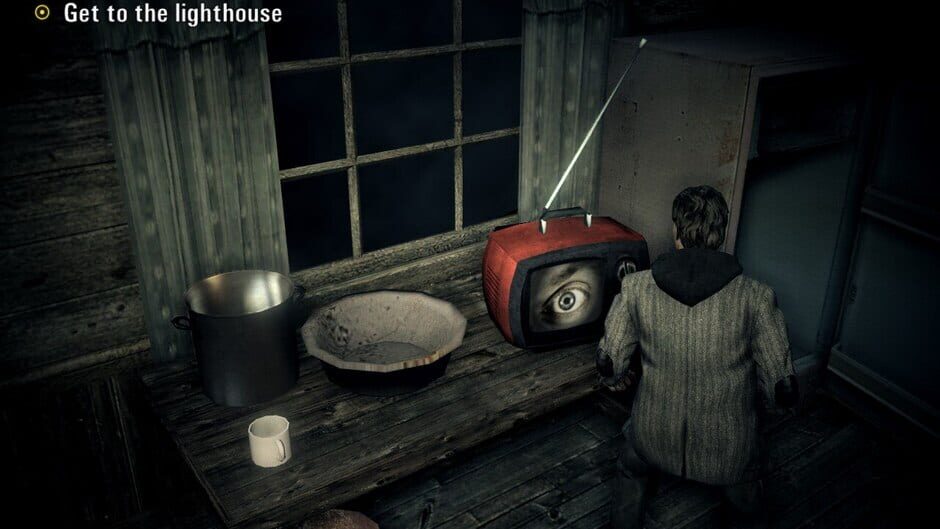
Alan Wake presents itself less as a traditional horror game than as a supernatural thriller whose chapters the player directly experiences. Remedy builds the adventure around storytelling: Alan’s inner narration, manuscript pages found in the environment, radio broadcasts, television programs and the residents of Bright Falls all contribute to the feeling that a story is constantly being composed around the protagonist.
This logic extends to the structure itself. The campaign is divided into episodes, with introductions, dramatic breaks and endings designed like cliffhangers. The game therefore borrows part of the rhythm of television series while using exploration and combat to keep the player inside the narrative.
The manuscript is one of its most interesting devices. Some pages reveal what happened to other characters, while others describe a scene before Alan reaches it. The player therefore moves forward with a strange kind of knowledge: knowing that something disturbing is supposed to happen without necessarily knowing when or in what form. The text does not merely explain the story afterward; it actively shapes anticipation.
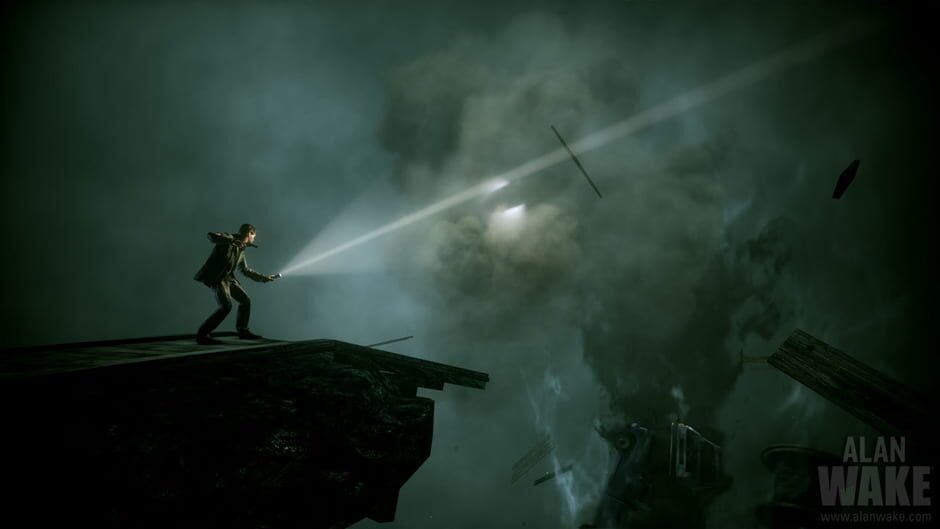
Combat is built around an equally clear rule. The enemies known as the Taken are surrounded by darkness that protects them from conventional weapons. Alan must first focus the beam of his flashlight on them to burn away that protection, then use revolvers, shotguns or other weapons to eliminate them.
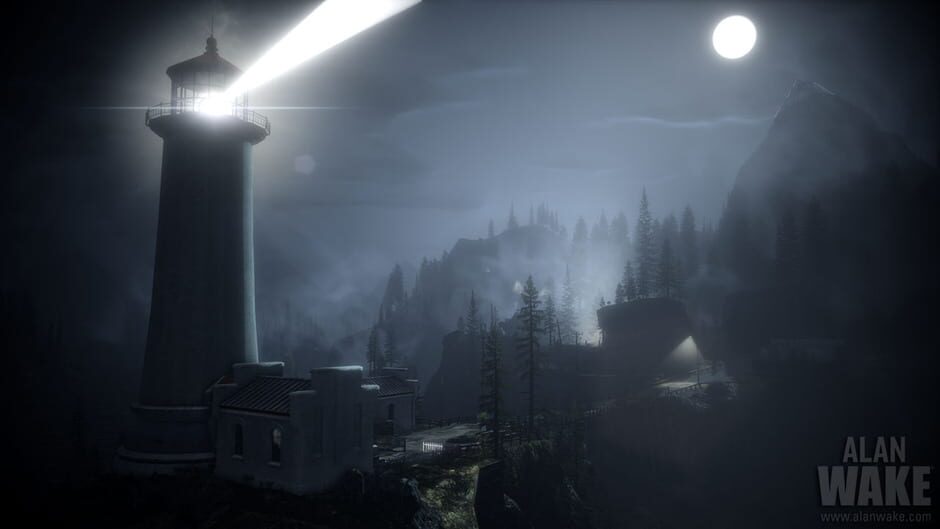
Light therefore becomes both a weapon and a refuge. Streetlights, spotlights and strongly illuminated areas provide moments of safety, while flares, flashbangs and other light sources can repel or neutralize the darkness. During nighttime sequences, seeing a lamp in the distance almost feels like spotting a destination for survival.
This mechanic gives encounters a particular rhythm. Alan is not a soldier: dealing with several attackers at once is difficult, and he must monitor his positioning as carefully as his ammunition or batteries. Focusing the flashlight on one enemy for too long while another approaches from the side can quickly turn a controlled encounter into an improvised escape.
The forests surrounding Bright Falls play an essential role in this tension. Night reduces visibility, branches move, shapes seem to appear between the trees and the Taken can emerge from several directions. Remedy often uses the environment to maintain uncertainty before a real confrontation even begins.
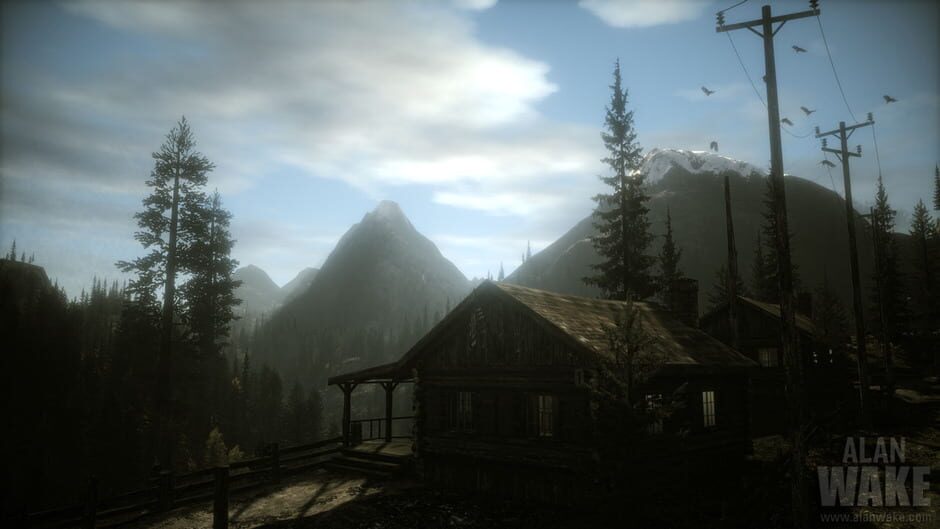
The contrast with daytime is deliberately strong. Bright Falls also has its residents, diner, police station, local events and a certain small-town eccentricity. Barry Wheeler, Alan’s agent and friend, notably brings much lighter energy into a story constantly pulled toward darkness. These moments give the town enough personality for its nighttime transformation to feel more unsettling.
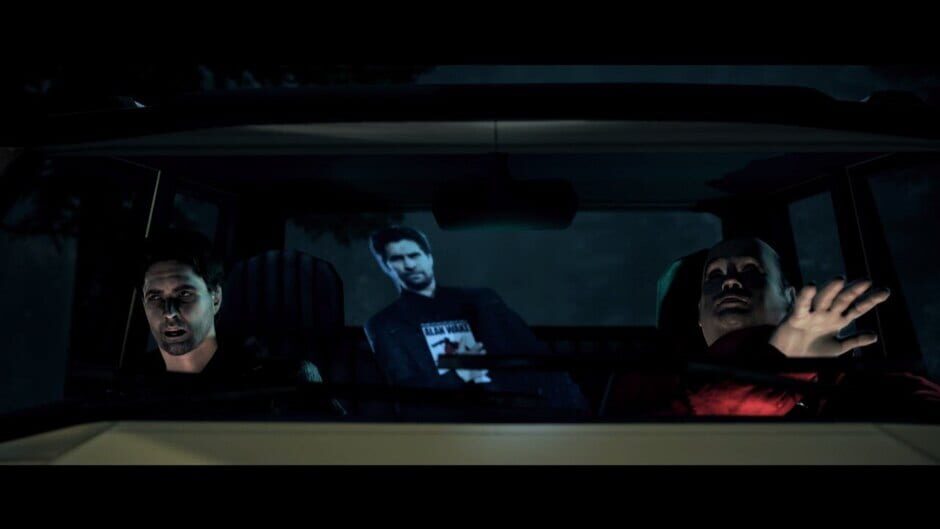
The game also alternates between sections on foot, exploration of abandoned locations and a few vehicle sequences. It nevertheless remains relatively directed: environments may offer detours and secrets, but Alan Wake favors precise narrative progression rather than a true open world. This structure allows Remedy to control the appearance of threats and the rhythm of revelations.
Ultimately, everything rests on the relationship between fiction and reality. Alan is a writer trying to understand a story in which he appears to be simultaneously the author, the protagonist and the victim. The further he goes, the less the question becomes simply “who wrote this manuscript?” and the more it becomes “how far can a story alter what is real?”
What to remember
- A psychological action thriller centered on writer Alan Wake and the disappearance of his wife Alice in Bright Falls.
- A mysterious manuscript whose pages describe or foreshadow events experienced by the protagonist.
- Enemies protected by darkness that must first be exposed to light before conventional weapons can harm them.
- Light used both as an offensive resource and as a refuge from the dark forces.
- A campaign structured in episodes, with presentation strongly influenced by the conventions of television thrillers.
- An atmosphere built on the contrast between the small town of Bright Falls and the nighttime forests surrounding it.
- A story where writing, reality and perception gradually become impossible to separate clearly.
Conclusion
Alan Wake achieves something more interesting than simply making darkness dangerous: it gives light an almost narrative value.
A streetlight glimpsed between the trees is not merely part of the scenery. It means safety, a pause and sometimes the temporary end of a chapter of tension. Conversely, extinguishing a light or leaving an illuminated road is enough to suggest that the story may begin closing in around Alan again.
The combat system eventually reveals some repetition, particularly when several encounters rely on the same sequence of flashlight use followed by gunfire. But the mechanic remains remarkably consistent with the rest of the work. Alan is not merely fighting enemies: he is literally removing the darkness protecting them before he can affect them.
The episodic structure further reinforces the feeling of being trapped inside fiction. Manuscript pages sometimes announce what is going to happen, Alan’s voice recounts certain events with the distance of an author, and each new revelation calls into question the boundary between what he writes and what he experiences.
Bright Falls therefore becomes more than a setting. It is ordinary enough for the supernatural intrusion to feel disturbing, yet strange enough that doubt never completely disappears.
Alan Wake ultimately builds its identity around a very particular fear: discovering that the story you are living may already have an ending written somewhere, then continuing to turn the pages anyway.
Good to know
- Alan Wake was developed by Finnish studio Remedy Entertainment and originally published by Microsoft Game Studios.
- The game was first released on Xbox 360 in May 2010.
- Alan Wake is a thriller writer suffering from writer’s block when he arrives in Bright Falls with his wife Alice.
- The main enemies are people or creatures possessed by a dark presence and protected by a layer of darkness.
- The flashlight is used to burn away that protection before conventional weapons can damage them.
- The original campaign uses an episodic structure that directly contributes to its thriller identity.
- The story would later continue through other works in the same universe, but this fiche focuses only on the original Alan Wake game.