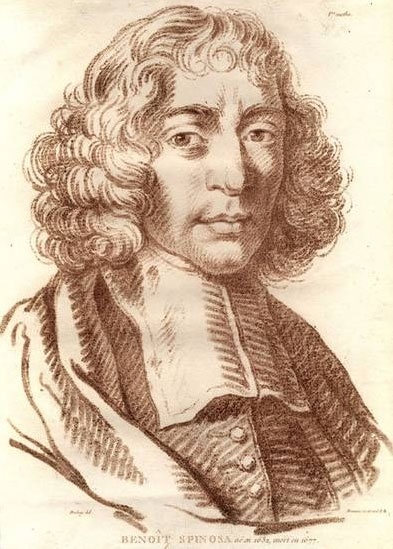
Baruch Spinoza
Details
- Roles
- Author
Referenced works
Referenced works (6)
Spinoza: Short treatise
Author
Long neglected, even mistreated, the Short Treaty has acquired, since the work of Filippo Mignini, the status of the first formulation of Spinoza's system. But for this very reason, it still too often remains in the shadow of Ethics. The Short Treatise deserves to be read (and reread) for itself, and not only with a view to understanding the genesis of Ethics. This is the main goal pursued by the contributions of th…
- Philosophy
Spinoza: Principles of Descartes' Philosophy
Author
Descartes' Principles of Philosophy (Renati Descartes Principiorum philosophiae pars I et II, more geometrico demonstratae) is the only work that Baruch Spinoza published during his lifetime, under his own name, in Amsterdam in 1663 (editor J. Rieuwertsz). Written at the request of a student, it takes up the Principles of Philosophy of Descartes (1644) by exposing them according to geometric order (more geometri…
- Philosophy
Spinoza: Treatise on the Reform of the Understanding
Author
“After experience had taught me that everything that frequently happens in common life is vain and futile, I saw that everything which was for me a cause or object of fear had in itself nothing good or bad, except to the extent that the soul was agitated by it, I finally decided to seek if there was something which was a true good, capable of being communicated and by which alone, all other things having been reject…
- Philosophy
Spinoza: Political Treatise
Author
The Political Treatise draws all the conclusions from The Ethics: after having addressed individuality, Spinoza attacks the life of man in society. It traces the genesis of the political constitution of a group. It shows how the right to preserve one's life takes precedence over the right to live according to one's will. Everyone must cede to others the power to govern them. And this other must ensure the safety and…
- Philosophy
Spinoza: Theological-political treatise
Author
“I am currently composing a treatise on the way in which I view Scripture, and my reasons for undertaking it are the following: 1° The prejudices of theologians; I know in fact that it is these prejudices which are especially opposed to men being able to apply their minds to philosophy; I therefore consider it useful to expose these prejudices and to rid thoughtful minds of them. 2° The opinion that the vulgar have…
- Philosophy
Spinoza: Ethics
Author
The starting point of Spinoza's reflection is his own experience: he knows, through observation, that he has a body, and he is aware of its affects. But, if this is indeed a kind of knowledge, it is an incomplete and painful knowledge: to be conscious is, for the human being, if not always to suffer, at least to suffer, to be constrained, overwhelmed. According to Spinoza, it is important to have an idea of one's o…
- Philosophy
Information may change.