
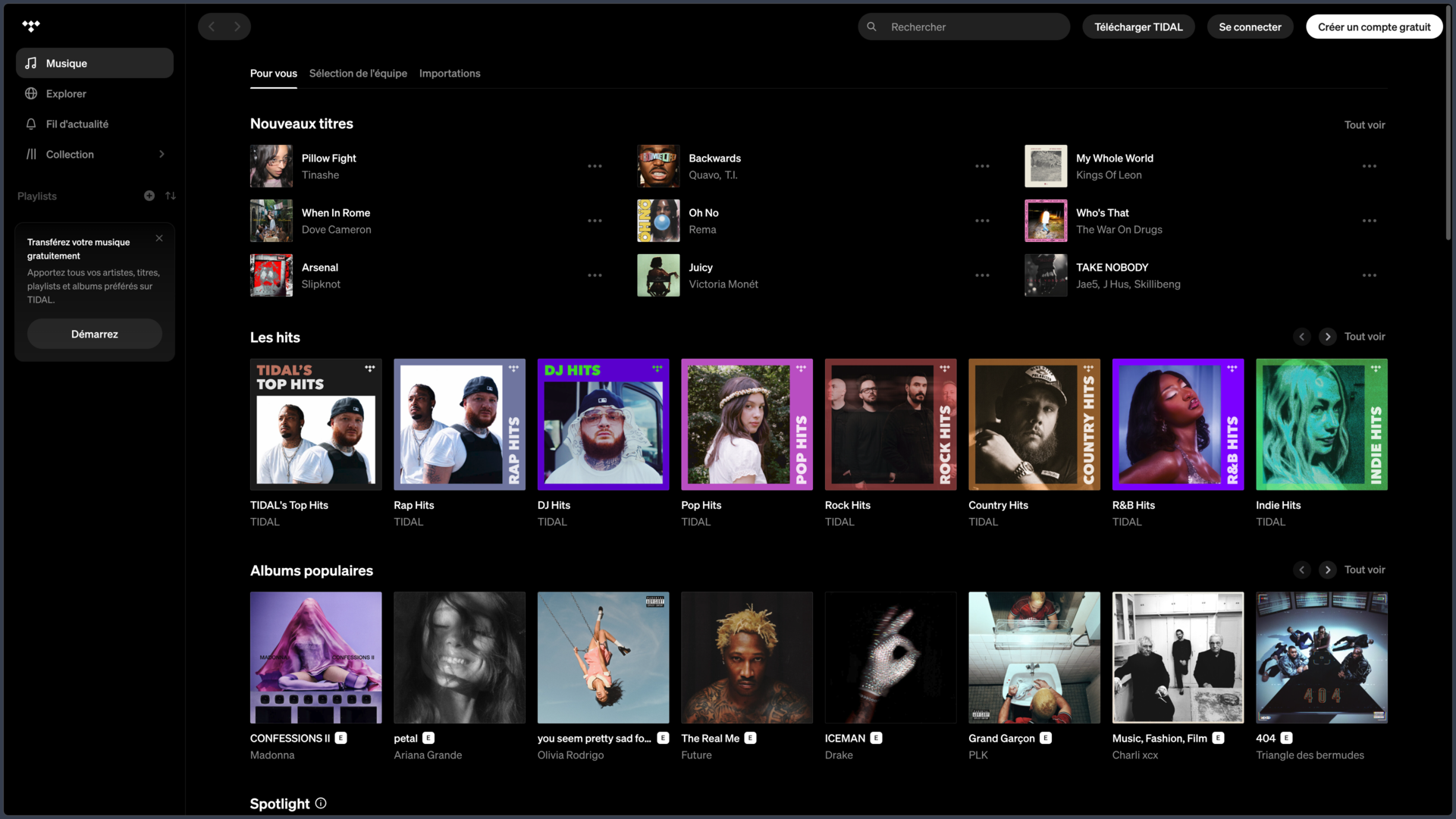
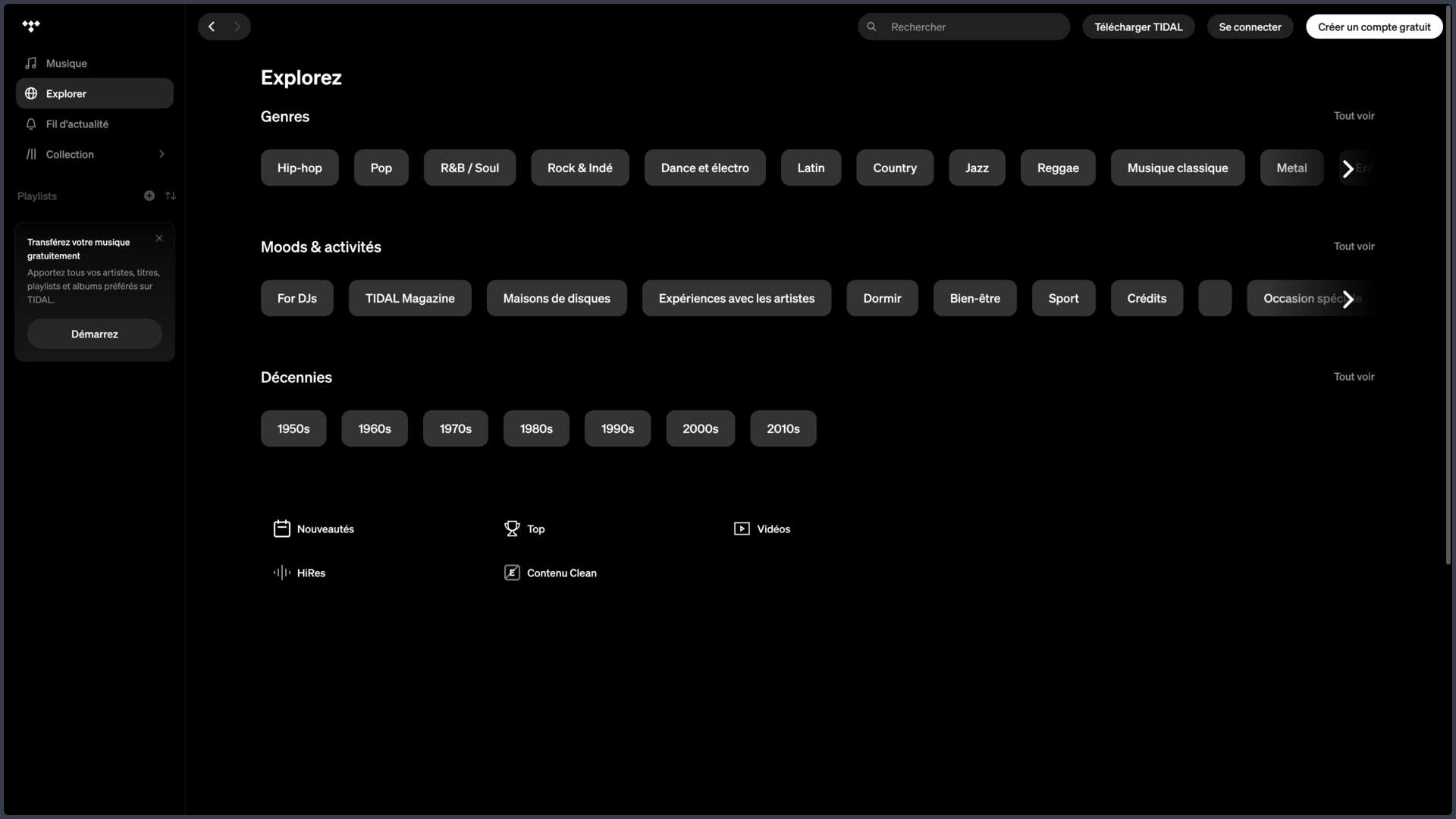
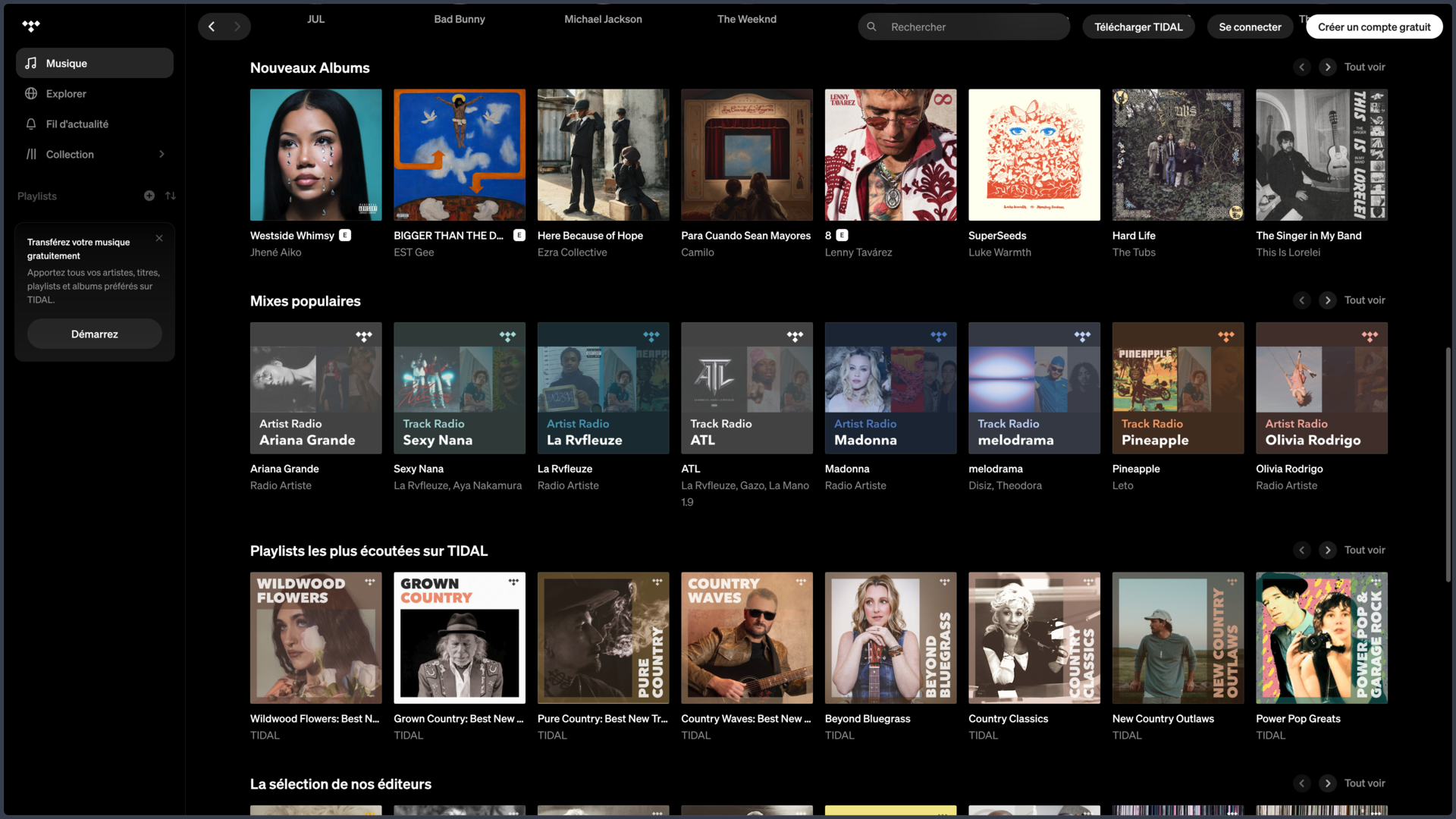
Overview
TIDAL is a music streaming service that mainly stands out for its focus on audio quality. Its catalog now exceeds 180 million tracks and combines high-fidelity music, personalized recommendations, editorial playlists, music videos, offline downloads and compatibility with a wide range of audio equipment.
The service previously offered several separate HiFi tiers. This structure has been simplified: the main subscription now directly includes lossless FLAC, Hi-Res FLAC up to 24-bit/192 kHz and Dolby Atmos when the track and device are compatible. A more expensive audiophile plan is therefore no longer required simply to access the best available quality.
TIDAL also maintains a strong creator-oriented positioning. Track pages can display detailed credits for songwriters, producers, engineers, musicians and other contributors, while TIDAL Artist Home and TIDAL Upload develop features aimed directly at artists and music professionals.
The service works on computers, browsers, smartphones and tablets, but also with many Hi-Fi systems through TIDAL Connect. A dedicated offer, TIDAL DJ, also makes it possible to use the catalog from certain DJ software and hardware.
Features
More than 180 million tracks and personalized discovery
TIDAL currently advertises a catalog of more than 180 million songs. It covers major commercial releases as well as independent catalogs, with albums, singles, EPs, playlists, music videos and various editorial selections.
Discovery combines automatic recommendations with TIDAL’s editorial work. My Mix adapts its selections to listening habits, while Daily Discovery offers ten personalized tracks each day to help users discover new music.
Other selections follow new releases from frequently played artists or adapt their content to certain genres and listening behaviors. Users can also start a radio station from a track or artist to continue playback automatically.
The My Activity section makes it possible to follow top artists and certain monthly listening statistics. Offline listening is also taken into account once the device synchronizes again.
FLAC, Hi-Res and three quality levels
Audio quality remains one of TIDAL’s main strengths.
The service now mainly uses FLAC, an open lossless format. Three principal quality levels are available:
| Quality | Format | Resolution |
|---|---|---|
| Low | Compressed AAC | Up to 320 kbit/s |
| High | Lossless FLAC | 16-bit / 44.1 kHz |
| Max | Hi-Res FLAC | Up to 24-bit / 192 kHz |
High corresponds roughly to CD quality, while Max uses the Hi-Res files available in the catalog.
This difference is only genuinely useful if the hardware can reproduce it. A smartphone using standard Bluetooth will not necessarily preserve the full benefit of a 24-bit/192 kHz file. A DAC, wired headphones or a compatible Hi-Fi system may be required to take full advantage of high resolution.
TIDAL discontinued MQA and Sony 360 Reality Audio in July 2024. FLAC is now the preferred format for high-resolution stereo and Dolby Atmos for immersive audio.
Dolby Atmos for immersive listening
Part of the catalog is available in Dolby Atmos Music.
Instead of limiting the mix to two stereo channels, Dolby Atmos allows sound elements to be positioned within a wider space around the listener. Compatible albums and tracks are identified directly in TIDAL.
Availability depends heavily on the hardware. Dolby Atmos works notably on certain iPhone and iPad models, Apple TV 4K, Nvidia Shield and various compatible audio systems.
When the device does not support Atmos, TIDAL automatically falls back to the available stereo version of the track.
The feature is not universal: TIDAL notably states that Dolby Atmos is not supported in its desktop applications. Not every album has an Atmos mix either.
TIDAL Connect for sending the stream directly to Hi-Fi equipment
TIDAL Connect allows playback to be controlled from the app while the music itself is streamed directly by a compatible speaker, amplifier or network player.
The smartphone then mainly acts as a remote control. The stream is not retransmitted over Bluetooth from the phone: the audio device retrieves the music directly from TIDAL.
This approach can preserve better quality and prevents playback from being interrupted by notifications or other phone sounds.
TIDAL Connect supports the full range of qualities offered by TIDAL, although Hi-Res FLAC compatibility depends on the hardware used.
The phone and playback device must be connected to the same network. Content downloaded for offline listening cannot be sent through TIDAL Connect.
Library, playlists and offline listening
Artists, albums, tracks and playlists can be saved in My Collection to build a personal library.
On smartphones and tablets, albums and playlists can be downloaded for listening without an Internet connection. TIDAL currently allows up to five devices to be registered for offline mode on a compatible account.
Downloads are limited to mobile and tablet applications. Desktop applications do not offer the same offline functionality.
As with other streaming services, these downloads remain protected and tied to the subscription. They are not FLAC files that users can freely recover or keep after leaving TIDAL.
Transferring a library from another service
TIDAL includes a migration process designed to make switching from another platform easier.
The service relies on TuneMyMusic to transfer playlists, favorite tracks, albums and artists from different streaming services.
Users connect their previous platform, select the elements to import and then choose TIDAL as the destination. Available matches are then searched for in the catalog.
TuneMyMusic currently allows up to 500 tracks to be transferred for free; larger libraries may require the transfer service’s Premium plan.
This feature avoids rebuilding several years of playlists manually when testing or adopting TIDAL.
Detailed credits for identifying the people behind a track
TIDAL has long placed particular importance on music credits.
Depending on the metadata supplied by labels and distributors, a track page can identify not only the main artist but also songwriters, producers, engineers, musicians and other professionals who contributed to the recording.
This restores some of the information once commonly found in CD booklets and can become a genuine discovery tool.
A listener may notice, for example, that the same producer, composer or engineer appears on several tracks they enjoy and then explore other projects involving that person.
The quality of this information nevertheless depends on the metadata received by TIDAL, so not every track offers the same level of detail.
TIDAL Upload for original creations
TIDAL launched TIDAL Upload in 2026, allowing eligible users to upload their own audio creations.
It makes it possible to upload tracks for which the user owns the rights, organize them as singles or albums, add cover artwork and edit their information.
Creators can decide who has access to their files and view statistics about listeners and plays when the content is shared.
Upload is currently available to users aged 18 or older in several regions, including the European Economic Area.
This should not be confused with importing an old personal MP3 collection as on Apple Music or YouTube Music: TIDAL Upload is primarily aimed at original files for which the user owns the rights.
TIDAL DJ for mixing the catalog in compatible software
TIDAL offers a dedicated plan for DJs.
TIDAL DJ provides access to the catalog from several compatible environments such as rekordbox, Serato and djay Pro, as well as various partner devices.
A DJ can access their TIDAL playlists and collection directly from the software and then use available tracks during sessions.
Certain partners also support stem separation, allowing users to isolate vocals, drums or other parts of a track. Offline mode is also available with some integrations.
These functions are not included in the standard individual subscription: they require the corresponding TIDAL DJ plan.
This integration nevertheless gives TIDAL a distinctive position among mainstream services, as it can serve both as an everyday listening platform and as a music source integrated directly into some DJ workflows.
Desktop, mobile and Web applications
TIDAL offers applications for Windows, macOS, Android, iPhone and iPad, along with a Web player.
The available audio quality can vary by platform, however. TIDAL notably states that some browsers do not support the Max level and recommends the dedicated application when users want to access the highest available quality.
Linux is not currently officially supported as a desktop operating system by TIDAL.
The service is also integrated with many televisions, network players, amplifiers, connected speakers, car systems and other audio devices.
For audiophile use, it is therefore important to check not only whether a device supports TIDAL, but also which FLAC quality level that integration actually supports.
A simplified paid offer
TIDAL no longer provides a permanent free tier for full catalog listening.
In Europe, prices for the main subscriptions increased in August 2026:
| Plan | Current price | Use |
|---|---|---|
| Student | €6.99/month | Eligible user after verification |
| Individual | €12.99/month | One user |
| Family | €21.99/month | Up to six accounts |
| TIDAL DJ | Separate pricing | Streaming in compatible DJ software and hardware |
Hi-Res FLAC and Dolby Atmos are included in the main subscription and no longer require a separate HiFi Plus plan.
New users can currently receive a 30-day free trial giving access to the main service features.
Subscriptions purchased through Apple or Google may be priced differently from plans bought directly from TIDAL.
Use cases
Listening in Hi-Res on a Hi-Fi system
A user equipped with a DAC, wired headphones or a compatible Hi-Fi system can select Max quality to play available Hi-Res FLAC files up to 24-bit/192 kHz.
With a TIDAL Connect-compatible device, music can be sent directly to a network player or amplifier without routing the audio signal through Bluetooth.
TIDAL then becomes particularly relevant for someone who genuinely cares about the complete audio playback chain.
Getting Lossless without paying for an extra tier
FLAC and Hi-Res are no longer locked behind a separate premium subscription.
A standard subscriber therefore gets the same ability to access high-quality files as a Hi-Fi enthusiast, provided the track and device are compatible.
This simplification brings TIDAL closer to Apple Music or Qobuz on audio quality while avoiding the previous split between HiFi and HiFi Plus.
Discovering who actually worked on a track
A listener interested in production can open a track’s credits to look for the producer, songwriters, musicians or engineers involved.
This information can be used to follow the work of a professional who contributes to several different artists.
For musicians, producers or simply listeners interested in how albums are made, this level of detail creates a meaningful difference compared with services that mostly highlight only the main performer.
Preparing and using a library for DJing
A DJ can prepare playlists in TIDAL and then access them from compatible software.
This avoids having to immediately purchase every track simply to test a set or explore new selections.
Depending on the partner, stem separation and offline mode can extend the workflow.
The service does not necessarily replace a local library of purchased files, however: track availability remains tied to the catalog, connection, licensing and the TIDAL DJ subscription.
Leaving another platform without rebuilding the entire library
Someone using Spotify, Apple Music, Deezer or another service can transfer a significant portion of their favorites and playlists through TuneMyMusic.
They can then test TIDAL’s recommendations, sound quality and interface with a collection already close to what they previously used.
This is particularly useful during the 30-day trial when comparing two services without starting from an empty library.
Publishing and sharing original creations with TIDAL Upload
A musician who owns the rights to their recordings can use TIDAL Upload to organize and share those files directly.
They can build an album, add cover artwork, manage access and view certain listening statistics.
The feature does not necessarily replace official music distribution to streaming platforms, but it adds an interesting space within TIDAL between personal library, sharing and creator tools.
Conclusion
TIDAL remains one of the streaming services most clearly focused on sound quality and the professional music ecosystem.
The move to FLAC and Hi-Res FLAC as its main formats simplified the offer. A single subscription now provides access to Lossless, 24-bit/192 kHz when available and Dolby Atmos without requiring an additional HiFi Plus tier.
Audio quality is only part of the service, however. TIDAL Connect improves integration with Hi-Fi systems, detailed credits provide greater visibility to the people actually involved in a recording, recommendations support everyday discovery and TIDAL DJ opens the catalog to certain professional workflows.
TIDAL Upload adds another dimension from 2026 by allowing eligible creators to upload and share their own recordings directly.
The service is not without compromises. It no longer offers a permanent free tier, European prices increased in 2026, and Hi-Res or Dolby Atmos capabilities vary according to devices and integrations. Certain offline functions also remain limited to mobile devices.
For someone mainly looking for ad-free streaming, high-resolution FLAC at no extra cost, strong Hi-Fi integration and particularly useful features for production enthusiasts or DJs, TIDAL nevertheless retains a very distinctive position among major music platforms.
Points to consider
-
TIDAL no longer offers a permanent free plan for unrestricted access to its full catalog. A 30-day trial remains available to new users.
-
The catalog currently exceeds 180 million tracks, according to TIDAL.
-
In Europe, the Individual plan increased to €12.99/month and the Family plan to €21.99/month in August 2026. The Student plan is available at €6.99/month for eligible users.
-
Lossless FLAC, Hi-Res FLAC and Dolby Atmos are included in the main subscription and no longer require the former HiFi Plus plan.
-
Max quality can reach 24-bit/192 kHz, but only when that version of the track is available and the device or integration supports it.
-
MQA and Sony 360 Reality Audio have not been supported since July 2024. TIDAL now prioritizes FLAC for stereo and Dolby Atmos for immersive audio.
-
Dolby Atmos is not supported in TIDAL’s desktop applications and availability varies according to device.
-
TIDAL Connect can preserve the available quality up to compatible hardware, but not every Connect device necessarily supports Hi-Res FLAC.
-
Offline mode is intended for mobile and tablet applications. Up to five devices can currently be registered for offline downloads.
-
Linux is not officially supported as a desktop platform, although Web access may work depending on the browser and features used.
-
TIDAL DJ requires a dedicated plan for access to the catalog from compatible DJ software and hardware.
-
TIDAL Upload is intended for audio creations for which the user owns the rights. It is not a general system for freely importing an entire old personal music library.