
Presentation
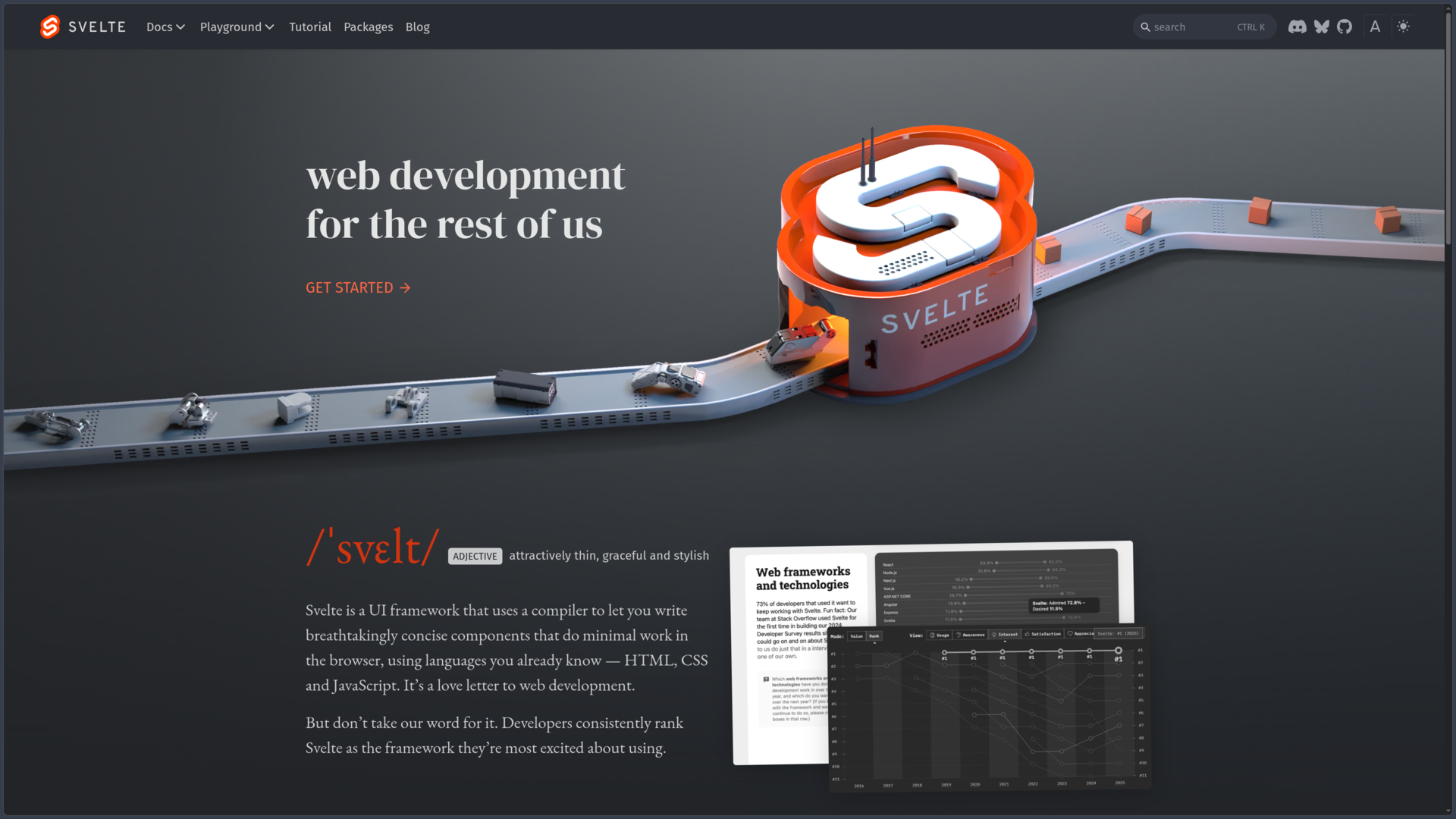
Svelte is an open-source framework for building Web interfaces from components using HTML, CSS and JavaScript.
Its main distinction lies in its compiler. A large part of the work is performed during the build process: declarative components are transformed into JavaScript capable of updating the DOM precisely in the browser.
This approach differs from libraries that perform more work at runtime and allows Svelte to offer a relatively concise syntax.
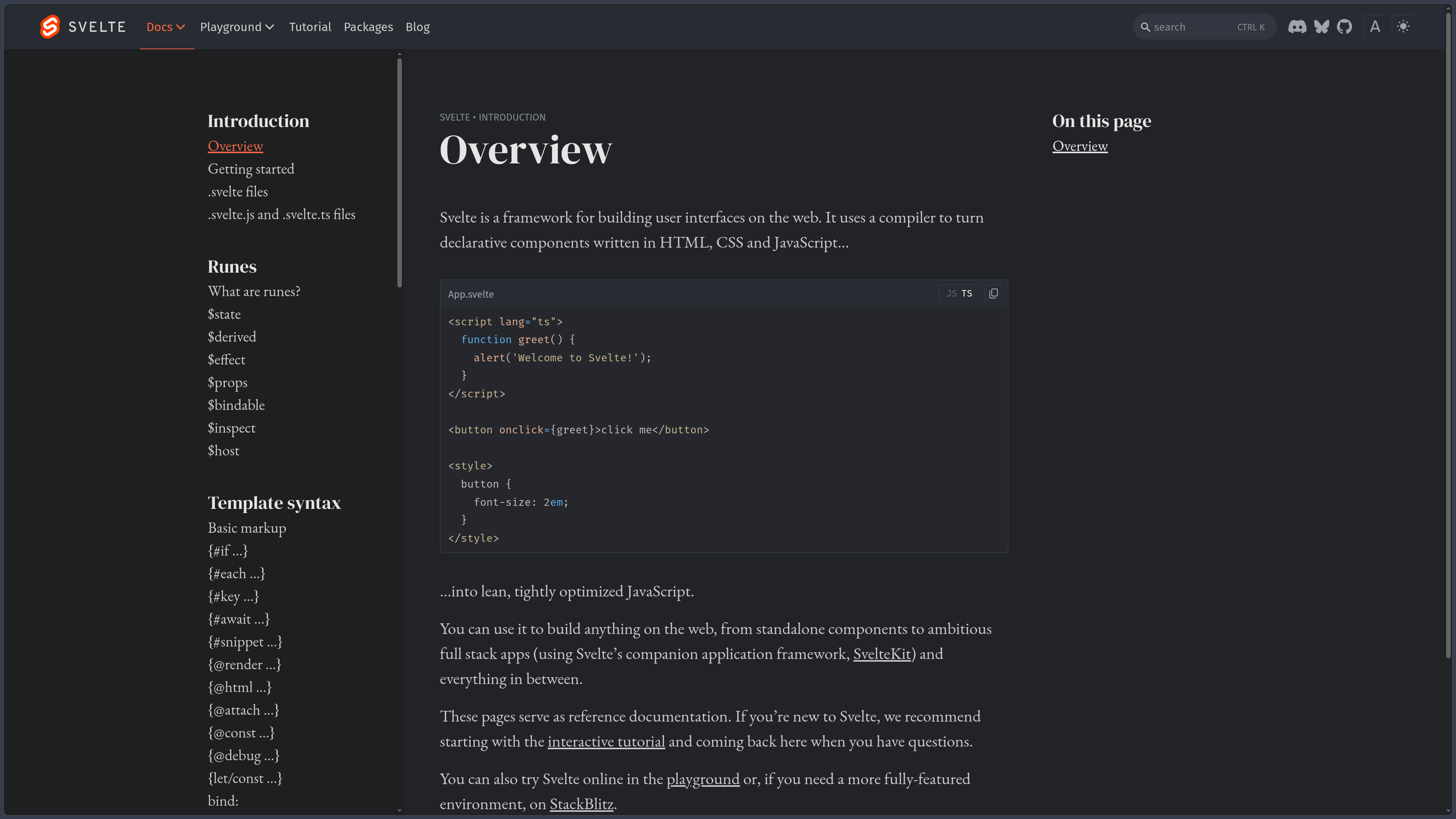
A .svelte file can group logic, markup and styles inside the same component. Svelte also supports TypeScript, scoped styles, animations, transitions and different mechanisms for sharing state.
Since Svelte 5, the modern reactivity system is mainly based on runes, notably $state, $derived, $effect and $props.
To build a complete application with routing, server rendering and backend features, the official ecosystem relies on SvelteKit, which remains separate from the Svelte framework itself.
As of October 3, 2026, Svelte 5.57.1 is the latest stable version.
Features
Compiled components
Svelte interfaces are organized into components.
A .svelte file can contain a <script> block, interface markup and a <style> block.
The compiler then transforms this component into JavaScript intended for the browser or server-side rendering.
This compilation allows Svelte to generate the operations required to update the interface directly.
Runes and reactivity
Svelte 5 introduces runes as the modern reactivity mechanism.
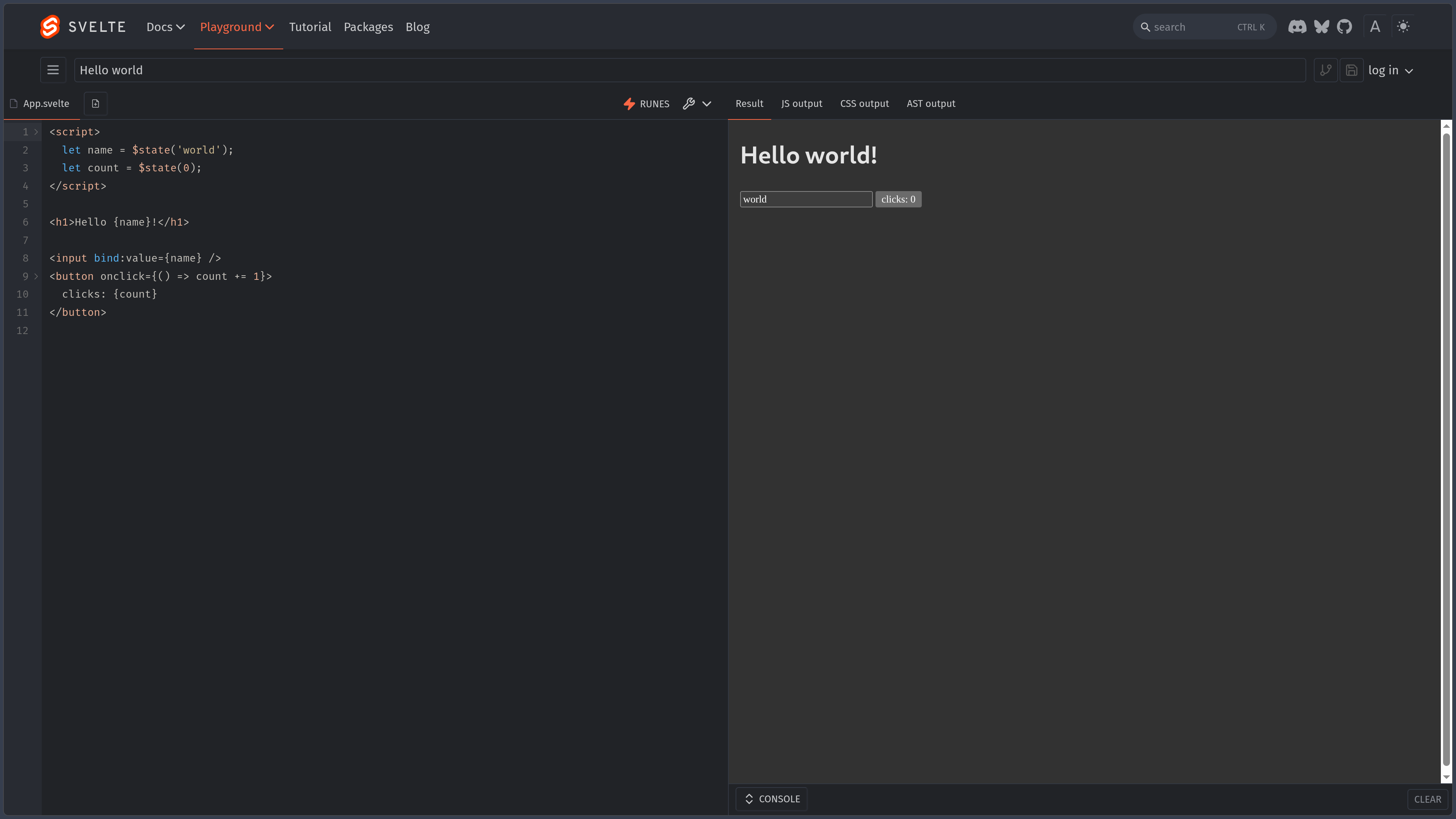
$state declares reactive state, while $derived represents a value calculated from other reactive data.
$effect runs logic when its dependencies change, notably for communicating with an external API, manipulating a canvas or integrating a third-party library.
Dependencies are tracked automatically when reactive values are used.
Props
In components using the modern syntax, $props() retrieves properties passed by the parent component.
Props can be typed with TypeScript and destructured like standard JavaScript values.
Svelte also supports bindings when selected data needs to be modified between components in a controlled way.
Templates
Svelte templates use a syntax close to HTML.
The {#if}, {#each} and {#await} blocks respectively handle conditions, collections and asynchronous operations.
JavaScript expressions can be inserted directly into the markup.
Svelte 5 also uses snippets and {@render} to compose and pass reusable sections of content between components.
Events and bindings
Event handlers can be declared directly as properties, for example onclick.
The bind: directive synchronizes a value with selected form elements or DOM properties.
It can notably be used with bind:value, bind:checked or bind:this.
These mechanisms cover many common interactions without adding a large amount of intermediate code.
Scoped styles
Styles declared inside a .svelte component are scoped by default.
The compiler adapts selectors to limit their scope to the relevant component.
Global styles can still be deliberately defined when the application requires them.
This approach makes it easier to build self-contained components without imposing a particular CSS library.
Transitions and animations
Svelte provides built-in tools for transitions and animations.
Functions such as fade, fly, slide and crossfade can accompany elements as they appear or disappear.
The animate: directive can handle certain movements caused by list changes.
These features cover many animation requirements without an additional dependency.
Attachments and actions
Svelte can associate behavior with a DOM element.
Actions, historically used with use:, remain available.
Since Svelte 5.29, attachments provide a more flexible and composable approach for running logic when an element is mounted or when selected dependencies change.
They can notably connect an external library or a specific DOM API to an element.
Stores
Svelte still provides stores with writable, readable and derived variants.
They offer a simple subscription contract for sharing or connecting reactive state.
With Svelte 5, runes nevertheless make it much easier to manage reactive state inside .svelte.js or .svelte.ts files.
Stores remain particularly useful for certain existing libraries, asynchronous data sources or systems following the store subscription contract.
TypeScript
Svelte directly supports TypeScript inside components.
A <script lang="ts"> block can use type annotations, interfaces and other features that do not require TypeScript-specific runtime transformation.
Svelte tooling also provides component analysis and type checking.
The svelte-check command can be used in a project or continuous integration pipeline to detect different issues.
Vite and development tooling
Svelte integrates with Vite for modern projects.
The development toolchain provides fast compilation, Hot Module Replacement and production builds.
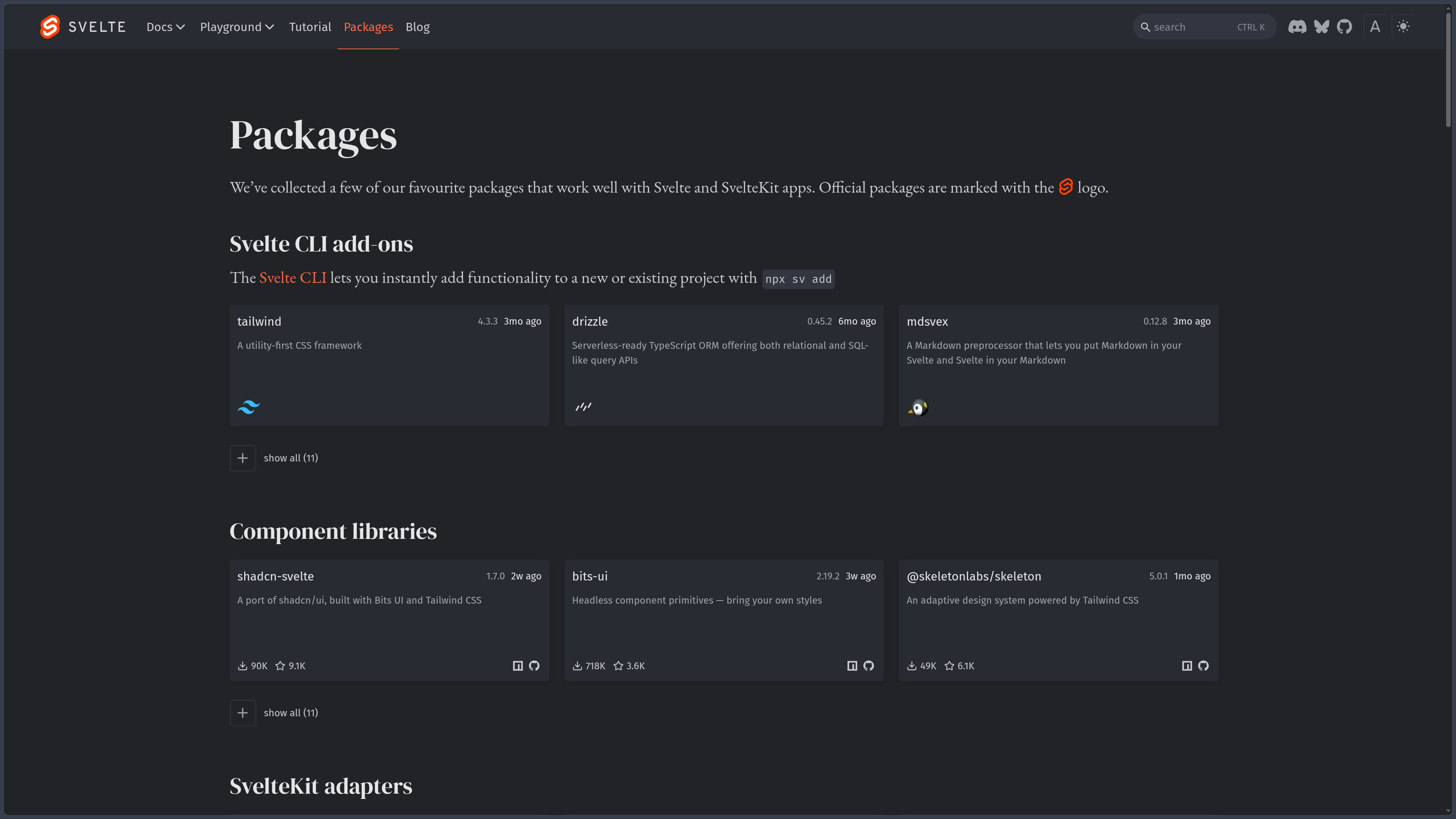
The official sv CLI can create and maintain applications in the Svelte ecosystem.
For a new complete application, sv create currently generates a project based on SvelteKit.
Svelte and SvelteKit
Svelte mainly focuses on components and user interfaces.
By itself, it does not provide a complete architecture for routing, server-side data loading or backend functionality comparable to a full-stack framework.
SvelteKit extends Svelte with file-based routing, SSR, static generation, server endpoints, forms, data loading and deployment through different adapters.
SvelteKit 3 has been the current generation of the official application framework since October 2026.
Use cases
Build an interactive Web interface
Svelte suits interfaces composed of forms, tables, dynamic components and frequent interactions.
Built-in reactivity links state directly to the display.
Add a component to an existing project
The Svelte compiler can also produce components intended to be integrated into a broader architecture.
It is therefore not necessary to adopt SvelteKit immediately for every use case.
Develop a SPA
Svelte can serve as the UI layer of a single-page application.
For a structured application with real routing and data loading, SvelteKit is generally the recommended solution.
Build a full-stack application
Combined with SvelteKit, Svelte can serve as the foundation of an application including server rendering, routes, forms and backend logic.
The same ecosystem can therefore cover both interactive components and the complete structure of a site.
Create a component library
.svelte components, their scoped styles and TypeScript support are well suited to creating design systems and reusable interface libraries.
Conclusion
Svelte stands out through an approach where the compiler performs a significant part of the work before execution in the browser.
Its components naturally group markup, logic and styles, while Svelte 5 runes provide an explicit reactivity model that can also work outside components.
Transitions, bindings, TypeScript and scoped styles complete the framework without imposing a very heavy architecture.
Svelte nevertheless remains primarily focused on the interface. For routing, server rendering and full-stack features, SvelteKit is the official extension.
For building modern Web interfaces with compact syntax, strong compiler integration and a relatively coherent ecosystem, Svelte offers a distinctive alternative to more traditional frontend frameworks.
Points to consider
-
Svelte 5.57.1 is the latest stable version as of October 3, 2026.
-
Svelte is free and open source under the MIT license, including for commercial use.
-
Svelte 5 uses runes as its modern reactivity syntax.
$state,$derived,$effectand$propsreplace several implicit mechanisms used in earlier versions. -
The older Svelte 3 and 4 syntax remains largely compatible with Svelte 5. A full migration to runes is therefore not immediately required for every existing component.
-
Svelte is primarily a UI framework. To build a complete application, the Svelte team generally recommends SvelteKit.
-
SvelteKit is a separate project. Version 3.0 was released on October 1, 2026 and does not correspond to Svelte's own version number.
-
Stores remain supported, but runes now cover some needs that previously required a store.
-
Actions remain usable, although attachments introduced in Svelte 5 now provide a more flexible solution for new use cases.
-
Svelte 5 requires a modern browser. Older browsers such as Internet Explorer are not supported.
-
TypeScript is supported directly, but certain TypeScript features requiring transformation into JavaScript may need a preprocessor.
-
Untrusted HTML must always be handled carefully. As with any Web framework, injecting unsanitized user content can create XSS vulnerabilities.
-
Svelte dependencies should be kept up to date. Several security fixes notably related to SSR and content injection were published in 2026.