
Presentation
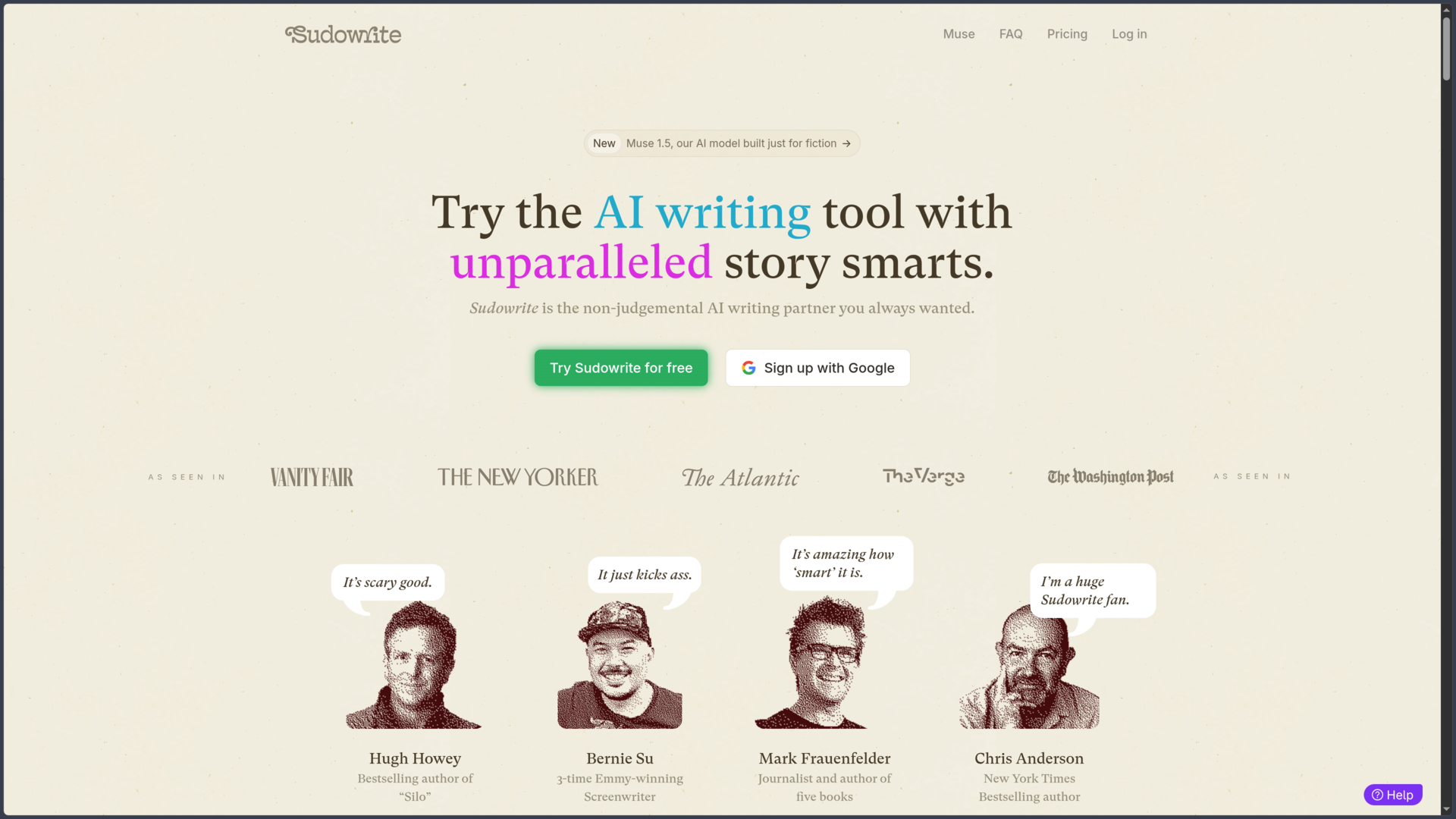
Sudowrite is an AI-powered writing assistant designed mainly for fiction authors.
Created by writers Amit Gupta and James Yu, it is not limited to a chat box: the application combines an editor, narrative planning tools, a Story Bible, scene and chapter generation, rewriting features, brainstorming, editorial feedback and multiple AI models.
The goal is to retain enough context about the world, characters, style and story structure to provide more coherent suggestions than a general-purpose assistant used with isolated prompts.
Sudowrite has its own models specialized in fiction, including Muse and Ballad, while also offering access to more than thirty models from different providers.
The service mainly runs in the browser and also provides mobile applications for Android, iPhone and iPad.
Features
Story Bible
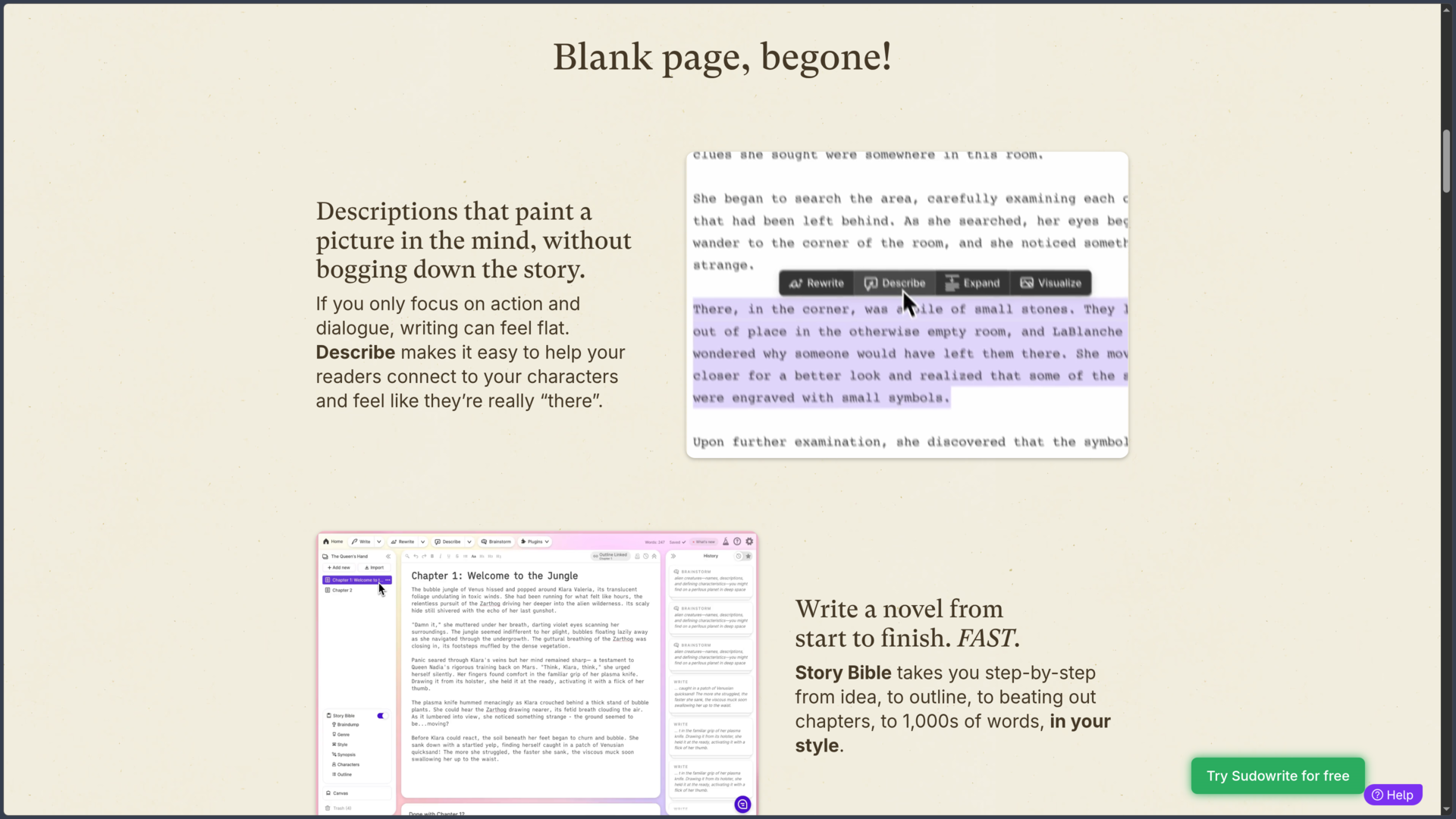
The Story Bible centralizes the important information of a project.
It can contain genre, style, synopsis, characters, worldbuilding, outline and planned scenes.
It serves both as an organizational space for the author and as a source of context for the AI.
A project can begin with a simple Braindump in which the author places ideas before progressively structuring them.
Write
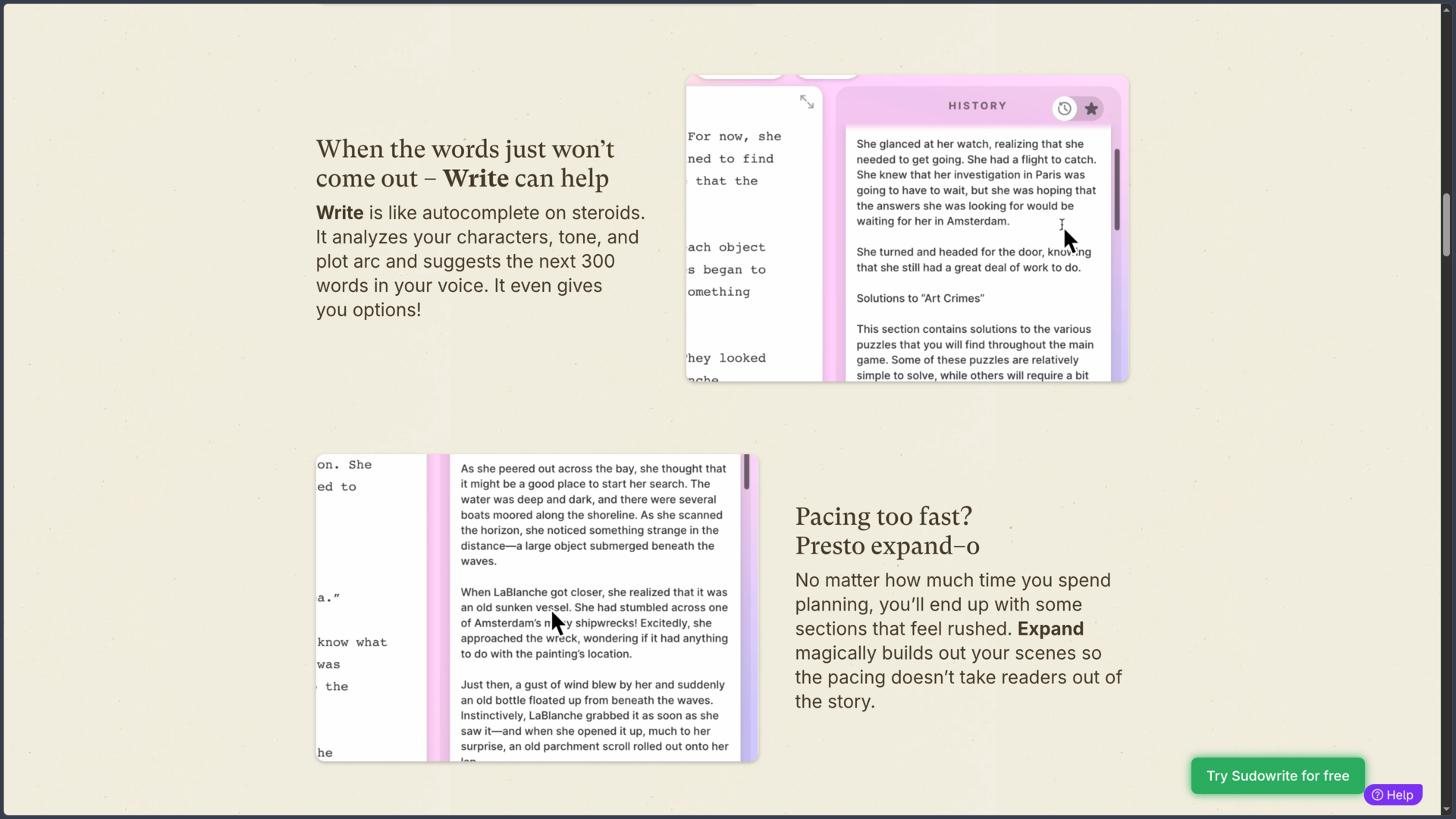
Write continues the manuscript directly from the current cursor position.
Auto mode lets Sudowrite suggest what comes next, while Guided allows the author to indicate what should happen.
Write can examine up to around 20,000 words preceding the writing point, along with relevant information from the Story Bible and chapter continuity.
The goal is therefore not simply to answer an instruction, but to continue a text while taking the existing story into account.
Scenes and Draft
Sudowrite makes it possible to structure a chapter as Scenes.
Each scene can specify location, point of view, expected events, tone, pacing and additional instructions.
The Draft tool then turns this structure into prose and can produce a chapter several thousand words long.
This method suits authors who prefer to define the narrative progression precisely before generating a first draft.
Rewrite, Describe and Expand
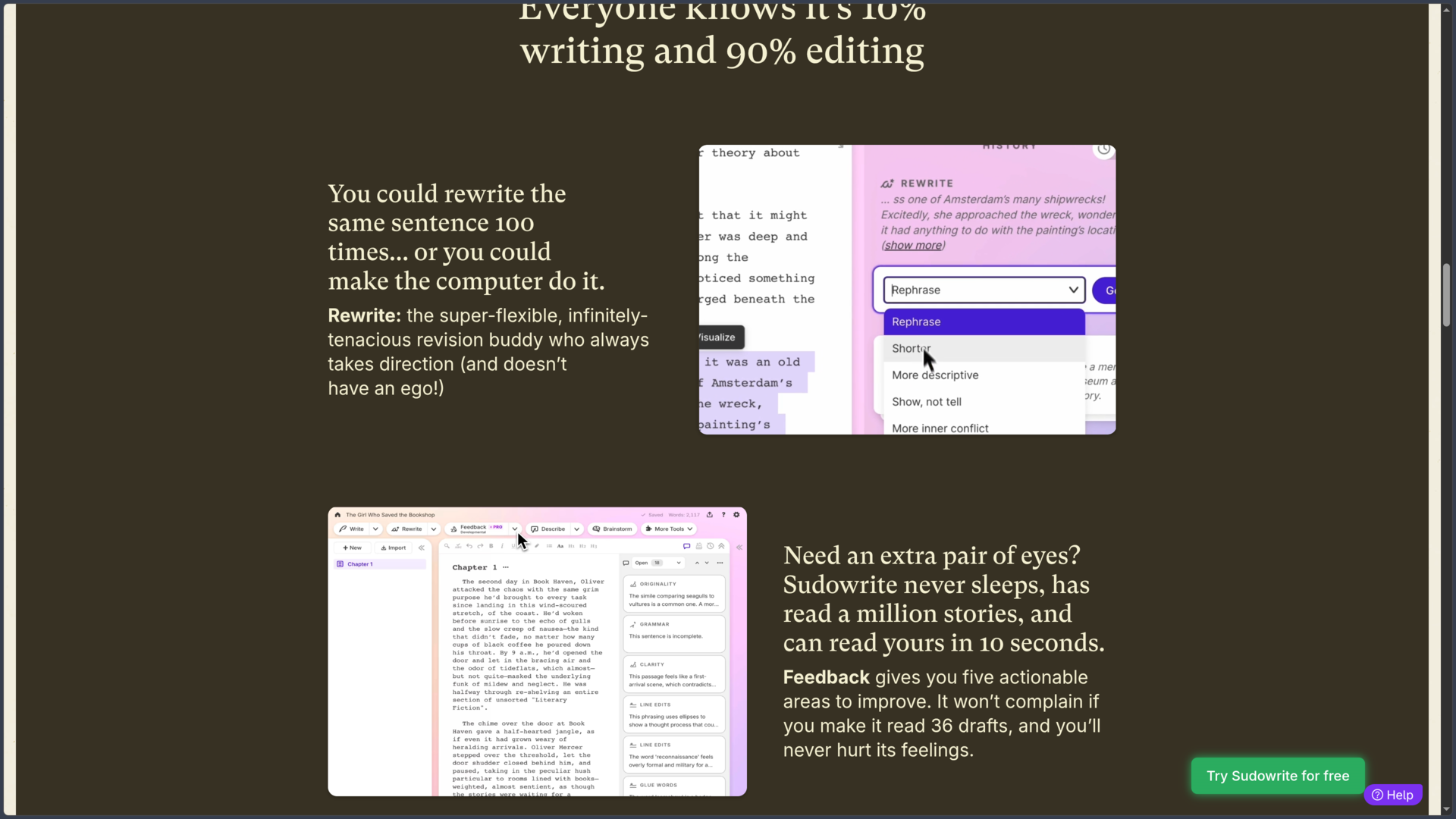
Rewrite proposes different versions of an existing passage.
It can rephrase, shorten, make text more descriptive, reinforce “show, don’t tell” or strengthen certain narrative elements.
Describe focuses more on sensory details: sight, sound, smell, touch, taste and metaphors.
Expand, by contrast, develops a passage that is too brief by slowing the pacing or adding details consistent with the surrounding text.
Brainstorm and Chat
Brainstorm helps generate names, powers, plot twists, worldbuilding elements and other ideas.
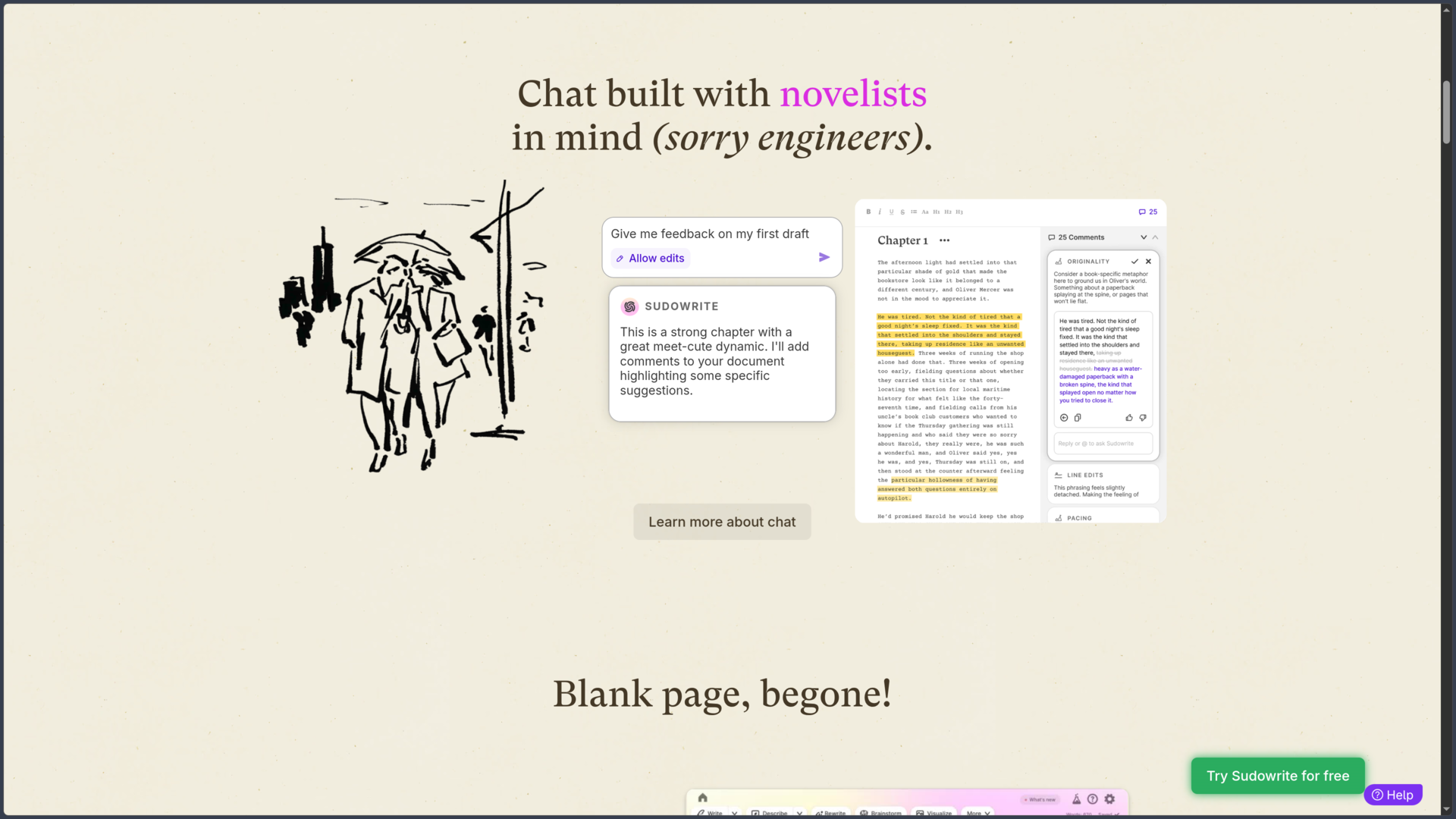
Chat allows freer interaction with the AI to discuss the story, look for narrative solutions, analyze a passage or request changes.
Unlike a separate general-purpose chatbot, Chat can use the context available inside Sudowrite and the Story Bible.
Muse, Ballad and other models
Sudowrite uses several models depending on the feature and the author’s preferences.
Muse is its flagship model specialized in fiction. Sudowrite presents it as specifically trained to produce narrative prose and avoid some repetitive phrasing or clichés often found in general-purpose models.
Ballad focuses more on balancing creative prose with precise instruction following.
The platform also provides access to more than thirty models from Anthropic, OpenAI, Google, xAI, Z.ai, Alibaba and other providers.
The selected model affects style, speed and credit consumption.
Continuity and series
Sudowrite provides features designed for book series.
Projects placed in a Series Folder can share selected characters, worldbuilding elements and structural information.
A timeline helps indicate the canonical order of the different books.
The AI can therefore reuse information from other books in the series rather than treating every project as completely separate.
Feedback
Feedback analyzes a passage, chapter or manuscript and adds comments directly in the margin.
Several types of analysis are available: development, structure, pacing, characters, dialogue, line editing, copy editing or simulated beta-reader feedback.
Comments can point out an issue and suggest an action or revision.
Feedback is currently reserved for Professional and Max subscriptions.
Canvas
Canvas provides a two-dimensional visual space for freely organizing ideas, cards and outlines.
It can be used to map a plot, move scenes, group ideas or build a structure before drafting begins.
This approach complements the Story Bible with a more spatial tool for authors who prefer visual planning.
Visualize and portraits
Visualize turns a descriptive passage into an image.
The feature can take into account certain character information stored in the Story Bible in order to improve visual consistency.
Character profiles can also contain several portraits and preserve a reference representation.
These features are mainly intended to explore a fictional world visually rather than replace specialized graphic-creation tools.
Plugins
Sudowrite includes a plugin system focused on writing.
Plugins can change tone, switch point of view, work on dialogue, analyze text or automate a specific task.
Users can add existing plugins from a directory or create their own tool by describing what they want it to do.
Sharing and collaboration
Documents can be shared by link with readers, editors or collaborators.
Invited people can notably read the text and leave comments depending on the selected sharing options.
This feature makes it possible to gather feedback without repeatedly exporting every new version of the manuscript.
Mobile applications
Sudowrite provides applications for Android, iPhone and iPad.
They notably allow access to Write, Rewrite, Chat and Smart Dictation, as well as viewing and editing selected Story Bible elements.
The mobile application remains more limited than the Web version for several advanced features: full series management, document history, plugins and some generation tools are mainly available in the browser.
Use cases
Plan a novel
Story Bible, Braindump, characters, worldbuilding and outline make it possible to progressively turn a broad idea into a narrative structure.
The author can remain fully in control of this preparation or use AI to propose alternatives.
Unblock a scene
Write can continue a passage when the author is unsure how to proceed.
Guided mode provides more control by letting the author specify a precise direction for the generation.
Produce a first draft
Scenes and Draft can turn a detailed outline into prose spanning several thousand words.
The result remains a first draft to review and revise rather than text that is automatically ready for publication.
Revise a manuscript
Rewrite, Quick Edit, Expand and Feedback make it possible to work both at sentence level and on the overall structure.
The different tools therefore cover several stages between first draft and revision.
Maintain continuity across a series
Series Support shares characters and worldbuilding across several projects.
This feature can avoid manually recreating the entire context when an author works on multiple books set in the same universe.
Conclusion
Sudowrite is built around one very specific goal: applying artificial intelligence to the real workflow of a fiction author.
Story Bible, Write, Draft, Rewrite, Feedback and Series Support go beyond simple text generation from a prompt because they attempt to maintain the context of the manuscript and its world over time.
Muse and Ballad reinforce this specialization, while access to numerous external models makes it possible to change engines depending on style, cost or task difficulty.
This richness nevertheless comes with a credit system that can sometimes be difficult to predict and does not remove the need to review, rewrite and control the consistency of generated text.
For planning, writing and revising a novel with AI specifically designed around fiction, Sudowrite is one of the most specialized tools in the field.
Points to consider
-
Sudowrite is a proprietary and paid service. A free trial is available without a credit card, but there is no permanent free plan for using the AI features.
-
Current annual prices start at $10/month for Hobby & Student, $22/month for Professional and $44/month for Max.
-
With monthly billing, the same plans currently cost $19, $29 and $59.
-
The quotas are respectively 225,000, 1,000,000 and 2,000,000 credits per month.
-
Credits do not directly correspond to a fixed number of words. Consumption varies depending on the model, amount of context read, generated length and feature used.
-
Unused credits from the Max plan can roll over for twelve months.
-
Feedback is currently reserved for Professional and Max plans.
-
Sudowrite uses its own models as well as numerous third-party models. The list evolves quickly as providers release new generations.
-
Muse and Ballad are fiction models developed specifically for Sudowrite. Muse particularly focuses on creative prose, while Ballad aims for a stronger balance between style and instruction following.
-
Sudowrite states that it does not use user manuscripts to train its AI models.
-
Sudowrite does not claim ownership of text imported or generated for the user. The service terms state that rights to user content remain with the user.
-
The Story Bible improves context but does not guarantee perfect continuity. Generations should be reviewed for contradictions, invented details or misplaced narrative elements.
-
The Web application remains the most complete version. Android and iOS/iPadOS applications provide a smaller set of features and also serve as mobile writing and dictation tools.
-
Sudowrite can work in many languages, but certain features may fall back to English when the language is misinterpreted or when the selected model performs less well in that language.
-
The mobile interface is currently mainly offered in English.
-
The service runs in the cloud and is not local-first. The manuscript and project information must be transmitted to the service so that the AI features can analyze them.
-
Generated results remain probabilistic. Fluent prose does not guarantee narrative consistency, factual accuracy or literary quality sufficient for publication without human intervention.