
Overview
Spotify is a streaming service primarily dedicated to music, although its scope has gradually expanded to podcasts, video and audiobooks. Its basic principle remains simple: rather than buying and storing each album on a computer or phone, users access a remote catalog from their devices and gradually build a personal library of tracks, albums, artists, shows and playlists.
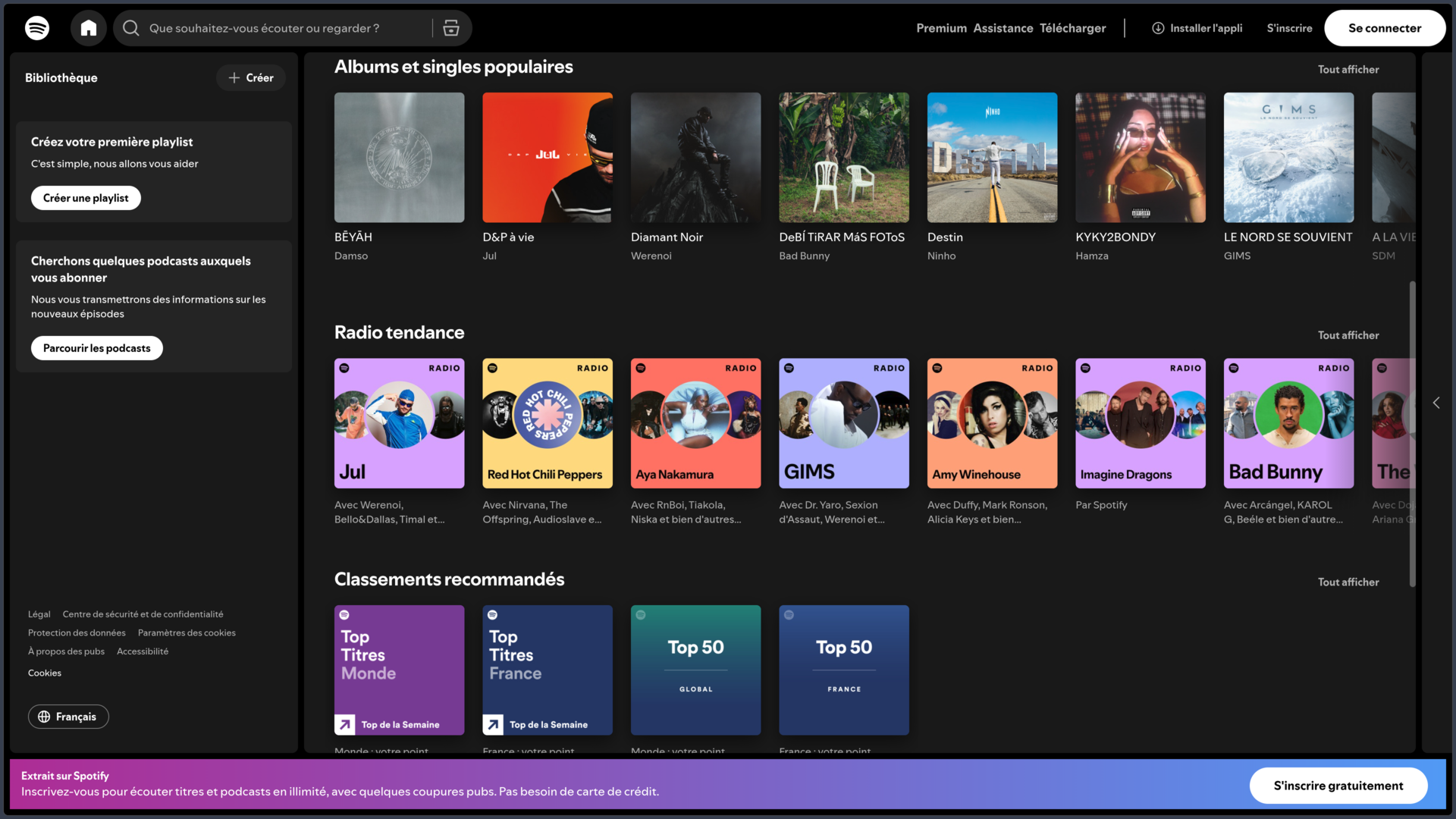
This model has profoundly changed the everyday relationship with music. Spotify no longer necessarily requires users to know in advance which album they want to hear. The home page, personalized mixes, Discover Weekly, Release Radar, daylist and various editorial selections also turn the service into a discovery tool. Users can search for a specific artist or song, but they can also let the platform gradually shape their listening around their habits.
Personalization therefore occupies a central place. Tracks played, songs skipped, artists followed, saved playlists and listening habits allow the service to refine its suggestions. Two Spotify accounts can consequently display very different home pages and recommendations even though they access the same service.
Spotify operates according to a freemium model. A significant part of the service can be used without a subscription, with advertising and various playback or feature restrictions depending on the device. Premium plans notably remove audio advertising from music, add offline listening, provide greater control over playback and unlock higher audio quality, including Lossless.
In France, at the time of this verification on September 7, 2026, Premium Individual costs €12.14 per month, Premium Duo €17.20, Premium Family €21.24 and Premium Student €7.07. Trial periods and promotional offers are regularly available, but they vary according to the period and eligibility and therefore do not constitute the permanent price of the service.
Spotify is finally designed as a deeply multi-device environment. Mobile applications, desktop clients, the web player, televisions, consoles, cars, watches and connected speakers can all participate in the same experience. Spotify Connect even allows one device to control playback taking place on another, making the service feel more like an audio library shared across the home than a simple player installed on a phone.
Features
A vast library organized around search and discovery
Spotify provides access to millions of tracks and a large amount of other content without requiring users to manually manage the corresponding audio files.
Search can find artists, albums, tracks, playlists, podcasts and other content. An artist page usually brings together discography, popular tracks, appearances, related content and different entry points for continuing exploration.
The personal library then serves to keep what is worth finding again. Liked songs, albums, followed artists, podcasts and playlists can be grouped together without having to download or physically own the files.
This turns the question “where did I store this album?” into “what have I saved to my account?” The library therefore follows the user when they change phones or use another computer.
This convenience has a fundamental trade-off: the Spotify library remains a collection of references to a licensed catalog, not a collection of music files owned by the user. If the rights to an album change or content disappears from the service in a particular territory, its presence in a playlist does not guarantee that it will always remain playable.
Recommendations that have become an essential part of the product
Spotify does not merely display a catalog. Much of its value comes from its ability to suggest what the user might want to listen to next.
Discover Weekly brings together a personalized weekly selection of tracks likely to match the account’s tastes. Release Radar focuses more on recent releases connected to artists the user listens to or follows.
Spotify Mixes create selections around artists, genres, decades and particular listening habits. Daylist changes throughout the day and tries to reflect shifts in mood and context observed in listening behavior.
Other features use tracks the user already enjoys as a starting point for gradually introducing recommendations. Smart Shuffle can, for example, mix an existing playlist with suggestions adapted to its overall mood.
These systems greatly reduce the effort required to discover music. It becomes possible to open Spotify without a specific idea and quickly find a selection that fits established habits.
This personalization should nevertheless be regarded as a suggestion rather than musical authority. Recommendations rely on the available data, Spotify’s systems and its own editorial environment. They can be highly effective at extending existing tastes while sometimes creating a loop in which certain artists or styles recur more frequently than others.
Personal, editorial and collaborative playlists
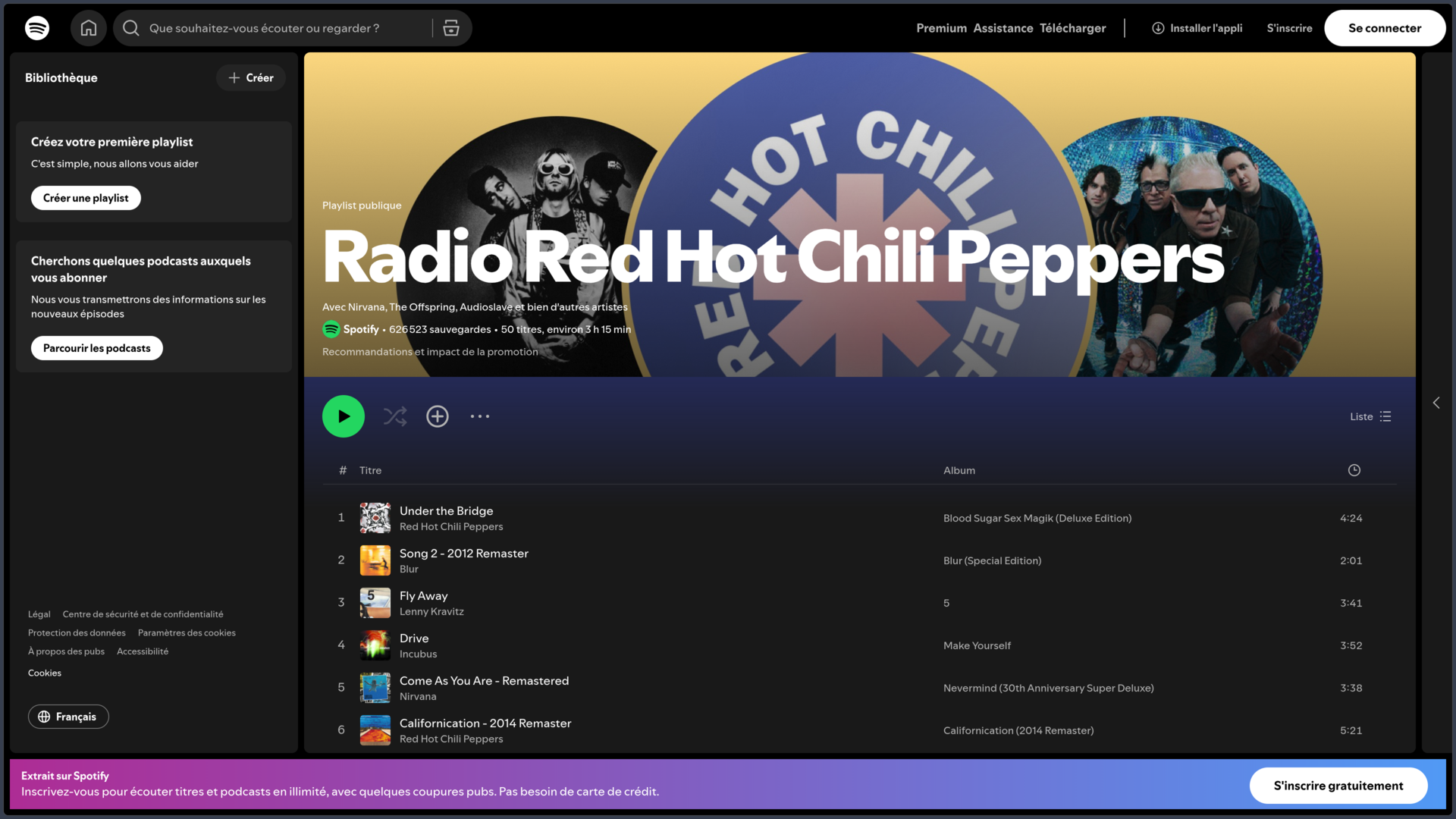
The playlist has become one of Spotify’s central objects. It can serve as a simple list of favorite songs, accompany an activity, preserve a particular musical period or form a genuine personal editorial selection.
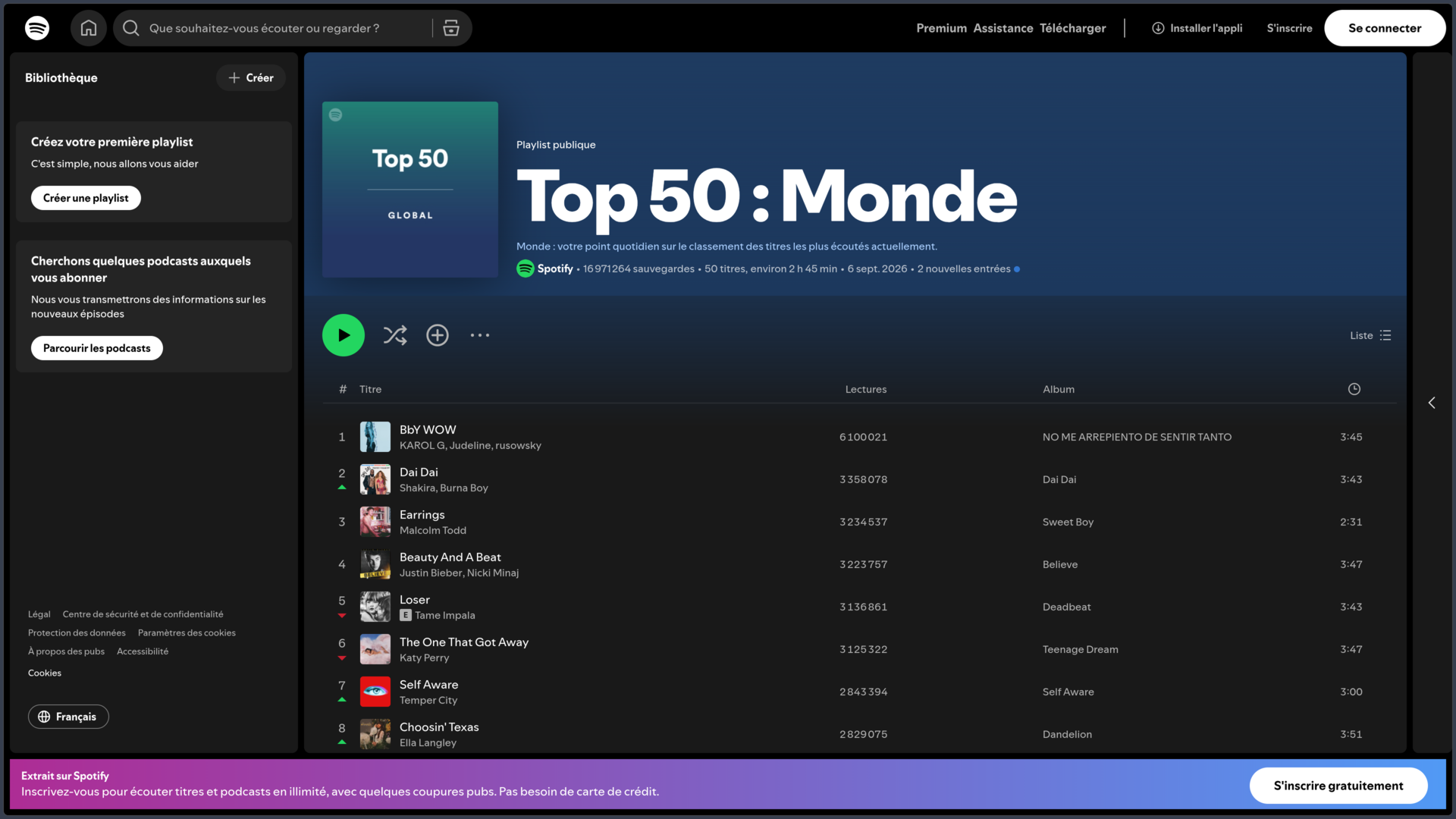
Playlists created by Spotify complement those built by users. Some are curated by editorial teams around a genre, mood or context, while others are generated or personalized according to the account.
Lists can be made public, shared and, in some cases, built collaboratively. This social dimension turns the playlist into a shared object: sending a selection can replace the compilation CD or copied playlist once prepared for someone else.
Spotify also offers features such as Blend, which attempts to combine the tastes of several people, and Jams, designed to build and manage a shared playback queue.
A Premium user can start a Jam and then invite others to add songs. Participants can be in the same room or, in certain Premium configurations, listen together remotely.
The platform therefore no longer serves only individual music discovery. It also tries to recreate part of the collective listening experience through accounts that each retain their own history and recommendations.
Spotify Connect to move listening between devices
Spotify Connect allows a phone, computer or other device to act as a remote control for playback taking place elsewhere.
A track started on a computer can be sent to a compatible speaker and then controlled from a phone. The queue and account remain tied to the service rather than to a single isolated player.
This approach works with a wide range of devices and complements other technologies such as Bluetooth, Chromecast, AirPlay, Alexa and Google Assistant.
Spotify is also available directly on various televisions, game consoles, watches and automotive systems. The exact experience varies by device, but the goal remains to preserve the same library and account.
This continuity is one of the service’s major practical advantages. Users do not need to transfer a library between their phone, computer and living room: the different devices simply become multiple access points to the same environment.
Each account is nevertheless limited to one simultaneous music stream at a time. Duo and Family subscriptions do not bypass this rule on a single account: they provide several separate Premium accounts so multiple people can listen independently.
Offline listening mainly reserved for Premium
Spotify Premium allows users to download albums, playlists and podcasts for listening when an Internet connection is unavailable.
The current limit is up to 10,000 tracks per device on a maximum of five devices. Someone preparing for a trip can therefore keep a considerable amount of music locally.
Download quality can be selected separately from streaming quality, including Lossless when available and when storage capacity permits.
These downloads are not comparable to buying a digital album. The files remain managed by Spotify, protected and playable within the application. They cannot be exported as ordinary FLAC or MP3 files to another player.
Spotify also requires the account to reconnect at least once every 30 days in order to keep downloads available. Offline listening therefore works as a temporary extension of the service rather than permanent acquisition of the files.
The free service allows certain podcasts to be downloaded, but downloading music for offline listening is one of the Premium benefits.
From compressed streaming to 24-bit Lossless
Spotify offers several quality levels to balance data usage, storage and audio fidelity.
With Spotify Free on desktop, mobile and tablet, available settings range roughly from 24 Kbit/s to 160 Kbit/s depending on the selected level. Premium notably adds a “Very High” quality around 320 Kbit/s.
Since the rollout of Lossless, Premium subscriptions can also stream music in quality equivalent to FLAC up to 24-bit/44.1 kHz when both the track and device are compatible.
This development addresses one of the historical gaps between Spotify and several competitors that had already offered lossless catalogs for years.
The audible difference nevertheless depends heavily on the equipment, recording and connection method. Bluetooth may re-encode the signal using its own codec and prevent the chain from remaining genuinely lossless all the way to the headphones. A wired connection or properly compatible Spotify Connect device may be better suited.
Lossless files are also significantly larger. They therefore increase both streaming data usage and the storage required for downloads.
Finally, Lossless applies to music. Podcasts, videos and audiobooks do not use this lossless quality.
Podcasts, video and audiobooks in the same library
Spotify has long expanded beyond music. Podcasts have their own environment with subscriptions, saved episodes, recommendations and, in some cases, video.
This coexistence makes it possible to move from an album to a show without changing applications. For some people, this genuinely simplifies everyday audio use; for others, mixing several formats makes the home page feel less exclusively focused on music.
The platform is also developing audiobooks. In France, the subscription catalog announced by Spotify includes more than 600,000 titles.
Premium Individual currently includes 12 hours of audiobook listening per month within the eligible catalog. On Duo and Family plans, these hours are included for the plan manager. Premium Student does not include this listening allowance.
Top-ups and add-ons can supplement this allowance when the user wants to listen for longer.
This model therefore differs from unlimited music streaming: access to the audiobook catalog is based on a monthly allocation of hours and conditions that vary according to the subscription type.
A free version that has become more flexible, but remains different from Premium
Spotify can be used without a subscription and provides access to a large part of its musical universe with advertising.
Since changes to the free service introduced in 2025, users have had more opportunities to search for and directly start a track, notably from search or from a song that has been shared with them.
This does not mean that Spotify Free now has all the controls available in Premium. On mobile, some sessions remain subject to Smart Shuffle and other specific rules associated with the free offer.
Premium retains music listening without audio advertising, offline playback, much more complete control over track order and the queue, and access to higher quality levels.
The free version therefore remains genuinely usable for discovering the service, regularly listening to music and building a library. Premium is more suitable for people for whom Spotify becomes their primary everyday music player.
Lyrics and social features around listening
When data is available for a track, Spotify can display synchronized lyrics during playback.
It is also possible to share certain passages through social applications, turning a line from a song into something directly shareable rather than requiring users to copy or search for it elsewhere.
Sharing also applies to songs, albums, artists, podcasts and playlists. Spotify links have become a common way to quickly send a music recommendation.
Integration with other services can go further. Discord can, for example, display what someone is listening to and allow Premium users to listen together.
Jams add a more active dimension: several people can contribute directly to a shared queue rather than simply observing one another’s listening activity.
These features do not turn Spotify into a complete social network, but they make listening a far less isolated activity than with a traditional local audio player.
A web client and applications on almost every screen
Spotify provides official applications on Windows, macOS, Android, iOS and iPadOS, complemented by a player accessible directly from a web browser.
The web player works with the major recent versions of Chrome, Firefox, Edge, Opera and Safari. It allows the service to be used on a machine where the application cannot or should not be installed.
Spotify also provides a client for Linux, notably through a Debian package and Snap. One important clarification is required, however: Spotify itself states that the Linux version is developed as a project maintained by some of its engineers and that it is not an officially supported platform at the same level as Windows and macOS.
Applications also extend to televisions, game consoles, cars, smartwatches and various audio systems.
Actual coverage therefore depends on each manufacturer, but few music services currently have such a broad hardware ecosystem.
Use cases
Replacing a local music library with a synchronized library
A user who previously listened to music from MP3 or FLAC files can search for albums in Spotify, follow artists, save favorite songs and build playlists.
The collection no longer needs to be manually copied between computer and phone. A change made on one device is automatically found on the others.
This approach greatly simplifies access to music when the main objective is listening.
It is much less suitable for someone for whom owning, organizing and preserving the files themselves is part of the musical experience. A Spotify collection depends on the service, any active subscription and the availability of works in the catalog.
Regularly discovering new artists
A user can combine Discover Weekly, Release Radar, daylist, personalized mixes and editorial playlists.
A discovered track can be added to Liked Songs, lead to the full album and then to the discography or other related artists.
Spotify’s strength then appears in the continuity between discovery and listening. There is no need to separately search for a track through a search engine and then find somewhere to play it: the recommendation is already inside the player.
It remains useful to deliberately move beyond recommendations when trying to explore scenes, eras or styles far removed from existing habits. Highly effective personalization can paradoxically become too comfortable.
Preparing music before a trip
A Premium subscriber can download several playlists or albums to their phone before leaving.
The music then remains available on a plane, on a train without coverage or in an area with poor mobile connectivity.
Users can choose a lower quality to save storage or, conversely, download in Lossless when the device has enough space.
The system remains tied to the Spotify account, however, and periodically requires a connection. For permanent archiving intended to survive independently from the service, a collection of purchased files remains more appropriate.
Using the same account across computer, phone and living room
Someone can work with Spotify Desktop, resume playback from their phone and then send the music to a Spotify Connect speaker.
The phone then becomes a remote control rather than the audio source itself.
This model works particularly well in homes equipped with several compatible speakers or devices because the music does not need to be transferred between them.
Duo and Family subscriptions also allow several people to retain their own libraries and recommendations rather than sharing one common account that would mix all listening histories together.
Building playlists for an activity or a group
A playlist can accompany exercise, work, a party, a trip or simply preserve a selection associated with a particular period.
It can remain private, be published or shared with other users.
For collective listening, a Jam allows participants to add tracks to the queue and directly contribute to the session.
Spotify therefore becomes not only a music catalog but also a tool for organizing listening.
This use remains intended for a personal context. Spotify’s terms do not allow the normal service to be used as a commercial public-performance solution in a bar, restaurant, shop or other establishment.
Centralizing music, podcasts and audiobooks
Someone who alternates daily between music, podcasts and audiobooks may prefer to keep all of these forms of content in one application.
The same account, search and device synchronization can then serve several types of listening.
This can reduce the number of applications required, especially when Spotify is already used for several hours a day for music.
This centralization also has a downside: the rules are not identical for every medium. Lossless does not apply to podcasts or audiobooks, and the Premium audiobook catalog works with a limited monthly duration rather than unlimited access comparable to music.
Conclusion
Spotify has become much more than a player for launching an album. Its real strength lies in the layer it builds between a huge catalog and the user’s habits: synchronized library, immediate search, recommendations, playlists, sharing and continuity across devices.
This approach explains why the service can become almost invisible in daily use. Spotify can be opened on a computer, resumed on a phone and transferred to a speaker, with everything remaining tied to the same account without having to manage a single file.
Discovery is probably its other major advantage. Discover Weekly, Release Radar, daylist, mixes and editorial playlists provide several complementary ways to find music without turning every session into an active search.
The arrival of Lossless up to 24-bit/44.1 kHz also reduces a long-standing Spotify trade-off. Premium users can now prioritize much higher quality when they have suitable equipment, storage and connectivity.
The trade-off remains inherent to streaming. Saving an album or downloading a playlist does not mean owning its files. The catalog depends on licensing agreements, downloads remain locked inside the application and the entire personal library remains tied to the account and the continued existence of the service.
Personalization creates another, more subtle dependency. Spotify becomes extremely effective at organizing what users already know and suggesting what resembles their habits. It is therefore useful to keep deliberately searching elsewhere when the objective is to discover things that do not yet fit the profile the platform has built.
For someone looking for an extremely practical music service available almost everywhere, capable of combining on-demand listening, discovery, playlists, sharing and Lossless quality without manually managing a collection of files, Spotify remains one of the most complete references in streaming. For someone who primarily values ownership of works, personal archiving or independence from a subscription and remote catalog, its logic addresses a very different need.
Points to consider
-
Spotify is a proprietary service: the applications and content are licensed and do not become the property of the user. The service is intended for personal, non-commercial use.
-
French prices at the time of this verification are €12.14/month for Premium Individual, €17.20 for Duo, €21.24 for Family and €7.07 for Student. Temporary promotions may change the amount paid during the first months without changing the standard price.
-
Premium Family is intended for family members living at the same address and allows up to six separate accounts. Duo also requires two people living at the same address.
-
Premium Student requires eligibility verification: the plan is intended for adult students enrolled in an eligible accredited higher-education institution and can be used for a maximum period defined by Spotify.
-
Lossless is reserved for Premium and reaches up to 24-bit/44.1 kHz. Availability depends on the track and device, and a Bluetooth connection may prevent the signal chain from remaining truly lossless all the way to headphones or speakers.
-
Lossless does not apply to podcasts, videos or audiobooks and uses significantly more bandwidth and storage space than compressed quality levels.
-
Premium downloads are not exportable music files: they remain playable inside Spotify and are limited to 10,000 tracks per device across a maximum of five devices. The account must connect at least once every 30 days to keep them available.
-
A saved album is not guaranteed to remain available forever: Spotify’s catalog depends on licensing and may vary by country or change over time. A track can therefore become unavailable even if it still appears in an older playlist.
-
A Spotify account normally allows only one music stream at a time. Duo and Family plans provide several separate accounts precisely so multiple people can listen independently.
-
Audiobooks do not follow the same model as music: Premium Individual currently includes 12 hours per month from the eligible catalog; on Duo and Family, this allowance applies to the subscription manager. Premium Student does not include these hours.
-
Recommendations depend heavily on listening history and personalization: they make discovery remarkably easy, but can also favor styles and artists close to habits already identified.
-
Content selection and placement are not entirely neutral: Spotify’s terms state that certain aspects of selection and placement may notably be influenced by commercial considerations and agreements with third parties.
-
The Linux application exists but is not officially supported at the same level as Windows and macOS: Spotify describes it as a project developed by some of its engineers and warns that the experience may differ from its other desktop clients.
-
Spotify Free remains advertising-supported and retains certain restrictions despite the more flexible free listening experience. Premium is still required for offline music, Lossless and complete control over several playback features.
-
Spotify is not intended for commercial music playback in public venues: a personal subscription does not authorize its use as background music in a bar, restaurant, shop, studio or other professional establishment.