
Presentation
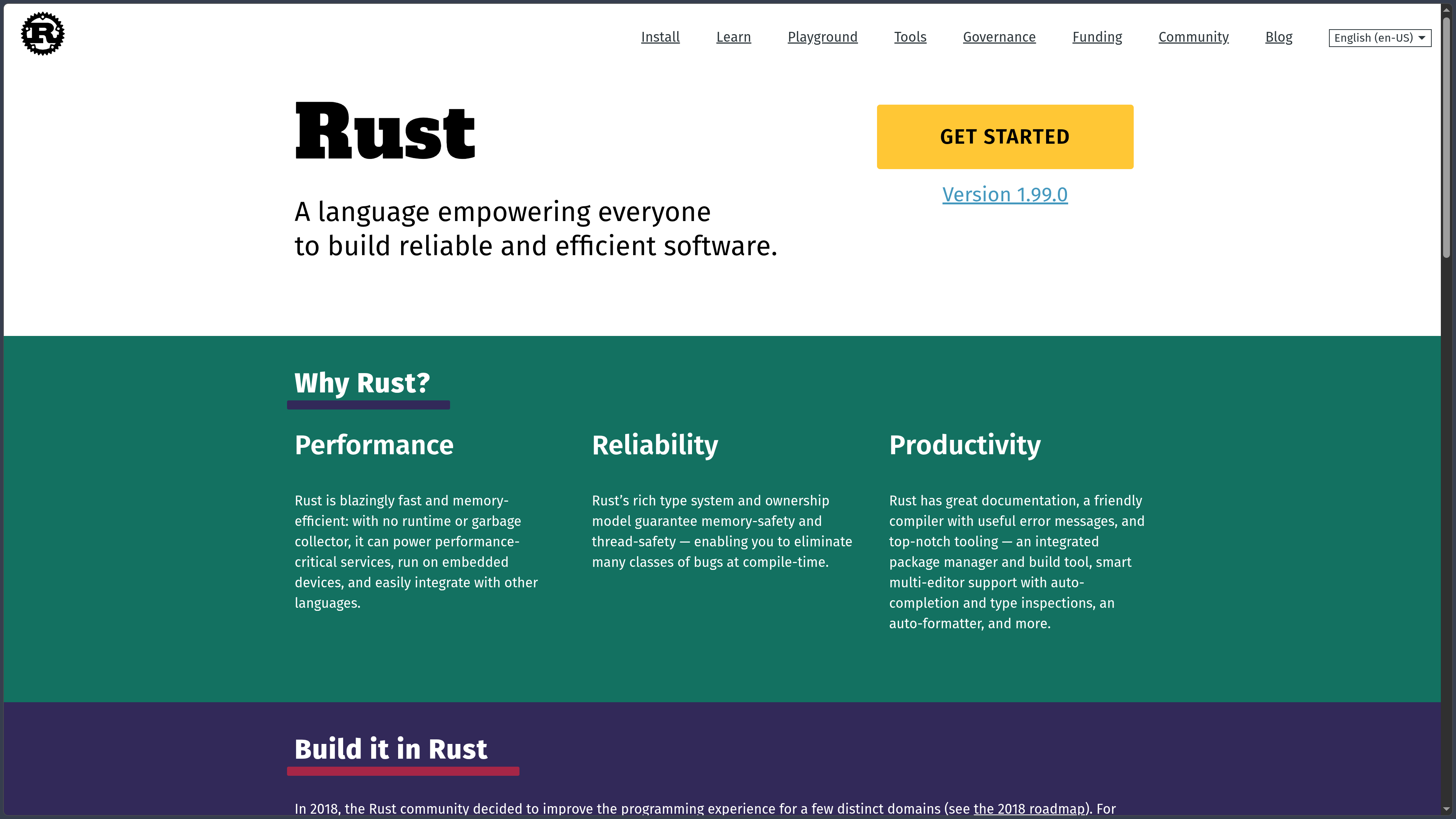
Rust is an open-source programming language focused on performance, reliability and memory safety.
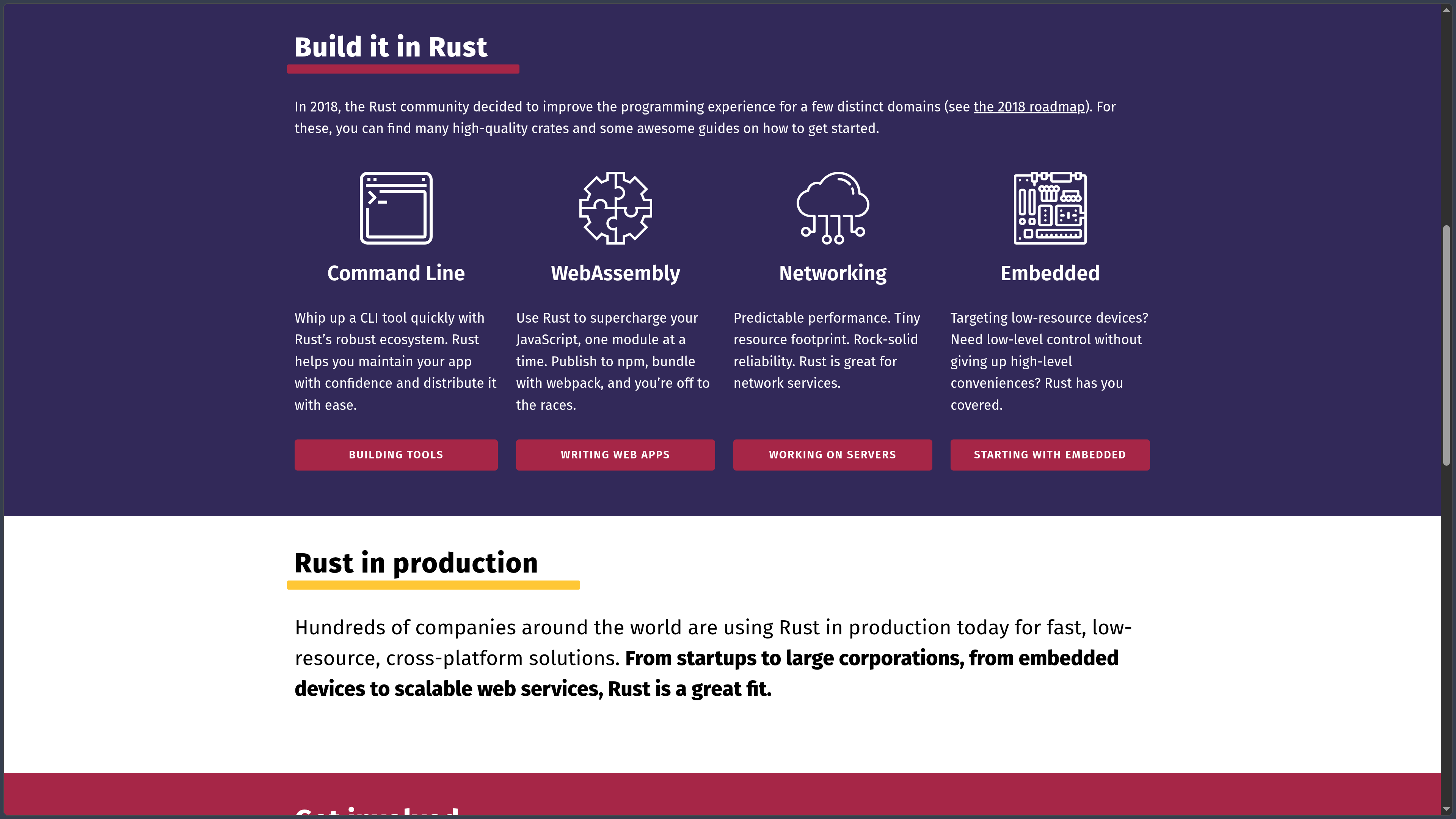
It is aimed particularly at areas where resource control and performance matter: systems software, command-line tools, network services, high-performance applications and engines, WebAssembly and embedded systems.
Its most distinctive feature is its ownership system. Rust tracks the lifetime and use of data at compile time in order to prevent many memory errors without relying on a garbage collector.
This approach preserves low-level control comparable to languages such as C or C++ while moving a significant part of verification to the compiler.
Rust also comes with a particularly integrated development environment built around rustup for toolchain management, Cargo for building and managing projects and crates.io for distributing libraries.
As of October 3, 2026, Rust 1.99.0 is the current stable version. The reference edition for new projects remains Rust 2024.
Features
Ownership and borrowing
The ownership system defines who owns each value and how long it remains valid.
A value can be moved, borrowed by reference or borrowed mutably according to rules checked by the compiler.
The borrow checker notably prevents several categories of errors involving invalid references, certain incorrect concurrent accesses or data being freed too early.
These checks are performed at compile time and do not add a garbage collector during program execution.
Memory safety without a garbage collector
Rust automatically releases resources when their owner goes out of scope.
This management prevents a large proportion of classic errors such as use-after-free or double free in safe Rust code.
The language nevertheless retains an unsafe mechanism for operations that cannot be verified automatically, particularly certain low-level interactions or interfaces with external code.
Using unsafe therefore does not disable Rust as a whole: it marks the areas where the developer must personally uphold certain safety rules.
Performance and low-level control
Rust compiles to native code and targets performance suitable for demanding applications.
It provides precise control over allocations, data structures and memory representation while still offering high-level abstractions.
Many abstractions are designed around a zero-cost abstractions principle: using them should not impose unnecessary runtime overhead compared with an equivalent hand-written implementation.
Rust can therefore be used both for low-level libraries and complete applications.
Cargo
Cargo is Rust's official build tool and package manager.
It can create a project, compile code, run an application, launch tests, generate documentation and publish a library.
Dependencies and the main project metadata are declared in the Cargo.toml file.
This integration avoids having to assemble several separate tools for the fundamental needs of a project.
crates.io
crates.io is the main public registry for the Rust ecosystem.
Rust libraries and packages published there are called crates.
Cargo can automatically download project dependencies and resolve their versions using the corresponding lock file.
The ecosystem covers networking, Web development, databases, serialization, graphical interfaces, games, cryptography, scientific computing and embedded systems.
Each crate nevertheless retains its own license and maintenance level.
rustup and toolchains
rustup is the recommended method for installing and managing Rust.
It makes it possible to switch between the stable, beta and nightly channels, install multiple toolchains or add compilation targets.
Cargo is installed with the standard Rust toolchain.
This system also makes it easier to update the development environment without manually replacing each component.
Concurrency
Rust's type system is also used to prevent certain concurrency errors.
Ownership rules and traits such as Send and Sync allow the compiler to control how certain data can be transferred or shared between threads.
This philosophy is sometimes summarized by the expression fearless concurrency: moving some potential concurrency errors to compile time rather than discovering them during execution.
Rust does not eliminate every possible concurrency problem, however, particularly logical deadlocks or poor architectural decisions.
Error handling
Rust mainly distinguishes between recoverable errors and situations considered unrecoverable.
The Result type explicitly represents an operation that may fail and generally requires the program to handle or propagate that possibility.
The Option type represents the presence or absence of a value without relying on a traditional null reference.
These mechanisms help make several categories of errors visible directly in function signatures and program flow.
WebAssembly
Rust can target WebAssembly — Wasm in order to run compiled code in a browser or other compatible runtimes.
It can therefore complement JavaScript for certain operations requiring performance, reuse of an existing library or shared logic with a native application.
The ecosystem provides tools for creating the bindings required between Rust, WebAssembly and JavaScript.
Rust is not, however, intended to systematically replace JavaScript for an entire Web application.
Embedded and systems development
Rust can be used in environments with limited resources or without a complete operating system.
Embedded projects can use the language with a reduced portion of the standard library, access peripherals and produce native binaries for different architectures.
The guarantees provided by the type system are particularly valuable when memory errors can cause difficult-to-diagnose behavior on hardware.
Actual support nevertheless depends on the target, microcontroller and available ecosystem.
Interoperability with C
Rust can communicate with C code through its support for foreign function interfaces, or FFI.
This makes it easier to introduce Rust gradually into existing projects or use system libraries already available in C.
FFI boundaries generally require additional care because the Rust compiler cannot guarantee the safety of external code on its own.
Rust 1.99 notably extends capabilities around variadic functions using the C ABI.
Rust 2024 and the release cycle
Rust uses editions to introduce certain language changes while maintaining compatibility between libraries using different editions.
Rust 2024, introduced with Rust 1.85, is the default edition used by new projects created with Cargo.
It is not a separate compiler version: a recent compiler can build crates from different editions together.
Rust also follows a regular stable release cycle.
Rust 1.99.0, released on October 1, 2026, is the current stable version, while Rust 1.100 is already on the beta channel.
Use cases
Develop systems tools
Rust can be used to create utilities, system components and software requiring precise resource control.
Its native compilation and lack of a garbage collector are particularly suitable for programs where performance and predictable behavior matter.
Create command-line tools
Cargo and the Rust ecosystem make it easy to create CLI programs distributed as standalone binaries.
The language is particularly well suited to tools that need to process files, data or system operations quickly.
Develop network services
Rust can be used to build servers, APIs and network services when performance and resource control are important criteria.
Its concurrency model and asynchronous ecosystem make it possible to handle large numbers of network operations.
Use WebAssembly
A Rust library can be compiled to WebAssembly and then used inside a Web application.
This makes it possible to share selected components between native and Web environments or accelerate specific processing in the browser.
Develop engines and high-performance applications
Rust is also used in the development of engines, graphical tools and games.
Its memory control and type system make it possible to build high-performance architectures while reducing certain categories of low-level bugs.
Conclusion
Rust combines native performance, resource control and strong compile-time guarantees.
Its ownership system is its defining feature: it makes memory management safer without introducing a garbage collector, at the cost of a model that developers need to learn and understand.
Cargo, crates.io and rustup provide a coherent environment for creating, testing, documenting and distributing projects.
Rust is particularly well suited to systems software, CLI tools, network services, WebAssembly, embedded development and applications where performance and reliability matter strongly.
Its learning curve is nevertheless steeper than that of languages such as Python, particularly because of ownership, borrowing, lifetimes and the type system.
For developing high-performance software while aiming to eliminate a large proportion of classic memory errors at compile time, Rust offers a particularly strong approach.
Points to consider
-
Rust 1.99.0 is the current stable version as of October 3, 2026. Rust 1.100 is already on the beta channel.
-
Rust 2024 is the default edition for new Cargo projects. An edition is not equivalent to a separate new version of the language.
-
Rust is free and open source. Official projects are generally distributed under a dual MIT or Apache License 2.0 license.
-
Third-party crates have their own licenses. Rust's dual license does not automatically apply to every dependency downloaded from crates.io.
-
The ownership system requires dedicated learning. Initial encounters with the borrow checker can make certain concepts more difficult than in Python or languages using a garbage collector.
-
Rust mainly guarantees memory safety for safe code.
unsafeblocks, FFI and certain native dependencies still require careful review. -
Memory safety does not mean complete absence of bugs. Business logic errors, deadlocks, excessive resource use and logical vulnerabilities remain possible.
-
Compilation times can become significant on large projects, particularly with many dependencies or complex generics.
-
Crates should be evaluated before adoption. Maintenance, provenance, license, dependencies and security history still need to be checked, as in any package ecosystem.
-
Target compatibility varies. Windows, macOS and Linux have strong support, while WebAssembly, embedded platforms or specific architectures may require dedicated configuration and libraries.
-
Rust is a language and toolchain, not an IDE. rust-analyzer nevertheless provides advanced integration with many editors such as VS Code, Vim/Neovim, RustRover, Helix, Emacs, Visual Studio and Zed.