
Presentation
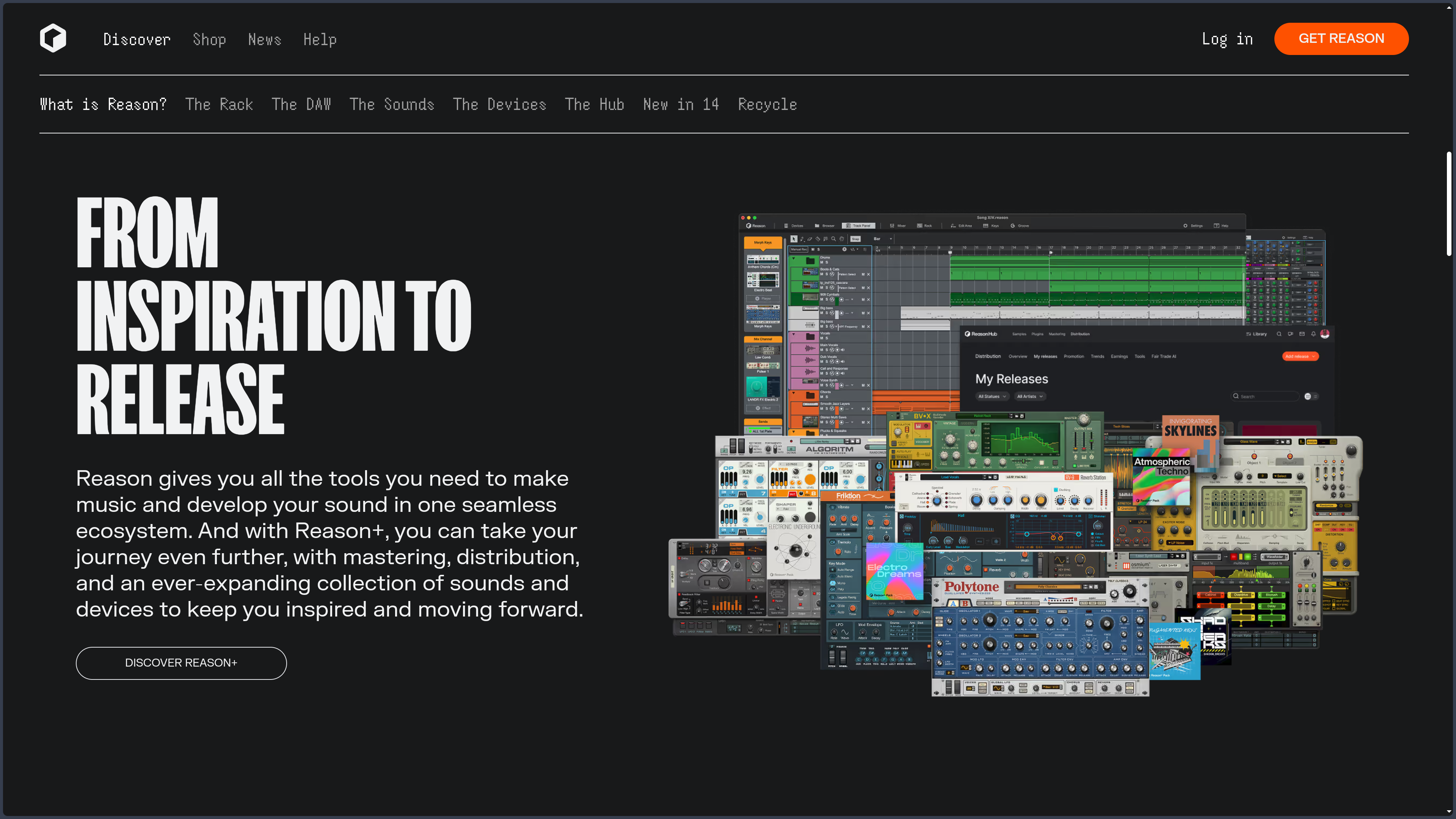
Reason is a digital audio workstation, or DAW, developed by Reason Studios. First released in 2000 under the company’s former name, Propellerhead Software, it was built around an immediately recognizable idea: recreating on a computer the logic of a studio filled with synthesizers, samplers, drum machines, effects and cables that can be connected freely.
At the heart of the software is its virtual Rack. Each instrument or effect appears as a device inserted into a signal chain. Connections can be created automatically for quick work, but it is also possible to access the cabling and build much more personal routing configurations. A signal can be split, modulated, sent through several processors or used to control another device. This logic gives Reason an almost hardware-like dimension: understanding how sound flows through the system becomes part of the creative process.
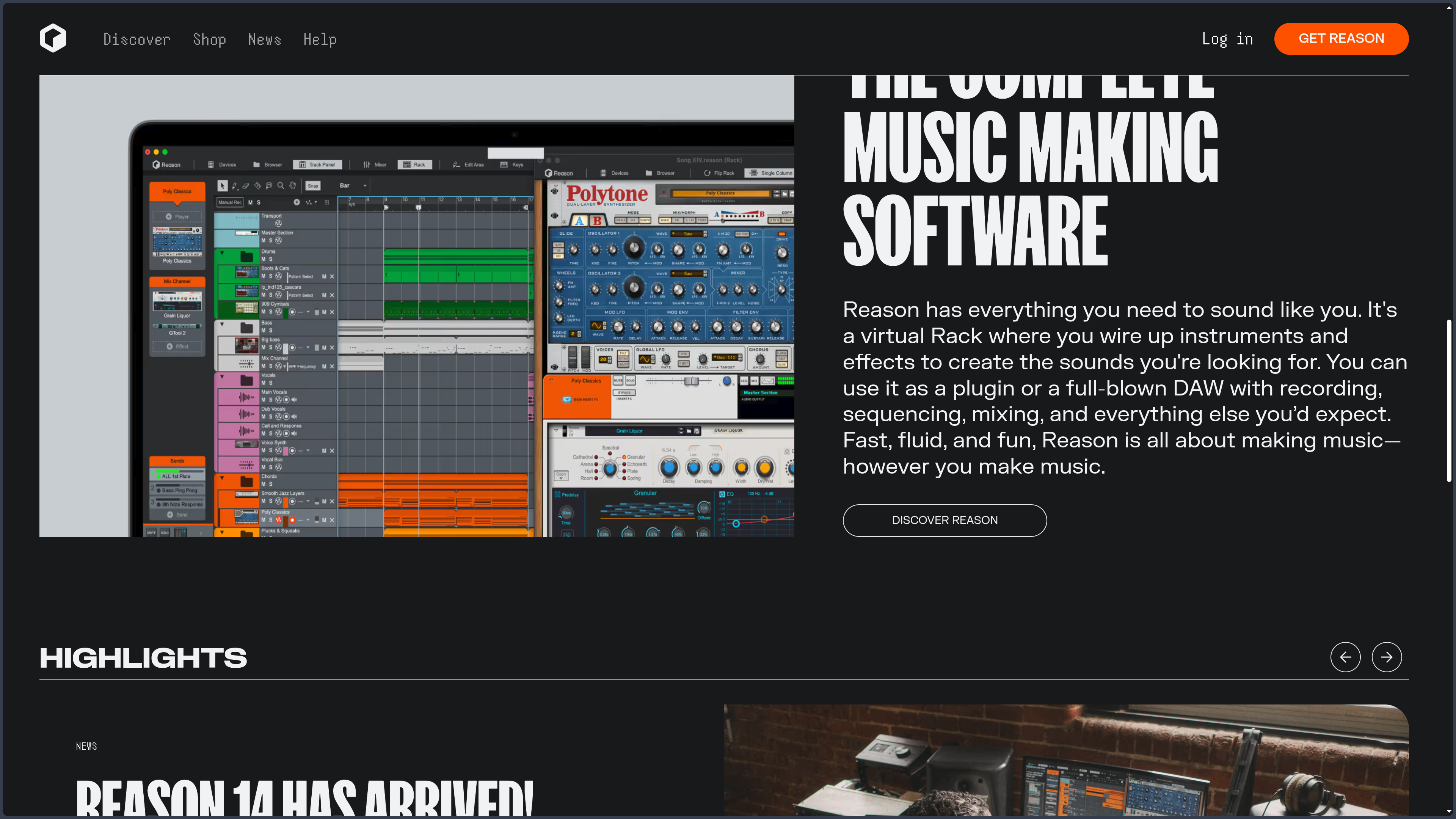
The Rack no longer summarizes the entire application, however. Reason also includes a multitrack sequencer, audio and MIDI tracks, recording and editing tools, a complete mixer, automation functions and support for external plug-ins. Reason 14 brings these different areas closer together through a more track-centered workflow. The new Track Panel gives direct access to a track’s instruments, effects, sends and main mixing controls from the sequencer, while Rack per Track organizes devices into columns to make larger projects easier to navigate.
This evolution matters because it addresses one of Reason’s long-standing paradoxes. The Rack offers enormous freedom, but it could sometimes require moving repeatedly between the sequencer, mixer and long columns of devices. Reason 14 preserves the modularity while giving the track more importance as the main unit of work. The software can now be used much more like a conventional DAW, with the Rack explored in greater depth only when a sound or routing setup requires more control.
Reason also has a second identity through Reason Rack Plugin. The complete Rack can run as a VST3, AU or AAX plug-in inside another DAW. An Ableton Live, Cubase, Logic Pro or Pro Tools user can therefore access Reason’s instruments, effects, Players and routing capabilities without moving an entire project into Reason’s sequencer.
Since its integration into the LANDR group, Reason Studios has also developed this approach through Reason+, which combines the DAW, Rack Plugin, Reason Studios devices, an evolving sound library and various services related to mastering, stem separation and distribution. The software can still be purchased as a perpetual license, leaving users a choice between owning the DAW and subscribing to a broader ecosystem.
Features
Building sound inside the Rack
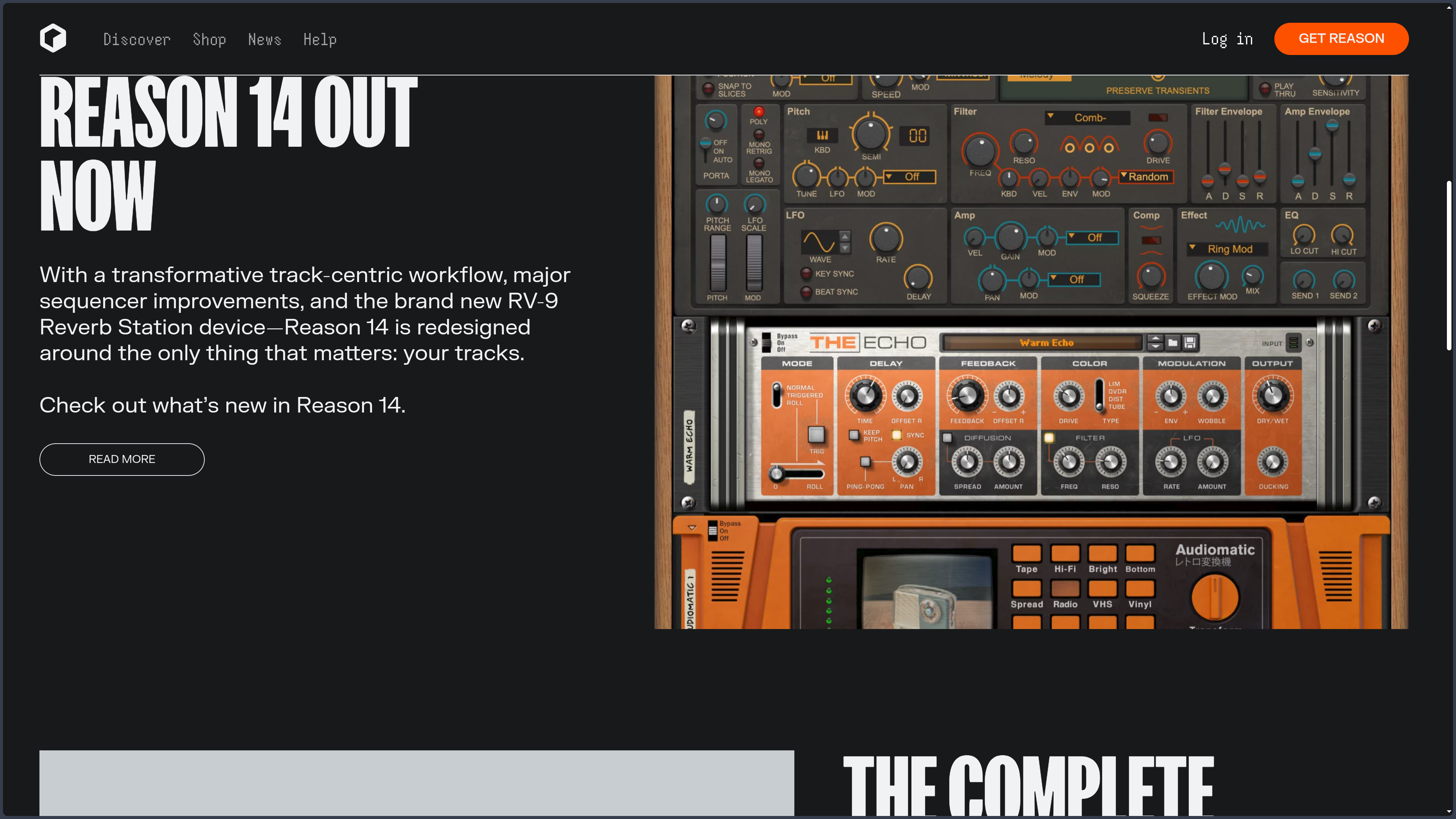
The Rack remains the feature that gives Reason its personality. An instrument can be followed by a filter, distortion, compressor and reverb; a modulation source can control several parameters; an audio or CV signal can be split and later recombined. The principle is visual enough to begin simply, but it becomes much deeper once users start building their own chains.
That modularity does not mean everything has to be wired manually. Reason automatically creates the most logical connections when devices are added. Users can therefore compose without becoming studio technicians, then open the more technical side of the Rack when they want to understand or modify the signal path.
Utilities such as Spider Audio and CV make it possible to split or merge signals, while Combinator can group several devices and expose the important controls through a customized interface. A complex synthesis and effects chain can therefore be turned into a simpler personalized instrument that is easier to manipulate and reuse.
This logic makes Reason particularly interesting for sound design. The user does not merely choose a synthesizer or effect: they can build a system in which several devices interact to create behavior that would be difficult to obtain from a single plug-in.
A collection of instruments and effects that forms an ecosystem
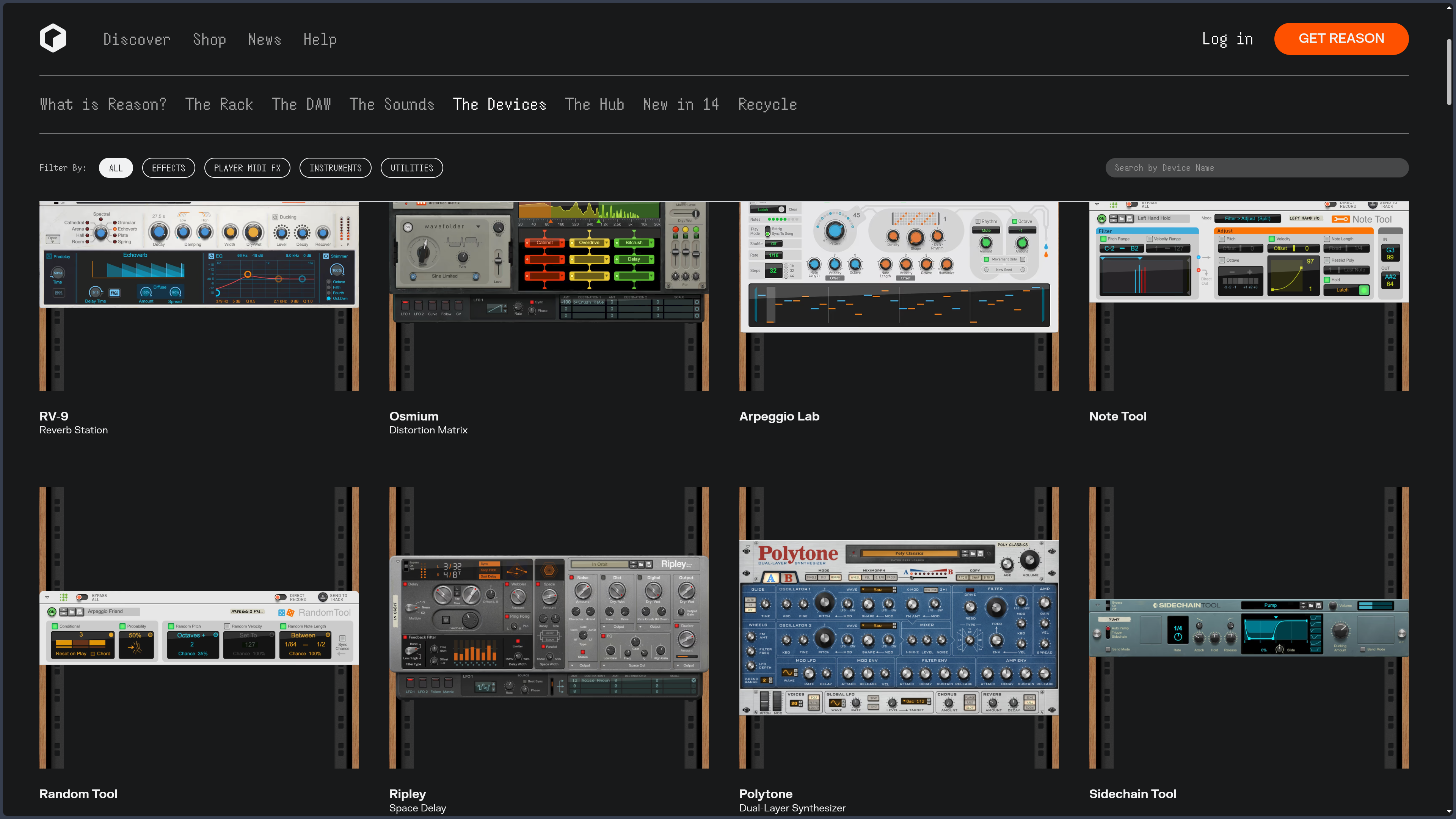
Reason comes with a substantial collection of instruments, effects and utilities. It includes long-standing synthesizers such as Subtractor, Malström and Thor, alongside more recent devices such as Europa, Monotone, Mimic, Grain, Polytone and Objekt. Drum and sampling tools notably include Redrum, Kong, Dr. Octo Rex and NN-XT.
This range makes it possible to move from subtractive synthesis to sampling, physical modeling, granular textures or rhythm programming without leaving the Rack. The effects follow the same logic, with dynamics processing, distortion, modulation, delay, reverb, pitch and mastering tools.
The catalog should not be understood as a simple list of plug-ins included with the software. Reason’s value appears mainly in the interactions between these devices. An older instrument can receive modulation from a newer Player, pass through several effects and then be encapsulated in a Combinator. This internal compatibility allows different generations of devices to continue working as parts of the same system.
Reason also supports Rack Extensions, its own extension format, as well as VST plug-ins inside the standalone DAW. It is therefore possible to combine Reason devices with external instruments and effects instead of working inside a closed environment.
Composing in a sequencer that has become more central
The sequencer can record and edit MIDI notes, audio and automation on a conventional timeline. Clips can be moved, cut, copied and, in Reason 14, looped more directly. Track Folders make projects with many tracks easier to organize, while the piano roll has also been reworked.
The major change in Reason 14 comes from the Track Panel. The selected track directly displays its device chain, effects, sends, level, panning and main routing options. A track can therefore be developed without constantly switching between several large areas of the interface.
Rack per Track extends this approach by assigning a Rack column to each new audio or instrument track. In a large song, the devices belonging to a track therefore remain grouped together instead of gradually forming one long chain that becomes difficult to navigate.
Reason also retains its Blocks Mode, which allows musical sections to be treated as reusable blocks before the full arrangement is built. This can be useful when a song relies on verses, choruses and variations whose structure is still evolving.
Recording and reshaping audio
Reason provides audio tracks without a software-imposed track-count limit and can record vocals, guitars, hardware synthesizers or other sources connected to an audio interface.
Audio Comp Edit makes it possible to keep several takes and select the strongest sections to build a final performance. Real-time time stretching and transposition help adapt recordings to a tempo or key, while Audio Slice Edit and quantization can correct or transform rhythmic placement.
A vocal editing mode also provides tools for reshaping certain characteristics of a take. Reason is therefore no longer simply the primarily MIDI-oriented virtual studio of its early versions: recorded sources can now take part fully in the same workflow as synthesizers, samples and automation.
The benefit remains consistent with the Rack philosophy. A recorded track immediately becomes another source that can be sent through effects chains, split, resampled or combined with other elements in the project.
Mixing without leaving the Rack philosophy
The Main Mixer provides channels with equalization, dynamics, inserts, sends, faders and routing to different buses. The software does not impose a channel-count limit, allowing anything from a small track to a much larger session to be built.
The mixer and Rack are not separate systems. Audio tracks and Mix Channels have corresponding devices in the Rack, while the mixer acts as the control interface for levels, equalization, dynamics and other processing. This relationship makes it possible to move between a traditional console view and a more technical reading of the signal path.
Output Buses can create submixes, while parallel processing and send effects can be organized without leaving the project. The Master Section also includes its own compressor and effect slots for finalizing the mix.
Reason 14 brings the mixer closer to the sequencer through the Track Panel, which gives access to the active track’s fader, panning and sends. The three historical areas — sequencer, Rack and mixer — remain present, but moving between them is less necessary for common operations.
Using the Rack inside another DAW
Reason Rack Plugin is probably one of the most important features for producers who appreciate Reason’s sound and modularity but do not want to change DAWs.
The Rack can be loaded as a VST3 or AAX plug-in on Windows, and as VST3, AU or AAX on macOS. Instruments, effects, Players and routing chains then become available inside the main project.
This approach changes Reason’s position relative to its competitors. It is no longer necessary to choose between Reason and Ableton Live, Cubase or Pro Tools. Another DAW’s sequencer can remain at the center of the workflow while Reason becomes a large modular instrument inside it.
Since 2026, Reason Studios has also sold Reason Rack separately from the complete DAW. This option is particularly relevant for users who are already satisfied with their production environment and mainly want access to the devices, sound design tools and modular workflow of the Rack.
Use Cases
Building an instrument that does not exist yet
An idea can begin with a simple synthesizer. A second device adds another texture, a Player generates variations, an LFO modulates the filter and several effects gradually reshape the result. Signals can be split and recombined before reaching the mixer.
Once the sound is complete, the entire setup can be grouped inside a Combinator and controlled through a few macros. What initially looked like a complex stack of devices becomes a personalized instrument that can be saved and reused.
Reason takes on a different role here from a DAW centered primarily on the timeline. Production is not only about arranging clips: it can also involve building the tools that will later be used to create the track.
Producing an electronic track from start to finish
Drums can be built with Redrum, Kong or a sampler, while bass, chords and textures are distributed across different synthesizers. Players can generate or transform certain sequences, and the sequencer gradually organizes the track.
Automation, audio tracks and Rack effects remain integrated in the same project through to the final mix. This workflow is particularly well suited to electronic music, beatmaking and productions in which sound design is part of the composition rather than something added only at the end.
Reason does not require everything to be built manually. Patches, samples and preconfigured chains make it possible to begin quickly, then open the Rack progressively when the project requires deeper customization.
Recording a real source and then transforming it
A vocal or guitar can be recorded on an audio track, assembled from several takes and synchronized or corrected before entering the Rack.
From there, the signal can be treated relatively conventionally with equalization, compression and reverb, or turned into genuine sound-design material. Distortion, delays, filters, pitch effects, modulation and parallel routing can reshape the recording heavily without requiring an external application.
This combination of recorded audio and modular logic is particularly useful for creators who combine real instruments, sampling and synthesis.
Adding Reason to an established workflow
A producer who has worked for years in Ableton Live, Cubase, Logic Pro or Pro Tools does not necessarily benefit from moving every project into another DAW.
Reason Rack Plugin allows that environment to remain in place while adding the Rack as an instrument or effects chain. A Reason synthesizer can be used on one track, a Combinator on another, while a more experimental processing chain is used only on a few sounds.
In this context, Reason stops being a potential replacement for the main DAW. It becomes an independent creative extension, making it possible to use its most distinctive component without changing the rest of the workflow.
Conclusion
Reason occupies a particular place among major digital audio workstations because its proposition does not rely only on the conventional capabilities of a DAW. Its real identity comes from the Rack and the way it makes the construction of sound visible. Instruments, effects, modulation and cables become elements of a system that can be taken apart, redirected and rebuilt.
This approach rewards curiosity. Reason can be used quite directly with patches and automatic connections, but much of its depth appears when users begin inspecting routing, creating unusual chains and understanding how several devices can work together. The software can therefore become as much an environment for learning signal flow as a production tool.
Reason 14 also addresses a historical weakness of this philosophy. As projects grew, moving between the sequencer, Rack and mixer could become cumbersome. Track Panel and Rack per Track now bring the experience closer to a modern track-centered workflow without removing what makes the software different.
Reason is therefore not necessarily the most obvious choice for someone looking primarily for a very traditional studio convention like Pro Tools or Cubase, nor for someone whose absolute priority is Ableton Live-style clip performance. It becomes particularly interesting for producers, composers and sound designers who want to understand, combine and transform the elements of their sound chain rather than simply stack plug-ins.
Reason Rack Plugin finally adds a pragmatic solution: Reason no longer has to become the main DAW in order for users to benefit from this philosophy. Its ability to exist both as a complete environment and as a Rack integrated into another application is now one of its strongest qualities.
Points to Consider
-
Two very different ways to buy Reason: Reason 14 can be purchased as a perpetual license, while Reason+ works through a subscription and adds ongoing access to Reason Studios devices, Sound Packs and various services. It is useful to distinguish between the software users want to own and the services they want to keep continuously.
-
Major future versions are not included for life with the perpetual license: purchasing Reason 14 provides unlimited use of that version, but a future major version may require a paid upgrade. Reason+ instead includes the latest version for as long as the subscription remains active.
-
Reason Rack is now available separately: buying the complete DAW is no longer required to use the Rack inside another application. Reason Rack 14 has its own perpetual license and subscription, which may be more relevant for users already established in another DAW.
-
Reason+ now extends beyond the software itself: since Reason Studios joined LANDR, the subscription also includes services and content related to mastering, stem separation, samples and distribution. These additions may strengthen the offer for some creators, but they are not required to use the fundamental capabilities of the DAW.
-
The Rack can take time before revealing its depth: automatic connections make it possible to begin quickly, but understanding audio routing, CV, splits and multi-device combinations requires more learning. That complexity is part of Reason’s appeal, but it will not suit every workflow.
-
Modularity can also make projects difficult to read: very long chains or many parallel routings can become complex to follow. Reason 14 significantly improves this through Track Panel, Track Folders and Rack per Track, but consistent organization remains important in larger projects.
-
The Rack Plugin depends on the format supported by the host DAW: Reason Rack runs as VST3, AUv2 or AAX depending on the platform and application. Host compatibility should therefore be checked before choosing Reason specifically for plug-in use.
-
Windows and macOS only: Reason 14 officially runs on Windows and macOS. Linux is not a supported platform.
-
Storage requirements can quickly exceed the application itself: Reason requires relatively little memory at minimum, but optional content, Rack Extensions, Sound Packs and libraries can occupy considerably more space than the base application. Reason Studios recommends at least 8 GB of RAM and additional storage for a comfortable setup.