

Overview
Qobuz is a French online music platform launched with a clear positioning: offering streaming without sacrificing sound quality, music documentation and the ability to actually purchase music. The service combines a catalog of more than 100 million tracks, Lossless and Hi-Res streaming, editorial recommendations, artist-focused content and a download store independent from the subscription.
Audio quality plays a central role. All current streaming subscriptions include lossless FLAC at 16-bit/44.1 kHz CD quality as well as Hi-Res versions up to 24-bit/192 kHz when labels provide them. There is therefore no separate surcharge required to unlock high resolution with the Studio plan.
Qobuz also stands out through its editorial approach. Instead of relying only on algorithmic recommendations, the platform publishes album reviews, interviews, selections, biographies, discographies, features and audio equipment reviews written by its teams. Digital booklets are also available with many releases.
Another major characteristic is the download store. Users can purchase an album or track independently from their subscription and download genuine DRM-free files in FLAC, ALAC, WAV, AIFF or other available formats. Certain albums are also offered in DSD or DXD for purchase.
Qobuz works on computers, mobile devices, tablets and browsers, while placing strong emphasis on Hi-Fi systems. Qobuz Connect notably allows direct control of a compatible network player, amplifier or speaker without routing the music through the phone’s Bluetooth connection.
Features
More than 100 million tracks in Lossless and Hi-Res
Qobuz offers more than 100 million tracks from major and independent labels, across genres ranging from pop and jazz to classical, rock, electronic and world music.
The service mainly distinguishes between several quality levels:
| Quality | Format | Resolution |
|---|---|---|
| MP3 | Compressed audio | Up to 320 kbit/s |
| CD Quality | Lossless FLAC | 16-bit / 44.1 kHz |
| Hi-Res | Lossless FLAC | Up to 24-bit / 192 kHz |
The Hi-Res catalog includes hundreds of thousands of albums and continues to evolve with new releases and remasters provided by labels.
Moving to Hi-Res does not automatically guarantee a spectacular audible improvement, however. The result depends on the quality of the master, DAC, amplification, headphones or speakers used. With a standard Bluetooth connection, some of the benefit of a 24-bit/192 kHz file may be lost because of the codec involved.
Qobuz can therefore go very far technically, while still letting users choose between maximum quality and more reasonable bandwidth consumption.
Qobuz Connect for Hi-Fi systems
Qobuz Connect allows users to select a compatible audio device from the app and hand direct playback over to it.
The smartphone or computer essentially becomes a remote control. The stream travels from Qobuz’s servers to the network player, amplifier or speaker without being retransmitted over Bluetooth from the control device.
This approach offers several advantages: it avoids certain Bluetooth limitations, leaves the phone available for other uses and allows playback at up to 24-bit/192 kHz Hi-Res when supported by the hardware.
Qobuz Connect is now integrated with many Hi-Fi brands, including Bluesound, Cambridge Audio, Denon, Devialet, Focal, HEOS, JBL, KEF, Marantz, McIntosh, Naim, Onkyo, Rotel, Technics and WiiM.
Compatibility still depends on the exact model and firmware. The presence of a brand within the Qobuz ecosystem therefore does not necessarily mean that every older device supports Connect.
A genuine DRM-free download store
Qobuz does not simply rent access to a catalog through a subscription.
Its store lets users permanently purchase albums and tracks, even without a streaming subscription. Purchased files are DRM-free and can be downloaded and kept independently from the service.
Depending on the available edition, several formats may be offered:
- FLAC, ALAC, WAV and AIFF up to 24-bit/192 kHz;
- FLAC, ALAC, WAV and AIFF at 16-bit/44.1 kHz CD quality;
- MP3 and AAC for compressed formats;
- DSD up to DSD512 on certain releases;
- DXD up to 24-bit/352.8 kHz on selected albums.
DSD and DXD concern the download store and are not offered as standard streaming formats.
This distinction between streaming and purchasing is important. An album downloaded for offline mode as part of the subscription remains tied to the service; an album genuinely purchased from the store becomes a collection of files that users can archive and play in the software of their choice.
Studio for streaming, Sublime for collectors
The Studio offer is Qobuz’s main subscription.
It includes unlimited ad-free streaming, CD-quality and Hi-Res audio up to 24-bit/192 kHz, offline listening, editorial content, digital booklets, recommendations and access to the Qobuz applications.
In France, Studio is currently available through several plans:
| Studio plan | Price |
|---|---|
| Solo annual | €149.99/year, equivalent to €12.49/month |
| Solo monthly | €14.99/month |
| Duo monthly | €19.99/month |
| Family monthly | €24.99/month |
| Student | €5.99/month |
Duo and Family plans are intended for people living in the same household.
Sublime includes the same streaming features as Studio but adds a benefit aimed at people who still purchase music: discounts of 30% to 60% on a large selection of Hi-Res albums from the store.
Sublime Solo currently costs the equivalent of €16.66/month, with the annual subscription paid in one installment. Duo and Family variants are also available.
The value of Sublime therefore depends less on streaming than on purchase frequency. Someone who never buys Hi-Res albums generally does not need this plan.
An editorial approach closer to a music magazine
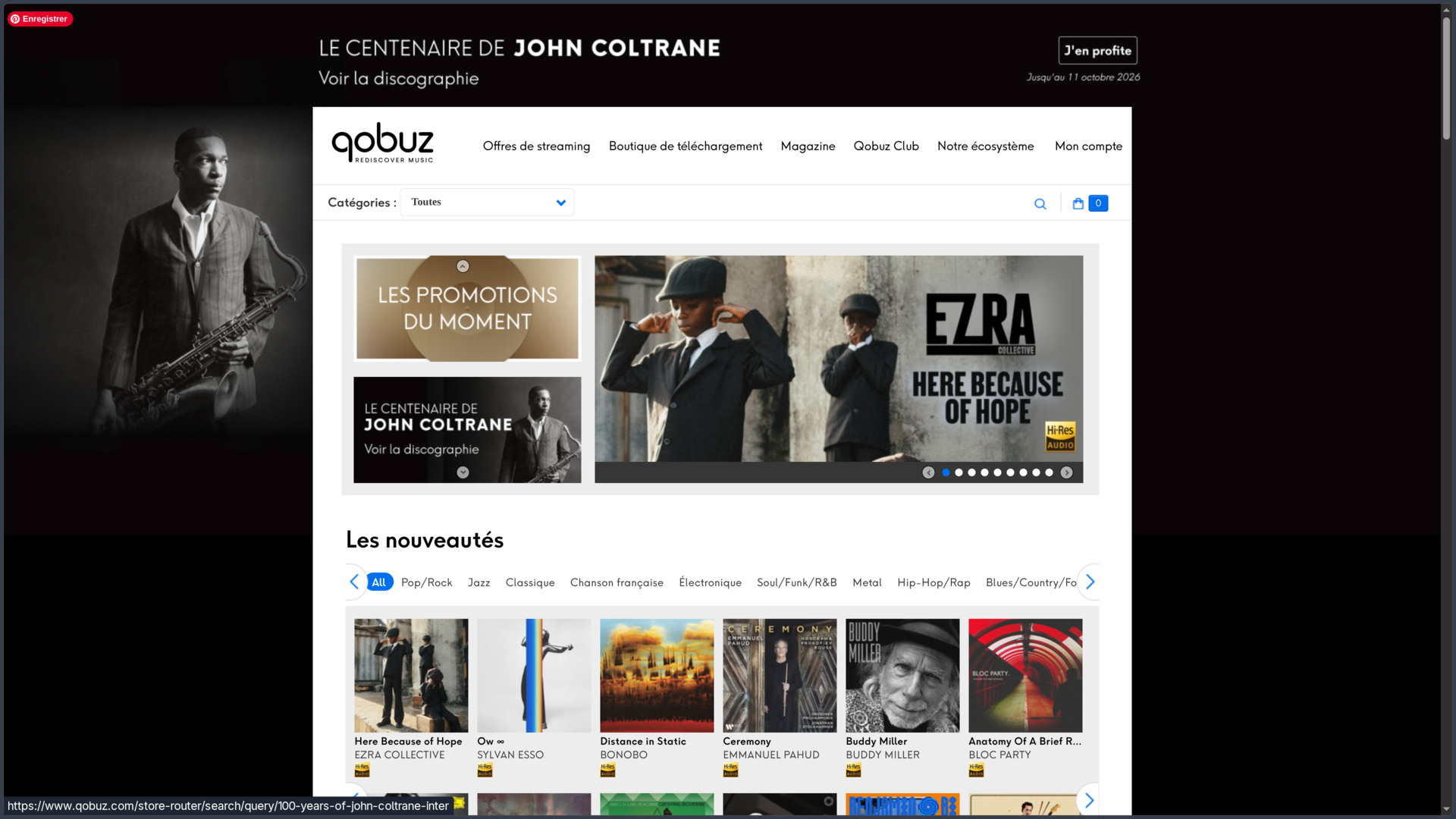
Qobuz gives an unusual amount of space to editorial content for a streaming service.
Its teams publish reviews of new and classic releases, interviews, features dedicated to artists or music movements, videos and themed selections.
Recommendations are therefore not generated exclusively from user history. Part of discovery is based on people who actually select and comment on albums.
This approach particularly suits listeners who enjoy placing an album in context, exploring a discography or understanding why a release is worth hearing instead of simply launching an automated sequence of tracks.
Qobuz also publishes reviews and guides dedicated to audio equipment, reinforcing its connection with the Hi-Fi world.
Booklets, metadata and music documentation
Many albums provide access to digital booklets and additional information.
Depending on the data provided by labels, this may include credits, composers, performers, dates, production information or texts associated with the release.
This documentation is especially useful for classical music, jazz or recordings involving many contributors, where the main artist alone does not necessarily explain the full recording.
Qobuz therefore tries to preserve part of the physical-record experience: listening is not necessarily separated from cover artwork, credits or editorial context.
Not every release offers the same level of documentation, of course, because this richness also depends on the information supplied by rights holders.
Playlists, favorites and transfer from another service
Users can save albums, artists and tracks to favorites and create their own playlists.
Playlists can be public, private or collaborative, allowing them to work equally well for personal collections or shared selection building.
To avoid starting from scratch when switching platforms, Qobuz has integrated a transfer system powered by Soundiiz.
It can import playlists, albums, artists and tracks from services such as Spotify, Apple Music or Deezer.
Since 2026, Qobuz has included a one-month Soundiiz Pass allowing unlimited transfer of an existing library. After that period, the normal limits of Soundiiz’s free tier apply.
Matches still depend on the catalog: a track available on the previous service may not exist in exactly the same edition on Qobuz.
Offline listening
The Qobuz apps allow albums, tracks or playlists to be downloaded for listening without an Internet connection.
The selected quality can be adapted to the user’s needs. Downloading a large library in Hi-Res can consume substantial storage space, while CD quality is often a more reasonable compromise on a smartphone.
These downloads are intended for offline playback within the application and remain tied to the subscription.
They must therefore be distinguished from purchases made through the Qobuz store, which produce genuine DRM-free files that can be kept independently from the streaming account.
The Web player does not provide offline listening.
Applications and hardware compatibility
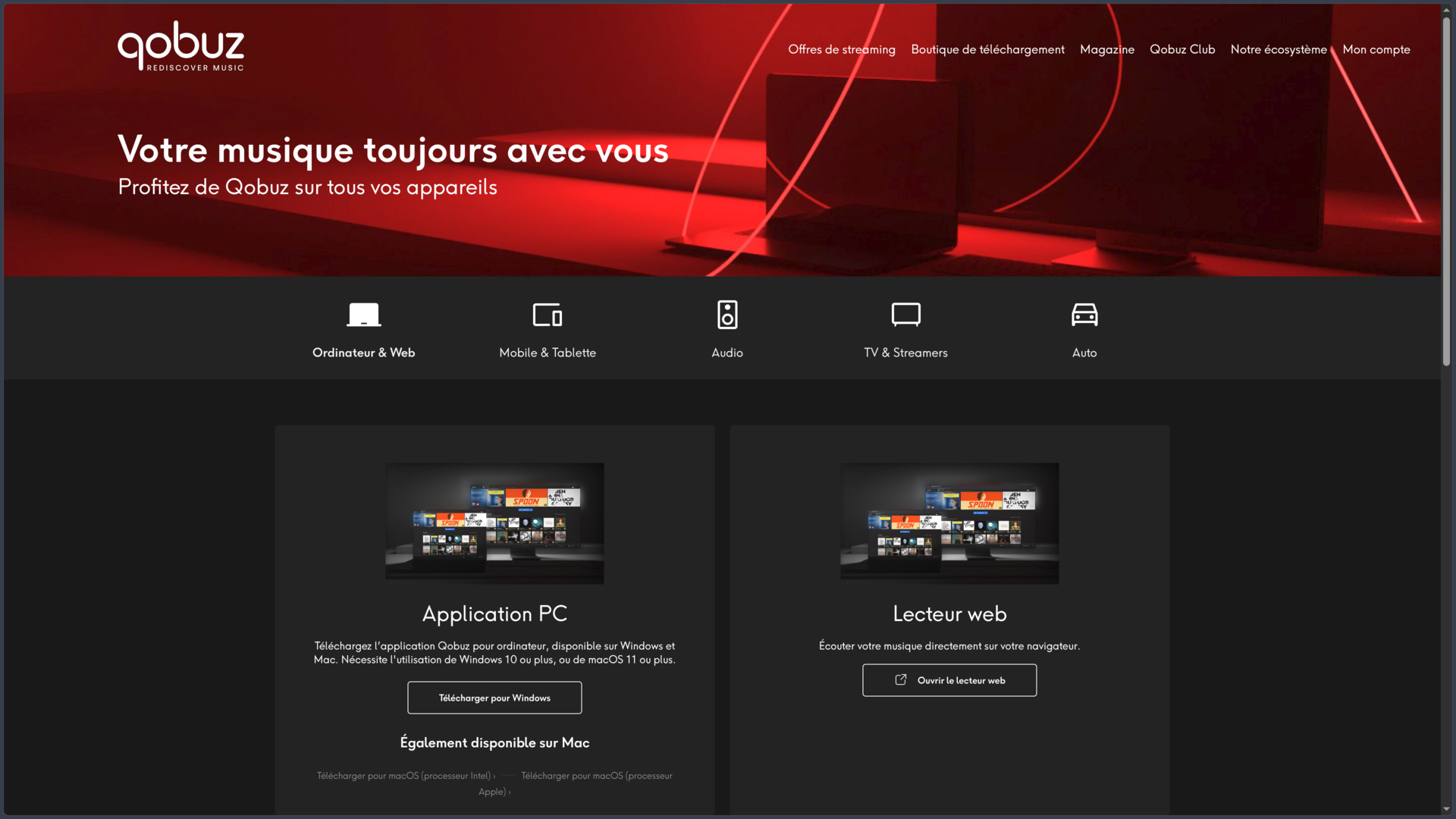
Qobuz offers official applications for Windows, macOS, Android, iPhone and iPad, along with its Web player.
The service is also integrated with Android TV, selected Samsung Smart TVs, Apple CarPlay, Android Auto and Android Automotive.
Its Hi-Fi ecosystem is particularly extensive. In addition to Qobuz Connect, the service can work with different network players, amplifiers, DACs, audiophile software and multiroom systems from partner brands.
On Windows, users looking to optimize a Hi-Fi setup can notably use output modes such as WASAPI Exclusive or ASIO with a compatible DAC.
Linux currently does not have an official Qobuz desktop application. The Web player is therefore the most direct solution on that platform, with the limitations associated with browser playback.
Use cases
Building a Hi-Res listening chain
A user with a computer, external DAC and compatible headphones or Hi-Fi system can configure Qobuz at maximum quality and then use an appropriate output mode.
When the recording is available in Hi-Res, the stream can reach 24-bit/192 kHz.
With Qobuz Connect, the same user can directly control a compatible network player or amplifier from a phone without using Bluetooth as the middle layer.
Qobuz therefore becomes particularly relevant when playback-system quality genuinely forms part of the music experience.
Purchasing albums to keep permanently
A listener can use streaming to discover new albums and then purchase only those they want to keep long term.
DRM-free purchased files can be archived on a NAS, backed up, copied to a portable music player or played through other compatible software.
This possibility clearly distinguishes Qobuz from platforms where the entire library disappears once the subscription ends.
For users who want to combine the flexibility of streaming with ownership of a digital collection, the model is particularly appealing.
Using Sublime to build a Hi-Res collection
An enthusiast who regularly purchases high-resolution albums may prefer the Sublime subscription.
Streaming remains identical to Studio, but discounts of up to 60% on certain Hi-Res purchases can gradually offset the higher subscription cost.
Its value therefore depends on actual user behavior: Sublime is not a plan with better streaming quality, but one intended for people who also buy their music.
Discovering albums beyond the algorithm
A user tired of mainly automated recommendations can explore Qobuz reviews, selections and editorial features.
A review may lead to an album, then to a discography or other artists connected to the same movement.
This approach is closer to reading a music magazine or receiving recommendations from a record shop than simply scrolling through a personalized feed.
It is especially suited to people who enjoy listening to complete albums and understanding their context.
Moving from Spotify, Deezer or Apple Music without losing playlists
The integrated Soundiiz transfer system can recover a large part of an existing library.
Playlists, albums, favorite artists and tracks can be moved to Qobuz before users manually rebuild their habits.
The unlimited transfer month included with Soundiiz in 2026 makes this especially convenient for larger libraries.
Once migration is complete, users can genuinely compare recommendations, interface and audio quality with their own content instead of an empty account.
Conclusion
Qobuz occupies a distinctive position among major music platforms because it does not simply aim to provide a huge catalog and instant playback.
Its identity is built around three complementary pillars: high-quality streaming, editorial discovery and DRM-free music purchasing.
The audio side is particularly strong. CD quality and Hi-Res up to 24-bit/192 kHz are included in Studio, while Qobuz Connect makes it possible to use those streams directly on a growing range of Hi-Fi equipment.
The store adds a different philosophy from pure streaming. Discovering an album through the subscription and then purchasing it permanently remains possible, with several formats available and files that do not disappear after cancellation. Sublime pushes this approach further through discounts on Hi-Res purchases.
Reviews, interviews, booklets and human recommendations also provide more context around albums. This editorial choice may seem secondary to someone who mainly listens to automatic playlists, but it becomes a real strength for listeners who like exploring works and artists.
Qobuz still comes with a few compromises. There is no permanent free tier, the monthly Studio subscription costs more than some major competitors, Linux has no official application and the value of Hi-Res depends heavily on the equipment used.
For listeners who want to combine Lossless streaming, high resolution, genuine Hi-Fi integration, music documentation and the ability to own their albums, Qobuz nevertheless offers a much broader approach than a simple on-demand playback service.
Points to consider
-
Qobuz does not offer a permanent free plan for full streaming. A one-month free trial is currently available to new Studio subscribers.
-
The catalog exceeds 100 million tracks, from major and independent labels.
-
Studio Solo currently costs €14.99/month in France, or €149.99/year, equivalent to €12.49/month.
-
Studio Duo costs €19.99/month, Family €24.99/month and Student €5.99/month according to current French pricing.
-
Studio already includes Lossless and Hi-Res up to 24-bit/192 kHz. Sublime does not improve streaming quality: it mainly adds discounts on Hi-Res purchases.
-
Sublime Solo starts at the equivalent of €16.66/month with annual payment, with discounts of up to 60% on a large selection of Hi-Res purchases.
-
Purchases made through the store are DRM-free and can be downloaded in formats including FLAC, ALAC, WAV or AIFF depending on availability.
-
DSD and DXD are available on certain releases for purchase, but are not part of Qobuz’s standard streaming formats.
-
Qobuz Connect can transmit up to 24-bit/192 kHz Hi-Res to compatible devices without routing the audio stream through Bluetooth.
-
Hi-Res only reaches its full potential with suitable equipment. A DAC, wired headphones or a compatible Hi-Fi setup may be required depending on the device used.
-
The Web player does not support offline listening. Streaming downloads remain tied to the subscription and should be distinguished from genuinely purchased files.
-
Linux currently has no official Qobuz Desktop application, although the Web player provides access to the service.