
--- CONTENU MARKDOWN ---
Overview
You have two hundred files to rename.
You can open them one by one.
Click.
Rename.
Start again.
And quietly reflect on the decisions that brought you here.
Or write a few lines of Python.
That is often how people first encounter the language: not because they wanted to learn a new programming paradigm, but because a mildly annoying problem could probably be automated.
Then the little script becomes a tool.
The tool retrieves data.
The data needs to be analyzed.
An API appears.
Then an interface.
And without really planning it, Python is still there.
A language that tries not to stand between the idea and the code
Python is a general-purpose programming language created by Guido van Rossum in the early 1990s.
Its reputation largely comes from something that becomes visible within the first few lines: its syntax prioritizes readability.
for image in images:
resize(image)
You do not need fifteen lines of ceremony to roughly understand what is happening.
That does not mean Python is a “simple” language in every use case.
It has classes, generators, decorators, context managers, asynchronous programming, metaclasses, descriptors, type annotations, and enough depth to occupy more than a few long evenings.
But it tries to keep common operations relatively readable.
That difference matters.
Python does not remove the complexity of problems. It mainly tries not to add too much complexity before you have even started solving them.
One language, many worlds
Python is not specialized in a single field.
That is precisely what makes the sentence “Python is used for…” so difficult to finish.
It is used, among other things, for:
| Field | Example uses |
|---|---|
| Automation | Scripts, files, system tasks, pipelines |
| Web | APIs, backends, services, websites |
| Data | Analysis, transformation, visualization |
| Science | Numerical computing, research, simulation |
| AI | Machine learning, deep learning, agents, data processing |
| Development | Tests, builds, internal tools, CLI |
| Education | Learning programming |
| Desktop | Applications and graphical tools |
This versatility does not come only from the language itself.
It mainly comes from everything built around it.
Django or FastAPI for the web.
NumPy, pandas, or SciPy for data and science.
PyTorch, TensorFlow, scikit-learn, or Transformers for AI.
Pillow for images.
Requests or HTTPX for networking.
PySide, PyQt, Tkinter, or Kivy for interfaces.
Jupyter for interactive exploration.
The language is the center.
The ecosystem is what gives it so many different jobs.
Python and CPython are not exactly the same thing
There is a useful distinction.
Python refers to the language, its syntax, concepts, and specifications.
CPython is its reference implementation, written primarily in C.
It is what most users install when they download Python from python.org.
But other implementations exist or have existed with different goals: PyPy for certain optimizations through JIT compilation, MicroPython for microcontrollers, and various integrations designed for specific environments.
This nuance becomes important as soon as performance, the GIL, native extensions, or compatibility enter the discussion.
A property of CPython is not necessarily a fundamental property of the Python language itself.
A community rather than a single owner
Python does not belong to a company that decides its roadmap alone.
The Python Software Foundation — PSF is a nonprofit organization that protects and supports the ecosystem, maintains infrastructure such as python.org and PyPI, and supports the community.
The technical evolution of the language relies on core developers, contributors, and the PEP — Python Enhancement Proposal process.
Since the end of the historical model in which Guido van Rossum held the role of BDFL, governance of the language has been organized around an elected Steering Council.
This obviously does not make every decision simple.
No developer community has yet discovered the patch that removes human debate.
But it gives Python a continuity that does not depend on the quarterly product roadmap of a particular company.
Python 3.14 today, Python 3.15 already in sight
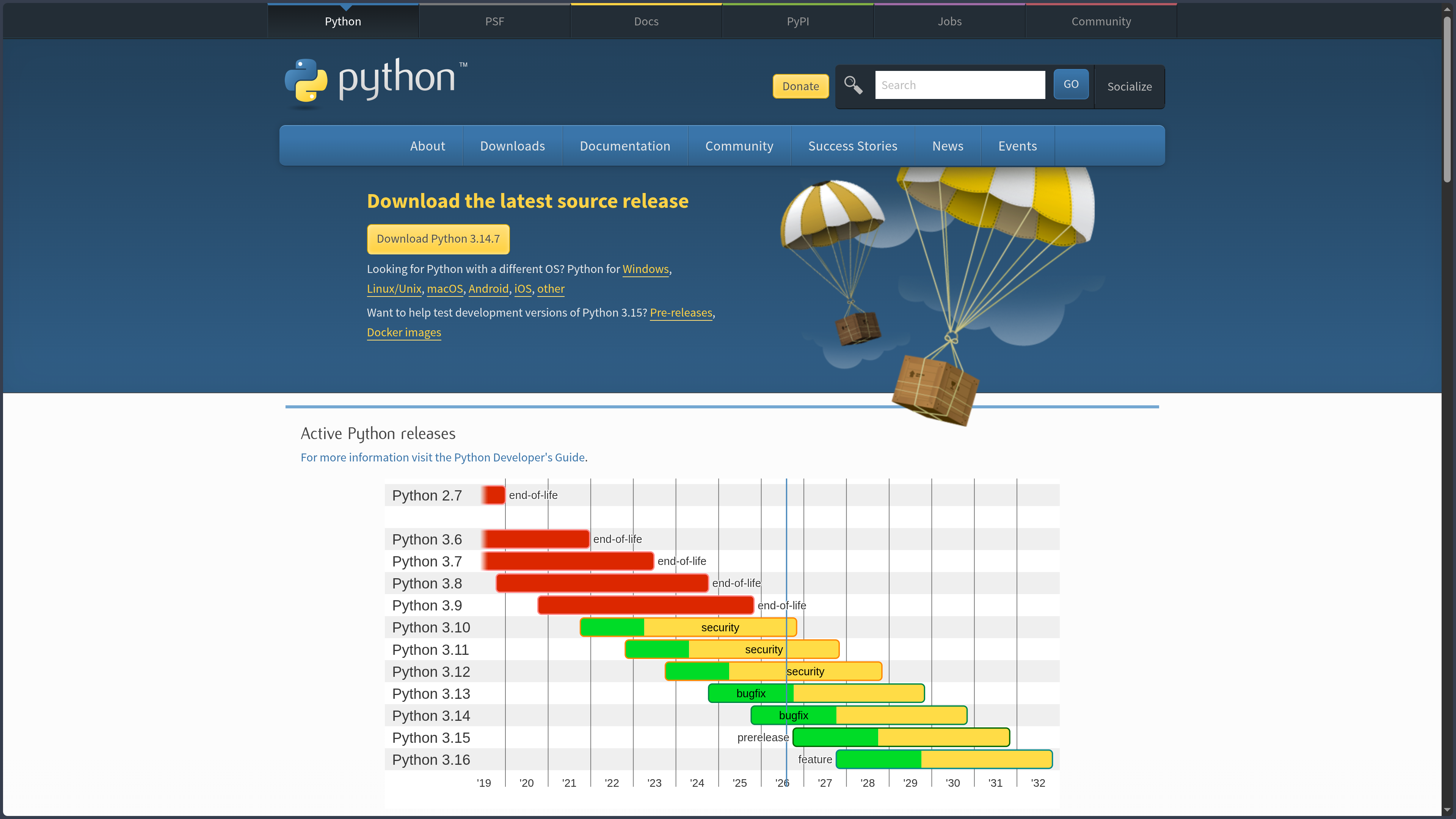
As of August 7, 2026, the current stable branch is Python 3.14, with Python 3.14.7 released on August 5.
Python 3.14 notably marked an important step for free-threaded Python, now officially supported, as well as for multiple interpreters, deferred annotations, and several improvements to tooling and the runtime.
Python 3.15 is already very close.
Its first release candidate, Python 3.15.0rc1, was released on August 4, 2026.
But “release candidate” still contains the important word: candidate.
The final release is scheduled for October 2026.
For a production project, Python 3.14 therefore remains the stable reference at the time of this profile.
Features
Syntax designed for reading
Python notably uses indentation to structure code blocks.
No braces around every condition or function.
No need to explicitly declare a variable’s type before assigning a value to it.
name = "Ambre"
age = 28
if age >= 18:
print(f"{name} is an adult.")
This readability contributes greatly to its accessibility.
It also makes code written by someone else relatively quick to read — which, in a real project, happens slightly more often than eternally writing brand-new software on a white sandy beach.
Python nevertheless remains a dynamically typed language.
The types of objects are determined at runtime.
That flexibility speeds up a great deal of development, but it can also postpone certain errors until the program actually executes the affected path.
Several paradigms without much ceremony
Python does not impose a single way of organizing code.
It supports programming that is:
- imperative;
- procedural;
- object-oriented;
- functional in certain uses;
- asynchronous.
A small automation can remain a twenty-line script.
A larger application can be organized around modules, classes, services, and packages.
Functions can be used as values, generators can be built, decorators can be written, and much more sophisticated objects can be defined.
That progression matters enormously.
Your first Python program does not need to look like your last one.
A surprisingly broad standard library
Python already ships with many tools.
The standard library covers, among other things:
files and paths, JSON, CSV, SQLite, regular expressions, dates, compression, logging, tests, networking, processes, concurrency, basic cryptography, command-line arguments, serialization, and numerous protocols.
The historical phrase “batteries included” summarizes this philosophy rather well.
A great deal can be accomplished before installing a single external dependency.
For example:
from pathlib import Path
for file in Path(".").glob("*.txt"):
print(file.name)
No need to immediately search for a package just to browse a few files.
And when the standard library is no longer enough, another world opens up.
PyPI: a few lines of language, then hundreds of thousands of projects
The Python Package Index — PyPI is the main package repository of the Python ecosystem.
At the time of this verification, it lists more than 850,000 projects.
That is dizzying.
And it completely changes how software is developed.
Need to read an Excel file?
Communicate with an API?
Build a machine-learning model?
Manipulate an image?
Create a CLI?
There is probably already a library that solves part of the problem.
The reference package manager, pip, can install these distributions:
python -m pip install requests
Python’s real superpower is often found here.
Not in some magical language statement.
In the extremely high probability that someone has already built a large part of what you need.
Virtual environments: keeping projects from stepping on each other
Project A uses one version of a library.
Project B needs another.
If everything is installed into the same global Python, peace may not last very long.
The standard venv module allows you to create an isolated environment:
python -m venv .venv
Each project can then have its own dependencies.
You activate the environment.
Install the required packages.
And the application no longer has to negotiate its existence with the thirty-seven Python experiments carried out on the same machine since 2022.
This isolation has become an essential practice in the ecosystem.
In Python, learning how to create a virtual environment comes almost immediately after learning how to write a loop.
Dynamic typing, with optional annotations
Python supports type hints:
def total(price: float, quantity: int) -> float:
return price * quantity
These annotations improve code documentation and allow IDEs and tools such as mypy or Pyright to detect many inconsistencies before execution.
But they do not turn Python into a statically typed language.
By default, Python does not automatically prevent a function from receiving an incompatible value just because an annotation says otherwise.
Typing therefore becomes progressively more structured without completely abandoning the historical flexibility of the language.
For large projects, that is often a very useful compromise.
Scripting and REPL: try before you build
Python can be used interactively.
You launch the interpreter.
Type an expression.
Observe the result.
Then try again.
This fast loop is extremely useful for:
testing an API, checking a transformation, exploring a library, manipulating some data, or understanding how a function behaves.
Environments such as IPython and Jupyter take this logic much further.
They can mix code, results, charts, text, and experimentation.
That explains part of Python’s popularity in research and data work.
The idea can stay alive while you explore it.
You do not need to build the whole application before discovering whether it was interesting.
Asyncio: handling lots of waiting without naively multiplying threads
Python provides asyncio as a standard infrastructure for asynchronous programming.
It becomes particularly useful when a program spends a lot of time waiting:
network responses, files, databases, APIs, or other input/output operations.
With async and await, an application can organize many concurrent tasks without treating every operation as an independent system thread.
This is one of the foundations of many modern Python web frameworks.
But concurrency does not automatically mean CPU parallelism.
And that is where an old character in Python’s story appears.
The GIL is finally starting to lose its status as destiny
In traditional CPython, the Global Interpreter Lock — GIL limits the simultaneous execution of Python bytecode by multiple threads within one interpreter.
For a long time, this made it harder to use threads directly to accelerate purely CPU-bound workloads.
Solutions have existed for years: multiprocessing, native extensions, specialized libraries, distributed computing.
But Python is evolving.
Since Python 3.13, CPython has offered a free-threaded build in which the GIL can be disabled.
With Python 3.14, this configuration is officially supported.
It allows multiple threads to execute Python in parallel across several CPU cores.
This is not yet a magical “make everything faster” button.
Some third-party extensions may re-enable the GIL when they are incompatible, and the free-threaded build still has performance and compatibility tradeoffs.
But something very old is clearly starting to move.
Talking to C, C++, and the rest of the world
Python can be extended with functions and types written in languages such as C or C++.
This capability plays a huge role in its scientific ecosystem.
A Python API can be pleasant to use while computationally intensive work happens inside much faster native code.
That is part of the secret behind many libraries.
The user writes:
result = model(data)
Underneath that relatively innocent line may be C, C++, Fortran, CUDA, or other layers that are considerably less innocent.
Python then becomes an orchestration language.
It does not necessarily perform every operation itself.
It connects the pieces that know how to do them.
Use cases
Automating what you have absolutely no desire to do again tomorrow
A folder contains 800 images.
They need to be renamed, their extensions checked, a JSON file generated, and any files that fail certain rules moved elsewhere.
That is almost an accidental advertisement for Python.
Scripts make repetitive tasks easy to automate with very little infrastructure.
Files.
Folders.
CSV.
APIs.
Conversions.
Backups.
Reasonable scraping.
Text processing.
Administration.
Git.
Builds.
A manual operation repeated often enough frequently ends up becoming a .py script.
And a small amount of well-directed laziness can be an excellent developer skill.
Building the backend of a web application
A mobile application or JavaScript interface needs to register users, manage data, and expose an API.
Python offers several families of frameworks.
Django provides a highly integrated environment for building complete web applications.
Flask takes a lighter approach.
FastAPI has become established in many modern API projects, notably thanks to its use of type annotations and integration with OpenAPI standards.
Python does not run directly in the browser like JavaScript.
But on the server side, it remains extremely present.
Exploring data before you even know exactly what you are looking for
You load a CSV.
Look at a few rows.
Calculate an average.
Filter.
Produce a chart.
Notice something.
Change the hypothesis.
Then start again.
Python fits this exploratory way of working particularly well.
The ecosystem around NumPy, pandas, Matplotlib, SciPy, Jupyter, and many other tools makes it possible to move quickly from raw data to something that can be analyzed and manipulated.
It is not only a question of performance.
It is a question of distance between the question and the experiment.
Building with artificial intelligence
In 2026, it is impossible to talk about Python without talking about AI.
A large part of the modern machine-learning and deep-learning ecosystem exposes Python as its primary interface.
PyTorch.
TensorFlow.
scikit-learn.
Transformers.
Diffusers.
LangChain.
LlamaIndex.
And a huge number of specialized libraries.
That does not mean the calculations themselves are entirely executed in Python.
Often, they are not.
GPUs, CUDA, optimized kernels, and native libraries do the heavy lifting.
Python is used to prepare the data, build pipelines, define models, and orchestrate the experiment.
That is exactly where it excels.
Prototyping before knowing whether the idea deserves an architecture
Some ideas do not immediately deserve:
microservices, Kubernetes, six abstraction layers, and a meeting about repository naming conventions.
Sometimes, you just need to know whether it works.
Python is excellent for quickly building a proof of concept.
A function.
A script.
A small API.
A notebook.
A minimal interface.
The prototype may never become the final product.
Or perhaps, as often happens, someone will say:
“It’s only temporary.”
And the server will still be running that code four years later.
Software has its own sense of humor.
Learning programming without immediately fighting the syntax
Python is widely used in education.
Its readability makes it possible to focus relatively quickly on fundamental concepts:
variables, conditions, loops, functions, data structures, algorithms, and objects.
A beginner already has to learn how to think like a program.
There is not necessarily any need to ask them to simultaneously negotiate with pointers, a compiler, and thirty braces.
That does not make Python a language only for beginners.
That is precisely part of its appeal.
You can learn with it.
And continue building serious systems with it years later.
PANACHES review
Python’s real strength may not actually be its syntax.
It is the low resistance it creates between an intention and a first working version.
You want to test an idea.
You can often express it quickly.
You want to go further.
There is probably a library.
You want to build an API.
A framework exists.
Analyze data.
An entire ecosystem exists.
Run an AI model.
Welcome to another galaxy of packages.
That continuity explains much of its longevity.
Accessible does not mean small
Python sometimes suffers from its own reputation.
Because it is recommended to beginners, people may assume it is a “simple” language that serious projects inevitably outgrow.
That is false.
The language remains approachable at the entrance.
But the ecosystem can reach considerable depth.
There is an important difference between:
writing your first lines of Python
and
designing a large Python application properly.
Architecture.
Concurrency.
Typing.
Packaging.
Profiling.
Memory management.
Tests.
Deployment.
Native extensions.
The questions return.
They simply arrive a little later.
And that is not necessarily a bad thing.
Its greatest advantage is also its greatest trap: there is a package for everything
The Python ecosystem is enormous.
That is wonderful.
Until you encounter:
four libraries doing almost the same thing,
three project management approaches,
several packaging systems,
two environments that behave differently,
a tutorial from 2019,
a command that is now discouraged,
and Stack Overflow confidently explaining something that was completely correct under Python 3.7.
Python itself can be fairly coherent.
Its ecosystem is much less so.
You therefore need to distinguish the language from the historical habits accumulated around it.
Python is often the language that connects the others
This may be its most interesting role.
A pipeline uses C++ for performance.
CUDA for the GPU.
A PostgreSQL database.
An AI model.
JSON files.
An external API.
A few system commands.
And in the middle:
Python.
Not necessarily because it is the best at every one of those tasks.
Because it is very good at making them communicate.
Python often wins not by doing everything better, but by making many different things simple enough to assemble.
And AI has strengthened that position
The explosion of artificial intelligence could have made Python less central.
It produced almost the opposite effect.
A large part of modern AI research and tooling uses Python as an experimentation and orchestration layer.
That creates a cumulative effect.
Researchers use Python.
Libraries are therefore written with Python APIs.
New teams choose Python because the libraries are there.
Then new tools appear for that community.
The ecosystem attracts the ecosystem.
It is a loop that is extremely difficult for a competitor to reproduce.
But Python is not the automatic answer to everything
For systems code with very strong performance or memory constraints, Rust, C, or C++ may be more natural.
For an application whose core lives directly in the browser, JavaScript or TypeScript are unavoidable.
For highly concurrent services that are easy to deploy as binaries, Go has some very attractive qualities.
In some enterprise environments, Java, Kotlin, or C# remain extremely solid.
For specialized statistical analysis, R retains its own universe.
And languages such as Julia explore a different balance between scientific expressiveness and performance.
Choosing Python simply because “everyone uses Python” would miss the point.
The better question remains:
what are you trying to build?
Points to consider
The Python version is part of the project
Python evolves regularly.
As of August 7, 2026, Python 3.14.7 is the latest stable version.
Python 3.15.0rc1 already exists, but remains a pre-release and is not recommended for production environments.
That distinction should remain clear.
A new version can bring better performance, new features, and important improvements.
But third-party libraries may need time to catch up.
Installing “the newest version that exists” is therefore not always the same thing as choosing “the best version for this project today.”
The system Python is not your personal sandbox
On Linux in particular, Python may be used by the operating system and its tools.
Wildly installing or replacing packages in that global environment can create conflicts.
It is not the ideal place to test fourteen versions of libraries found in a tutorial.
Virtual environments exist precisely to avoid this kind of mixture.
For a project:
an isolated environment is usually a much better habit than an optimistic sudo pip install.
Environments and dependencies require discipline
Python makes installing a library extremely easy.
That also makes installing many libraries extremely easy.
Then comes the question:
Which exact versions?
For which Python version?
On which platform?
With which transitive dependencies?
A project therefore needs to describe its environment well enough to be reproducible.
pyproject.toml, lock files depending on the chosen tool, virtual environments, containers, or systems such as conda can all contribute to that reproducibility.
The command pip install thing solves today’s problem.
A maintainable project also needs to think about the problem six months from now.
Dynamic typing speeds things up as much as it can surprise you
Python makes it possible to modify a program very quickly.
But some inconsistencies that would have been detected by a static compiler may not appear until runtime.
Type annotations and modern static analyzers greatly reduce this problem.
They are not mandatory in every project, however, and by default they are not runtime validations.
On a large codebase, progressively adding typing discipline can make Python much more comfortable to maintain.
The GIL has not disappeared from traditional standard Python
Python 3.14 marks a major step: free-threaded mode without the GIL is now officially supported.
That does not mean every Python installation suddenly uses this configuration.
The standard CPython build with the GIL is still very much present.
Free-threading must be used in an appropriate configuration, and not all third-party extensions are necessarily compatible yet.
Some may even re-enable the GIL when imported.
The change is therefore real.
But we are still in a transition.
Free-threading does not mean “twice as fast with two threads”
Parallelism unfortunately does not obey the poetry of round numbers.
The free-threaded build itself introduces some overhead in several situations.
A single-threaded application may therefore be slightly slower than with the standard build.
And a program does not automatically become parallel simply because the GIL is gone.
You still need to think about:
data sharing, synchronization, contention, locks, architecture, and the actual nature of the workload.
Removing one lock does not automatically turn the entire building into a highway.
Python is generally not the champion of raw computation executed directly in the language
CPython has historically prioritized flexibility and a simple execution model over the raw performance of compiled languages such as C, C++, or Rust.
That can become visible in large CPU-bound loops written directly in Python.
But comparing only that speed can also be misleading.
NumPy, PyTorch, and many other libraries move intensive calculations into optimized native code.
The Python program orchestrates.
The real computation happens elsewhere.
The real application should therefore be profiled rather than simply concluding:
“Python is slow.”
Sometimes it is.
Sometimes the Python line has simply asked a GPU to perform three trillion operations.
PyPI is huge: trust is not automatic
Being able to install more than 850,000 projects from a public index is an extraordinary strength.
It is also a risk surface.
A third-party package is code added to your application and, often, executed on your machine or server.
You therefore need to examine:
the actual project, its maintainer, activity, documentation, dependencies, license, releases, and origin.
Typosquatting and supply-chain compromises are not abstract concepts.
pip install is a very short command.
The amount of trust it grants can be much larger.
Python packaging has improved, but its history is still visible
Python now has modern standards around pyproject.toml, wheels, and a much more structured PyPA ecosystem.
But years of evolution remain visible.
pip.
venv.
virtualenv.
pipx.
build.
setuptools.
Poetry.
PDM.
Hatch.
uv.
conda.
And a few old tutorials still recommending that you execute setup.py directly.
There is not always one universal answer to “how should I manage my Python project?”
The good news is that the modern landscape is becoming much cleaner.
The bad news is that the Internet preserves old answers perfectly.
Mobile support exists, but it still does not look like desktop
Python 3.14 now provides official embeddable binaries for Android.
That is an important development.
It does not mean Android has suddenly become a Python platform identical to Windows, macOS, or Linux where you simply install the interpreter and then any library.
Packaging, native integration, and extension compatibility remain specific constraints on mobile.
On the iOS side, official packages are appearing with the Python 3.15 series, currently in pre-release, but python.org does not provide a stable Python 3.14 iOS release at the time of this verification.
That is why this profile includes Android among the current platforms, but not yet iOS.
“Easy to learn” does not mean “impossible to write badly”
Python makes it possible to get a first result very quickly.
That is wonderful.
It also makes it possible to quickly produce a 2,800-line file containing:
global variables, network calls, business logic, database access, and a function named process_final_v2().
The language does not eliminate the need for architecture.
It simply postpones the moment when its absence becomes painful.
And ultimately, this may be the best way to summarize Python:
It lets you start small without deciding too early how far the project will need to go.