
Presentation
Mammouth AI is a French platform that brings together several artificial intelligence models in a single interface.
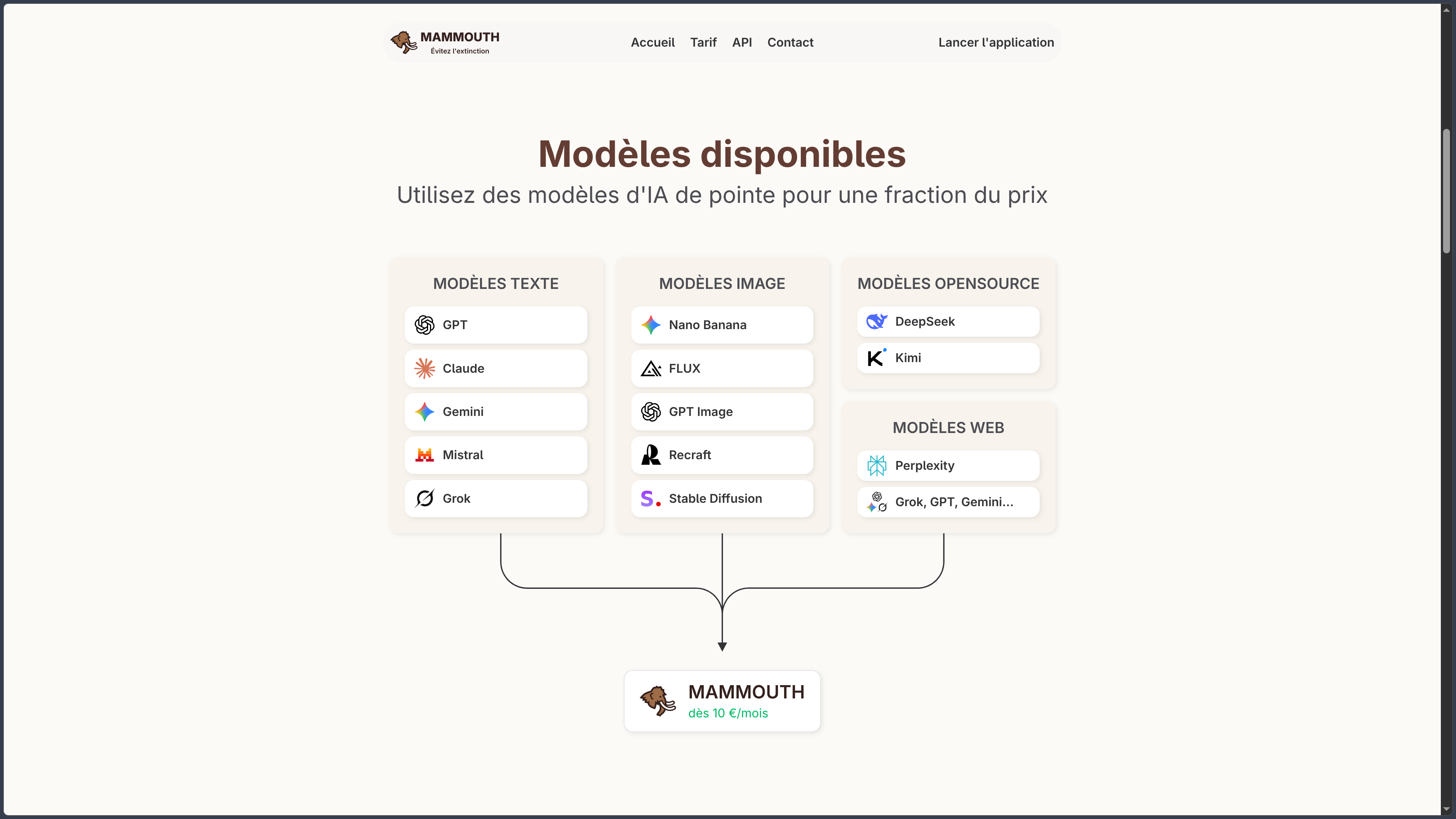
Instead of imposing a single provider, the service makes it possible to work with different model families such as Claude, GPT, Gemini, Grok, Mistral, Llama, DeepSeek, Qwen or Kimi depending on availability and requirements.
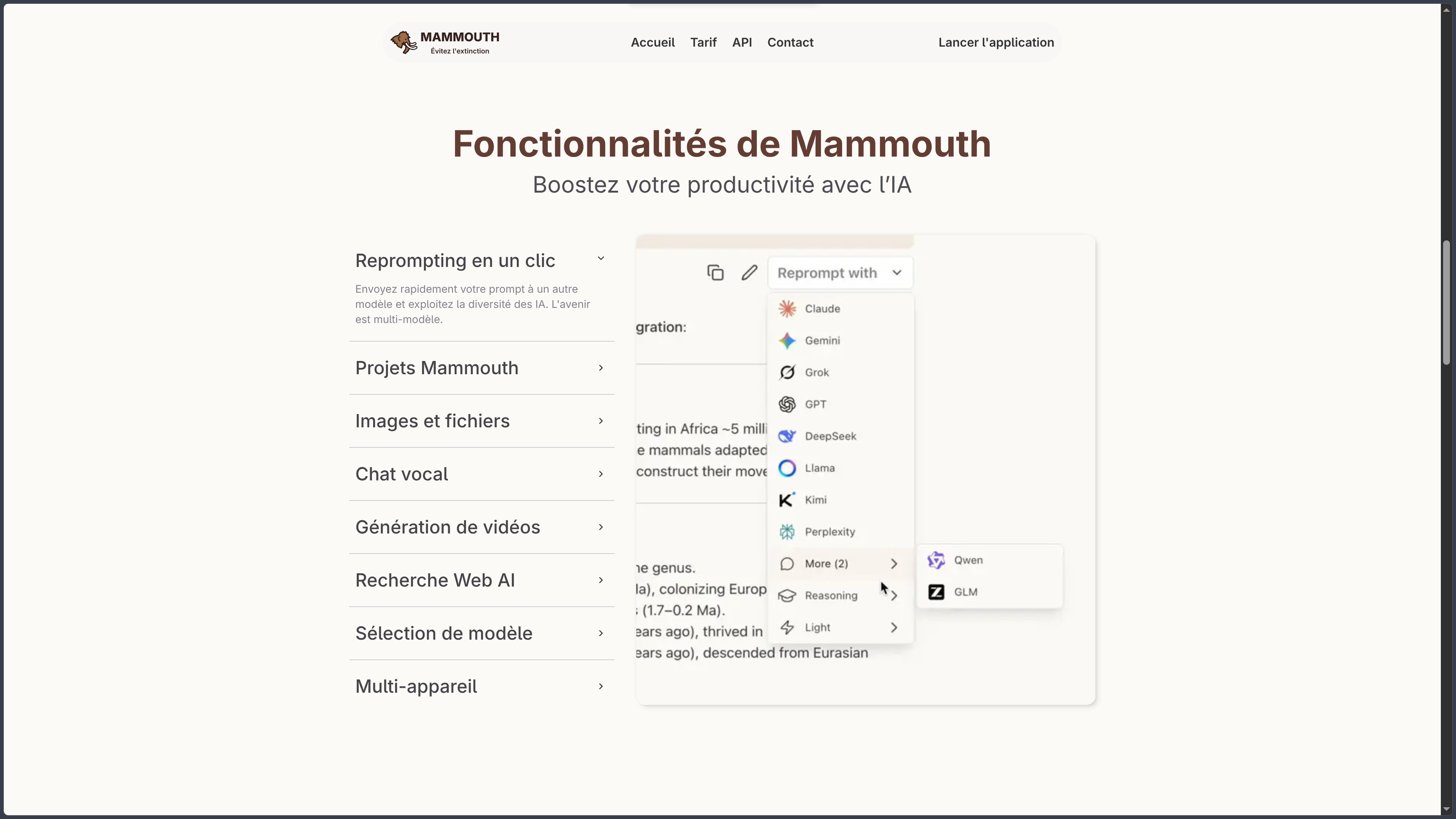
Users can select a model directly or let Mammouth handle routing more automatically. The reprompting feature also makes it possible to send the same question to another model in order to compare or complement the answers without manually rebuilding the prompt.
The platform is not limited to chat: it integrates Web search, reasoning, file analysis, document generation and editing, images, videos, music, voice, custom assistants, external connectors and tools for developers.
Mammouth AI is operated by Mammouth AI SAS, a French company, and its business model is mainly based on subscriptions.
Features
Multiple models in one interface
Mammouth brings together different providers and model families in one place.
Users can choose a model according to the task: writing, programming, reasoning, research, document analysis or multimedia generation.
The catalog evolves frequently in order to integrate new models and replace previous generations.
Intelligent routing can also automatically select a model when no specific choice is imposed.
Reprompting and comparison
The reprompting feature makes it possible to submit a previously asked question to another model.
Relevant history is preserved so that the second model has access to the conversation context.
This feature makes it easier to compare answers or switch to a more capable model when the first response is not sufficient.
Web search and Deep Research
Mammouth can enrich models with Web search.
This capability is available with several model families and can be enabled from the input area.
Perplexity models are also offered for sourced research and Deep Research tasks.
Agentic mode can combine several search steps in order to handle more complex requests.
Agentic Mode
Agentic Mode is designed for tasks that require several successive operations.
It can notably be involved in document generation, document editing and in-depth Web research.
For certain document-related tasks, Mammouth can open a virtual computing environment in order to manipulate files directly with tools and sub-agents.
Documents and files
Mammouth supports numerous formats: PDF, office documents, spreadsheets, presentations, images, audio, video, code and configuration files.
A conversation can currently contain up to 20 files for a total maximum size of 100 MB.
PDF files can reach 100 MB, while different limits apply to images and other formats.
Documents can be analyzed, transformed and, for certain workflows, generated or edited directly.
Image generation
The platform brings together several image-generation models.
Depending on the available catalog, users can choose different families suited to illustration, photorealism, design or images containing text.
This approach makes it possible to compare several engines without maintaining a separate account with each provider.
Video and music
Mammouth also supports video generation through several compatible models.
The available selection evolves with providers and with the possible retirement of certain models.
Since 2026, the service has also offered music generation with Lyria directly from the interface.
Voice
Mammouth provides real-time voice chat as well as dictation.
Voice conversations are transcribed so their content can be retrieved afterwards.
A Text-to-Speech feature also makes it possible to have AI responses read aloud in several languages.
Custom Mammouths
Custom Mammouths are used to create specialized assistants.
Each Mammouth can bring together instructions, files, a default model and conversations around a project or topic.
They can, for example, represent a writing assistant, technical expert or workspace dedicated to a specific project.
They also serve as folders for organizing conversations.
MCP connectors
Mammouth supports MCP — Model Context Protocol connectors.
Preconfigured connectors are notably available for Microsoft 365, GitHub, Notion and Atlassian.
Custom MCP servers can also be added.
These connectors can therefore allow the model to interact with external tools or information directly from the conversation.
OpenAI-compatible API
Mammouth provides an API compatible with the OpenAI format.
It can be used from code or connected to tools such as n8n, Make, Cline and different development environments.
Starter, Standard and Expert subscriptions include respectively $2, $4 and $10 of API credits per month.
It is also possible to purchase API credits independently from a Mammouth subscription.
Mammouth Code
Mammouth Code is the platform's command-line coding agent.
It runs directly in a terminal and can be used from the integrated terminal in VS Code, Cursor, WebStorm or other IDEs.
The agent uses the Mammouth API and can select different models and effort levels depending on task difficulty.
Unlike the Mammouth platform itself, the Mammouth Code project is published as open source.
Teams and enterprises
Teams plans add centralized license management, billing and Mammouth sharing between collaborators.
Starter, Standard and Expert levels can be mixed within the same team.
Larger organizations also have access to groups, permissions and SSO integrations compatible with different SAML 2.0 providers.
Conversations remain private by default even when a Mammouth is shared.
Use cases
Compare several AI models
Mammouth makes it possible to query different models from the same environment instead of multiplying subscriptions and interfaces.
Reprompting is particularly useful for comparing the same answer across several models.
Work with documents
PDFs, office documents, spreadsheets, presentations and other files can be added to conversations.
Agentic Mode extends this behavior to more complex document transformation or generation tasks.
Perform sourced research
Web search and Deep Research features suit topics requiring external information and several stages of analysis.
The model can be selected according to the level of reasoning required.
Generate multimedia content
Images, short videos, music and speech synthesis can be produced from the same service.
Mammouth therefore acts more as a general-purpose AI platform than as a simple text chatbot.
Use several models in your own tools
The OpenAI-compatible API can centralize model access from an application, automation or development environment.
Mammouth Code uses the same infrastructure to provide a coding agent inside the terminal.
Conclusion
Mammouth AI provides an approach centered on access to several artificial intelligence providers from a single platform.
Its main strength lies less in a proprietary model than in aggregation: text, reasoning, Web search, documents, images, video, music and programming can be used without constantly switching services.
Custom Mammouths, MCP connectors and team features add an organizational layer, while the API and Mammouth Code extend the platform toward technical workflows.
This flexibility nevertheless implies quotas that vary depending on the model used and dependence on several external providers whose models, capabilities and pricing can evolve rapidly.
For using and comparing several AI models without multiplying separate interfaces and subscriptions, Mammouth AI provides a particularly broad solution.
Points to consider
-
Mammouth AI is a proprietary service operated by Mammouth AI SAS, a French company.
-
It is not a single proprietary AI model. The platform mainly relies on models provided by several external companies.
-
Current individual subscriptions start at $12/month excluding VAT for Starter, then $24 for Standard and $72 for Expert.
-
Quotas do not correspond to a fixed number of messages. They notably depend on the model, conversation length, documents and tools used.
-
Session quotas are fully renewed after three hours. When a limit is reached on a more powerful model, Mammouth can suggest or use a lighter variant so the user can continue working.
-
Standard provides around three times the Starter quota and Expert around ten times, according to Mammouth's current policy.
-
The model catalog evolves very quickly. Some models may be replaced or removed only a few weeks after being added.
-
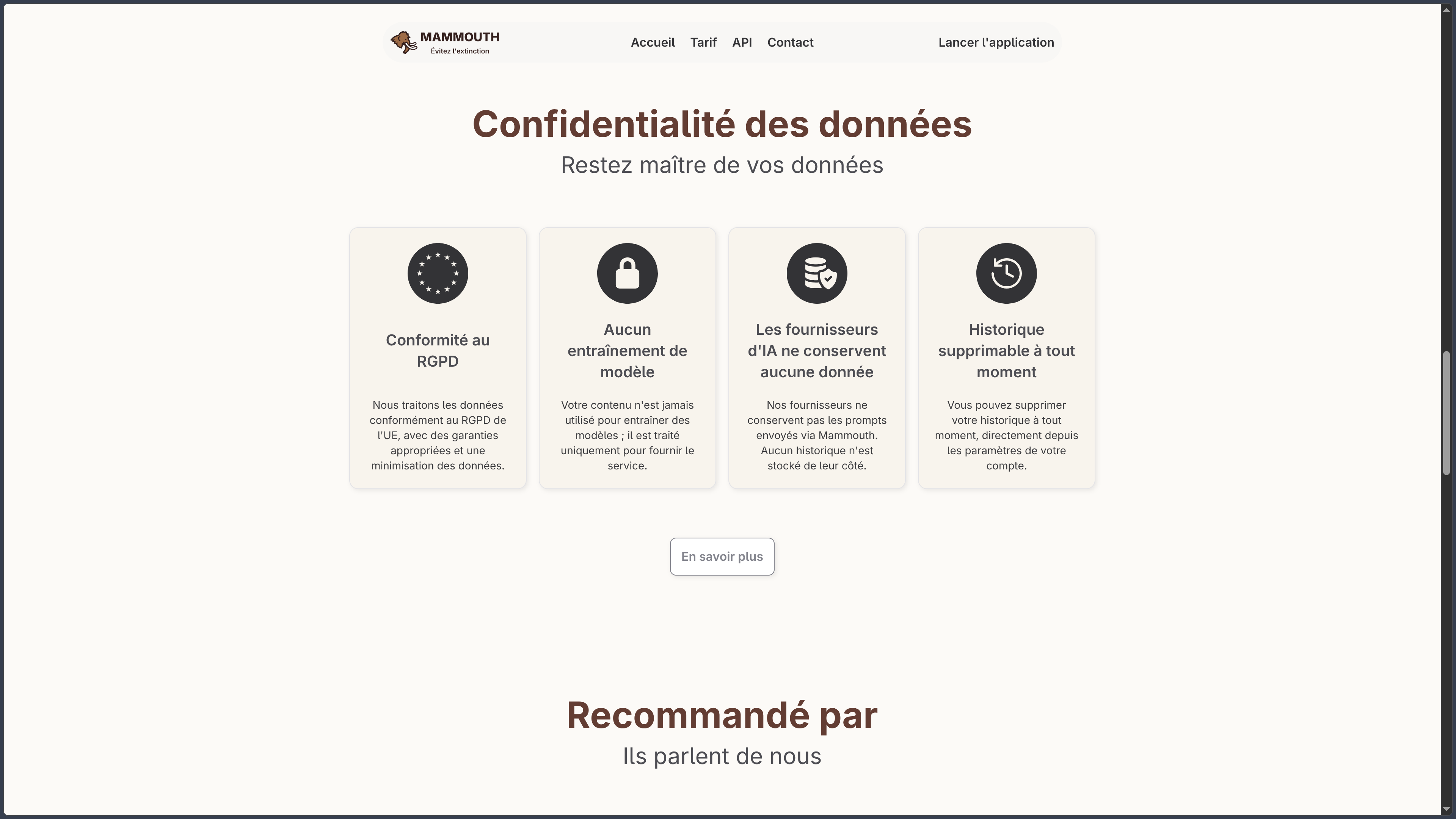
The platform does not use conversations to train its own models. Mammouth also states that its providers are required not to train on prompts transmitted through the service.
-
Model providers receive the content required for the request, notably the prompt, relevant context and document excerpts. Mammouth states that they do not directly receive the account identity and that their retention does not exceed 30 days under current agreements.
-
Mammouth stores prompts in order to provide conversation history, but users can delete that history.
-
The desktop application mainly relies on an installable Web application. It can be installed from a browser on Windows, macOS and Linux.
-
On iOS, Mammouth is currently not distributed through the App Store. The application can be added to the home screen from the browser.
-
An Android application is available through Google Play, in addition to the installable Web application.
-
Mammouth Code is open source, but this does not make the Mammouth AI platform itself open source.
-
Connectors and external providers may receive data required for their operation. Privacy requirements should therefore be assessed according to the services that are actually enabled.