
Presentation
Lumo is an artificial intelligence assistant developed by Proton, the Swiss company behind Proton Mail, Proton VPN, Proton Drive and Proton Pass.
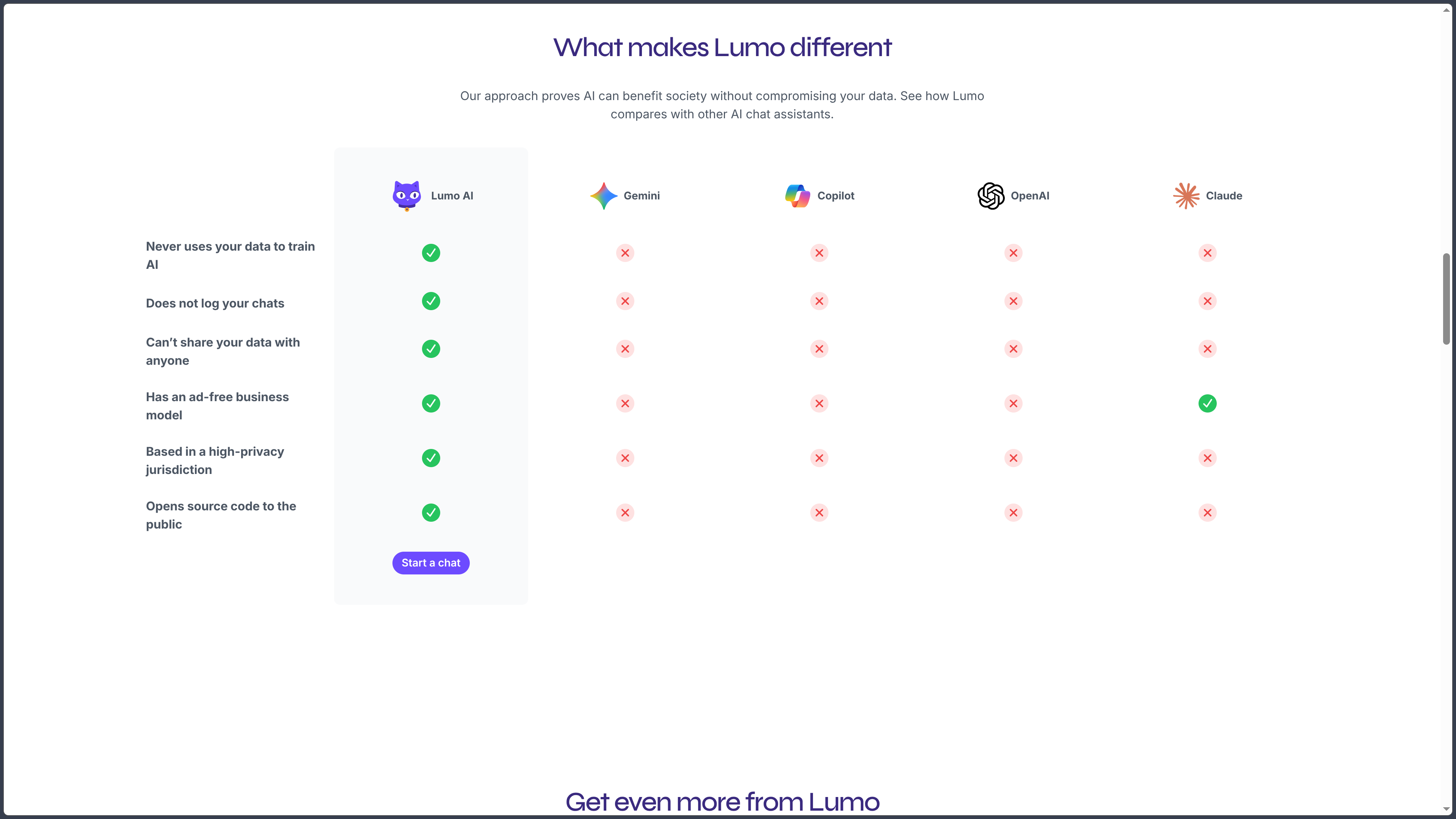
Its positioning strongly emphasizes privacy. Saved conversations are protected by zero-access encryption, preventing Proton from reading the history stored in the account. Conversations are not used to train Lumo's models.
Unlike assistants that send requests to different commercial providers, Lumo relies on open-source models running on servers controlled by Proton.
The current generation, Lumo 2.0, notably adds advanced reasoning, image generation and editing, improved Web search, persistent memory, Projects and custom assistants.
Lumo is available on the Web as well as on Android, iPhone and iPad.
Features
Models and reasoning modes
Lumo currently offers several model options.
Lumo 2.0 Lite prioritizes speed and efficiency for everyday tasks, while Lumo 2.0 Max targets requests requiring more reasoning and contextual understanding.
Apertus 1.5, developed in Switzerland by teams linked to EPFL, ETH Zurich and the Swiss National Supercomputing Centre, is also available as an open multilingual option.
Two reasoning modes are available: Fast for everyday responses and Thinking for more complex requests.
Open-source models hosted by Proton
Under the Lumo interface, Proton uses different open-source models and systems suited to the requested tasks.
The current catalog notably includes technologies from Qwen, GLM and Apertus as well as dedicated image-generation and image-editing models.
Proton can evolve this selection in order to use the models it considers most suitable.
Execution remains on infrastructure controlled by Proton rather than automatically sending conversations to external model providers.
Privacy and encryption
Saved conversations are protected by zero-access encryption.
Proton states that it does not retain logs that would make it possible to reconstruct conversations and that operational data related to a discussion is deleted after processing.
Prompts are not used to train the models.
Data in transit uses TLS, and requests are also protected so that their content can only be decrypted on the GPU servers responsible for generating the response.
Web search
Web search is optional.
By default, Lumo answers using the knowledge contained in its models. When Web search is enabled, it can retrieve more recent information to complement its response.
Proton selects its search providers according to privacy, performance and reliability criteria.
This feature is particularly useful for news, sourced research or information that may have changed since the model was trained.
Image generation and editing
Lumo 2.0 includes image generation.
A text description can be transformed into an image directly within the conversation.
Lumo can also use specialized models to modify certain existing images.
The free plan includes a limited number of generations, while Lumo Plus increases the available limits.
File and data analysis
Lumo can analyze documents, spreadsheets, notes and other files added to a conversation.
It can summarize their content, answer questions or use the information as context.
Since 2026, Lumo can also transform certain data into visualizations and charts.
This feature makes it possible, for example, to explore a table or report without automatically sending the data to a third-party AI provider.
Proton Drive
Lumo integrates directly with Proton Drive.
Files stored in Drive can be added to the temporary knowledge base of a conversation or associated with a Project.
It is also possible to link a Proton Drive folder to a Project so that new files added to the folder become available as context.
This integration makes it possible to work with documents from the Proton ecosystem without repeatedly downloading and re-uploading them manually.
Projects
Projects bring conversations, files and instructions together around the same topic.
They can be used to organize research, professional work, academic work or a creative project.
Project information is synchronized across devices and protected by encryption.
A Project can currently contain up to 200 files.
The free plan includes one Project, while Lumo Plus allows an unlimited number.
Memory
The Memory feature allows Lumo to retain certain useful information across multiple conversations.
It can remember, for example, preferences, a writing style or recurring context.
Stored memories are protected by zero-access encryption and can be viewed, modified or deleted by the user.
Automatic Memory updates can also be disabled.
Custom Lumos
Custom Lumos allow users to create assistants specialized for a particular task or domain.
A custom Lumo can receive specific instructions in order to adapt its behavior, style or role.
This approach can be used to create a writing assistant, research assistant, learning assistant or a helper dedicated to a recurring workflow.
Unlimited Custom Lumos are part of Lumo Plus.
Ghost Mode
Ghost Mode temporarily limits the context used by Lumo.
When enabled, the assistant stays focused on the current conversation without using saved history or remembered personality traits.
This feature is suitable for one-off requests that the user does not want connected to their usual context.
Mobile applications
Lumo has native applications for Android, iPhone and iPad.
The mobile applications provide access to the same conversations as the Web version when the user is signed in to their Proton account.
They notably add voice input and improved handling of tasks that continue processing when the user temporarily switches to another application.
The Android application is also distributed through F-Droid and directly as an APK.
Use cases
Ask questions without feeding an advertising profile
Lumo is suitable for users who want to benefit from an AI assistant while limiting the collection and reuse of their conversations.
Proton's business model is not based on targeted advertising.
Analyze confidential documents
Reports, documents or spreadsheets can be used as context to obtain summaries, explanations or analyses.
Lumo's focus on encryption and Proton-controlled hosting may be particularly relevant when the documents are sensitive.
Perform Web research
Optional Web search makes it possible to complement the model's knowledge with recent information.
Users can therefore keep search disabled for general tasks and enable it when freshness becomes important.
Organize a project across multiple sessions
Projects, Memory, instructions and files make it possible to preserve the context of recurring work.
Lumo can therefore serve as a continuous workspace rather than starting from an empty conversation every time.
Write and program
Lumo can help write, rewrite, translate, summarize or explain content.
It can also generate, analyze and explain code for common development needs.
Conclusion
Lumo mainly stands out through an approach in which privacy is part of the product architecture, rather than being added only through settings.
Zero-access encryption, no training on conversations, open-source models running on Proton-controlled servers and open client code form the core of this positioning.
Lumo 2.0 now gives it a much broader scope with reasoning, Web search, images, files, Memory, Projects and Proton Drive integration.
It nevertheless remains dependent on the performance of the open-source models selected by Proton and may therefore produce results that differ from the major proprietary models available from other providers.
For using a general-purpose AI assistant while strongly prioritizing privacy, transparency and control over data, Lumo is a particularly interesting alternative.
Points to consider
-
Lumo 2.0 is the current generation of the service as of October 4, 2026.
-
The models currently offered include Lumo 2.0 Lite, Lumo 2.0 Max and Apertus 1.5.
-
The underlying technical catalog changes regularly. Proton currently uses different open models such as Qwen, GLM, Apertus and specialized image models.
-
Lumo can be used for free, even without a paid Proton subscription.
-
The free plan has limits on the Max model, number of messages, history, images and Projects.
-
Lumo Plus significantly increases the limits and notably adds unlimited Projects and Custom Lumos.
-
The US App Store currently lists Lumo Plus at $12.99/month or $119.99/year. Prices may differ depending on region, taxes and purchase channel.
-
Saved conversations use zero-access encryption, preventing Proton from reading stored history.
-
Lumo does not use conversations to train its models.
-
Models run on servers controlled by Proton, rather than on the commercial platforms of the model providers.
-
Apertus 1.5 may receive feedback only with the user's explicit consent.
-
Web search is disabled by default and must be enabled when a response requires recent information.
-
Lumo is open source. The Web, Android and iOS clients are published by Proton; the corresponding repositories notably use the GPL-3.0 license.
-
Lumo is available on the Web, Android, iPhone and iPad.
-
Performance and knowledge depend on the selected model. A fast Lite model may be less suitable than a Max model or Thinking mode for complex problems.
-
Like any generative assistant, Lumo can produce errors or fabricated information. Important results should be verified even when processing privacy is stronger.