

Overview
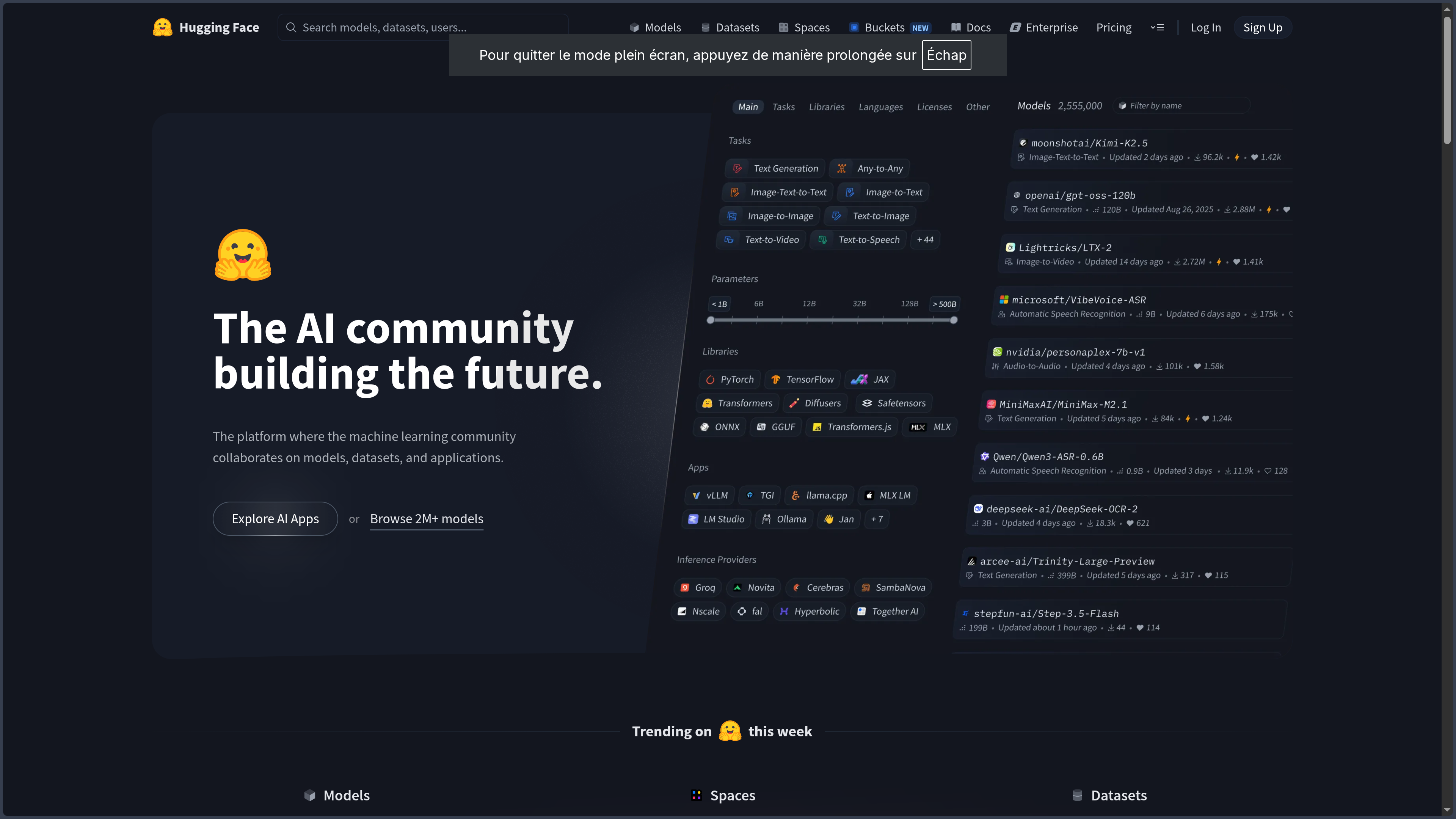
Hugging Face is one of the main infrastructures for sharing, discovering, and collaborating around AI models.
Its central service, the Hugging Face Hub, works as a repository platform tailored to machine learning.
You can find there models, datasets, demos, their history, their documentation, and, when authors indicate it properly, their licenses and evaluation results.
This organization is what makes Hugging Face so important.
The platform does not merely show that a model exists.
It often lets you consult the model card, download the files, examine dependencies, test a demo, and then prepare a local execution or a remote deployment.
The Hub covers a very broad field: language, image, vision, audio, video, translation, classification, embeddings, robotics, or agents.
Hugging Face also develops several open-source libraries that have become common in AI workflows, notably Transformers, Datasets, Diffusers, Tokenizers, Safetensors, and huggingface_hub.
This richness can give the impression of an immense catalog.
The platform's identity is, however, more precise:
Hugging Face provides a common layer to distribute, document, test, and operate AI resources.
It can be used to find a small local model as well as to organize a team's private resources.
It thus occupies a fairly particular position.
Hugging Face is not only a host.
Nor is it a single model provider.
It is a circulation infrastructure between research, models, datasets, code, demos, and deployment.
This openness comes with an important trade-off: quality, safety, and licenses are highly variable.
The presence of a resource on Hugging Face is never automatic validation.
Features
Hub: models, datasets, and versioned repositories
Models and datasets are organized into repositories with files, versions, history, documentation, and metadata.
This repository logic is essential to understand the platform.
A model is not just a "download" button.
It can be associated with:
- an architecture;
- a configuration;
- several weight formats;
- versions;
- tokenizer files;
- a license;
- examples;
- evaluation results;
- discussions;
- dependencies.
Datasets follow a similar logic with their files, structure, versions, and provenance information.
This organization facilitates collaboration and reproducibility.
It does not guarantee that the documentation is complete.
A community repository can be excellent or almost empty.
Model Cards, Dataset Cards, and documentation
Model Cards and Dataset Cards can specify recommended uses, limitations, data, performance, license, or known biases.
These cards are particularly important because they give context to the downloaded files.
Two models with close performance on a benchmark may have been trained for completely different uses, languages, or licenses.
A good Model Card can therefore influence a decision more than a simple ranking.
Quality remains variable.
A card produced by the author is not an independent certification.
It must be confronted with real tests and the project's conditions.
Testing with Spaces and demos
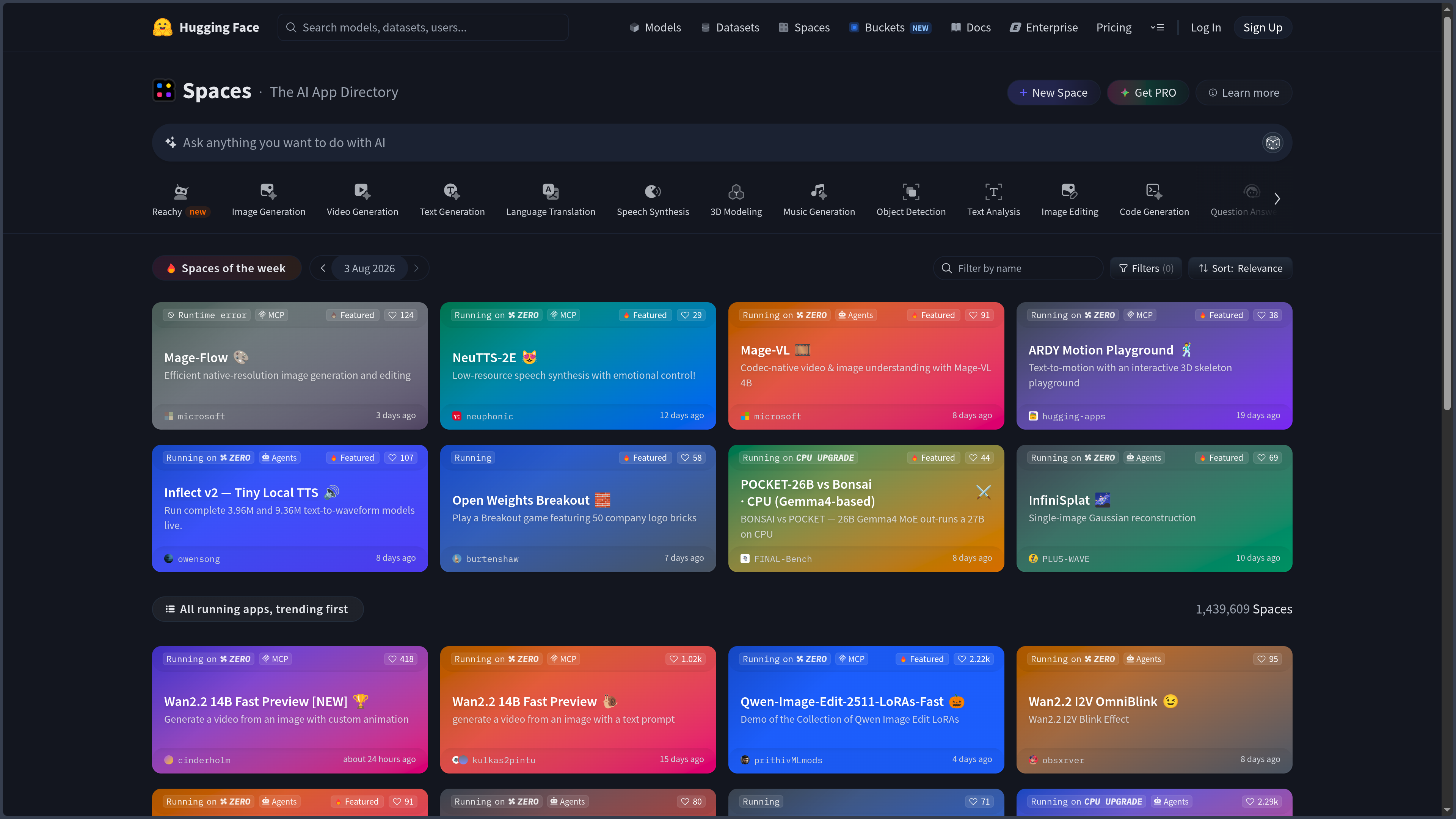
Hugging Face Spaces lets you publish interactive applications and demos.
A Space can be used to test a model, present a prototype, or quickly share an interface.
It is one of the most visible bridges between technical repository and user experience.
An abstract model becomes immediately testable.
For researchers and creators, this is very handy before preparing a local installation or a full integration.
A community Space remains, however, a demo.
Availability, security, confidentiality, maintenance, and performance are not guaranteed at the level of a production service.
The Space operator and the data sent must be identified before using sensitive content.
Downloading and running locally
A model can be downloaded to run on a workstation, a server, or a private infrastructure with compatible libraries and engines.
This possibility makes Hugging Face an important transit point for users who want to leave a hosted API behind and regain more control over execution.
The Hub then plays the role of distribution.
The actual execution can take place in Transformers, Diffusers, llama.cpp, ComfyUI, Ollama, LM Studio, or other environments.
This distinction is important.
Hugging Face hosts the resources.
The inference engine used locally then determines part of performance, compatibility, and hardware constraints.
Formats, quantization, numerical precision, and architecture can strongly modify the experience.
Open-source libraries
The Hugging Face ecosystem is not limited to the Web site.
Transformers provides a common interface for many model architectures.
Diffusers plays a similar role in several visual generation workflows.
Datasets facilitates loading and processing datasets.
Tokenizers, Safetensors, and huggingface_hub address other layers of the workflow.
These libraries have helped standardize many practices around open models.
They remain, however, distinct software projects.
A Hugging Face sheet should show their role in the ecosystem without becoming training material for each of them.
API, Inference Providers, and Endpoints
Hugging Face provides APIs, SDKs, and deployment services.
Inference Providers let you access different inference providers from a common layer.
Inference Endpoints let you deploy models in dedicated environments.
This continuity offers several paths:
test → quickly integrate → deploy more durably → optionally regain control of the infrastructure.
It is useful for teams that do not yet know what level of management they want to take on.
It also implies different costs, provider conditions, and confidentiality levels.
Organizations, private repositories, and collaboration
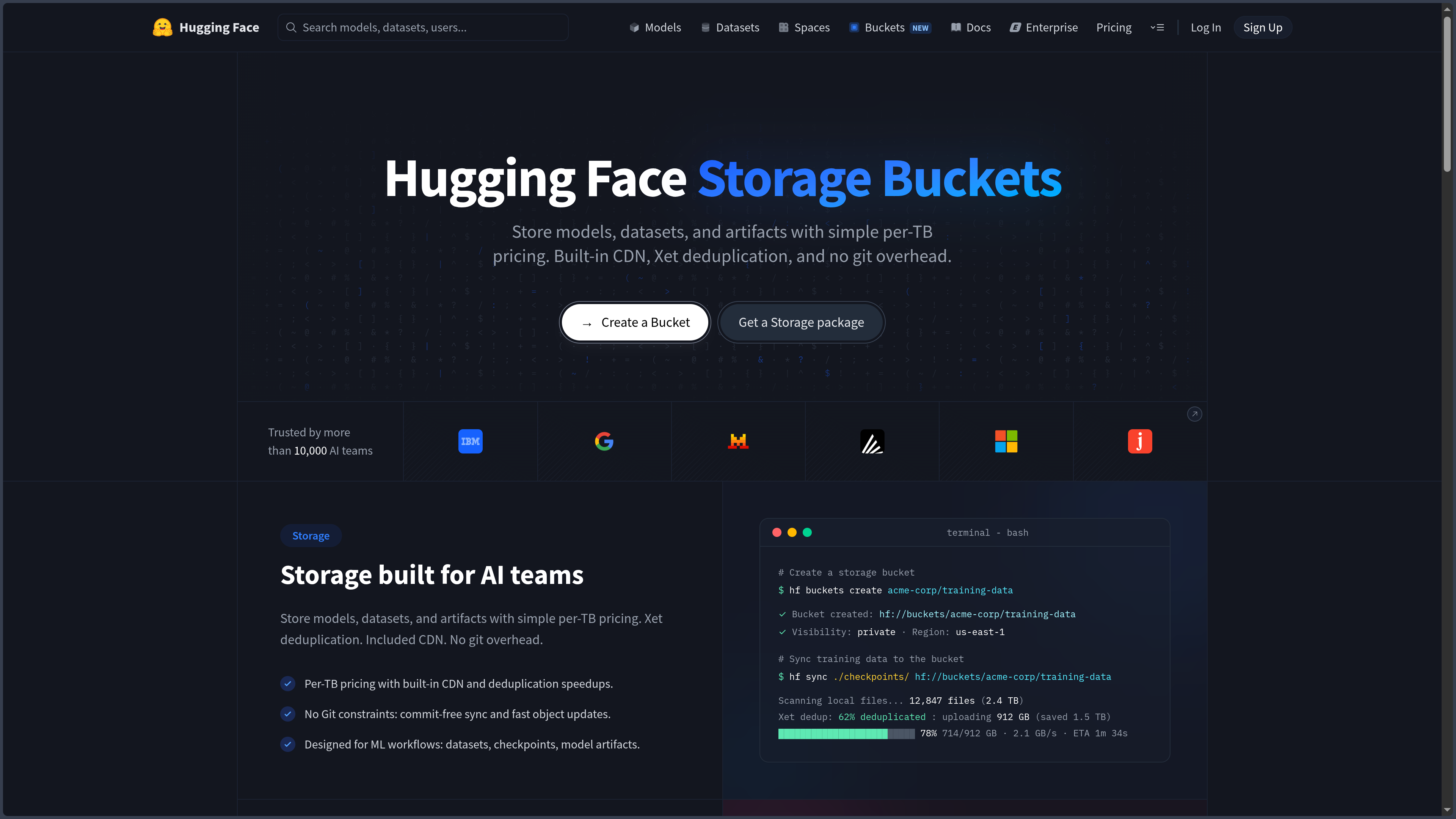
Hugging Face can also serve as private infrastructure for teams.
Organizations, private repositories, access groups, and professional features let you manage internal models, datasets, and applications.
This dimension is less visible than the public Hub, but it shows that the platform can serve as much for open discovery as for managing proprietary resources.
Access rights then become central.
A private model can contain sensitive information even if its usage code looks innocuous.
Community and research
Profiles, collections, discussions, scientific publications, and organization pages create an ecosystem that goes far beyond simple file storage.
For technical watch, this proximity between research, model, and demo is particularly valuable.
A paper can be linked to its implementation.
An implementation can be tested in a Space.
A model can then be downloaded.
This continuity explains much of Hugging Face's central role in the open AI ecosystem.
Use Cases
Finding a model for a project
The Hub lets you search by task, language, architecture, library, license, or compatibility.
It is often the first starting point to identify a local model.
Running AI locally
Files can be downloaded and then used with different inference engines.
Hugging Face then plays the role of a distribution library.
Testing and comparing
Cards, metadata, demos, and evaluations provide a first reading of differences between several resources.
Real testing must, however, be done with your own data and constraints.
Creating a demo
Spaces lets you quickly turn a prototype into an application accessible from the Web.
Publishing a model, dataset, or prototype
Researchers, developers, and companies can version their resources, document them, and share them publicly or in private spaces.
Integrating or deploying
APIs and inference services let you move from a model discovered on the Hub to integration in a software or service.
Organizing a team's resources
Private repositories and organizations can be used to centralize internal models, datasets, and demos.
Tracking research
The links between publications, models, and implementations facilitate scientific and technical watch.
PANACHES Review
An infrastructure more than a catalog
Reducing Hugging Face to a model library hides its real value.
The platform creates continuity between:
discovery → documentation → distribution → demo → integration → deployment.
This continuity explains why it has become central in many AI workflows.
The repository is a good abstraction
The idea of managing a model or dataset as a versioned resource brings an extremely useful structure.
Model weights are no longer isolated from their documentation, versions, and license.
This logic brings AI resource management closer to practices already known in software development.
A gateway to local
The Hub is particularly interesting when a project wants to compare a hosted service with a solution running on its own hardware.
It does not make local AI simple by magic.
It mainly makes resources findable, documented, and shareable.
Openness shifts responsibility to the user
A popular model can have a restrictive license, incomplete documentation, dangerous dependencies, or mediocre performance on a specific case.
Hugging Face provides many clues.
It does not replace evaluation.
The libraries bring real technical depth
Transformers, Diffusers, and the other projects explain why Hugging Face is more than a Web site.
The platform also influences how developers load, test, and share models.
This depth justifies a richer sheet than a simple model directory.
A technical platform
The interface remains accessible.
Actually exploiting the resources often requires understanding formats, dependencies, hardware, quantization, and deployment.
For a beginner, the catalog can therefore seem much simpler than the work needed after the "Download" click.
Points of Attention
- Check each license: models, datasets, and Spaces do not share a common license.
- Open weight does not automatically mean open source.
- Examine Model Cards and documentation before integrating a resource.
- Community documentation may be incomplete or incorrect.
- Prefer safe formats when downloaded files may execute code on load.
- Do not confuse community Space and production service.
- Identify the actual operator before sending sensitive data to a demo or provider.
- Anticipate storage and hardware resources: some models are very large.
- Quantization and inference engine can strongly modify performance of a local model.
- Inference services and GPU can generate significant costs even if Hub access is largely free.
- Test a model in your own context rather than relying only on public benchmarks.
- Evaluate the maintenance and dependencies of the repository before long-term integration.
- Private repositories require real access governance.