
Overview
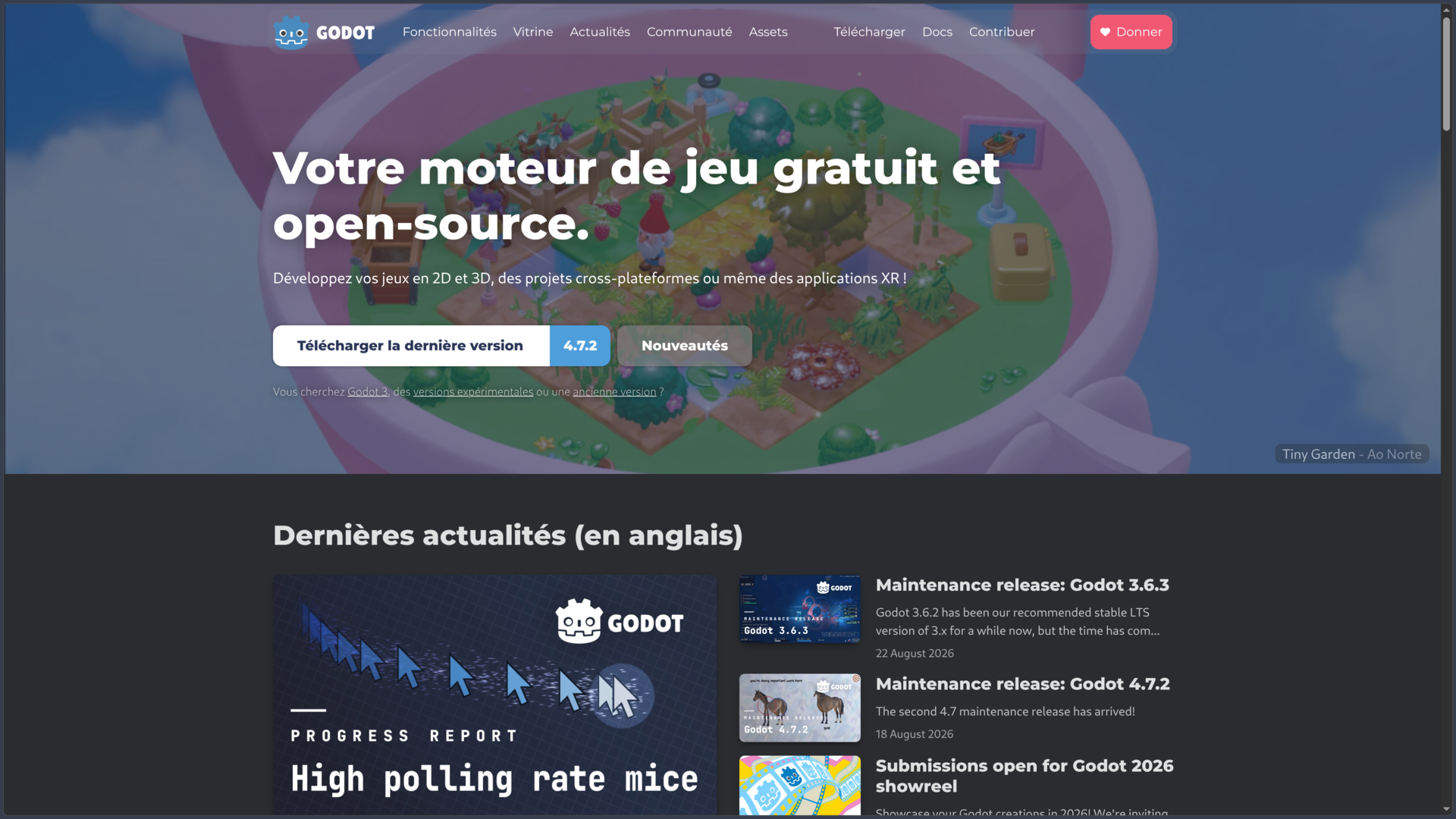
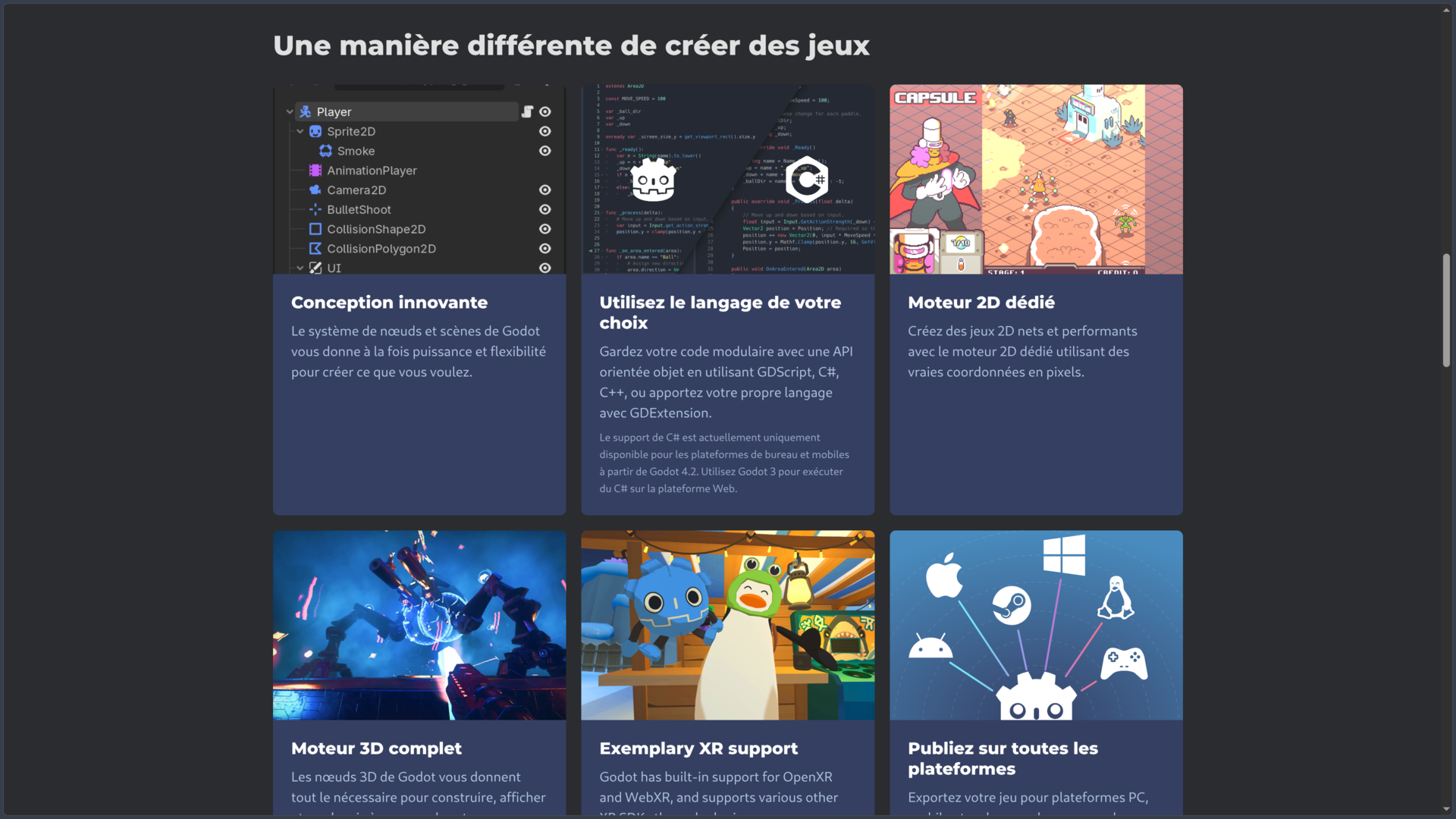
Godot Engine is a free and open-source 2D and 3D game engine designed for creating video games, while also being suitable for interactive applications, simulations and graphical tools. The engine is built around a scene and node system: every project element can be assembled from specialized building blocks representing a camera, character, interface, sprite, sound, light or collision.
This architecture is one of Godot’s main differences. A scene is not limited to a complete level: it can represent an enemy, a menu, a weapon or any other reusable element. Scenes can then be nested inside one another to progressively build the project.
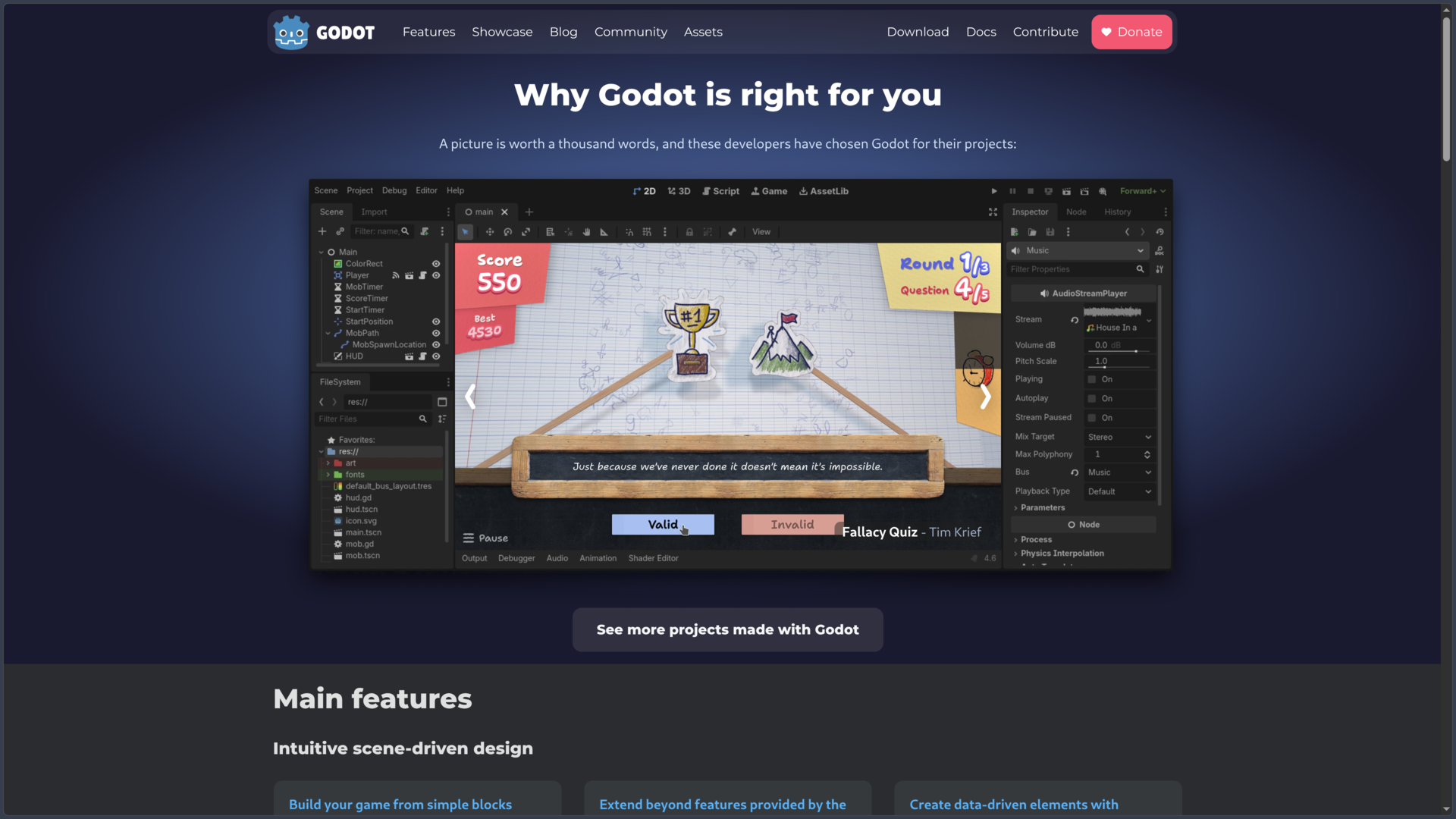
Godot directly includes a scene editor, 2D environment, 3D viewport, script editor, debugger, profiler, animation systems, physics, audio and particles, along with the tools required to export the project to several platforms.
The engine is distributed under the MIT license. It can be downloaded, used, modified and redistributed free of charge, including for commercial projects. Developers retain ownership of their games and Godot charges no royalties on sales or generated revenue.
Development is community-driven and the code is collectively owned by its contributors. The Godot Foundation, a nonprofit organization created in the Netherlands, notably provides financial and administrative support for the project without owning the engine itself.
At the time of this verification, the current stable version is Godot 4.7.2, released on August 18, 2026. The 4.8 branch is already in development, but the versions available in September 2026 remain snapshots intended for testing rather than the stable reference for production projects.
Features
An architecture based on scenes and nodes
Godot organizes projects as trees of nodes.
Each node has a specific role: Sprite2D for displaying a sprite, CharacterBody3D for managing a 3D character, Camera2D or Camera3D for the camera, AudioStreamPlayer for sound, or Control nodes for building interfaces.
These nodes are assembled into reusable scenes. A scene representing an enemy can, for example, contain its model or sprite, collision system, animation, sounds and scripts. That scene can then be instantiated several times across different levels.
This structure encourages modular design. Instead of building a game as one huge monolithic system, developers can create independent components and then combine them.
Godot also uses a signal system that allows objects to communicate without multiplying direct dependencies between scripts.
A genuine dedicated 2D engine
Godot includes a native 2D engine, rather than simply placing a 2D layer on top of a 3D engine.
It notably provides sprites, TileMaps, 2D lighting, CPU and GPU particles, cameras, paths, collisions, physics bodies, shaders and animation tools.
Coordinates are designed directly around pixels, which makes it easier to create platformers, metroidvanias, 2D RPGs, strategy games, puzzle games or highly graphical interfaces.
Developers can use the same scene and scripting systems as in 3D, but with nodes and tools specifically adapted to 2D representation.
This specialization partly explains Godot’s popularity among independent developers working on 2D games: the engine does not treat this type of project as a simple by-product of the 3D pipeline.
A much more complete 3D engine with Godot 4
Godot 4 also provides a modern 3D pipeline with physically based rendering, real-time lighting, materials, shaders, particles, volumetric fog, reflections, decals and several global illumination systems.
Three renderers make it possible to adapt the project to the target hardware:
| Renderer | Main use |
|---|---|
| Forward+ | Modern desktop hardware and advanced graphical effects |
| Mobile | Mobile devices and lighter scenes |
| Compatibility | Older hardware, modest platforms and Web |
Forward+ notably uses Vulkan, Direct3D 12 or Metal depending on the platform, while Compatibility relies on OpenGL.
The engine also provides several lighting solutions such as lightmaps, VoxelGI, SDFGI and screen-space indirect lighting.
Godot directly imports several 3D formats, with glTF 2.0 as the recommended format, and can also work with .blend files by automatically using Blender’s export functionality.
It still includes fewer integrated AAA production tools than Unreal Engine. For many independent, stylized or mid-sized projects, however, its 3D pipeline is more than capable of producing complex environments.
GDScript, C# and C++ depending on the need
Godot provides several ways to program a project.
GDScript is the engine’s native language. Its lightweight syntax resembles Python without being based on Python. It is directly integrated into the editor and is the language recommended by Godot for beginners.
It provides optional static typing, code completion, signals, classes, multithreading and direct access to the entire engine API.
Godot also offers a .NET edition intended for C#. This can be especially useful for developers coming from Unity or already working within the .NET ecosystem.
For parts requiring greater performance or integration with native libraries, GDExtension makes it possible to use C and C++ without recompiling the whole engine.
Languages can be mixed within the same project. A team can therefore write most gameplay systems in GDScript while reserving C++ for particularly demanding processing.
Community bindings also exist for Rust, Swift, D, Go, Java/Kotlin, Nim or Odin, although their maturity varies and they do not all receive the same level of official support.
An integrated but extensible editor
The editor brings together the main tools required for development: scene tree, inspector, 2D and 3D editors, scripts, shaders, animations, audio and resource configuration.
Godot also includes a debugger, CPU/GPU profiler, performance monitoring tools, a remote inspector and the ability to modify certain scenes or properties while the game is running.
The project can be launched directly in a separate window or embedded into the editor to simplify testing.
The integrated script editor works very well for GDScript, but Godot can also work with external tools such as Visual Studio Code, Vim, Emacs, Visual Studio or JetBrains Rider depending on the language used.
Plugins can modify the editor itself by adding docks, custom inspectors, importers, new scene tools or specialized workflows.
Asset Store and community extensions
Godot 4.7 introduces integration with the new Godot Asset Store, intended to gradually replace the former Asset Library.
It makes it possible to retrieve plugins, scripts, project templates, tools and other resources from the Godot ecosystem to extend the engine.
The new Asset Store notably adds ratings, user reviews, multiple versions, changelogs and tools intended for asset creators.
As of September 2026, direct asset sales are still among the features announced for the platform’s future development. The former Asset Library remains available for earlier Godot versions but is considered deprecated and is expected to gradually become read-only.
This evolution remains important for Godot: rather than integrating every possible feature into the engine core, some functionality can be distributed through official or community extensions.
Animation, audio, shaders and physics built in
Godot includes a complete animation system capable of working with properties, transformations, skeletons and many other parameters.
The 2D and 3D systems include physics engines with static bodies, rigid bodies, characters, areas, collisions and joints. The 3D side also adds features such as soft bodies and ragdolls.
The audio engine supports 2D and 3D playback, audio buses, effects, microphone recording, pitch, polyphony and positional sound.
Godot also provides its own shader language inspired by GLSL along with a visual shader editor. Shaders can be used for 2D rendering, 3D, particles, skies or fog.
These features make it possible to build a large part of a game without assembling several external middleware solutions for every basic need.
Exporting to desktop, mobile and Web
Godot provides templates for directly exporting to several systems:
- Windows;
- macOS;
- Linux;
- Android;
- iOS;
- Web.
The editor itself has official versions for Windows, macOS and Linux. An Android editor also exists, with a still-experimental status, along with a Web editor.
Godot 4.7 notably improves the Android workflow by making it possible to perform more export and publishing operations directly from the Android platform.
Web exports use WebAssembly and WebGL 2.0. They remain more constrained than native builds, particularly in terms of performance and available features.
One important limitation concerns C# with Godot 4: .NET projects can be exported to desktop as well as Android and iOS with certain limitations, but C# Web export is still not supported. For a Godot 4 Web game, GDScript therefore generally remains the simplest option.
Consoles are possible, but not through the standard public templates
The console situation is different.
Godot does not publicly distribute official open-source export templates for PlayStation, Xbox or Nintendo Switch because the manufacturers’ SDKs are subject to confidentiality agreements that are incompatible with open publication.
This does not mean that a Godot game cannot be released on consoles.
A studio approved by the platform holder can use the relevant SDKs and develop its own exports or work with specialized providers. Several companies now provide Godot porting solutions and services for Nintendo Switch, Switch 2, Xbox Series X/S, PlayStation 5 and other consoles.
W4 Games notably provides middleware ports for several platforms.
Steam Deck is a different case: because it is based on Linux, standard Godot Linux exports can be used directly.
For a project targeting consoles from the beginning, porting cost, certification requirements and the porting partner therefore need to be planned much earlier than for a desktop project.
Use cases
Creating an independent 2D game
A developer can build a character from several nodes, create levels with TileMap, manage physics with CharacterBody2D and write gameplay in GDScript.
Scenes make it possible to turn enemies, objects or interfaces into reusable elements.
This workflow is particularly well suited to 2D platformers, RPGs, roguelites, puzzle games and independent action games.
The engine remains lightweight enough to support rapid iteration without requiring heavy infrastructure around the project.
Developing a 3D game without royalties
A small team can create a complete 3D game with lighting, PBR materials, animation, physics, shaders and integrated effects.
The final game can then be sold commercially without paying Godot a percentage of the generated revenue.
This makes the engine especially attractive for studios that want to retain a predictable software cost while preserving the ability to modify the engine when needed.
This freedom does not, of course, remove licensing obligations for assets, middleware and external services that may be used in the project.
Quickly prototyping a concept
The combination of scenes, nodes and GDScript makes it possible to build a playable prototype quickly.
A developer can create a small scene, attach a few scripts and immediately test the behavior from the editor.
The debugger, remote inspector and live modifications then reduce the back-and-forth between code and game.
Godot is therefore well suited to game jams, prototypes, educational projects and validation phases before a larger production begins.
Using C# while moving away from Unity
A developer familiar with Unity can download the .NET version of Godot and continue working in C#.
The engine’s philosophy remains different: Godot uses its own node, scene and resource systems rather than copying Unity’s workflow.
The transition therefore requires real learning, but does not necessarily force a simultaneous change of programming language.
For a project targeting the Web, however, this strategy needs to be reconsidered because Godot 4 still does not support C# export to that platform.
Building a tool or interactive application
Godot is not limited to games.
Its interface system, real-time rendering, 2D/3D tools and ability to export complete applications also make it suitable for viewers, interactive interfaces, internal tools or graphical software.
The Godot editor itself is built using the engine’s UI components, showing how far the system can be pushed.
For software mainly requiring forms, databases and traditional desktop widgets, a conventional application framework may remain more appropriate. Godot becomes particularly interesting when the interface and interactive rendering play a central role.
Conclusion
Godot Engine has evolved from a relatively discreet independent engine into one of the main open-source alternatives to Unity and Unreal Engine.
Its difference is not based only on price. The engine is fully open source under the MIT license, with no subscriptions, royalties or proprietary lock-in for the project. A studio can inspect the code, modify the engine, maintain its own version and freely commercialize its creations.
Its scene and node system offers a modular approach that differs significantly from some other engines. Combined with GDScript, it allows rapid prototyping while remaining structured enough to build larger projects.
2D remains one of its historical strengths, but Godot 4 has significantly improved 3D rendering, shaders, animation and performance. The three renderers also make it possible to target modern machines as well as mobile or more modest hardware.
Version 4.7 continues this maturation with new tools, Godot Asset Store integration, a better Android workflow and various rendering and editor improvements. The current stable version 4.7.2 has already received two maintenance releases since the initial 4.7 release in June 2026.
Godot still has limitations. Console support relies on private or third-party solutions, some professional workflows remain less developed than in Unreal Engine, the asset ecosystem is smaller than that of long-established commercial engines, and certain combinations such as C# + Web are still unavailable.
For an independent developer, a studio wanting control over its technology or a team looking for a complete, multiplatform, free and genuinely open-source 2D/3D engine, Godot is now mature enough to go far beyond the role of a learning or prototyping engine.
Points to consider
-
Godot Engine is completely free and open source under the MIT license. There are no mandatory subscriptions, per-seat fees or royalties on revenue generated by a game.
-
The current stable version is Godot 4.7.2, released on August 18, 2026. Godot 4.8 is in development but is not yet the stable branch.
-
The engine can be used commercially, but a distribution using Godot must retain the engine copyright notice and MIT license in its documentation or credits.
-
Projects created with Godot remain the property of their authors. The engine’s MIT license does not require publishing the game’s source code.
-
GDScript, C# and C++ through GDExtension are officially supported. Other languages have community bindings whose maturity may vary.
-
C# builds use a separate .NET version of Godot and require the corresponding .NET SDK.
-
Godot 4 still does not allow C# projects to be exported to the Web. GDScript remains better suited when a browser version is one of the main targets.
-
The editor officially runs on Windows, macOS and Linux, with Android and Web versions whose features remain partly experimental.
-
Native exports cover Windows, macOS, Linux, Android, iOS and Web, although each platform has its own signing and publishing constraints.
-
PlayStation, Xbox and Nintendo do not have public export templates supplied directly with Godot. Developers must be approved by the platform holder and use or develop a solution compatible with the manufacturers’ private SDKs.
-
The new Godot Asset Store is integrated into Godot 4.7. The former Asset Library remains available for previous versions but is now considered deprecated.
-
The Asset Store remains younger than the Unity or Unreal marketplaces, and direct asset sales are still among the features planned for its future evolution.
-
The Godot Foundation financially and administratively supports the project but does not own Godot: the engine copyright remains distributed among its contributors.