
Presentation
Euria is an artificial intelligence assistant developed by Infomaniak, a Swiss company specializing in cloud services, email and collaborative tools.
Its positioning is built around data sovereignty. The models are hosted and run directly in Infomaniak data centers in Switzerland, without relying on artificial intelligence APIs operated by foreign hyperscalers.
Euria exclusively uses open-source models selected according to the task. Infomaniak notably mentions technologies from Mistral, DeepSeek, Llama, Granite and Whisper.
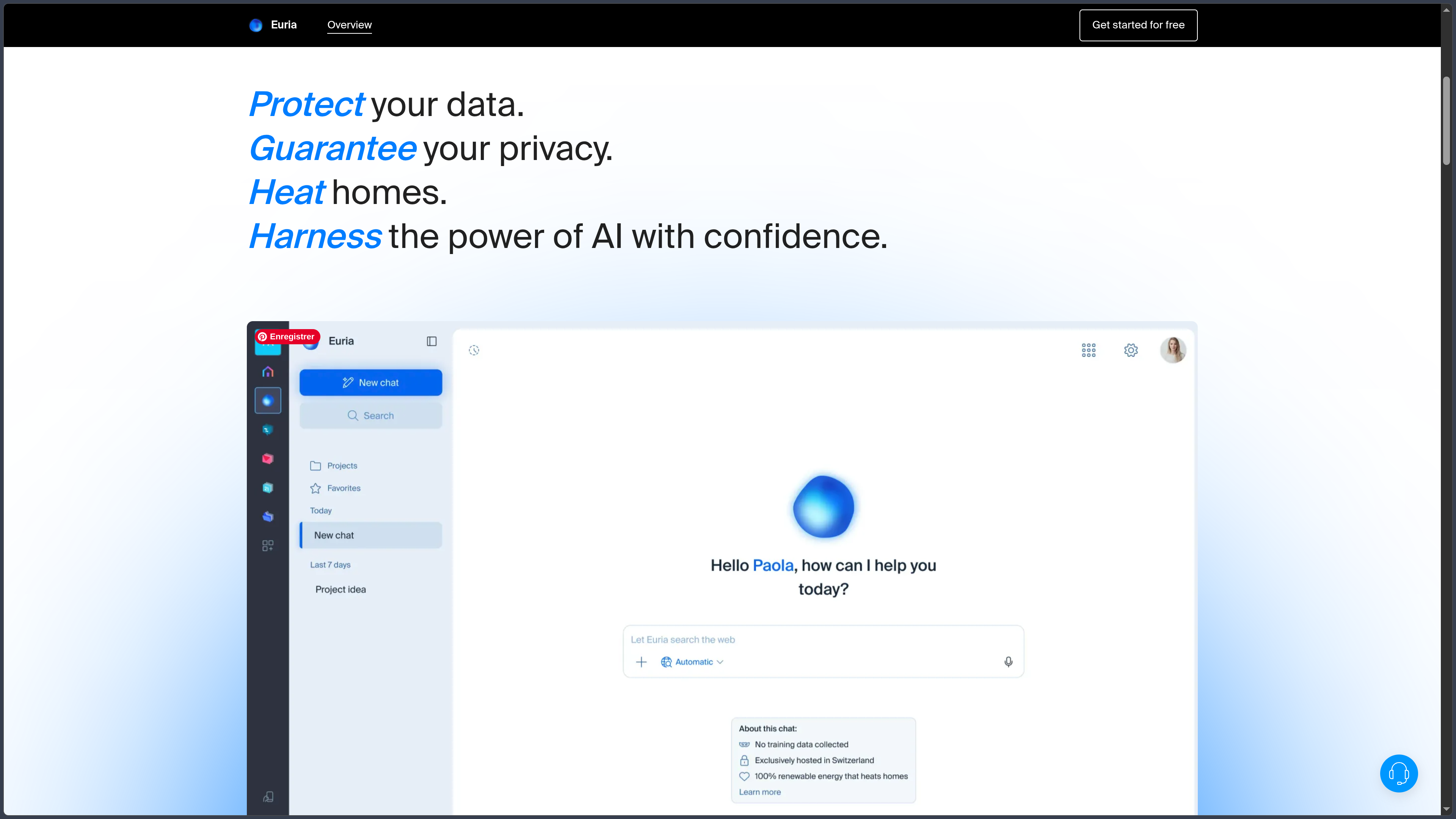
The assistant covers conversation, writing, translation, Web search, file and image analysis, audio transcription and work organization through Projects.
It is available as a standalone Web and mobile application, while also integrating deeply with kSuite, notably Mail, kChat and selected kDrive workflows.
Features
Conversation and reasoning
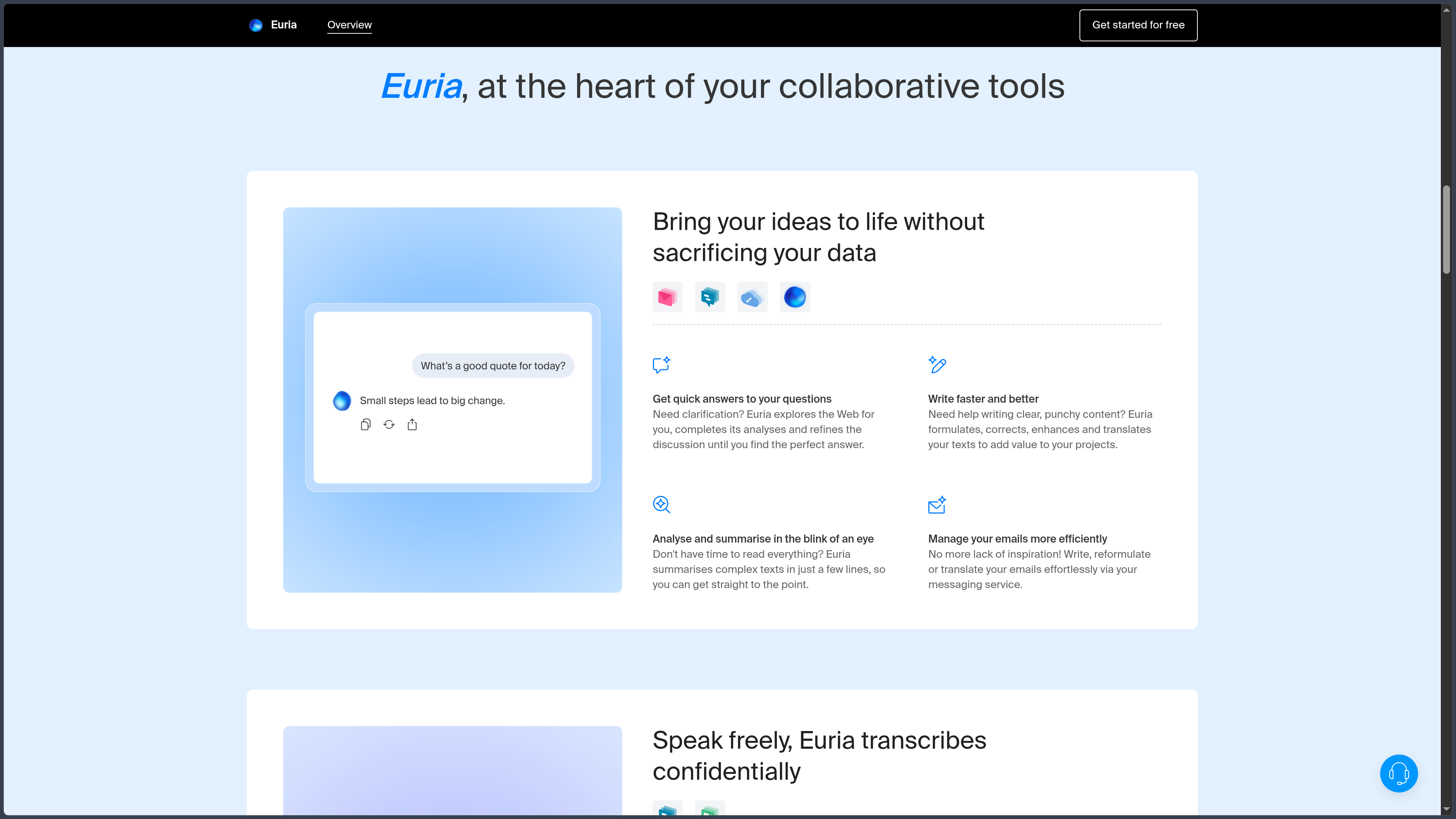
Euria works as a conversational assistant capable of answering questions, explaining concepts, writing, rewriting, summarizing or translating content.
Users can choose different reasoning modes depending on the complexity of the request.
The models used may evolve over time so that Infomaniak can adapt resources and capabilities to different use cases.
Open-source models
Euria relies exclusively on open models running locally within Infomaniak infrastructure.
Technologies currently cited include Mistral, DeepSeek, Llama, Granite and Whisper.
This architecture avoids automatically sending prompts, files or conversations to APIs operated by providers such as OpenAI, Google or Anthropic.
The exact model used may depend on the task being performed.
Web search
Euria can perform Web searches when a request requires external or more recent information.
This feature makes it possible to complement the internal knowledge of the models without requiring the user to conduct several searches manually.
The application can determine when Web access is relevant in order to answer more accurately.
Documents and images
Files can be added to conversations so that Euria can analyze them.
The assistant can notably extract information from PDFs, Word documents, spreadsheets, text files and other common formats.
It can also interpret images and scanned documents, retrieve text or answer questions based on their content.
File size and quantity limits vary depending on the plan used.
Audio transcription
Euria can transcribe recordings and audio files.
This feature is suitable for voice notes, meetings, interviews or minutes.
Transcription services are currently advertised as unlimited in the relevant Euria plans.
The assistant can then summarize or make use of the resulting text.
Projects and custom instructions
Projects make it possible to group several conversations around the same topic.
Each Project can receive its own instructions: tone to use, assistant role, business context, expected format or other working rules.
Documents can also be associated with the Project in order to create a custom knowledge base.
This organization is particularly suited to recurring work or cases requiring stable context.
Ephemeral mode
Euria offers an ephemeral mode for conversations that should leave no trace in the history.
The discussion is then not retained and cannot be recovered later.
This mode notably targets particularly sensitive information or one-off requests that the user does not want to keep.
Mail and writing
Euria is integrated with Infomaniak Mail in certain plans.
It can write a message from a few instructions, rewrite a passage, correct grammar, change the tone or suggest a reply.
It can also summarize a received email in order to quickly extract its main points.
kChat
Inside kChat, Euria can serve as a conversational assistant.
It can answer questions, rewrite messages, perform translations or summarize selected discussions.
The integration makes it possible to use AI directly from the collaborative environment without manually transferring content to an external service.
kDrive and documents
Certain professional plans make it possible to use Euria directly with kDrive.
The assistant can then search for information in files, produce summaries or work with documents stored in the Infomaniak environment.
The availability of this integration nevertheless depends on the kSuite tier used.
Mobile applications
Euria has applications for Android, iPhone and iPad, in addition to its Web interface.
Conversations and Projects can therefore be accessed across several devices with the same account.
Voice input and transcription features are particularly useful on mobile.
Use cases
Work with sensitive data
Exclusive Swiss hosting and the absence of external AI APIs make Euria particularly relevant for organizations that want to limit data transfers.
Internal documents, reports or correspondence can be analyzed within Infomaniak infrastructure.
Create a business assistant
Projects make it possible to combine instructions and documents in order to build a specialized workspace around a company, client or activity.
Euria can then use this context in Project conversations.
Summarize and analyze documents
A document can be added in order to obtain a summary, retrieve information or ask questions about its content.
This approach notably suits reports, PDFs, office documents and spreadsheets.
Transcribe a meeting
Audio features can turn a recording into text and then produce a summary or extract important points.
The entire process remains within Infomaniak infrastructure.
Write and translate
Euria can be used to produce, correct, shorten, expand or translate text.
Its integration with Mail and kChat makes these features directly usable in professional communications.
Conclusion
Euria mainly stands out through an approach where artificial intelligence remains entirely operated within Infomaniak's Swiss infrastructure.
Rather than depending on APIs from major American or Asian providers, the service selects open-source models that Infomaniak runs directly on its own servers.
Web search, documents, images, transcription and Projects now give it a broad enough scope to act as a general-purpose assistant while remaining integrated with the kSuite ecosystem.
This approach is particularly relevant for individuals, companies and organizations that place greater importance on data location, privacy and sovereignty.
For using a general-purpose AI assistant hosted in Switzerland and based on open models, Euria is a particularly coherent European alternative.
Points to consider
-
Euria is developed by Infomaniak Network SA, an independent company based in Geneva, Switzerland.
-
Request processing and model execution take place in Infomaniak data centers in Switzerland.
-
Euria relies exclusively on open-source models deployed locally. Infomaniak notably cites Mistral, DeepSeek, Llama, Granite and Whisper.
-
User data is not used to train or fine-tune the models.
-
Infomaniak states that it does not send requests to external AI providers or hyperscalers.
-
Euria can be used for free with my kSuite, but quotas and limitations apply depending on the plan.
-
The free my kSuite plan currently includes two Projects with a maximum of five conversations per Project. Higher tiers increase or remove these limits.
-
Message quotas use a rolling 24-hour window rather than resetting at a fixed time each day.
-
A conversation can currently reach up to 254,000 tokens.
-
Transcription services are advertised as unlimited.
-
File limits vary depending on the plan. Infomaniak regularly changes these quotas, so the documentation associated with the account remains the reference for exact values.
-
Ephemeral mode does not retain the conversation, making it suitable for requests that should not remain in the history.
-
The different kSuite integrations are not available with every plan. Euria access to kDrive notably requires certain professional tiers.
-
Euria is available on the Web and has Android and iOS/iPadOS applications.
-
The Euria service is not entirely published as an open-source project. However, Infomaniak notably publishes its Euria Android application under the GPL-3.0 license and exclusively uses open-source AI models.
-
The AI infrastructure uses local renewable energy and Infomaniak recovers the heat generated by its data centers to supply district heating networks.
-
Like any generative model, Euria can produce incorrect answers. Infomaniak explicitly recommends checking important information, particularly in medical, legal or financial contexts.