Presentation
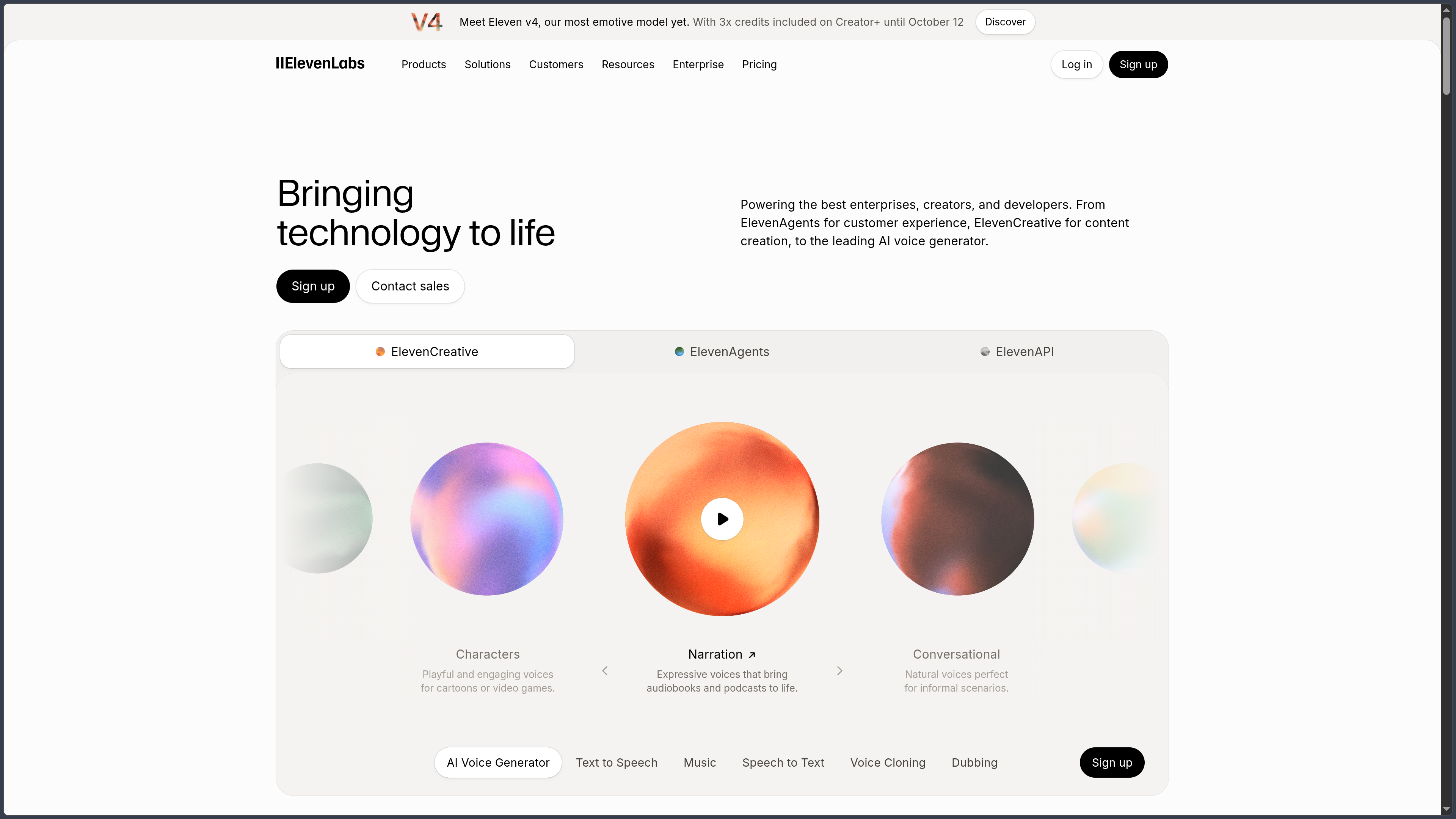
ElevenLabs is an artificial intelligence platform specialized in voice and audio creation. It can turn text into speech, create or clone voices, modify recorded performances, dub content, transcribe audio and generate sound effects or music.
Its historical product is Text to Speech, but the ecosystem has expanded considerably. ElevenLabs now provides a creative environment combining multiple audio tools, production and localization features, as well as APIs for integrating these technologies into applications.
The platform is particularly used for voice-overs, audiobooks, podcasts, video games, videos, educational content and projects requiring multiple languages.
Since September 2026, Eleven v4 has been the main new generation of speech synthesis. The model places greater emphasis on interpreting context, rhythm, emotion and multi-speaker dialogue, while Eleven v4 Turbo targets use cases requiring faster responses.
ElevenLabs is available through the Web and also offers mobile applications for iOS, iPadOS and Android.
Features
Speech synthesis with Eleven v4
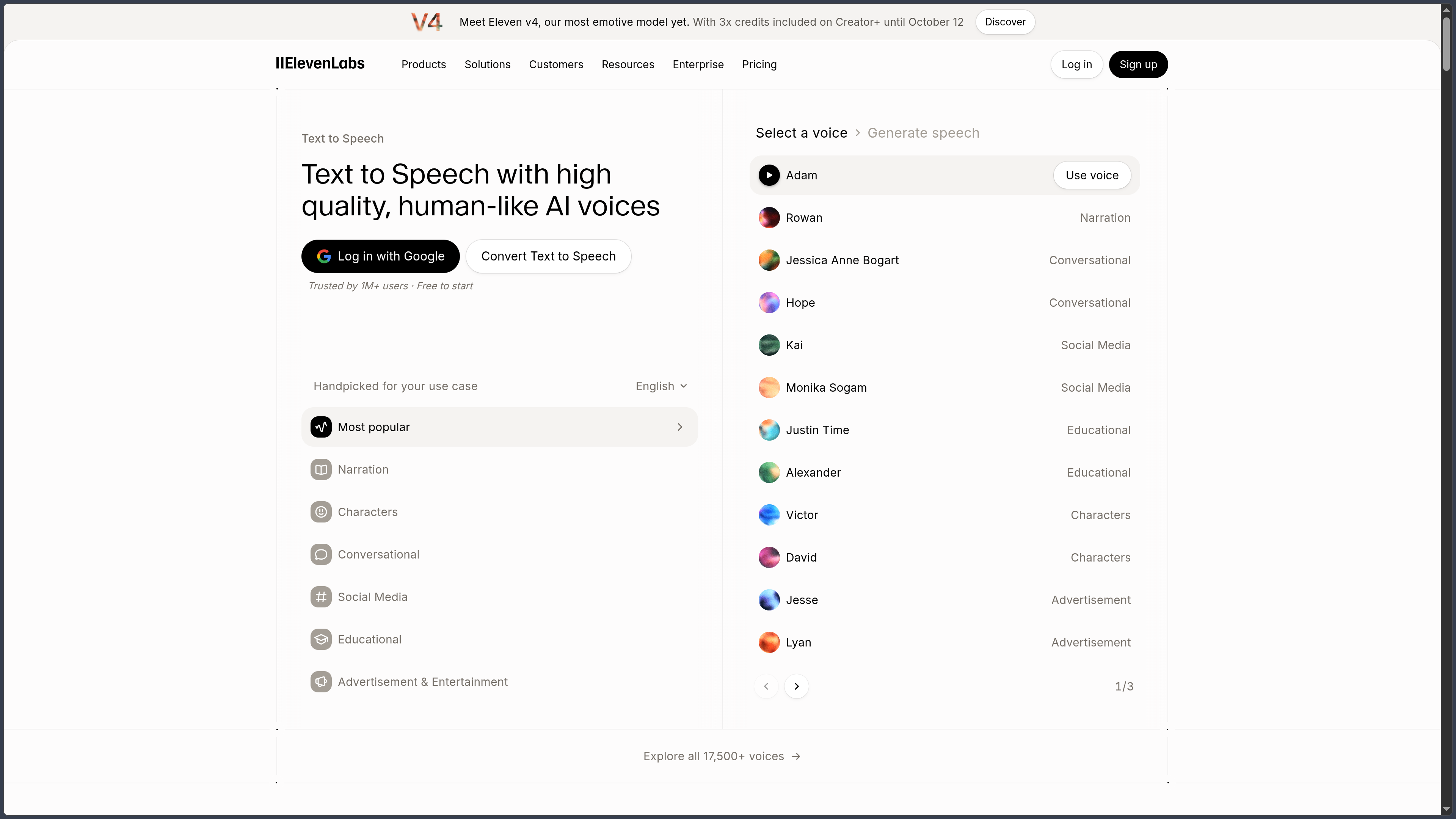
Text to Speech turns text into synthetic speech by interpreting punctuation, context and different tone cues.
Eleven v4 is designed to produce more expressive speech and maintain voice identity more consistently throughout narration or dialogue.
The model can adapt performance to very different styles: calm narration, conversation, strong emotion, fictional characters or more institutional voice-over delivery.
The Eleven v4 family covers more than 90 languages and can preserve the same vocal identity across several languages depending on the voice and project.
Eleven v4 Turbo follows the same approach with reduced latency for conversational or interactive use cases.
Voice Library and voice design
The Voice Library makes it possible to browse different voices available on the platform.
Filters and audio samples help users find a voice suited to a character, narration or production.
When the library does not contain the desired timbre, Voice Design can create a voice from a written description.
A prompt can specify accent, apparent age, pacing, register, personality or performance style, after which ElevenLabs generates several proposals.
Voice Design is particularly useful for quickly exploring a vocal direction, although final consistency depends on the model and the quality of the description.
Voice cloning
ElevenLabs provides two main cloning methods.
Instant Voice Cloning quickly creates a representation of a voice from a limited amount of recorded material. This method is available from the Starter plan.
Professional Voice Cloning uses more data and a more in-depth process in order to achieve a more consistent and faithful reproduction. It is available from the Creator plan.
Quality depends heavily on the source material: background noise, compression, microphone variations or unusual delivery can reduce the fidelity of the result.
Professional cloning also requires voice verification. A user can only directly create a Professional Voice Clone of their own voice; another person must create and verify their own clone before being able to share it.
Speech-to-Speech and Voice Changer
The Voice Changer transforms a spoken recording into another voice while preserving much of the original performance.
Unlike simple Text to Speech, the system can preserve rhythm, pauses, emotion and interpretation from the source recording.
This approach is suitable for characters, dialogue or productions where the actor wants precise control over how a line is performed while using a different vocal identity.
It can also be used to create several characters from a reference performance.
Dubbing and localization
ElevenLabs can translate and dub audio or video files into more than 90 languages.
The system aims to preserve tone, pacing, emotion and the characteristics of each speaker while retaining background audio from the original content.
Automatic dubbing makes it possible to quickly create a first localized version.
Dubbing Studio provides greater control by allowing users to edit transcripts, reassign speakers or regenerate individual segments separately.
This approach can be used for videos, podcasts, training material and other content intended for multiple markets.
Transcription with Scribe
Scribe is ElevenLabs' Speech to Text system.
It converts audio into text in more than 90 languages and can provide precise word-level timestamps.
Speaker diarization can distinguish multiple speakers, while audio tags can identify certain non-verbal events.
Scribe v2 notably adds the ability to provide important terms to recognize along with different features designed for complex transcription.
Transcription can therefore be used both for subtitle creation and for indexing podcasts, meetings, interviews or video content.
Sound effect generation
ElevenLabs can generate sound effects from a text description.
A prompt can request an ambience, a one-off sound or an effect intended for a specific scene.
This feature can be used to support a video, enhance a narration, prepare a game prototype or complete a creation without manually searching a sound library for every effect.
The results remain generative: several attempts may be needed when a sound must follow a precise duration, rhythm or creative intention.
Eleven Music
Eleven Music extends the platform into music generation.
Users can describe genre, mood, instrumentation, structure and optionally lyrics in order to create a complete track.
Recent models support instrumental pieces as well as songs with vocals and multiple languages.
Music v2 and v2.5 also provide more advanced workflows with audio references, section-based generation, lyric editing and modification of selected parts of a track.
This feature is aimed notably at soundtracks for videos, advertising, podcasts, games and other creations requiring original music.
Studio and long-form productions
ElevenLabs Studio provides an environment designed to organize projects that are longer than isolated generations.
It can be used to build a narration, manage several chapters, associate different voices and revise individual sections without regenerating the entire project.
This workflow is particularly suitable for audiobooks, podcasts, training content and other structured productions.
Generation still uses the account's credit system, so large projects can consume available quotas quickly.
ElevenCreative
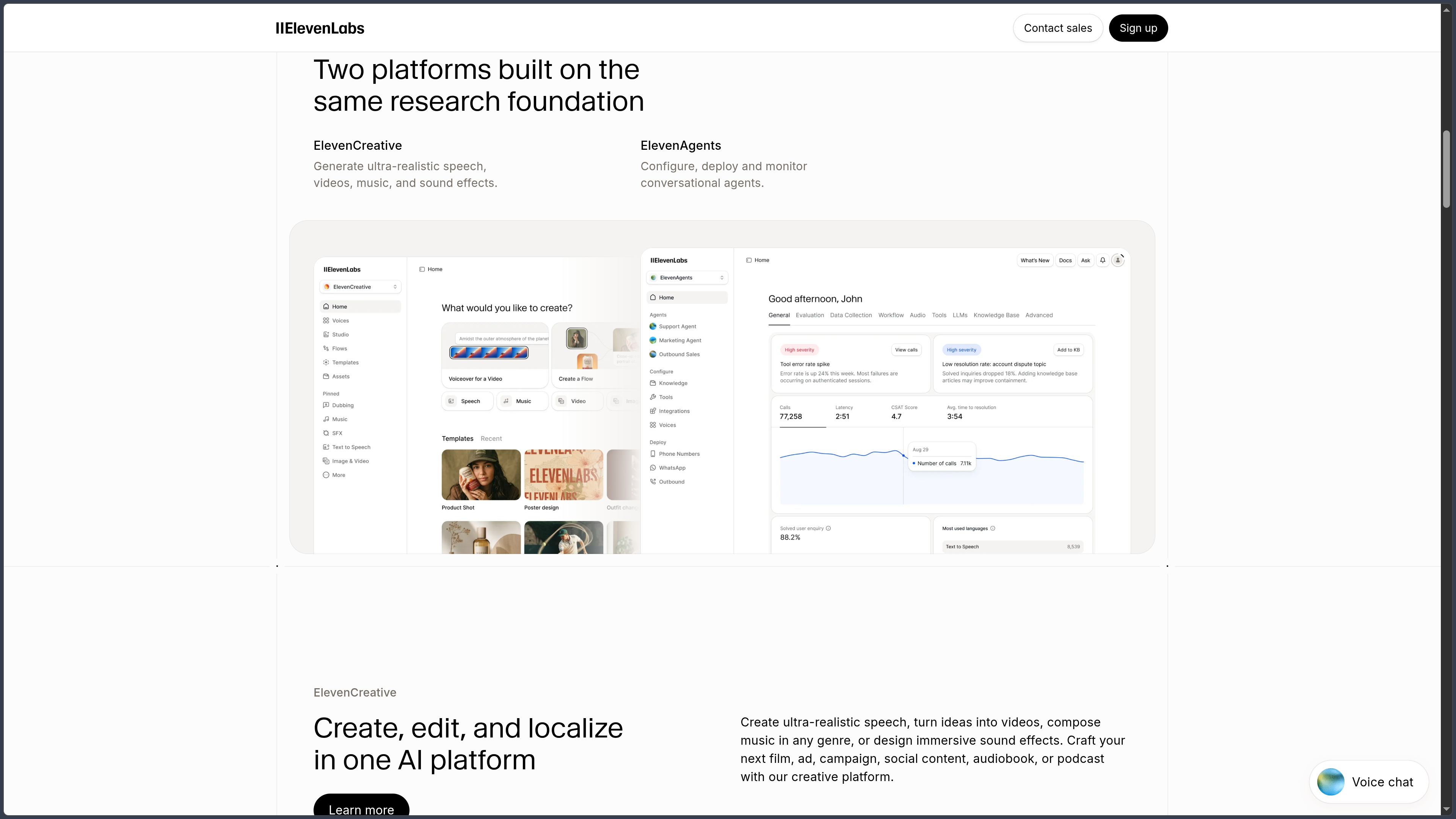
ElevenLabs now brings several capabilities together inside ElevenCreative, an environment for generating, editing and localizing content.
In addition to ElevenLabs voice models, this workspace can integrate music, sound effects and different image and video models.
Templates combine several steps to automate selected workflows, for example creating a visual and then a video accompanied by a voice-over.
This evolution expands ElevenLabs beyond pure audio, although voice technologies remain central to its identity.
API and SDKs
ElevenLabs provides an API for integrating its features into applications, games, Web services or automated pipelines.
Text to Speech, transcription, cloning, speech-to-speech, sound effects, music and several other services expose programmable interfaces.
SDKs simplify integration into different environments, including Python and JavaScript.
Streaming can also begin playing audio before the entire generation is finished, which becomes important for voice assistants, interactive characters and conversational applications.
Use cases
Create a voice-over
A creator can provide a script, choose a voice and adjust the delivery style in order to produce narration for a video, documentary or educational content.
The resulting audio file can then be integrated into editing software.
Produce an audiobook
Studio can organize long-form text, divide it into chapters and use one or several voices.
Eleven v4 notably aims for better voice consistency across long productions and dialogue.
Dub a video
An existing video can be transcribed, translated and recreated in another language.
Dubbing Studio can then be used to manually revise selected passages when translation, timing or performance requires greater control.
Create voices for a video game
Voice Design can be used to explore different character profiles, while Text to Speech and Speech-to-Speech produce dialogue.
The APIs can then integrate generation into a pipeline or, for some projects, into an interactive experience.
Generate sound effects and music
A video project or game prototype can combine narration, sound effects and music within the same ecosystem.
The different generations remain independent and can then be finalized inside specialized audio or video software.
Conclusion
ElevenLabs has evolved from a service mainly known for speech synthesis into a much broader platform focused on AI-based audio creation and processing.
Voice remains its central strength. Eleven v4, Voice Design, voice cloning and Speech-to-Speech cover different ways to create a performance, from straightforward narration to more expressive characters and dialogue.
Dubbing and Scribe extend these tools into localization and transcription, while sound effect generation and Eleven Music now cover a broader part of audio production.
The API also makes these technologies usable beyond the Web interface, particularly in applications, games or automated workflows.
This breadth means users need to understand the credit system, differences between models and the rights associated with each plan.
Voice cloning also requires particular attention: having technical access to a voice does not mean having the right to use it.
For generating voice-overs, creating vocal characters, localizing content, transcribing audio or integrating generative audio into a project, ElevenLabs is now a particularly comprehensive platform.
Points to consider
-
The Free plan does not allow commercial use. Content generated for free is reserved for non-commercial use and requires attribution when published according to ElevenLabs' terms.
-
Paid plans include a commercial license, subject to the service terms, the rights held over the content used and any specific restrictions applying to Beta features.
-
Starter begins at $6 per month and Creator at $22 per month at standard pricing. Temporary promotional offers displayed during certain periods should not be confused with base prices.
-
Credits are shared across different products. Their consumption depends on the feature and model used, so a given quota does not correspond to a fixed audio duration across all use cases.
-
Unused credits from paid subscriptions can roll over within certain limits, while the Free plan does not benefit from this rollover.
-
Voice cloning requires the necessary rights to the voice being used. ElevenLabs' terms notably prohibit unauthorized, deceptive or harmful impersonation.
-
Professional Voice Cloning is restricted to your own voice. Another person must create and verify their own professional clone before they can share it.
-
Automatic tools do not guarantee perfect results. Pronunciations, proper names, emotion, translation, synchronization and speaker identification may require corrections.
-
Eleven v4 is the latest generation as of October 3, 2026. It was launched on September 28, 2026 alongside Eleven v4 Turbo for low-latency use cases.
-
Mobile applications are available on iOS, iPadOS and Android, but the platform's full range of advanced features and professional workflows remains more comfortable through the Web interface or API.
-
ElevenLabs prices are displayed in US dollars and exclude taxes. The final billed amount may therefore vary depending on applicable taxation.