
Overview
Dribbble is a platform dedicated to designers and visual creative professionals. Founded in 2009, it first became known as a community where designers shared short previews of their work, called Shots. The service has since expanded around a broader goal: showcasing work, gaining visibility and finding assignments or clients.
The platform is particularly strong in UI/UX design, web and mobile design, product design, branding, illustration, motion design and graphic design. Profiles function as portfolios, while search tools make it possible to browse creations, designers, studios and services by specialty.
Dribbble is therefore less generalist than Behance or DeviantArt. Its value mainly comes from digital design professions and from connecting creators with clients.
Features
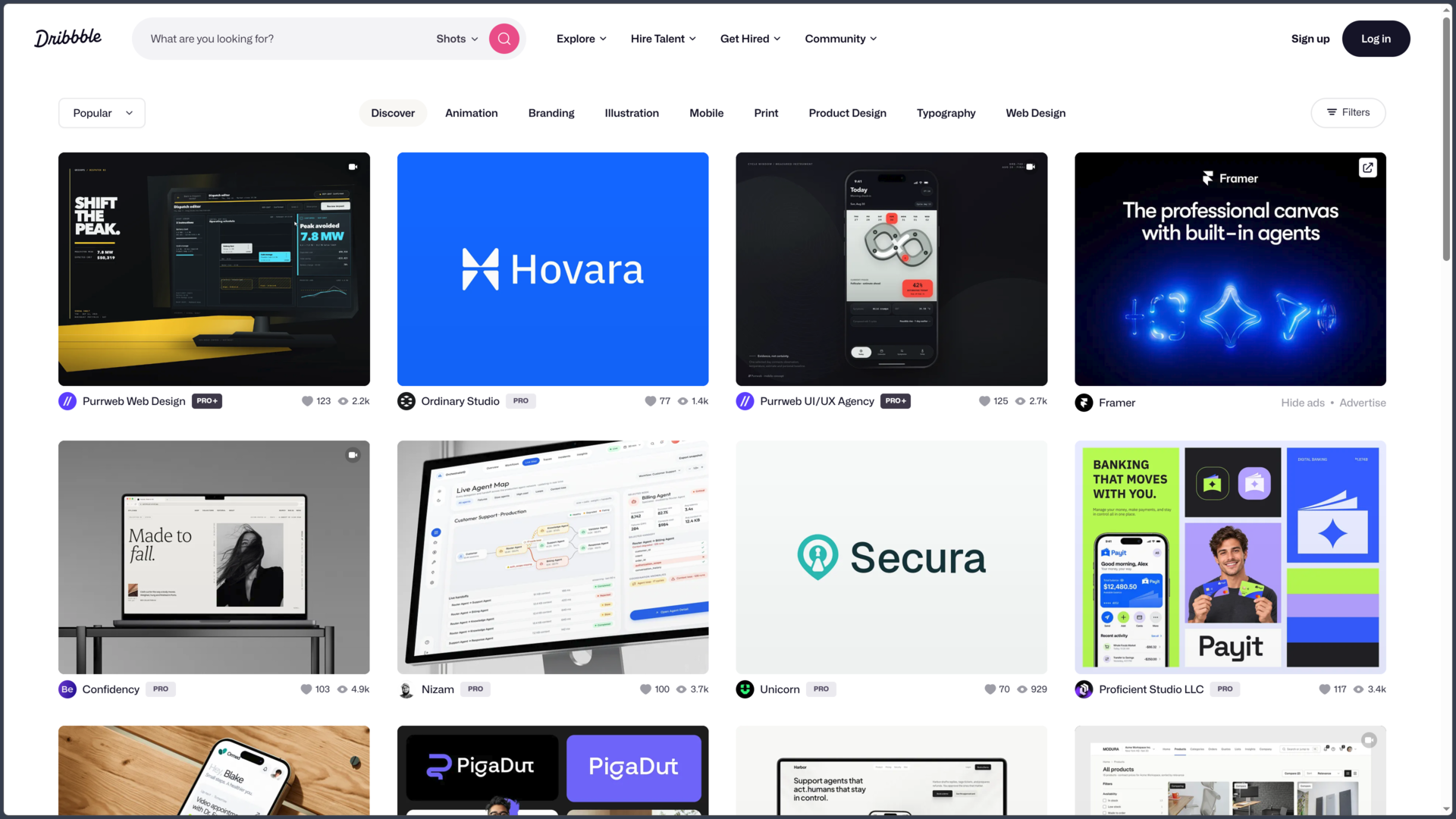
Portfolio, Shots and discovery
Designers can publish their projects as Shots accompanied by images, animations, descriptions and information about the work presented.
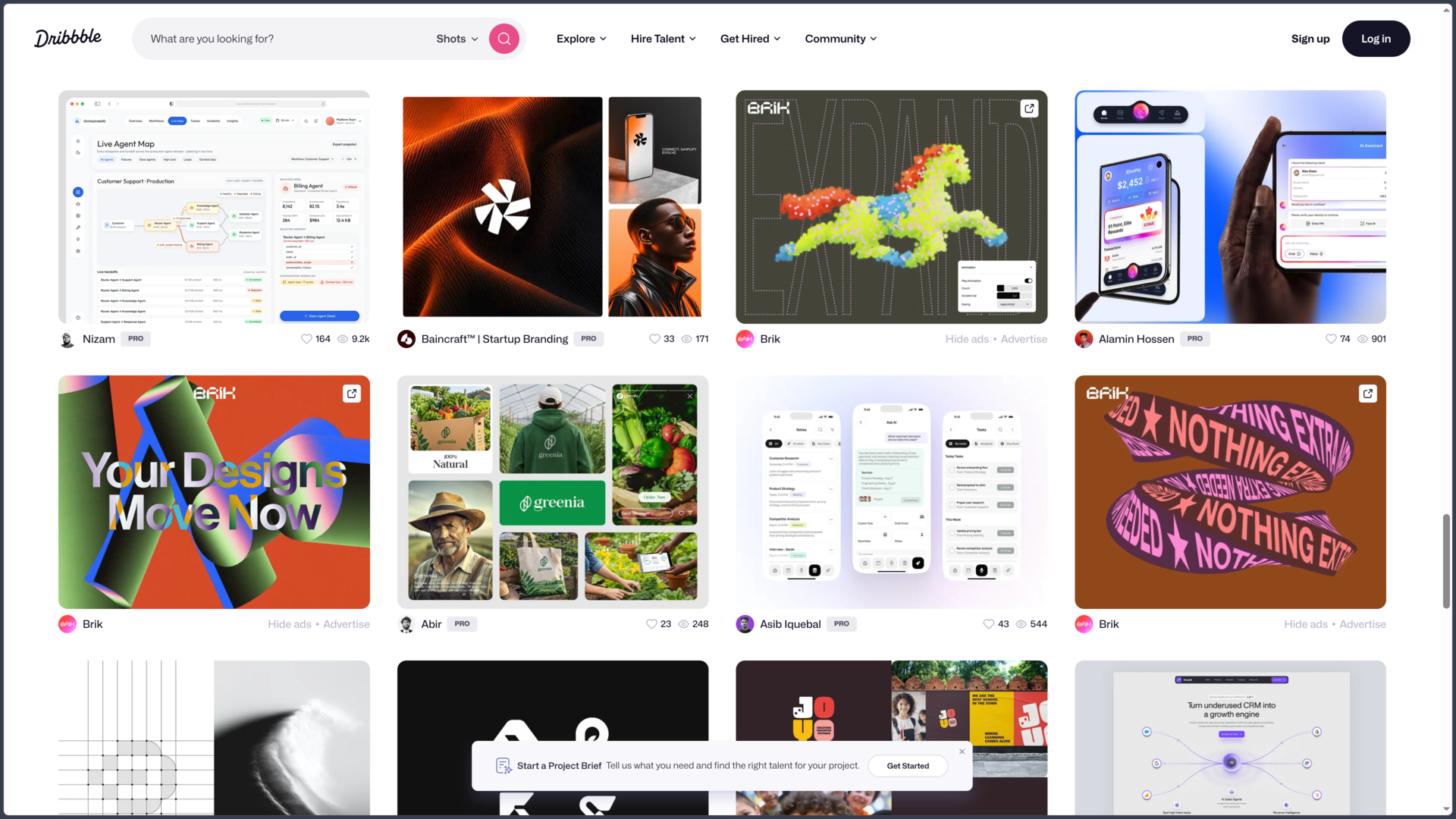
The profile gathers these creations together and makes it possible to gradually build a professional showcase. Likes, follows and comments add a community dimension, while searches by category and keyword make it easier to discover new designers.
Dribbble also remains an important source of inspiration for observing trends in interface design, branding, illustration, animation and digital product design.
Finding clients and offering services
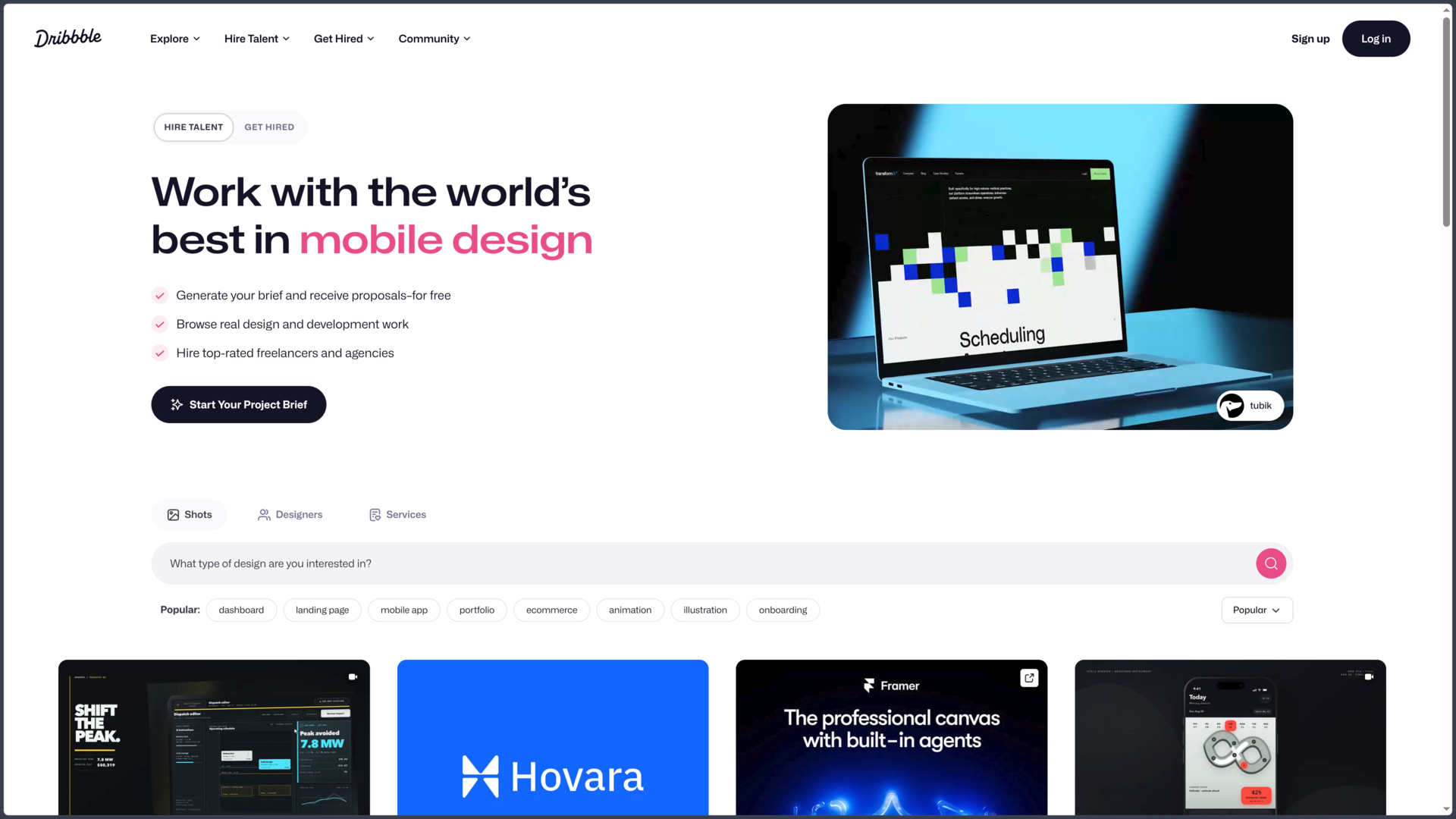
Dribbble is no longer limited to showcasing work. Designers can directly present services such as logo creation, interface design, branding, illustration or web development.
Clients can search for a professional, review previous work and ratings, then submit a project request. Dribbble can handle payment and hold the funds until the assignment is completed.
Project Briefs also allow clients to publish a need that designers can answer with a proposal.
This evolution now brings Dribbble closer to a freelance marketplace specialized in creative professions.
Searching for design jobs
Dribbble also includes a section dedicated to job listings.
Companies can publish full-time, part-time, contract or remote positions. For designers, the advantage is being able to keep their portfolio and professional search within the same environment.
The platform is particularly relevant for UI/UX, web, product, branding and graphic design roles rather than for every artistic profession.
Dribbble Pro for increasing visibility
Basic use remains free, while Dribbble Pro adds features aimed at designers actively looking for clients.
At the time of this verification, annual plans are displayed at $4/month for Lite, $8/month for Standard and $99/month for Plus.
Depending on the plan, Pro notably provides better positioning in searches, more service listings, access to more Project Briefs, a portfolio website and benefits on platform fees.
The value of Pro therefore mainly depends on professional use of Dribbble: for simply publishing a few pieces and looking for inspiration, the free account may be enough.
A restrictive policy on fully AI-generated creations
Dribbble distinguishes between using AI as an assistance tool and content entirely produced by a generator.
Its current community guidelines state that users must not publish work that is entirely AI-generated. When AI has only contributed to the creative process, Dribbble recommends mentioning it in the description.
This position distinguishes the platform from services such as DeviantArt or ArtStation, where generative content can be published under specific labeling rules.
Use cases
Presenting a UI/UX or web portfolio
A designer can select their best screens, prototypes, animations or visual identities and organize them on their profile.
Short Shots can attract attention, while more complete projects can provide additional context about the design work.
The profile then becomes a showcase that can easily be shared with a recruiter or client.
Finding a specialized freelancer
A company looking for a designer for a landing page, logo or application can directly browse profiles matching that specialty.
Previous work makes it possible to quickly assess whether the designer’s style and level match the project before requesting a proposal.
Dribbble has an advantage here over a general-purpose marketplace: the search starts directly from the visual work.
Following design trends
Even without publishing a portfolio, Dribbble can serve as an inspiration library.
Searching for dashboards, mobile applications, logos, SaaS interfaces or animations quickly reveals hundreds of visual proposals.
This wealth of material should be used as reference rather than as a library of designs to reproduce: published work remains the property of its creators.
Conclusion
Dribbble has evolved from a designer community centered on Shots into a more complete platform combining portfolio, inspiration and freelance activity.
Its main advantage remains its specialization. While DeviantArt welcomes almost every form of creation and ArtStation is particularly strong in the video game and film industries, Dribbble focuses more heavily on digital design, UI/UX, product, branding and web design.
This positioning makes the platform useful for showcasing visual work, finding designers and gradually turning a portfolio into a client acquisition tool.
The free account is enough to discover the community and start publishing. Pro mainly becomes worthwhile when a designer is actively looking for assignments and wants to improve visibility among clients.
Points to consider
-
Dribbble currently operates mainly as a Web service: the official iOS and Android applications were discontinued in 2021.
-
The free plan allows users to start building a profile and publishing work, while Pro mainly adds visibility and client acquisition tools.
-
The Pro prices verified in September 2026 are $4/month for Lite, $8/month for Standard and $99/month for Plus when billed annually. Monthly pricing may differ.
-
Dribbble is highly specialized in design: it will generally be more relevant for UI/UX, web, branding or product design than for photography, traditional painting or artistic 3D.
-
Clients hiring a freelancer through Dribbble may pay platform fees of 2% to 5% depending on project size, while certain Pro subscriptions may reduce or remove some fees for designers.
-
Traditional job listings are separate from freelance assignments. Companies currently pay to publish a listing on the job board.
-
Fully AI-generated content is not allowed under the current community guidelines. Partial use of AI should ideally be disclosed in the description.
-
Published creations remain protected by their creators’ rights: using Dribbble as a source of inspiration does not authorize copying or reusing a design.