
Overview
Debian is a community-driven GNU/Linux distribution developed by the Debian Project. Created in 1993, the project has become one of the major foundations of the Linux world, both as a system directly used on computers and servers and as a technical base for other distributions. Ubuntu, Kali Linux, Tails and PureOS, among others, build on work carried out in Debian before adding their own choices and objectives.
This importance does not come from an effort to systematically provide the newest software. Debian was instead built around a different idea: allowing the system to evolve slowly enough for a release declared stable to genuinely remain stable. Once published, the Stable branch mainly receives security fixes and corrections for important problems rather than a continuous stream of new features that could alter the system’s behavior.
This philosophy explains Debian’s reputation on servers and machines that need to remain predictable. An application installed today is less likely to change abruptly after a routine update. When a vulnerability appears, Debian often prefers to backport the fix to the version already present rather than immediately replace the software with an entirely new generation.
The project is not limited to this stable branch, however. Debian permanently maintains Stable, Testing and Unstable. Stable is the recommended production release. Testing prepares the next generation and receives newer software after it has passed through Unstable. Unstable, also known as Sid, is where most active development takes place and where many new versions arrive first.
This organization allows Debian to serve several types of users without turning Stable into a rolling release. A server can remain on the most conservative branch, while a developer or experienced user can choose Testing to gain faster access to newer components, while accepting a different level of predictability.
The current stable release is Debian 13.6 “Trixie”. Debian 13.0 was released on August 9, 2025, and its sixth revision, 13.6, on July 11, 2026. Its support cycle extends over five years: three years of full support followed by two years of Long Term Support. Debian 13 is therefore expected to be supported until June 30, 2030.
Features
A Stable branch that prioritizes continuity
The meaning of “stable” in Debian is less about the total absence of bugs than about the intention to limit unexpected changes after release. The versions of many applications therefore remain close to those selected when the distribution was published.
When a security problem appears, Debian can integrate the required fix into that version rather than automatically move to the latest version available from the original developer. This method reduces the risk that a security fix also brings a new interface, configuration change or incompatibility with another component.
Point releases such as Debian 13.6 mainly gather security fixes and important corrections that have already been published. They are not a new generation of the system and do not require reinstallation when Debian is already kept up to date.
To obtain certain newer applications while remaining on Stable, users can also rely on Backports. These provide rebuilt versions coming mainly from Testing for specific needs without turning the whole machine into a Testing system.
APT and a particularly extensive software catalog
Debian uses DEB packages, managed at the system level by dpkg and, in everyday use, mainly through APT. APT resolves dependencies, retrieves packages from configured repositories and allows users to install, remove or update the system from the command line or through various graphical tools.
Debian 13 contains around 69,830 packages. This number does not represent the same number of independent graphical applications: it also includes libraries, system tools, drivers, runtimes, extensions, services and development components. It nevertheless illustrates the scale of the integration work carried out by the project.
This wealth of software often avoids having to manually search for a program on the Web and then run a different installer for every publisher. Web servers, databases, programming languages, desktop environments, editors, networking tools and thousands of other components can be installed from the same infrastructure.
The model remains open enough to supplement these repositories when needed. Flatpak can, for example, be added for certain desktop applications, while third-party repositories or language-specific package managers can cover needs that go beyond the versions provided by Stable.
Choosing a desktop environment instead of receiving an imposed interface
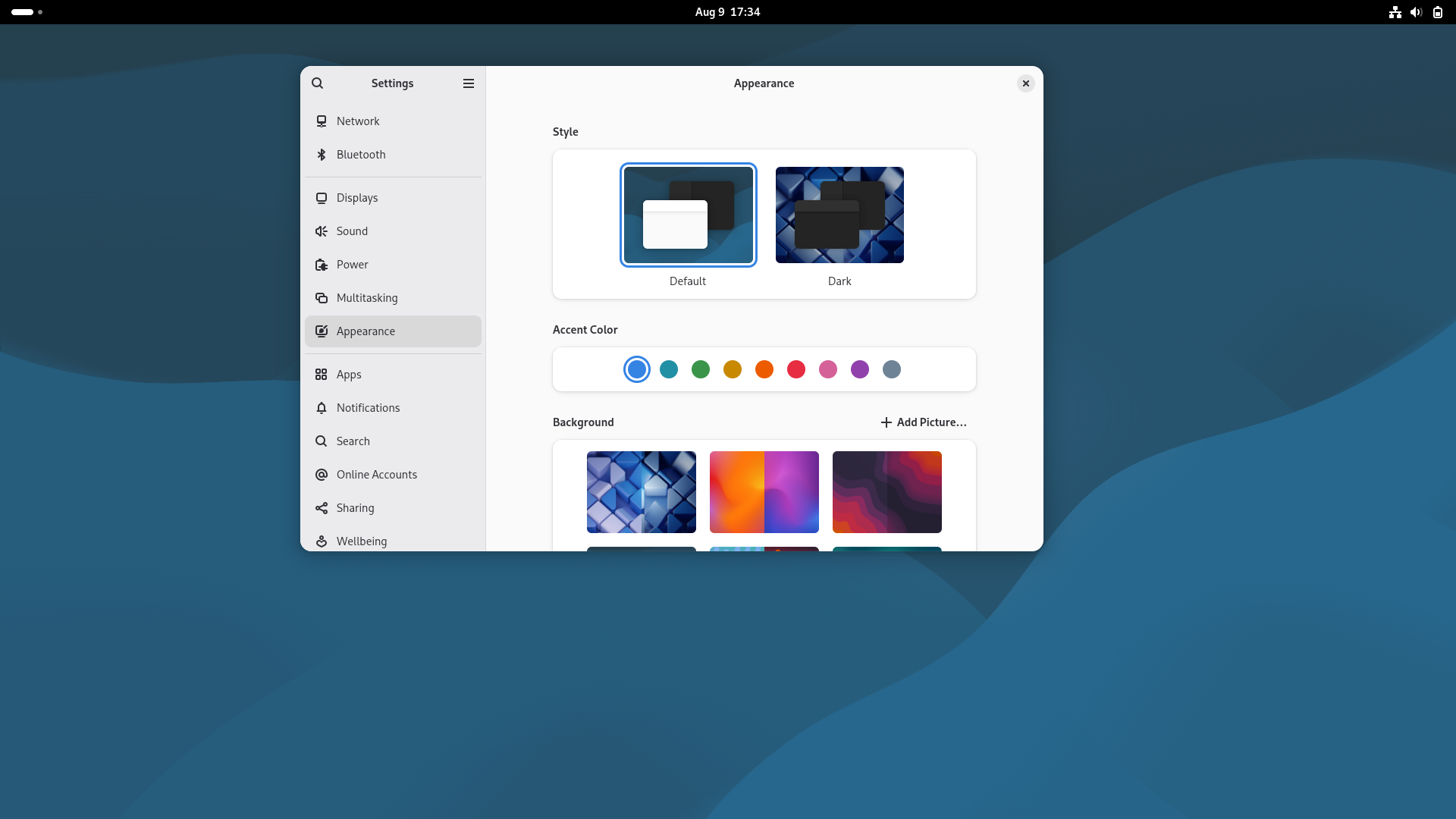
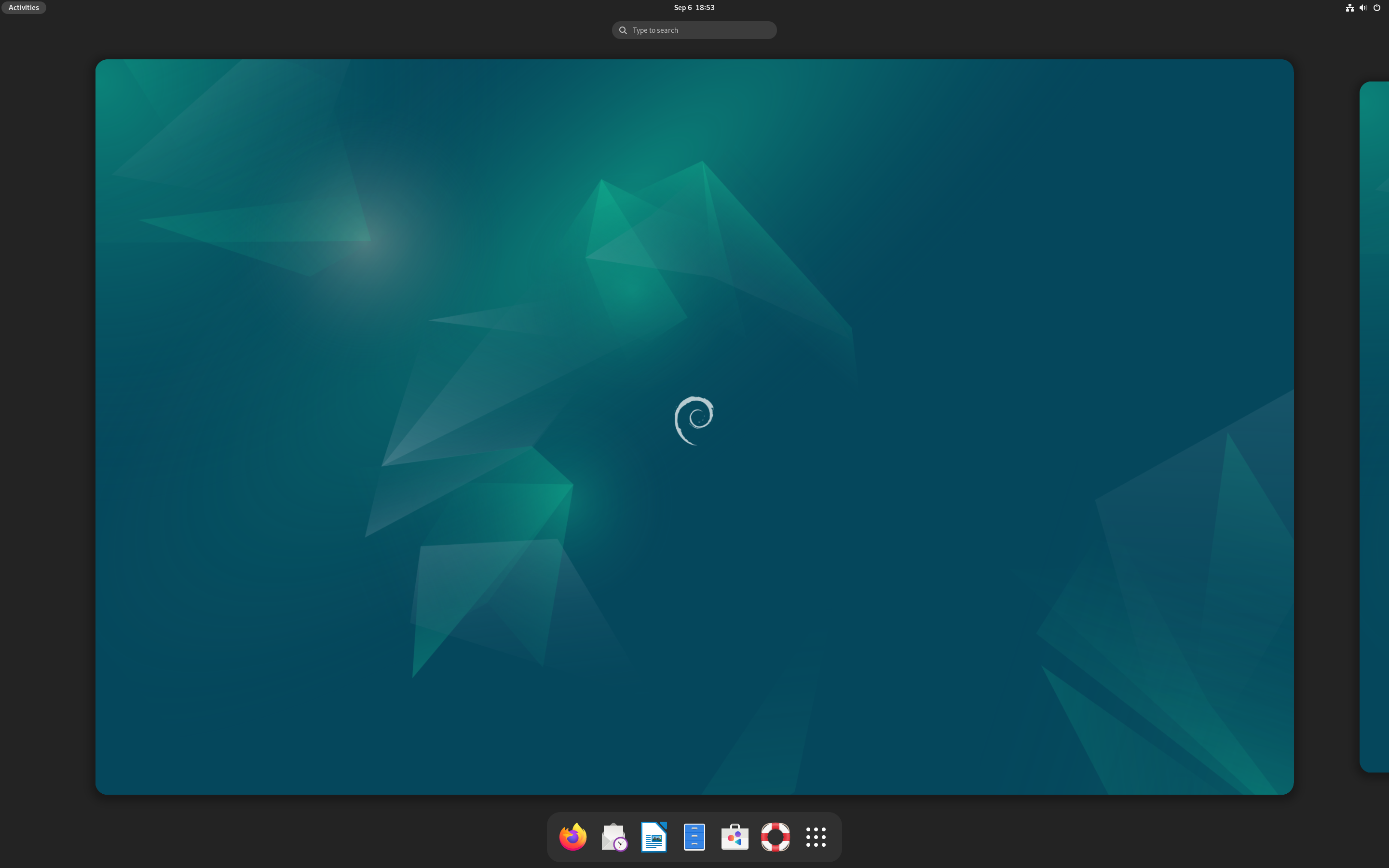
Debian is not tied to a single graphical environment. Debian 13 notably provides GNOME 48, KDE Plasma 6.3, Xfce 4.20, LXQt 2.1 and LXDE, with additional desktops available from the repositories.
GNOME offers a clean interface organized around workspaces and the Activities view. KDE Plasma takes a much more customizable approach and is generally more familiar to users coming from Windows. Xfce and LXQt place greater emphasis on lightweight operation, while other environments can meet still different preferences.
This freedom changes the way Debian can be approached. Two installations using exactly the same base can feel like very different systems depending on the chosen desktop, window manager and applications.
Live images also make it possible to try several environments before installation. Debian can therefore be used as a relatively ready-to-use system or as a foundation from which users progressively build their own workstation.
A free-software policy that genuinely structures the project
Debian does not treat open source as a simple marketing characteristic. The Debian Social Contract and the Debian Free Software Guidelines, or DFSG, define the criteria used to determine what can be considered free within the official distribution.
The main section contains software that complies with these principles. Debian also provides separate sections such as contrib, non-free and non-free-firmware for components that cannot be treated in the same way.
This distinction allows the project to maintain a clear position on free software while acknowledging the realities of modern hardware. Some Wi-Fi cards, GPUs or other devices require firmware whose code cannot be freely redistributed or modified under the same conditions as the rest of the system.
Since Debian 12, redistributable firmware from non-free-firmware can be included in official installation images. Debian can then detect when some of it is required and install it automatically, making installation on contemporary hardware significantly easier than with older generations.
A system equally capable on the desktop and the server
Debian does not publish an entirely separate distribution for servers. The same base can be installed with a complete graphical environment or with only the components required for a remote machine.
A server can therefore remain extremely minimal and then receive Apache, Nginx, PostgreSQL, MariaDB, SSH, Podman or other services from the repositories. Administration relies on the same APT, systemd and update mechanisms used on a workstation.
This consistency is useful when the same person manages several machines. Commands, system organization and package formats remain coherent across a personal computer, a home server and a cloud instance.
Debian also provides images for several cloud environments and is a common foundation for containers. Its stability and the size of its repositories explain why it remains widely used in hosting, self-hosting and Linux infrastructure.
Running on more than a conventional x86 PC
Debian has a long tradition of supporting multiple hardware architectures. At release, Debian 13 officially supports amd64, arm64, armhf, ppc64el, riscv64 and s390x for new installations.
This diversity makes it possible to use Debian on very different machines: conventional PCs, ARM servers, certain development boards, POWER systems, RISC-V platforms or IBM mainframes.
Support for multiple architectures is also valuable to developers and projects that want to distribute the same software across several processor families. Debian’s build infrastructure compiles and tracks packages for these platforms from the same project.
Debian 13 nevertheless marks an important change: the 32-bit PC i386 architecture is no longer offered for new complete installations. It remains available as a coarchitecture on amd64 to run certain 32-bit applications, but Debian should no longer be considered a current solution for installing a complete new system on an old i386-only PC.
A foundation that feeds part of the Linux ecosystem
Debian’s influence extends far beyond its own users. The project provides a package base, tools, quality policies and infrastructure complete enough for other distributions to build on rather than start from scratch.
Ubuntu is probably the best-known example, but Debian also lists projects such as Kali Linux, Tails, PureOS and Grml among its derivatives. Each takes part of Debian’s work and adapts it to a different audience or mission.
This relationship is not designed only as one-way inheritance. Debian encourages derivative distributions to send their fixes and improvements back to Debian or upstream projects so that developments can benefit the wider ecosystem.
For a developer or organization, this position makes Debian particularly interesting as a foundation. Building a specialized system can then consist of selecting and configuring a vast existing base rather than maintaining every component directly from its original source.
Use cases
Installing a Linux workstation designed to remain predictable
A user who works on their computer every day may prefer their browser, desktop environment and tools to change in a controlled way rather than constantly receive the latest versions.
Debian Stable responds precisely to this need. Once the system is configured, routine updates mainly concern security and important corrections. Deeper changes arrive with the next major release and can then be prepared as a genuine migration.
This stability is particularly suitable for machines used for work, writing, development or service administration, where the system should remain a support tool rather than a permanent subject of experimentation.
Building a long-lasting server
Debian can be installed without a graphical environment and retain only the services that are actually required. A machine can host a website, database, storage, containers or various self-hosted tools while keeping a relatively minimal base.
Debian 13’s five-year cycle limits the frequency of major migrations. Security fixes continue to be provided during the support period, while version stability reduces changes that could affect existing configurations.
For infrastructure requiring an even longer lifespan or contractual commercial support, other solutions may be more appropriate. But for many personal, community, development or production servers, Debian provides a particularly solid foundation.
Creating a reproducible development environment
A developer can install Python, GCC, Rust, OpenJDK, PostgreSQL, MariaDB, Nginx, Git and many other tools directly from the repositories. Debian 13, for example, provides Python 3.13, GCC 14.2, OpenJDK 21 and PostgreSQL 17 in its current generation.
The value is not only in having access to this software. Its integration into a stable release provides a common base that several machines can reproduce over a long period.
When a project requires a more specific or more recent version, containers, virtual environments, Backports or language-specific package managers can extend the Debian base without necessarily modifying the entire system.
This combination works particularly well for developers who want a predictable host while isolating changing dependencies inside their projects.
Using Testing for a more current workstation
Debian Stable is not the only way to use the distribution. An experienced user who wants newer versions can choose Testing, currently intended to become the next Stable release.
Software arrives there after passing through certain stages in Unstable. Testing therefore offers a different compromise: more novelty than Stable, but a moving base that is still preparing for its future release.
This choice should not simply be presented as “Debian, but newer.” Security handling and package transitions are not identical to Stable, and periods of major change can cause more problems.
Testing is therefore best suited to someone who understands this compromise and accepts participating more directly in Debian’s living development cycle.
Building a specialized system or distribution
An organization can use Debian as the foundation for an appliance, server image, educational environment or new distribution.
The DEB format, APT, repositories, build tools and tens of thousands of packages already exist. The project can therefore focus its work on its particular objective instead of maintaining the kernel, libraries, compilers and every required application itself.
The large number of Debian-derived distributions shows how deeply this foundation role is part of its identity. Debian is not only a system that can be installed: it is also infrastructure on which other systems can be built.
Conclusion
Debian and Fedora represent two fairly different ways of building a major community-driven distribution. Fedora seeks to bring users closer to recent technologies quickly while publishing regular releases. Debian Stable places greater emphasis on the continuity of a generation once it has been declared ready.
This restraint explains part of its longevity. Stable packages are not always the newest a few months after release, but this is not accidental delay: it is the result of a deliberate compromise between novelty and predictability. Important fixes continue to arrive without constantly transforming the environment on which applications depend.
Debian also has a depth that is difficult to reduce to its image as a server distribution. Several desktop environments, nearly 70,000 packages, numerous architectures, more rapidly evolving branches and a central role in the creation of other distributions give it a very broad reach.
This versatility can also make the initial choices less obvious. Debian does not completely decide for the user which desktop to adopt, which proprietary software to add or how far to favor Stable over Testing. It provides a solid foundation, but leaves more decisions open than some distributions designed around a highly directed experience.
For people who want a free, durable, extensively documented Linux system that is stable enough to become almost invisible once configured, Debian remains one of the most coherent references. Its value is not in being spectacular with every new release, but in providing a foundation on which people can continue working for a long time.
Points to consider
-
Stable does not aim to permanently provide the latest software versions: once Debian is released, packages deliberately change very little. Security fixes are often backported rather than replaced by an entirely new generation. Users who systematically prioritize novelty may prefer Testing, Backports or another distribution.
-
Debian 13 has a five-year support cycle: full support is planned until August 9, 2028, followed by Long Term Support until June 30, 2030. Some architectures may, however, no longer be covered throughout the entire LTS period.
-
Testing and Unstable do not provide the same guarantees as Stable: Testing receives newer software but may experience delays in receiving certain security fixes or complex package transitions. Unstable is directly the active development branch.
-
Free software remains the central principle, but some hardware realities require non-free components: modern Debian images can include firmware from
non-free-firmwarewhen needed for hardware operation. This improves installation while maintaining an important distinction between the free system inmainand these components. -
The desktop choice strongly influences the experience: GNOME, KDE Plasma, Xfce, LXQt and other environments are available. Criticism aimed at the interface of one Debian installation therefore does not necessarily apply to Debian as a whole.
-
Installation offers many possibilities but may feel less guided than some mainstream distributions: the choice of images, desktops and components provides considerable flexibility, but a beginner may have more decisions to make than with a distribution that imposes a single configuration.
-
New 32-bit i386 installations are no longer supported by Debian 13: i386 remains usable as a coarchitecture on amd64 systems for certain 32-bit software, but an old computer that is exclusively 32-bit now requires another strategy.
-
Hardware compatibility should still be checked before a complete migration: installation images now include the non-free firmware Debian is allowed to redistribute, which significantly improves Wi-Fi and peripheral support, but not all hardware and proprietary drivers are necessarily supported in the same way.
-
Official support is mainly community-based: Debian provides extensive documentation, mailing lists, forums, a public bug-tracking system and a large community. A company requiring a commercial contract with service commitments will nevertheless need to use a third-party provider or choose an offering specifically designed for that type of support.