
Presentation
C++ is a compiled general-purpose programming language, particularly suited to software requiring performance, resource control and close interaction with hardware.
Created from C by Bjarne Stroustrup in the early 1980s, it gradually incorporated object-oriented programming, generic programming, lambda functions, compile-time computation, concurrency and a substantial standard library.
C++ is defined by an ISO standard rather than by a single official implementation. A program can therefore be compiled with different toolchains such as GCC, Clang or Microsoft Visual C++.
The language is used in operating systems, game engines, graphics software, browsers, databases, embedded applications, scientific tools and many desktop applications.
Its philosophy is based on a particular balance: providing high-level abstractions while allowing developers to retain precise control over memory, data representation and performance.
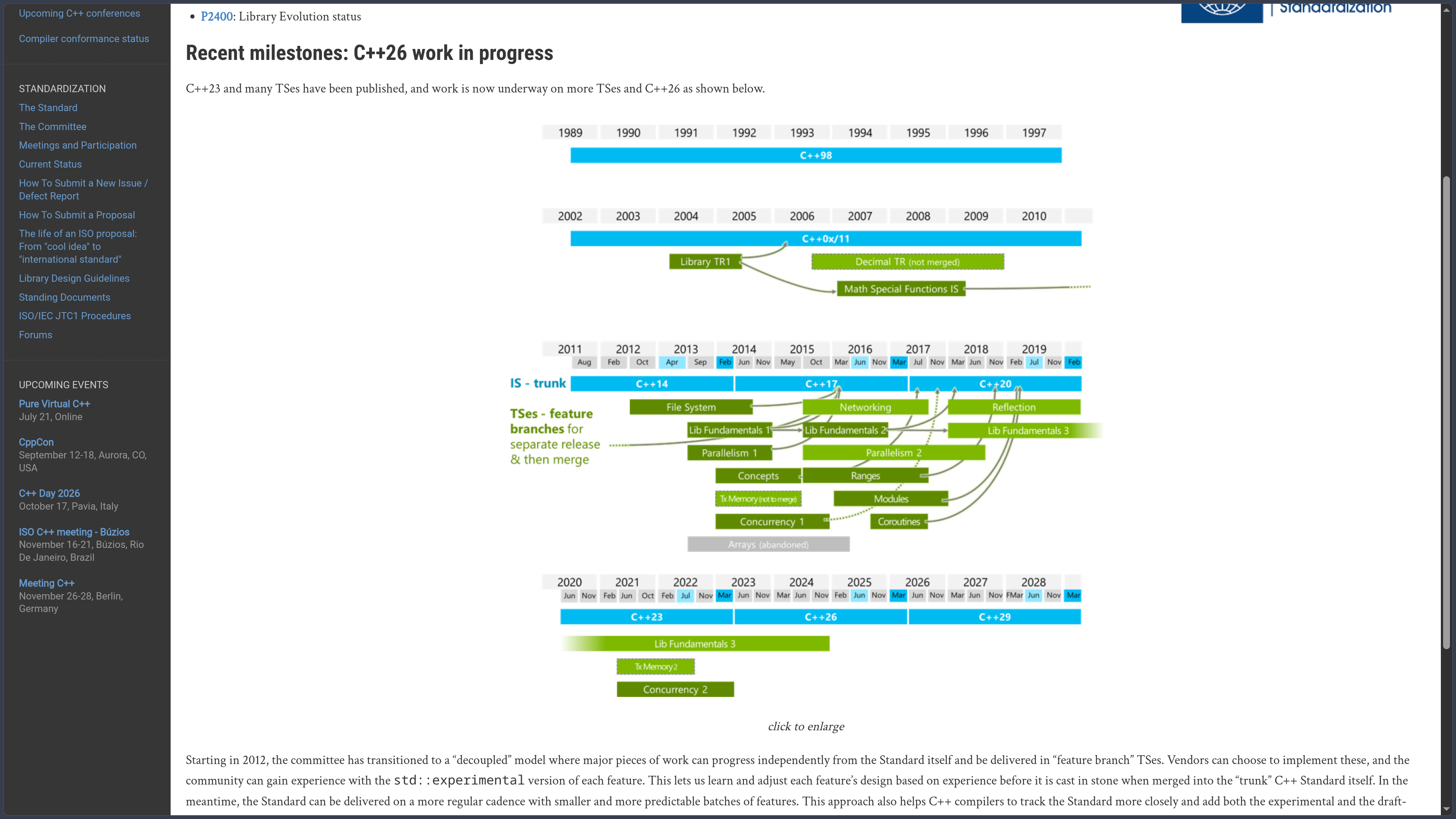
As of October 3, 2026, the published reference standard remains C++23, officially ISO/IEC 14882:2024. The future revision commonly known as C++26 is still undergoing standardization.
Features
Native compilation and performance
C++ is generally compiled directly into machine code before execution.
This approach allows the compiler to perform numerous optimizations and gives developers significant control over data representation and resource usage.
The language is therefore well suited to programs where latency, memory consumption or throughput are important constraints.
Actual performance nevertheless depends heavily on program architecture, compiler, optimization options and the libraries being used.
Resource management and RAII
C++ allows direct control over the lifetime of objects and resources.
The RAII — Resource Acquisition Is Initialization principle associates a resource with the lifetime of an object. When that object is destroyed, its destructor can automatically release memory, files, locks or other associated resources.
The standard library also provides smart pointers such as std::unique_ptr and std::shared_ptr to reduce the need for manual memory management.
C++ nevertheless still allows raw pointers and certain dangerous operations, so memory safety depends heavily on how the program is designed.
Object-oriented programming
C++ supports classes, encapsulation, inheritance and polymorphism.
A class can group data and behavior, define its construction and destruction rules and expose only the operations required for its use.
The language does not, however, force an object-oriented architecture.
A project can combine procedural programming, objects, generic functions and other styles according to its needs.
Templates and generic programming
Templates make it possible to write functions and types that work with several categories of data without duplicating their implementation.
They form one of the foundations of generic programming in C++.
This approach is notably used by containers and algorithms in the standard library.
Templates are resolved mainly at compile time, allowing high-performance abstractions but potentially increasing the complexity of error messages and compilation times.
Standard library
C++ provides a broad standard library.
It notably includes strings, arrays, vectors, lists, maps, sets, algorithms, iterators, file handling, threads, random-number facilities, dates and synchronization tools.
What is still commonly called the STL today mainly corresponds to the containers, iterators and algorithms integrated into this standard library.
C++23 further expands this set with elements such as std::expected, std::print, std::mdspan and new operations for ranges.
Concepts, ranges and modern C++
Modern versions of the language have introduced mechanisms intended to make generic code more expressive.
Concepts make it possible to define more clearly the constraints expected by a template.
Ranges simplify the composition of operations on data sequences without systematically writing intermediate loops.
These features complement auto, lambdas, move semantics, constexpr, structured bindings and other elements gradually introduced since C++11.
Modern C++ can therefore differ significantly from the style of C++ code commonly written in the early 2000s.
Concurrency
The standard library provides primitives for developing concurrent programs.
Threads, mutexes, condition variables, atomics, futures and other mechanisms make it possible to distribute certain processing tasks.
C++ gives programmers a great deal of control, but this freedom also means that concurrent access, synchronization and data lifetime must be managed carefully.
Data races and deadlocks remain possible when a concurrent architecture is incorrect.
Modules
Modules, introduced with C++20, provide a modern alternative to some traditional uses of header files and the preprocessor.
They are intended in particular to structure dependencies more clearly and reduce certain compilation costs.
Their adoption still depends strongly on the compiler, build system and libraries in use.
Headers and modules can therefore continue to coexist in existing projects.
Coroutines
C++ supports coroutines, which allow execution of a function to be suspended and later resumed.
They can be used to build asynchronous systems, generators or event processing without manually organizing all logic around callbacks.
The language mainly provides the fundamental mechanisms; higher-level abstractions depend largely on the libraries being used.
Compilation tools
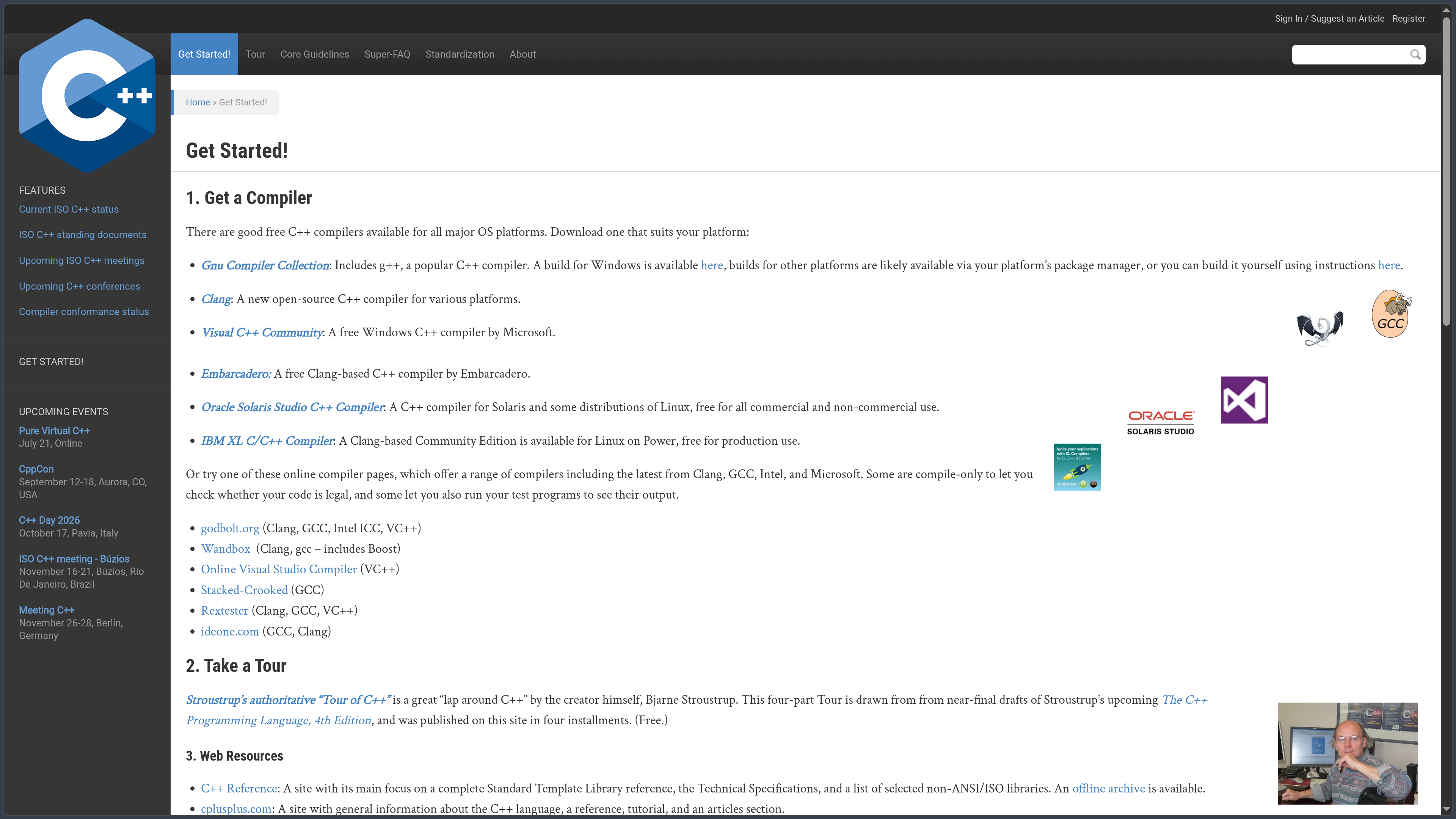
C++ does not impose a single official compiler.
GCC, Clang and Microsoft Visual C++ are among the main toolchains used on modern systems.
Each compiler follows its own schedule for implementing the different versions of the standard.
A feature belonging to a recent standard may therefore be available in one compiler but not yet fully supported in another.
Build systems and dependency management
Unlike Rust with Cargo, C++ does not provide a single project and package manager imposed by the language.
Tools such as CMake or Meson can handle project configuration and builds.
Package managers such as Conan or vcpkg make it easier to install external libraries.
This diversity provides considerable freedom but also makes the C++ environment less uniform than ecosystems with an integrated official toolchain.
Interoperability with C
C++ retains a strong historical relationship with C and can interface with libraries exposing a C ABI.
This makes it easier to use system libraries and integrate C++ into large existing codebases.
However, C and C++ are now two distinct languages: a valid C program is not necessarily a valid C++ program, and vice versa.
C++23 and C++26
C++23 is currently the latest published ISO standard.
It notably continues the evolution of the standard library, ranges, compile-time computation and generic programming.
The next generation, C++26, is still at the draft international standard stage.
It prepares major developments, particularly around static reflection, contracts and new library features.
Some compilers already make it possible to experiment with part of these features, but support remains incomplete and they should not yet be considered a universal production baseline.
Use cases
Develop a game engine
C++ remains particularly prominent in the development of game engines and components requiring high performance.
Engines such as Unreal Engine make extensive use of C++ for their native systems.
The language allows precise control over memory, data structures, rendering, physics and other performance-sensitive elements.
Create native software
C++ can be used to develop desktop applications, professional tools or cross-platform components compiled directly for the target system.
Many libraries can add graphical interfaces, audio, networking or multimedia processing.
Develop embedded systems
Its control over resources and lack of a mandatory garbage collector make C++ suitable for many embedded systems.
It can be used on devices with limited memory and computing capabilities.
The level of support nevertheless depends on the available platform and toolchain.
Build high-performance software
Scientific computing, simulation, graphics rendering, databases and network infrastructure can use C++ when performance is a major constraint.
The most critical components can be optimized very precisely while retaining higher-level abstractions elsewhere in the program.
Develop cross-platform libraries
C++ is frequently used to create a central library shared by several applications or systems.
The same codebase can be compiled for Windows, macOS, Linux or other platforms with limited adaptations when the dependencies being used are themselves cross-platform.
Conclusion
C++ remains a major language for software requiring performance, resource control and low-level access.
Its longevity has allowed it to build a broad ecosystem while continuing to evolve with concepts, ranges, modules, coroutines and an increasingly rich standard library.
This power nevertheless comes with substantial complexity. The language offers several ways to perform the same task and retains historical mechanisms that can cause memory errors or undefined behavior when misused.
Modern C++ therefore generally encourages RAII, standard containers, smart pointers and better-typed abstractions rather than systematic manual management.
For developing game engines, native software, systems, embedded tools or applications where performance remains a priority, C++ continues to be a particularly important language.
Points to consider
-
C++23 is the latest published ISO standard as of October 3, 2026, under the reference ISO/IEC 14882:2024.
-
C++26 is not yet a published ISO standard. Its text is currently at the Draft International Standard stage and may still change before publication.
-
C++ does not have a single official compiler. GCC, Clang and MSVC each follow their own standard-support schedule.
-
The
code_sourcefield is classified here as open source for convenience, because C++ has major open-source implementations such as GCC and Clang. The language itself is an ISO standard and MSVC uses a separate license. -
The official ISO standard is not distributed as open-source software. The ISO/IEC 14882 document is protected and sold by ISO.
-
C++ does not automatically guarantee memory safety. Invalid pointers, buffer overflows, use-after-free and other errors remain possible when language mechanisms are misused.
-
RAII, standard containers and smart pointers greatly reduce the need for manual memory management, but they do not eliminate every possible error.
-
Undefined behavior can produce difficult-to-predict results. Compilers may perform optimizations based on the assumption that valid programs do not execute such operations.
-
Support for recent standards varies between compilers. Even C++23 may not be implemented completely by every toolchain.
-
C++ does not provide a universal package manager comparable to Cargo or pip. Projects use different systems such as CMake, Conan or vcpkg according to their needs.
-
Compilation can become lengthy on large codebases, particularly with many templates, headers and dependencies.
-
Third-party dependencies have their own licenses and constraints. The status of C++ does not automatically determine the licensing of libraries integrated into a project.