
Overview
ArtStation is a platform designed to showcase and discover the work of professional artists, with a strong presence across video games, film, animation, illustration, concept art and 3D.
Unlike a general-purpose social network centered on rapid posting, ArtStation primarily functions as a professional portfolio. Each project can combine several images, videos, 3D renders, panoramas, creation stages or process explanations. The profile can also present skills, software knowledge, professional experience and other career information.
This positioning explains its importance across creative industries. Portfolios can be viewed directly by studios, recruiters, clients or other artists, while a dedicated jobs section makes it possible to search for permanent positions or freelance work.
ArtStation also brings several services together around the portfolio: a Marketplace for selling 3D models, brushes, tutorials, references and other digital resources, ArtStation Learning for following training courses, and a website builder that can turn a profile into a personal portfolio site.
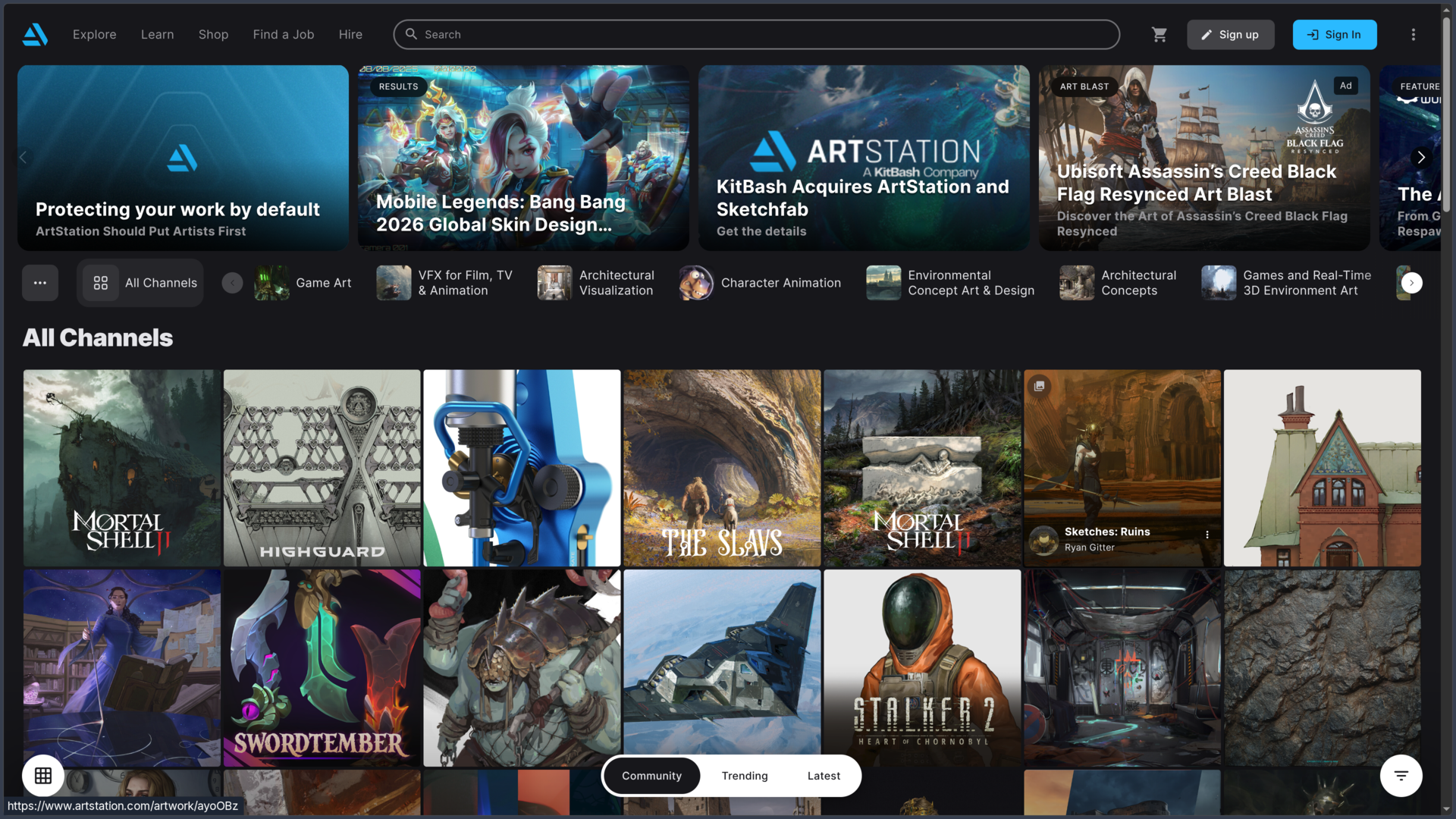
The platform had belonged to Epic Games since 2021, but ArtStation and Sketchfab were acquired by KitBash in August 2026. ArtStation nevertheless continues to operate as a distinct platform dedicated to artists and visual industries.
Features
Building a rich portfolio rather than a simple gallery
The core feature of ArtStation remains the portfolio. A project can combine multiple high-resolution images, videos, clips, 360° panoramas and 3D content from services such as Marmoset or Sketchfab.
This structure makes it possible to show not only a final image but also different views, details, research or production stages. For a character artist, environment artist or concept artist, this presentation is often far more relevant than a simple image feed.
Projects can be organized into albums and associated with categories, software or skills to make them easier to discover.
The professional profile complements the portfolio with experience, skills and a résumé. It can therefore serve both as an artistic showcase and as an entry point for recruiters or clients.
Discovering artists and following the community
The Explore page allows users to browse work published by the community according to different criteria, disciplines and trends.
Users can follow artists, like their work and find their latest publications. ArtStation nevertheless remains more focused on portfolio quality and professional visibility than on the daily posting model associated with Instagram or other general-purpose social networks.
This specialization is one of its main strengths: a search around concept art, 3D sculpting, environments or character design quickly leads to professionals working specifically in those areas.
ArtStation also organizes creative challenges that allow artists to work around a theme, build new pieces for their portfolio and compare their process with that of other participants.
Finding jobs and becoming visible to recruiters
ArtStation includes a section dedicated to creative job opportunities.
Studios can publish full-time positions or freelance assignments, while artists can search for opportunities directly from the platform.
The professional profile is particularly important in this context. Recruiters can search for artists according to their skills, location or experience.
ArtStation obviously does not replace a complete professional network such as LinkedIn, but it has one major advantage for certain roles: the portfolio and visual skills are available in the same place as the professional opportunities.
Selling digital resources and prints
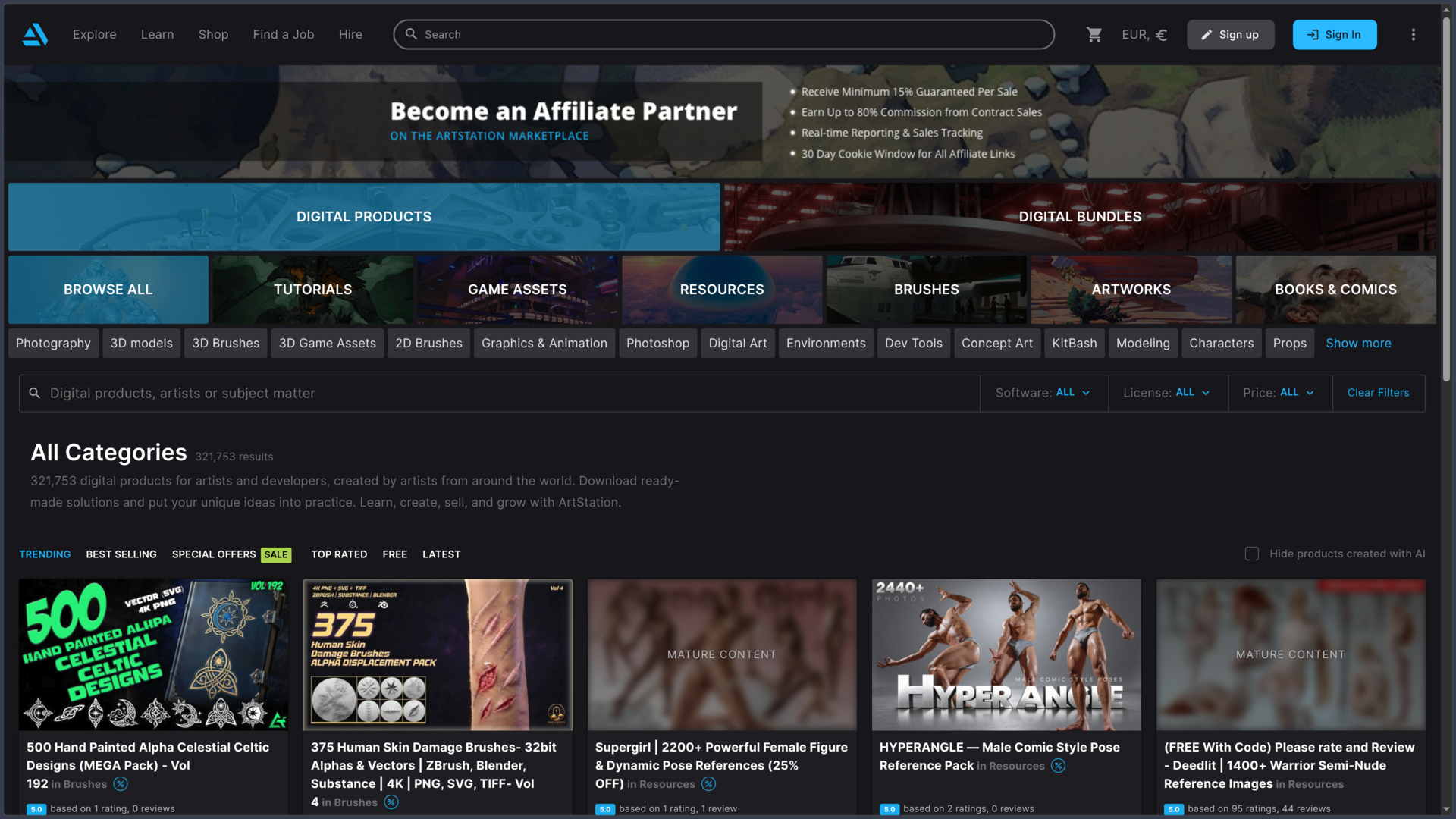
The Marketplace allows creators to directly sell different digital products: 3D models, brushes, assets, tutorials, reference packs, materials and other resources intended for artists.
ArtStation handles file hosting, payment and delivery to buyers. Products can appear on the Marketplace, the artist’s profile and their ArtStation website.
Pro accounts can benefit from more favorable selling conditions, with creators receiving up to 95% of the sale price depending on the transaction type and applicable conditions.
ArtStation also allows artists to sell physical prints of certain works without managing the printing, packaging and shipping themselves.
This part of the platform turns the portfolio into an interesting commercial complement: a work can demonstrate the artist’s skills while the brushes, models or resources used around that work can become products of their own.
ArtStation Learning for improving directly on the platform
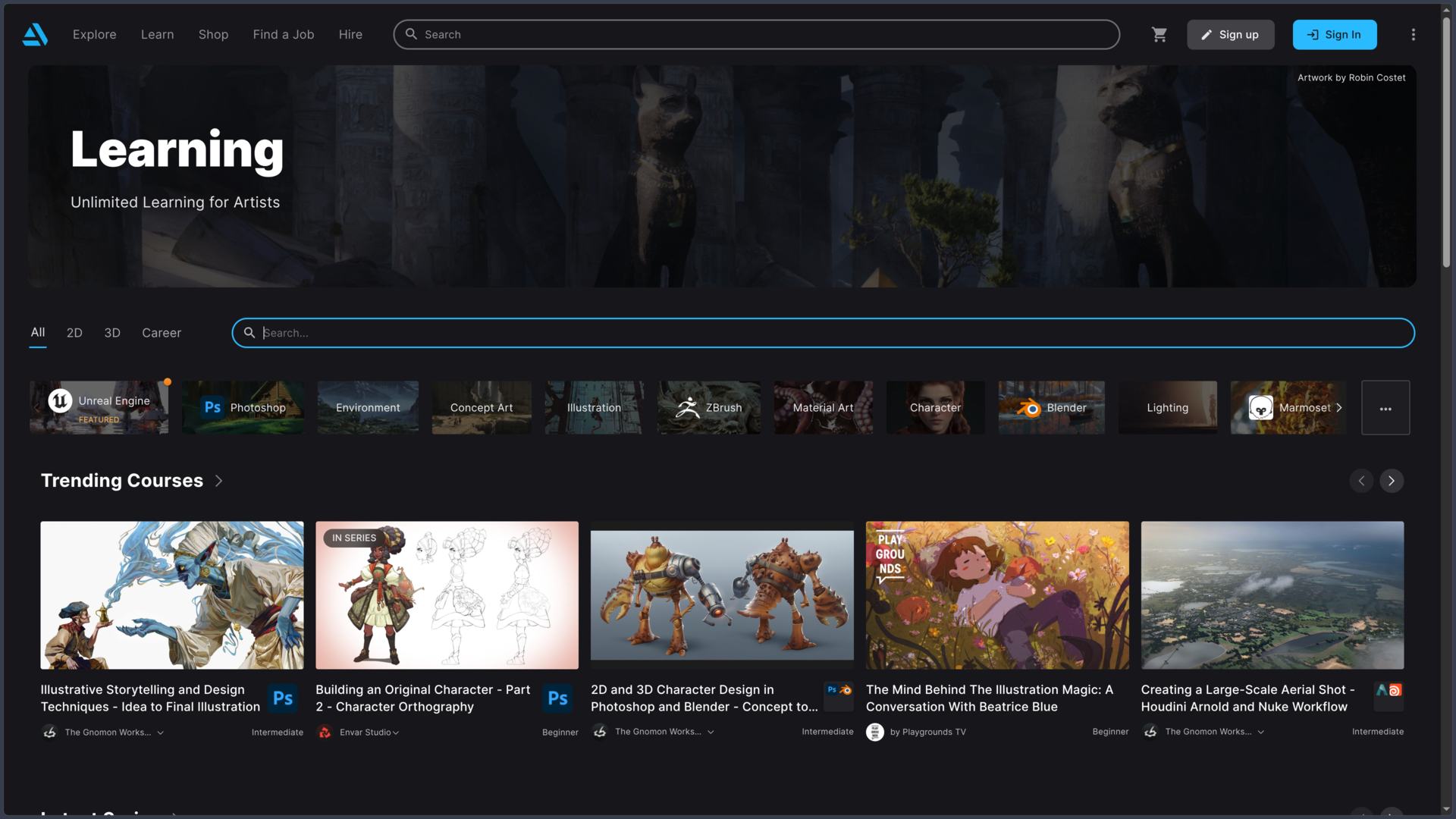
ArtStation Learning provides a library of video courses covering different artistic professions and techniques.
The courses cover areas such as 2D, 3D, concept art, illustration and various professional workflows. They are produced by experienced artists and can be followed at the learner’s own pace.
Access to ArtStation Learning is currently included in the free plan, making it an interesting resource even for someone who does not immediately want to publish their own portfolio.
Its integration with the rest of the platform also makes sense: users can discover an artist’s work and then access content where that artist explains techniques or production methods.
Turning a portfolio into a personal website
Each account can have a website linked to its ArtStation profile.
The free plan provides a basic version, while Pro adds more customization, additional themes and the option to use a separately purchased custom domain name.
Pro users also receive features such as advanced analytics, project scheduling, website customization and improved visibility in certain searches.
This solution can avoid the need to build an entirely separate portfolio website. It is particularly suitable for artists who want to manage their projects, profile and professional showcase within the same environment.
Specific rules around AI-generated content
ArtStation allows the publication of content that uses artificial intelligence, but requires projects created with generative tools to use the CreatedWithAI tag.
The platform also allows AI-generated works to be hidden from certain discovery areas.
For works published by artists, ArtStation now applies the NoAI label by default. Current terms also state that ArtStation does not use or license user content to train generative AI systems.
The NoAI label obviously cannot technically prevent every form of external scraping of a publicly available work, but it explicitly establishes that its use for AI training is not authorized.
Use cases
Building a portfolio for work in video games or film
A concept artist can create several projects focused on their strongest environments, characters or visual research.
Each project can present the final image, sketches, alternative proposals and selected stages of the process.
The portfolio therefore shows not only the result but also the way the artist thinks and develops their work.
When a studio is searching for a profile with specific skills, it can directly review these projects before making contact.
Properly presenting a 3D project
A 3D artist can combine final renders, wireframes, textures, details, sculpt screenshots and an interactive viewer within the same publication.
Instead of scattering the project across several posts, ArtStation allows the artist to build a coherent presentation closer to a genuine visual case study.
This approach is particularly useful for environments, characters, props or vehicles that require several views to properly understand the work involved.
Finding references and discovering new artists
ArtStation can also be used purely as a source of inspiration.
A user can browse environments, concepts, illustrations or 3D sculptures to identify artists, study styles or observe how certain professionals present their projects.
It is nevertheless important to distinguish inspiration from permission to reuse: works published on ArtStation remain protected by their creators’ rights and do not become free resources simply because they are visible online.
Selling creative resources
An artist who regularly creates their own brushes, models, materials or reference packs can publish them on the Marketplace.
Their portfolio then demonstrates the quality of their work while the Marketplace makes it possible to sell the related resources.
This combination is particularly suitable for creators who want to diversify their income without opening and managing a completely separate store.
Conclusion
ArtStation occupies a particular place among creative platforms because it does not simply try to become a social network for images. Its core remains the professional portfolio.
This positioning makes it particularly relevant for 2D and 3D artists working in video games, film, animation or entertainment. Projects can be presented with enough detail to genuinely show a process, while professional profiles, job listings and search tools create a direct connection with the employment market.
Marketplace, Learning and the Website Builder complement this foundation intelligently without replacing the main function. A single account can be used to showcase work, learn new techniques, search for opportunities and sell resources.
The free plan is already very complete. Pro becomes especially useful for artists who use ArtStation as a daily professional tool and want more customization, analytics, visibility or commercial options.
ArtStation is therefore not necessarily the best platform for publishing everything someone creates on a daily basis. However, for selecting the strongest work, presenting it properly and building a professional identity around artistic skills, it remains one of the most important references in the sector.
Points to consider
-
ArtStation is primarily a professional portfolio platform: it is generally better to prioritize a selection of strong work rather than automatically publishing every creation.
-
A free plan is available and already includes the portfolio, a basic website, ArtStation Learning, professional opportunities and the ability to sell digital products.
-
ArtStation Pro currently starts at $9.95/month and Studio at $29.99/month. Features and prices may change over time.
-
ArtStation is now owned by KitBash, after being acquired by Epic Games in 2021 and then sold together with Sketchfab in August 2026.
-
Works visible on ArtStation are not royalty-free. Public publication does not automatically grant permission to copy, reuse or integrate them into another project.
-
The NoAI label is now applied by default, while content created with generative tools must use the CreatedWithAI tag under the platform’s current rules.
-
The presence of AI-generated content remains an active issue on ArtStation. Filters are available and the platform has announced work on better discovery and control tools.
-
Marketplace, jobs and certain professional features are subject to specific conditions: commissions, selling rules, visibility or recruitment pricing should be checked before significant commercial use*