
Overview
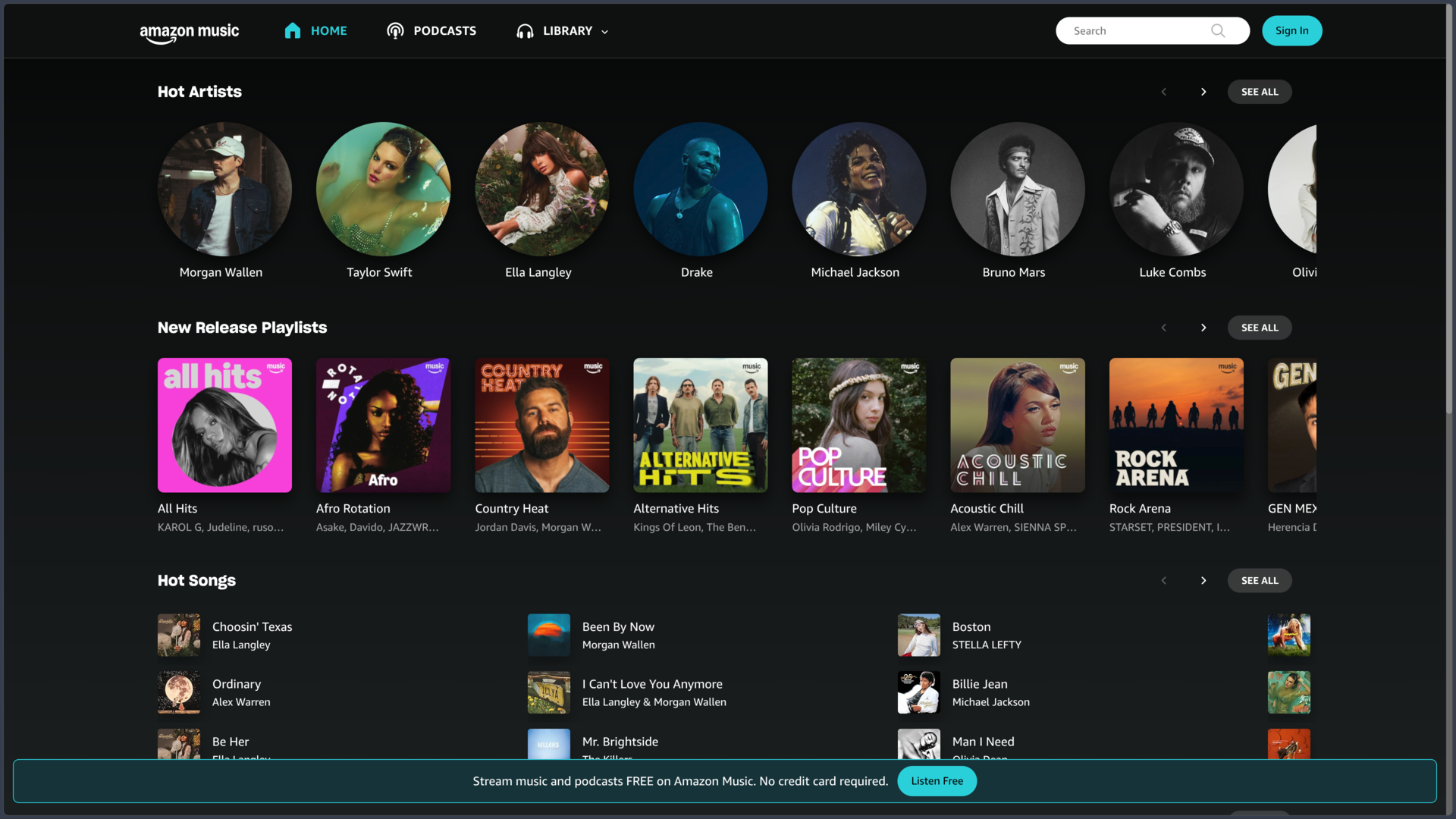
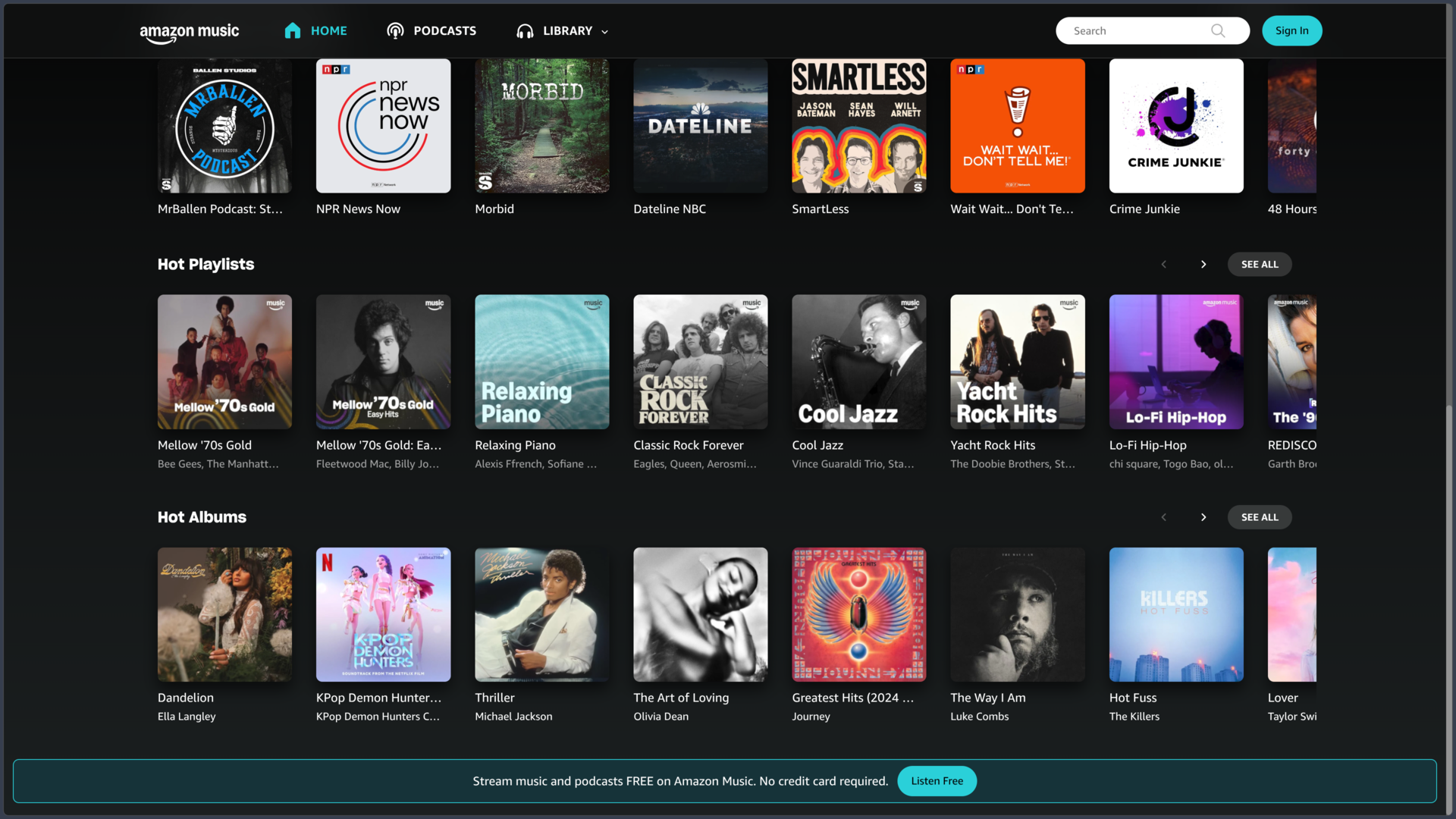
Amazon Music is Amazon’s music ecosystem. It brings together a catalog of 100 million tracks, playlists, stations, podcasts, live content and, depending on the subscription, audiobooks from the Audible catalog.
Its particularity comes from the number of entry points available. Amazon Music exists as Free, as a benefit included with Amazon Prime, and through the paid Amazon Music Standard and Amazon Music Unlimited subscriptions. A plan limited to one Echo or Fire TV device is also available.
This structure can appear more complex than Spotify or Apple Music, but it allows Amazon to cover several uses: free ad-supported listening, music included with Prime, on-demand streaming in high quality or a more complete subscription that also includes monthly audiobook access.
Audio quality now plays an important role in the paid plans. Amazon Music Standard and Unlimited provide access to lossless HD, several million tracks in Ultra HD up to 24-bit/192 kHz, and a Spatial Audio catalog in Dolby Atmos and 360 Reality Audio.
The service is also closely connected to the Amazon ecosystem. Alexa can launch a track, artist, playlist or station by voice command, while Echo devices, Fire TV and various compatible products can serve directly as playback devices.
Amazon Music nevertheless remains available outside that environment, with apps for Windows, macOS, Android, iPhone and iPad, along with a Web player.
Features
Free, Prime, Standard and Unlimited: four different experiences
Amazon Music does not correspond to a single subscription. The main plans differ primarily in playback control, audio quality and additional content.
| Plan | Playback | Ads | Quality | Offline |
|---|---|---|---|---|
| Amazon Music Free | Stations and playlists, limited control | Yes | Standard | No |
| Amazon Music Prime | 100 million tracks, mainly shuffle playback | No | Standard | All-Access Playlists only |
| Amazon Music Standard | On-demand | No | HD, Ultra HD, Spatial Audio | Yes |
| Amazon Music Unlimited | On-demand | No | HD, Ultra HD, Spatial Audio | Yes |
Amazon Music Free allows users to discover stations, playlists and podcasts for free without a bank card, but includes advertising and more restrictions on selecting exact tracks.
Amazon Music Prime is included with Amazon Prime. It gives access to the entire music catalog without ads, but most artists, albums and playlists work through shuffle playback. All-Access Playlists are the exception: they allow users to select tracks on demand, skip without limits and download them.
Amazon Music Standard turns the experience into a true on-demand streaming service, with full playback control, downloads and high-quality audio.
Amazon Music Unlimited includes those features and additionally provides, for eligible plans, access to one Audible audiobook per month.
This newer structure makes Standard and Unlimited relatively similar for music itself: the choice between them therefore depends mainly on the additional features included with Unlimited.
100 million tracks in HD
Amazon Music Standard and Unlimited provide access to 100 million tracks in HD without a separate high-fidelity surcharge.
Amazon defines HD as lossless audio of at least 16-bit/44.1 kHz, equivalent to CD quality. The stated average bitrate is around 850 kbit/s.
This quality is sufficient to preserve all the information contained in a CD master, unlike lossy compressed formats used by some standard offers.
The service automatically selects the best available quality according to the track, connection, device and settings configured in the app.
Users can also intentionally reduce quality when they want to limit mobile data usage or storage consumed by downloads.
Ultra HD up to 24-bit/192 kHz
Several million tracks are available in Ultra HD.
Amazon uses this term for files that can reach 24-bit with a sample rate between 44.1 and 192 kHz. Average bitrate can exceed 3,000 kbit/s for the heaviest versions.
The app displays HD or Ultra HD badges and can show several pieces of information: the maximum quality available for the track, the quality actually received by the device and the capabilities of the current audio output.
This transparency is useful in a Hi-Fi setup. A file may, for example, be available in 24-bit/192 kHz while being played at a lower resolution if the phone, operating system, DAC or connection cannot go further.
As with Qobuz, Apple Music or TIDAL, Hi-Res alone does not guarantee a better experience. The original master and playback equipment remain decisive.
Dolby Atmos and 360 Reality Audio
Amazon Music also offers a growing catalog of Spatial Audio tracks.
Two technologies coexist:
- Dolby Atmos Music;
- Sony 360 Reality Audio.
Unlike traditional stereo, these formats allow different elements of the mix to be positioned within a wider sound space around the listener.
On iPhone and Android, Standard and Unlimited subscribers can listen to certain Spatial Audio content using ordinary headphones or earbuds. The service also works with selected Fire TV devices, smart speakers and compatible home theater systems.
Spatial Audio is not available identically everywhere, however. Amazon Music’s Mac and PC desktop apps notably do not support immersive playback.
Not every track has a Dolby Atmos or 360 Reality Audio mix either.
Library, playlists and recommendations
Users can save artists, albums and tracks to their library and create personal playlists.
Amazon Music also builds recommendations based on listening history, liked tracks and followed artists. Editorial playlists and stations complement this personalization.
Amazon Music profiles have their own name, image, social identifier, follows and public playlists. Users can also follow other profiles.
With a Standard Family or Unlimited Family plan, up to six profiles can maintain separate recommendations, playlists and libraries.
Amazon Music also provides modes adapted to children and teenagers in certain environments, particularly within the Amazon Kids ecosystem.
Podcasts and ad-free content
Amazon Music is no longer limited to music.
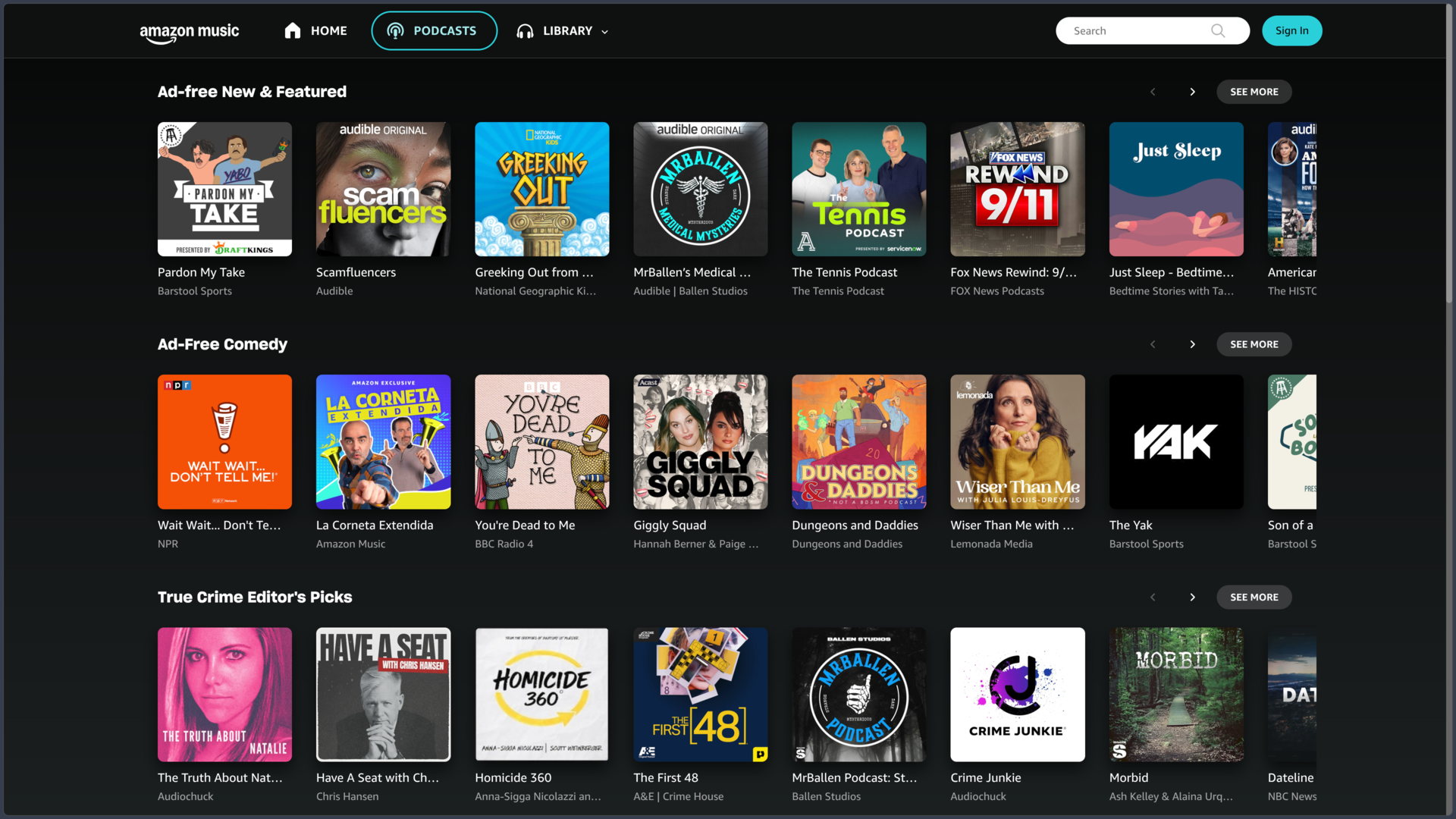
The service lists more than 15 million podcast episodes, with a selection of shows available without ads added by Amazon.
Podcasts are accessible through the different plans, including Free and Prime, although some features vary depending on the subscription.
Amazon Music therefore attempts to combine music and spoken content within the same app rather than reserving podcasts for a separate service.
Live content can also appear inside the app, including selected streams or events linked to the broader Amazon ecosystem.
More than 850,000 audiobooks with Unlimited
Amazon has progressively brought Amazon Music closer to Audible.
Amazon Music Unlimited currently highlights a catalog of more than 850,000 audiobooks. Eligible Individual subscribers, as well as the account holder of an Unlimited Family plan, can choose one audiobook per month to listen to while the subscription remains active.
This works differently from a traditional Audible subscription: Amazon Music remains primarily a music service and audiobook access is more limited.
Student and Single Device plans do not necessarily receive the same access.
For someone who regularly listens to both music and audiobooks, however, the price difference between Standard and Unlimited may become worthwhile.
Downloads and offline listening
Standard and Unlimited subscriptions allow users to download tracks, albums and playlists for offline listening.
Downloads can use several quality levels, up to HD, Ultra HD or Spatial Audio when the content and device support them.
The files remain locked inside the Amazon Music app, however. They cannot be exported to another player, burned to a CD or recovered as independent FLAC files.
Amazon Music Prime is more restrictive: only content from All-Access Playlists can be downloaded for offline use.
Amazon Music Free does not include this feature.
Especially deep Alexa integration
Integration with Alexa remains one of Amazon Music’s historical strengths.
On an Echo speaker, users can simply ask for an artist, track, genre or mood. Alexa can also search for a song using lyrics or approximate information when the exact title is unknown.
Amazon Music playlists and recommendations are directly available on Echo devices without requiring a smartphone as the source.
Certain Amazon devices also support HD or Ultra HD. Echo Studio is especially designed for high-fidelity and Spatial Audio content.
A Single Device plan even allows users to subscribe to Amazon Music Unlimited for only one compatible Echo or Fire TV device. It costs less, but cannot be used across several devices and does not include HD, Ultra HD or Spatial Audio.
Compatible with Sonos, Chromecast, AirPlay and many devices
The ecosystem extends beyond Amazon hardware.
Amazon Music works with various Sonos devices, televisions, car systems and connected speakers. Mobile apps can also use Chromecast or AirPlay depending on the environment.
Amazon states that HD and Ultra HD are available on many devices, including certain Echo products, Sonos systems, Fire TV devices, smartphones and computers.
The resolution actually obtained still depends on the complete playback chain between the service and speakers. A device advertised as Amazon Music-compatible is therefore not automatically able to reproduce 24-bit/192 kHz.
For audiophile use, the exact specifications of the device or DAC still need to be checked.
Importing playlists from another platform
Amazon Music now offers a workflow for transferring playlists from other music services.
This makes it easier to move from Spotify, Apple Music or another platform without manually rebuilding every selection.
Matches naturally depend on the Amazon Music catalog and available metadata. Certain editions, versions or unavailable tracks may therefore not transfer perfectly.
The import feature is nevertheless useful for properly testing Amazon Music with a library already close to existing listening habits.
Purchased music and AutoRip
Amazon also retains a connection with historical music purchases from its ecosystem.
MP3s purchased from Amazon may remain associated with the account and appear in the music library.
AutoRip also provides, for certain eligible physical releases purchased from Amazon, an automatic digital copy of the album.
This is different from streaming: purchased music remains distinct from tracks available only through Prime, Standard or Unlimited.
Amazon Music is no longer centered on file sales in the way Qobuz is. This feature mainly extends the user’s older Amazon music library.
Pricing depends heavily on the chosen plan
In France, Amazon Music now has several pricing levels.
| Plan | Current price | Main use |
|---|---|---|
| Amazon Music Free | Free | Stations and playlists with ads |
| Amazon Music Prime | Included with Prime | 100 million tracks, mainly shuffle playback |
| Amazon Music Standard | €11.12/month | On-demand streaming, HD, Ultra HD and Spatial Audio |
| Amazon Music Standard Family | €18.21/month | Up to six profiles |
| Amazon Music Unlimited | €12.14/month | Full streaming + additional benefits |
| Amazon Music Unlimited Family | €21.24/month | Up to six profiles and six simultaneous streams |
| Single Device | €6.07/month | One compatible Echo or Fire TV |
Amazon regularly offers longer promotional periods, but the standard trial currently displayed for Unlimited is 30 days for eligible new subscribers.
Prices may vary when the subscription is purchased through a third party or app store.
Use cases
Using a music service already included with Amazon Prime
A Prime member can use Amazon Music Prime without paying for a second subscription.
The catalog is very large and ad-free, which may be sufficient for launching an artist, mood or playlist without always searching for an exact song.
The trade-off is significant: much of the catalog works through shuffle playback and downloads are limited to All-Access Playlists.
For occasional listening, Prime may therefore avoid another subscription. To fully replace Spotify, Deezer or Apple Music, Standard or Unlimited provide more control.
Listening in Lossless and Hi-Res without a separate audiophile plan
Amazon Music Standard and Unlimited include HD and Ultra HD directly.
A user with wired headphones, a DAC or a compatible Hi-Fi system can therefore listen to files up to 24-bit/192 kHz without paying for an extra high-fidelity option.
The player also shows the quality actually being sent to the hardware, which helps identify any limiting component.
Amazon Music therefore becomes a credible alternative to TIDAL, Apple Music or Qobuz for someone mainly interested in Lossless playback.
Building a music setup around Alexa
In a household already equipped with Echo devices, Amazon Music integrates naturally.
A voice command is enough to start music in a room, request an artist, change playlists or launch a station.
Several speakers and compatible devices can be combined into multiroom groups depending on the Alexa setup.
For a user already deeply involved in the Amazon ecosystem, this continuity may matter more than certain interface differences between streaming services.
Combining music, podcasts and one audiobook per month
Amazon Music Unlimited can suit someone who uses several types of audio content.
The same app can play albums, playlists and podcasts, while eligible Unlimited subscribers also receive one Audible audiobook each month.
This may not replace a full Audible subscription for a heavy audiobook listener, but it can be enough for someone who listens only occasionally.
The difference with Amazon Music Standard then becomes easier to justify.
Using a family subscription with several profiles
Standard Family and Unlimited Family plans support up to six profiles.
Each member can keep their own library, playlists and recommendations without automatically mixing the entire household’s tastes.
Family plans also allow several simultaneous streams, unlike an individual subscription limited to one main stream at a time.
For a household where several people regularly use music streaming, the cost per user therefore becomes significantly lower than multiple individual plans.
Conclusion
Amazon Music has become a much broader ecosystem than a simple benefit associated with Echo speakers.
The service now covers free streaming, Prime benefits, on-demand listening, Lossless, Hi-Res, Spatial Audio, podcasts and audiobooks, with strong integration into Amazon hardware while remaining available outside that environment.
Its main characteristic is also its main source of complexity: Free, Prime, Standard and Unlimited do not provide the same experience. Prime does include the full catalog, but mostly through shuffle playback. Standard unlocks on-demand control and high-quality audio, while Unlimited adds certain benefits, particularly around Audible.
On the audio side, Amazon Music is especially competitive. CD-quality HD, Ultra HD up to 24-bit/192 kHz and Dolby Atmos are included in compatible subscriptions without an audiophile surcharge.
Alexa integration is also a concrete advantage for households already equipped with Echo, Fire TV or other Amazon devices. Conversely, someone who uses no Amazon services will gain less from that continuity and may prefer a platform with a simpler structure.
Amazon Music also lacks the deep editorial dimension of Qobuz or the classical specialization of Apple Music Classical. Its approach is more that of a large general-purpose audio service integrated into the Amazon ecosystem.
For someone who already has Prime or several Alexa devices, or wants to combine 100 million tracks, Lossless, Hi-Res, Spatial Audio, podcasts and audiobooks within one offer, Amazon Music is nevertheless a very complete option.
Points to consider
-
Amazon Music includes several very different plans: Free, Prime, Standard, Unlimited and Single Device. It is important to check exactly which one fits the intended use.
-
Amazon Music Prime is included with Amazon Prime and provides access to 100 million tracks without ads, but most of the catalog remains shuffle-only.
-
Prime All-Access Playlists allow on-demand and offline listening, unlike the rest of the Prime catalog.
-
Amazon Music Standard currently costs €11.12/month in France and provides on-demand playback, HD, Ultra HD, Spatial Audio and offline listening.
-
Amazon Music Unlimited currently costs €12.14/month for an individual plan and €21.24/month for a family plan in France.
-
The music catalog includes 100 million tracks in HD, while several million are available in Ultra HD.
-
HD means at least 16-bit/44.1 kHz, while Ultra HD can reach 24-bit/192 kHz.
-
Dolby Atmos and 360 Reality Audio are included with Standard and Unlimited, but availability depends on the track and device used.
-
Spatial Audio is not supported by Amazon Music desktop apps on Mac and PC, although those applications can play HD and Ultra HD.
-
Offline downloads remain protected inside the Amazon Music app. They cannot be exported as personal FLAC files.
-
Eligible Unlimited subscribers can listen to one audiobook per month, from a catalog promoted by Amazon as containing more than 850,000 audiobooks.
-
The Single Device plan is cheaper but limited to one compatible Echo or Fire TV device, without HD, Ultra HD or Spatial Audio.
-
Linux does not have an official Amazon Music desktop application. Access is mainly through the Web player.