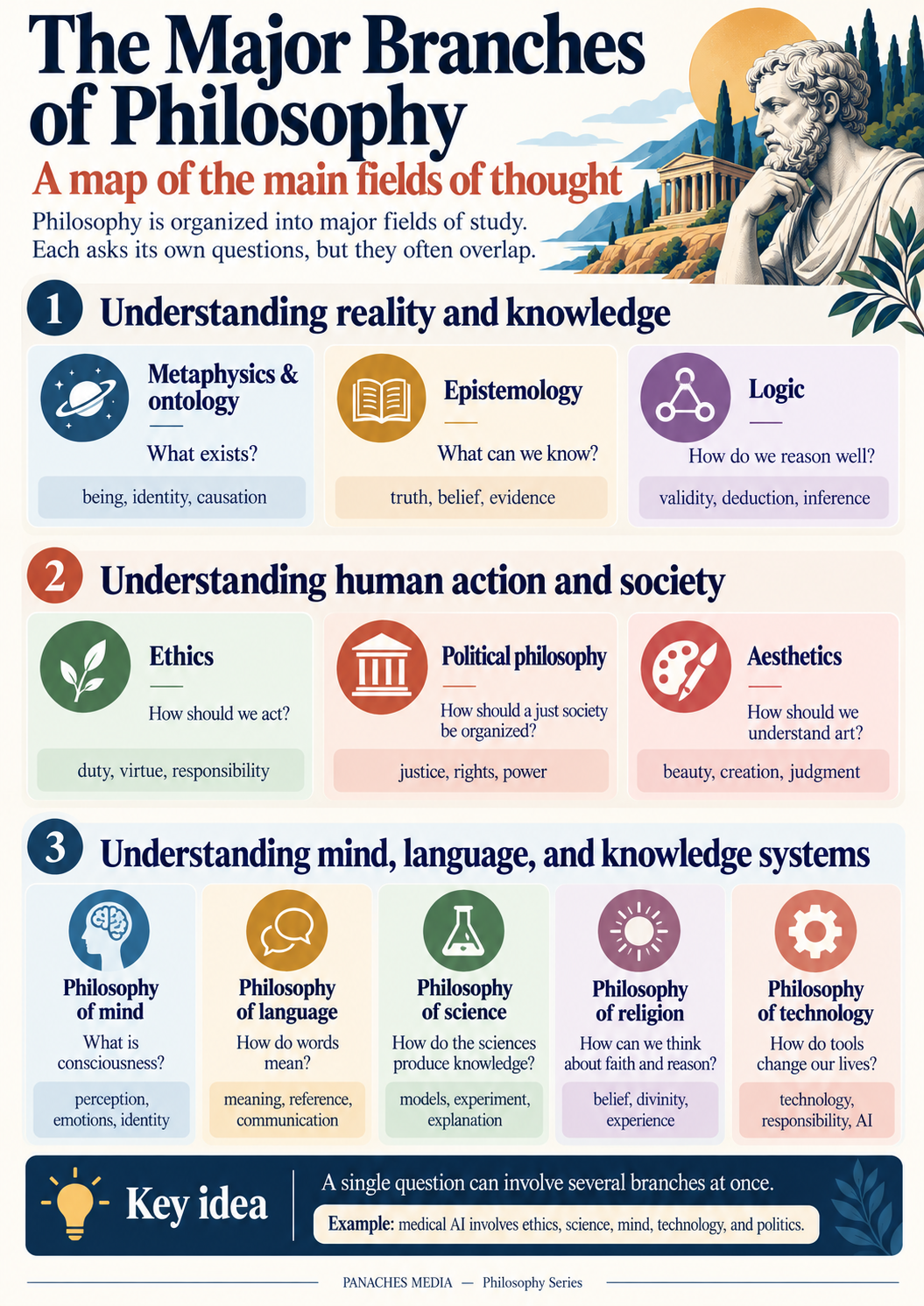
What is reality? How can we distinguish knowledge from mere belief? What makes an argument valid, an action right, or a work of art remarkable? Philosophy addresses such different questions that it can sometimes be difficult to recognize them as belonging to the same discipline. Yet throughout its history, philosophy has gradually become organized into major fields of inquiry. Metaphysics, epistemology, logic, ethics, political philosophy, aesthetics, and philosophy of mind each explore particular dimensions of our relationship with the world. Understanding these branches reveals how philosophical thought is organized, but also why their questions constantly intersect.
How Is Philosophy Organized?
When we first encounter philosophy, we generally come across philosophers, schools of thought, or major questions.
Plato, Aristotle, Descartes, and Kant. Stoicism, rationalism, existentialism, and pragmatism. Truth, freedom, happiness, and justice.
These three approaches are useful, but they do not always explain how philosophy is organized as a field of inquiry.
Consider a seemingly simple question: can we trust our perceptions?
This question concerns how our senses function, but it also involves our conception of knowledge.
It may lead us to ask what exists independently of our minds, how our experiences are organized, or which arguments can justify our beliefs.
A single question thus opens several avenues of investigation.
Epistemology examines the conditions of knowledge. Metaphysics investigates the nature of reality. Philosophy of mind studies perception and consciousness, among other things. Logic enables us to analyze the reasoning used to defend our conclusions.
These fields constitute what are generally called the branches of philosophy.
They did not all develop at the same time, and their boundaries are not perfectly stable.
Some questions once studied within natural philosophy now belong primarily to the physical or biological sciences. Others have given rise to new philosophical fields through contact with mathematics, linguistics, cognitive science, and computer science.
Philosophy therefore possesses an intellectual organization that evolves alongside knowledge and the problems of each era.
Fields, Movements, and Concepts: Three Different Levels
It is important not to confuse branches of philosophy with schools of thought.
A field primarily identifies a family of problems. A movement proposes particular ways of approaching those problems. A concept is an intellectual tool used to analyze them.
For example, freedom can be studied in metaphysics when we examine free will and determinism. It appears in ethics when we investigate individual responsibility, and in political philosophy when we reflect on rights and institutions.
Stoic, existentialist, or pragmatist philosophers may offer very different answers to these questions.
The same concept therefore crosses several fields and may be interpreted by opposing philosophical movements.
This distinction helps us understand the organization of philosophy without turning each branch into a particular doctrine.
The Major Fields at a Glance
| Branch of philosophy | Guiding question | What it studies |
|---|---|---|
| Metaphysics and ontology | What exists, and what is the nature of reality? | Being, existence, identity, causation, time, possibility. |
| Epistemology | What can we know, and how can we justify it? | Knowledge, truth, belief, evidence, doubt. |
| Logic | What makes reasoning valid? | Deduction, inference, validity, argumentation. |
| Ethics and moral philosophy | How should we act? | Good, evil, duty, virtue, responsibility, values. |
| Political philosophy | What makes a society just and legitimate? | Justice, power, rights, freedom, democracy. |
| Aesthetics and philosophy of art | How should we understand art and aesthetic experience? | Beauty, creation, interpretation, artistic judgment. |
| Philosophy of mind | What does it mean to think or be conscious? | Consciousness, perception, personal identity, emotions. |
| Philosophy of language | How do words acquire meaning? | Meaning, reference, interpretation, communication. |
| Philosophy of science | How do the sciences produce knowledge? | Explanation, models, theories, scientific evidence. |
| Philosophy of religion | How can religious beliefs be examined philosophically? | Faith, reason, divinity, religious experience, pluralism. |
| Philosophy of technology | How do technologies transform our existence? | Tools, technologies, responsibility, society, artificial intelligence. |
This map provides an introductory guide. Other important fields exist, and the boundaries between those presented here are frequently crossed by shared questions.
Metaphysics: What Is Reality?
Metaphysics belongs to the oldest fields of philosophical reflection.
It seeks, among other things, to understand the fundamental structures of reality.
What exists? What is a thing? Why do certain events occur? Does time exist independently? Does a person remain the same while undergoing change?
These questions can sometimes seem highly abstract.
Yet they arise whenever we attempt to understand what it means to exist, to be a particular thing, or to persist through time.
Beyond Physics?
The word "metaphysics" is historically associated with Aristotle's writings collected under the title Metaphysics.
The name probably refers to the organization of treatises placed after those devoted to physics, rather than to an original intention to designate a mysterious world beyond nature.
This distinction matters.
In everyday language, "metaphysics" sometimes evokes supernatural realities or unverifiable speculation.
But philosophical metaphysics is much broader.
It can concern perfectly ordinary objects: a table, a tree, a human body, or an event.
Its purpose is to examine the fundamental questions we can ask about them.
Identity: What Makes Something Remain the Same?
Imagine an old violin.
Over the years, its owner replaces some strings, then its bridge and several damaged components.
After numerous repairs, a significant portion of the original instrument has disappeared.
Is it still the same violin?
The answer seems obvious when we replace a single string. It becomes more difficult when the modifications are extensive.
This problem belongs to metaphysics because it investigates the conditions of identity through change.
The same kind of question can be asked about a person.
Our bodies change, our memories evolve, and our personalities may undergo profound transformations throughout our lives.
What allows us, then, to regard ourselves as the same person?
Different philosophical conceptions emphasize the body, psychological continuity, relationships, or other criteria of identity.
Metaphysics does not provide a single answer.
It seeks to understand what makes these answers possible and what difficulties they encounter.
Ontology: Examining What Exists
Ontology is closely connected to metaphysics.
It is particularly concerned with categories of being and the types of entities that make up reality.
In many contemporary contexts, ontology is considered part of metaphysics, although the two terms may receive different interpretations depending on the tradition.
Consider an example.
We readily acknowledge the existence of a mountain or an animal.
But what about numbers, properties, institutions, or fictional characters?
Does the number three exist in the same way as a stone?
Is a company a reality independent of the people, rules, and practices that constitute it?
Ontology seeks, among other things, to determine what kinds of entities we must recognize in order to understand the world.
It also examines the relationships between these categories.
Causation, Necessity, and Possibility
Metaphysics also examines relationships between events.
When we claim that one phenomenon causes another, what exactly does this causal relationship mean?
Could events have unfolded differently?
Do certain properties necessarily belong to a thing, while others are contingent?
These questions lead to reflections on necessity, possibility, and contingency.
They also arise in debates about determinism and free will.
If all our behavior depends on previous conditions, in what sense can we still speak of choice?
This question extends beyond metaphysics alone: it immediately intersects with ethics and philosophy of action.
Profoundly Different Metaphysical Traditions
There is no single conception of reality throughout the history of philosophy.
Aristotle develops an analysis of being, substances, and causes.
Avicenna examines the relationship between essence and existence.
Spinoza proposes a metaphysics in which all beings belong to a single natural order.
Nāgārjuna challenges certain conceptions of things possessing an inherent and independent nature.
Chinese, Indian, Arabic, and European philosophical traditions have also developed different reflections on change, dependence, and the structures of existence.
Metaphysics does not necessarily involve defending an invisible world: it seeks to determine what we are claiming when we speak about reality.
Epistemology: What Can We Really Know?
If metaphysics examines reality, epistemology investigates our capacity to know it.
It is one of the fundamental fields of philosophy.
How do we distinguish knowledge from belief? What justifies a claim? Can we be certain of what we know? Are our senses and memories reliable?
These questions are not reserved for laboratories or university libraries.
We encounter them whenever we attempt to determine whether information deserves our trust.
Believing Something Is Not Enough to Know It
Imagine someone checking the weather forecast and claiming that it will rain tomorrow.
Their prediction may be correct.
But if they were simply guessing, without any relevant information, can we say they knew it was going to rain?
The question reveals an essential difference between a true belief and knowledge.
In a classical conception, knowledge has often been analyzed as justified true belief.
This definition is an important historical reference point, but not all contemporary philosophers consider it sufficient.
The famous problems raised by Edmund Gettier in the twentieth century show, among other things, that some apparently justified true beliefs may depend on a kind of luck incompatible with what we wish to call knowledge.
Epistemology examines precisely these difficulties.
It is not enough to know whether a claim is true.
We must also understand how we can justify it and under what circumstances that justification is reliable.
The Different Sources of Knowledge
We acquire information in several ways.
We perceive objects, remember events, reason, and receive testimony.
Each of these sources raises problems.
Perception seems to provide direct access to the world. But illusions can deceive our senses.
Memory allows us to preserve information. Yet it may be incomplete or reconstruct certain events.
Reasoning enables us to draw conclusions. But we may make logical errors or begin from incorrect premises.
Testimony occupies a fundamental place in our knowledge. Nevertheless, it can be dishonest, inaccurate, or misinterpreted.
Most of our everyday knowledge actually depends on several sources at once.
We know that certain cities exist without having visited them ourselves. We accept a great deal of scientific knowledge through research that we have not personally reproduced.
Epistemology therefore studies the conditions under which we can trust other people, institutions, and verification procedures.
What Is Widely Shared Information Worth?
Consider a contemporary example.
A spectacular photograph circulates on social media. It is reposted by thousands of accounts and generates numerous reactions.
Is its popularity enough to establish its authenticity?
Clearly not.
But how should we verify it?
We can investigate its source, examine its context, compare different testimonies, and check whether the elements presented correspond to independently established facts.
This work partly belongs to journalistic and technical methods.
Epistemology asks a more general question: what reasons make a belief sufficiently reliable to be accepted as knowledge?
It also examines situations in which different people possess different information or interpret the same evidence differently.
The Limits of Knowledge
Finally, epistemology examines the boundaries of what we can know.
Some philosophers have searched for absolutely certain foundations.
Others have emphasized the revisable character of many human beliefs.
Skepticism is an important participant in this discussion because it challenges our claims to certainty.
But epistemology does not necessarily consist of choosing between absolute knowledge and knowing nothing.
It explores numerous intermediate positions concerning justification, reliability, probability, and the reasonable limits of our claims.
Its essential contribution is teaching us to distinguish the possible truth of a proposition from the reasons that allow us to regard it as true.
Logic: What Makes Reasoning Valid?
Logic studies, among other things, the structures of reasoning and the conditions under which a conclusion follows from certain premises.
It occupies a distinctive position within philosophy.
It is both an independent field of inquiry and a tool used in many other branches.
When a philosopher attempts to defend a position, the quality of their argumentation becomes essential.
But how can we know whether their reasoning is correct?
The Difference Between Truth and Validity
Consider the following argument:
- All birds are mammals.
- A sparrow is a bird.
- Therefore, a sparrow is a mammal.
The conclusion is false because the first premise is false.
Yet the reasoning has a logically valid form.
If both premises were true, the conclusion could not be false.
This is the relationship logic examines.
A valid argument is therefore not necessarily an argument based on true claims.
In classical deductive logic, validity means that there is no possible situation, under the interpretation being considered, in which all the premises are true and the conclusion is false.
An argument is called sound when it is valid and its premises are true.
This distinction is fundamental.
An argument may be perfectly constructed from a logical standpoint while resting on incorrect information.
Conversely, a true conclusion may have been reached through invalid reasoning.
Deduction, Induction, and Other Forms of Inference
Not all reasoning works in the same way.
Deduction seeks to establish a conclusion that necessarily follows from certain premises.
Induction allows us to propose generalizations from particular observations, but its conclusions do not necessarily carry the same guarantee.
If we observe that numerous metals expand when heated, we may attempt to formulate a general proposition.
However, a series of observations is not, by itself, enough to demonstrate logically that every future case will be identical.
Other forms of reasoning, particularly abduction, seek to determine which hypothesis would best explain a collection of facts.
These distinctions play major roles in science, historical investigations, and everyday discussions.
Errors in Reasoning
Logic and the study of argumentation also help identify certain errors.
Someone may, for example, reject a proposition simply because they dislike the person defending it.
They may present two possibilities as though they were the only ones available.
They may also assume that one event caused another merely because it occurred before it.
These errors are not all mistakes of formal logic: some concern the analysis of arguments expressed in ordinary language, their contexts, and the relevance of the reasons offered.
Informal logic and argumentation theory are particularly concerned with these dimensions.
A History That Extends Beyond Aristotle
Aristotle played a fundamental role in formalizing Western logic.
But the history of reasoning and theories of inference is much broader.
Indian Nyāya traditions and several Buddhist philosophies developed sophisticated analyses of argumentation.
Arabic-speaking philosophers also contributed to logical research, particularly through their discussions and transformations of Aristotelian traditions.
In ancient China, Mohist traditions produced important reflections on distinctions, inferences, and the conditions of arguments.
Modern logic then underwent profound transformations with the development of formal and mathematical tools, particularly through the work of Frege, Russell, and numerous twentieth-century logicians.
Today, several logical systems exist, both classical and non-classical, with different properties and applications.
Logic does not tell us, by itself, what to think about every subject. It helps us determine whether our conclusions are correctly connected to the reasons we provide.
Ethics: How Should We Act?
Ethics, also called moral philosophy, examines the values, obligations, and principles that guide our behavior.
Why are certain actions considered right or wrong?
Do we have duties toward others?
Are the consequences of a decision enough to determine its moral value?
Can we be responsible for an action whose results were unpredictable?
These questions concern individual choices as well as collective decisions.
A Moral Problem in an Ordinary Situation
Imagine someone discovering that a friend has lied to avoid a professional penalty.
Should they reveal the truth?
Several considerations may conflict.
Honesty has significant moral value.
But loyalty toward a friend may also appear to constitute an obligation.
We must also consider the consequences of the lie, the seriousness of the situation, and the people who might be harmed.
Ethics does not simply consist of quickly choosing between "good" and "evil."
It seeks to understand the reasons that justify our decisions and the principles underlying those justifications.
Normative Ethics: What Principles Should Guide Our Actions?
Normative ethics examines the criteria used to evaluate our actions morally.
Different philosophical theories offer competing answers.
Consequentialist approaches give fundamental importance to the effects of our decisions.
Deontological approaches emphasize duties, rights, and certain moral constraints.
Virtue ethics focuses on dispositions of character and the qualities necessary for a good life.
These theories are not separate branches of philosophy in the same sense as ethics itself.
They represent different answers to problems within moral philosophy.
Metaethics: What Are We Claiming When We Say "That Is Wrong"?
Metaethics takes a step back from particular moral judgments.
It investigates their meaning and status.
When we say that an action is unjust, are we merely expressing a personal preference?
Are we asserting something that can be true or false?
Do moral facts exist independently of our opinions?
How can we justify a moral claim?
These questions differ from determining whether a particular action is good.
Metaethics instead studies the nature of moral judgments and moral reasoning themselves.
It therefore intersects with metaphysics, epistemology, and philosophy of language.
Applied Ethics: Concrete Problems
Applied ethics examines situations in which several values, obligations, or interests may conflict.
Bioethics addresses medical decisions, consent, and responsibilities toward patients.
Environmental ethics investigates our obligations toward animals, ecosystems, and future generations.
Digital ethics studies questions raised by personal data, platforms, and automated systems.
Professional ethics concerns confidentiality, conflicts of interest, safety, and responsibilities toward the public, depending on the profession.
However, speaking of "application" does not mean that we simply choose a moral theory and use it mechanically.
Concrete situations may also require philosophers to clarify, criticize, or transform their principles.
| Dimension of ethics | Central question |
|---|---|
| Normative ethics | What criteria make an action right or wrong? |
| Metaethics | What do moral judgments mean, and how can they be justified? |
| Applied ethics | How should we examine obligations and conflicts of values in concrete situations? |
Ethics is therefore not limited to offering advice about good behavior. It is an investigation into the foundations, scope, and difficulties of our moral judgments.
Political Philosophy: How Should a Just Society Be Organized?
Political philosophy studies the relationships between individuals, institutions, power, and the principles that should organize collective life.
What makes a government legitimate?
Why should we obey laws?
Which freedoms must a society guarantee?
How should equality be understood when individuals possess very different resources and opportunities?
The answers to these questions profoundly influence how we conceive of institutions.
Justice and Legitimacy Are Not Exactly the Same Thing
Imagine a law being adopted through all the required democratic procedures.
It then possesses a certain institutional legitimacy.
But is that enough to guarantee that it is just?
A procedure may be followed correctly while producing a morally questionable decision.
Conversely, a decision that seems just to some may raise problems if it is imposed by an authority lacking legitimacy.
Political philosophers examine precisely the relationships between these dimensions.
Traditions associated with Rousseau, Locke, Kant, and Rawls propose different conceptions of legitimacy, rights, and justice.
They do not necessarily share the same principles.
Their confrontation nevertheless reveals that political power cannot be evaluated solely according to its effectiveness.
It must also be examined through its justification and its consequences for individuals.
Freedom, Equality, and Power
Political freedom can be interpreted in several ways.
It may be understood as the absence of certain constraints, as the effective ability to act, or as a condition in which individuals are not subjected to arbitrary domination.
Equality raises comparable difficulties.
Should we guarantee everyone the same rights?
The same resources?
The same real opportunities to lead the lives they wish to pursue?
These different conceptions may guide very different public policies.
Political philosophy also examines the relationship between individuals and the community.
Should a society prioritize personal autonomy, shared obligations, protection against inequality, or other principles?
There is no universally accepted answer.
Democracy, Deliberation, and Institutions
Political questions do not concern only the content of laws.
They also concern how laws are made.
Is a majority decision necessarily legitimate?
How can minority rights be protected?
What roles should public debate, expertise, and citizen participation play?
Political philosophical traditions have examined these questions through very different conceptions of government.
Contemporary debates add problems relating to the circulation of information, surveillance, digital systems, and the transformation of public spaces.
Political philosophy thus maintains close relationships with law, economics, sociology, and political science.
But it is distinguished particularly by its concern with the normative principles through which institutions can be evaluated, rather than merely describing how they function.
Aesthetics: What Gives an Experience or a Work of Art Its Value?
Aesthetics studies aesthetic experience, judgments of taste, beauty, and different forms of appreciation.
The closely related philosophy of art focuses more particularly on the nature of artworks, their creation, interpretation, and value.
These two fields overlap extensively, but they are not completely identical.
Aesthetics does not concern artworks alone.
A landscape, a building, a musical composition, or certain aspects of our environment may also give rise to aesthetic experiences.
Conversely, an artwork can possess philosophical interest without necessarily being beautiful.
Is Beauty Merely a Personal Preference?
We readily say that a painting is magnificent or that a piece of music possesses great expressive power.
But are such judgments purely subjective?
When two people disagree about an artwork, do they simply have different tastes, or can they offer genuine arguments?
Philosophical aesthetics examines the relationships between perception, emotion, culture, and judgment.
Hume investigated, among other things, the conditions under which artworks can be evaluated despite differences in taste.
Kant developed a major reflection on aesthetic judgment and the ways in which we make certain claims to shared agreement.
These investigations do not necessarily establish universal and indisputable standards of beauty.
Rather, they show that aesthetic experience can be discussed and analyzed.
What Turns an Object into a Work of Art?
Imagine an ordinary industrial object.
Presented in its usual context, it is primarily perceived according to its practical function.
But if it is moved into a museum and presented by an artist, its status may become problematic.
Why should we regard it differently?
Marcel Duchamp's famous Fountain, presented in 1917, helped make this question unavoidable in the history of modern art.
It revealed the difficulties we encounter when attempting to define art solely through beauty, technical mastery, or representation.
Different philosophical theories therefore assign essential roles to the artist's intention, historical context, artistic institutions, or the properties of the work itself.
But these criteria remain subjects of ongoing disagreement.
Can a Work Be Morally Problematic and Artistically Remarkable?
Aesthetics also intersects with ethics.
A work may possess great formal quality while conveying questionable representations.
Does its artistic value depend on its moral content?
Can an artwork provoke unpleasant emotions while nevertheless offering a significant aesthetic experience?
These questions concern cinema, literature, painting, music, and digital art.
Aesthetics is not limited to asking whether something is beautiful. It seeks to understand the diversity of sensory experiences, artistic forms, and the judgments we make about them.
Philosophy of Mind: What Does It Mean to Think and Be Conscious?
Philosophy of mind examines the nature of mental phenomena and their relationships with the body and the world.
What does it mean to have a thought?
What is the difference between perceiving an object and imagining it?
What is an emotion?
How should we understand our sense of being a conscious person?
These questions intersect with research in psychology, neuroscience, and cognitive science.
But they are not identical to those disciplines.
The Mind–Body Problem
When we experience pain, that experience is accompanied by biological and neural processes.
Science can study different mechanisms associated with these phenomena.
But how should we understand the relationship between those processes and the lived experience itself?
Is a physical description sufficient to explain what it means to experience pain?
The question is philosophical because it concerns the nature of subjective experience and its place within the physical world.
Numerous answers have been proposed.
Some traditions defend different forms of dualism between mental and physical phenomena.
Others maintain that the mind must be understood through material processes or the functions organizing cognitive activity.
No simple formula can summarize all these positions.
Consciousness and Subjective Experience
Consciousness presents a particularly important problem.
We can observe behaviors, measure brain activity, and study cognitive performance.
But how can we connect these observations to subjective experience?
There is a difference between describing the mechanisms associated with perceiving a color and understanding what it means for a subject to see that color.
This difficulty informs much of the contemporary debate.
Philosophy of mind also examines the relationships between consciousness, attention, memory, language, and personal identity.
It sometimes uses thought experiments to investigate the limits of our intuitions.
Can Animals and Machines Have Minds?
Philosophy of mind now encounters questions concerning animals and artificial intelligence systems.
What criteria allow us to attribute mental states to another being?
Is intelligent behavior sufficient to establish the existence of conscious experience?
What is the difference between producing an appropriate response and understanding what one is doing?
These questions should not be settled through simple analogies.
They require distinguishing several problems: the capacity to process information, language use, intentionality, intelligence, and subjective experience.
Philosophy of mind thus seeks to understand what we mean when we speak about thought, consciousness, and mental life, without reducing these phenomena to their outward appearance alone.
Philosophy of Language: How Do Words Give Meaning to the World?
Language occupies a fundamental place in how we think.
We use it to describe situations, transmit information, express emotions, and construct arguments.
But how can a sequence of sounds or signs mean something?
This is one of the major questions of the philosophy of language.
Meaning and Reference
Consider a simple sentence:
"The book is on the table."
To understand this statement, we must know, among other things, what its words mean and identify the objects to which they refer in the situation.
Philosophy of language therefore examines meaning, reference, and the conditions under which a proposition can be true or false.
How does a name designate a person?
What relationship exists between a word and the object we are talking about?
Why can some sentences have several interpretations?
These problems have been studied particularly within modern philosophical traditions, including the work of Frege, Russell, Wittgenstein, and numerous contemporary authors.
Does Meaning Depend on Context?
Now consider the sentence:
"I'll come back tomorrow."
Its meaning depends partly on who is speaking and when the words are uttered.
The term "tomorrow" does not refer to a fixed date independently of all context.
Philosophy of language examines this type of phenomenon, as well as how intentions, uses, and situations influence our understanding of statements.
A sentence can also perform an action.
When someone apologizes, makes a promise, or pronounces an official decision under appropriate conditions, they are not always merely describing the world.
They may help change a social relationship.
Research into speech acts, associated particularly with J. L. Austin and John Searle, has substantially developed this dimension.
Does Language Influence Our Thinking?
A broader question concerns the relationship between language and knowledge.
Do the words available to us influence how we organize our experiences?
Different philosophical traditions have examined this problem, including those outside Europe.
Kwasi Wiredu's research into conceptual categories and African languages demonstrates, among other things, the importance of not automatically treating certain linguistic distinctions as universal.
However, recognizing the influence of language does not necessarily mean that every language traps its speakers within a worldview they cannot transcend.
The relationships between thought, language, and culture are much more complex.
Philosophy of language thus studies a fundamental instrument of our reflection: the very instrument that allows us to formulate philosophical questions.
Philosophy of Science: How Do the Sciences Produce Knowledge?
Philosophy of science studies the concepts, methods, and reasoning involved in scientific research.
It does not seek to replace physics, biology, or mathematics.
Instead, it examines the conditions under which these disciplines construct knowledge.
What distinguishes a scientific hypothesis from an insufficiently justified claim?
How does an experiment support a theory?
What status should we give to the models researchers use?
How should we understand major transformations in the history of science?
Observation Is Not Always Enough to Explain
Imagine a researcher repeatedly observing a phenomenon.
They notice that a particular change in experimental conditions is accompanied by a measurable difference.
This observation may help support a hypothesis.
But it is not necessarily enough to establish an explanation.
Possible causes must be examined, certain factors controlled, and the conditions under which results can be reproduced determined.
Philosophy of science investigates the relationships between observation, experimentation, hypotheses, and theories.
It also examines the role of statistical reasoning and models.
Can Scientific Theories Be Definitively Verified?
In the twentieth century, Karl Popper developed an important conception of scientific inquiry by emphasizing the role of tests capable of revealing a theory to be false.
Thomas Kuhn, meanwhile, proposed a historical analysis of scientific transformations, examining changes in theoretical frameworks and research practices.
These works generated major debates.
However, contemporary philosophy of science generally does not assume that a single procedure can be applied mechanically to every scientific discipline.
Methods vary according to the objects studied, experimental possibilities, and available instruments.
Particle physics, astronomy, climate science, and certain branches of biology do not always possess the same investigative resources.
What Are Scientific Models For?
Scientists frequently use models to represent complex phenomena.
A climate model, for example, may integrate numerous variables to investigate different physical processes.
But a model never reproduces reality in its entirety.
It selects certain characteristics, rests on assumptions, and has limitations.
Philosophy of science therefore asks how the reliability of these representations should be evaluated.
Under what conditions is simplification acceptable?
How should uncertainties be interpreted?
What can we legitimately conclude from a simulation?
These questions play important roles today in research relating to the environment, medicine, and digital systems.
Philosophy of science does not seek to oppose abstract reflection to scientific investigation. It examines how scientific knowledge is constructed, justified, and interpreted.
Philosophy of Religion: Examining Beliefs Through Reflection
Philosophy of religion studies philosophical questions raised by religious beliefs, practices, and traditions.
It examines the relationships between faith and reason, different conceptions of divinity, religious experience, and the nature of spiritual commitments.
Contrary to a common assumption, it does not necessarily consist of defending the existence of God.
It can also analyze arguments challenging certain religious conceptions or develop reflections on nonreligious worldviews.
Can Religious Questions Be Examined Through Argument?
Philosophers have developed numerous arguments concerning the existence of God, the nature of ultimate reality, and the relationship between the world and a possible creator.
Others have criticized these arguments or questioned their assumptions.
A classical difficulty concerns the problem of evil.
How can suffering and injustice be understood in a world conceived as created or governed by a perfectly good and all-powerful deity?
The proposed answers belong to different intellectual traditions and themselves raise numerous objections.
A Plurality of Traditions
Philosophy of religion should not be reduced to monotheistic traditions alone.
Indian, Buddhist, Chinese, and other traditions have developed diverse conceptions of ultimate reality, religious practice, and the relationships between knowledge and spiritual experience.
Their categories do not necessarily correspond to familiar oppositions between belief and reason, religion and philosophy, or divinity and nature.
This diversity requires concepts to be examined within their historical contexts.
It also encourages us to distinguish philosophical study of a tradition from personal adherence to its doctrines.
Philosophy of religion seeks to understand and evaluate religious ideas through argumentation, without requiring every participant to share the same beliefs.
Philosophy of Technology: How Do Our Tools Transform Our Existence?
Technology has accompanied human societies since their beginnings.
Tools, manufacturing processes, writing systems, machines, and infrastructures have profoundly changed how we live.
Philosophy of technology studies the relationships between these devices, human activity, and social transformations.
Is a tool always merely a means serving an intention?
Do technologies also influence the objectives we pursue?
How should we understand the responsibilities associated with their design and use?
Technologies Are Not Necessarily Neutral
Imagine a digital system designed to recommend content.
It may appear purely technical: data are analyzed, and results are ranked according to certain criteria.
But these criteria depend on human decisions.
What should the system prioritize?
The relevance of information?
The diversity of viewpoints?
Users' immediate satisfaction?
The time spent on a platform?
Depending on the chosen objectives, the same kind of technology can produce very different social effects.
Philosophy of technology examines, among other things, how devices incorporate choices, guide behaviors, and transform possibilities for action.
Can Human Beings Be Easily Separated from Their Tools?
Technologies do not merely modify our external environment.
They also transform some of our capacities.
Writing allows knowledge to be preserved without relying exclusively on individual memory.
Scientific instruments make phenomena accessible that our senses cannot directly perceive.
Digital technologies change the conditions of communication, work, and creation.
The philosophical question then becomes more profound.
To what extent do our intellectual and social capacities develop through the technologies we invent?
This reflection intersects with the work of philosophers such as Gilbert Simondon and Bernard Stiegler, who studied, among other things, relationships between technical objects, culture, and forms of human activity.
Artificial Intelligence and Responsibility
The development of artificial intelligence renews several classical problems.
What is an automated decision?
Who should be held responsible for the consequences of a complex system?
How should its errors, limitations, and design choices be examined?
These questions simultaneously concern ethics, political philosophy, epistemology, and philosophy of mind.
Philosophy of technology nevertheless has a specific perspective.
It seeks to understand how the design, organization, and use of technologies transform our ways of acting and living together.
Specialized Fields That Extend the Major Branches
The philosophical map does not end with the disciplines presented so far.
Throughout its development, philosophy has diversified through contact with numerous fields of research.
Some specialties now possess significant intellectual traditions and distinctive problems.
Philosophy of Law
It examines the nature of legal rules, the conditions of their validity, and the relationships between law, morality, and justice.
Does an unjust law remain a law?
What distinguishes a legal obligation from a moral obligation?
Philosophers of law examine these questions in dialogue with legal scholars and political theories.
Philosophy of Mathematics
It investigates the status of mathematical objects, the nature of proofs, and the foundations of different theories.
Do numbers exist independently of our minds?
Are mathematical truths discovered or constructed?
This branch maintains close relationships with logic, epistemology, and metaphysics.
Philosophy of History
It investigates the conditions under which past events can be understood, explained, and narrated.
How should we construct a historical interpretation?
What importance should be given to individuals, institutions, and social structures?
Can general tendencies be identified in history without assuming that every event follows a predetermined direction?
These questions bring philosophy of history into contact with historical methods and the social sciences.
Philosophy of Education
It examines the aims of learning, the formation of judgment, and the relationship between transmitting knowledge and developing individual autonomy.
What should education be for?
Preparing citizens, transmitting culture, training people for professional activities, or developing their capacity for reflection?
These objectives may complement one another, but they can also conflict.
Social Philosophy
It studies the structures, norms, and relationships that organize collective life.
Relationships of recognition, institutions, social categories, and mechanisms of domination are among its subjects of investigation.
It shares some problems with political philosophy but may focus more closely on social relationships that do not operate directly through the state or formal political institutions.
Environmental Philosophy
It examines relationships between human beings, other living creatures, and ecosystems.
Do animals possess a particular moral status?
Do we have obligations toward future generations?
How should we understand the value of an environment independently of its immediate economic usefulness?
These problems involve ethics, metaphysics, political philosophy, and philosophy of science.
These specialties demonstrate that the branches of philosophy do not form a permanently completed system.
They emerge, evolve, and transform through contact with human questions and research in other disciplines.
When Several Branches Meet: The Example of Medical Artificial Intelligence
Distinctions between fields are useful for organizing research.
But they do not mean that real problems present themselves separately.
Consider a contemporary situation.
A hospital is considering using an artificial intelligence system to assist doctors in analyzing medical examinations.
The software generates assessments from data and offers indications intended to inform professionals' decisions.
At first glance, the question might seem to belong exclusively to computer science or medicine.
Yet numerous branches of philosophy can contribute.
One Situation, Several Questions
| Branch | Question raised by the system |
|---|---|
| Epistemology | Under what conditions do the software's results constitute reliable information? |
| Logic | Do the conclusions presented follow correctly from the information and rules used? |
| Philosophy of science | How are the models constructed, validated, and evaluated? |
| Ethics | How should patients be protected, and how should the risks of error be addressed? |
| Political philosophy | Could the system increase certain inequalities in access to healthcare? |
| Philosophy of law | How should responsibility and the obligations of the different parties be organized? |
| Philosophy of mind | Should producing appropriate results be distinguished from genuine conscious understanding? |
| Philosophy of language | Are the recommendations expressed clearly enough to be interpreted correctly? |
| Philosophy of technology | How does the tool transform professional practices and relationships between doctors and patients? |
Each field illuminates a particular aspect of the problem.
Epistemology examines the justification of the knowledge produced.
Ethics focuses on obligations toward patients.
Political philosophy investigates the effects of decisions on the community.
Philosophy of technology seeks to understand how the tool transforms human practices.
None of these questions replaces the necessary medical and computational research.
But each can contribute to making the analysis more comprehensive.
The value of philosophy becomes particularly clear here.
A single situation raises different questions, requiring complementary forms of argumentation and evaluation criteria.
The diversity of branches is therefore not a sign of fragmentation without coherence.
It allows problems to be examined at several levels.
How Can We Navigate the Branches of Philosophy?
Faced with this diversity, there is no need to begin by memorizing every discipline.
A more natural method is to start with a question and gradually identify the fields it involves.
If you want to understand what exists, you will probably encounter metaphysics and ontology.
If you wonder how to verify a claim, epistemology and logic will be important starting points.
If your question concerns human conduct, you will enter the field of ethics.
If you seek to understand institutions and rights, political philosophy will be particularly relevant.
If your interest concerns an artwork, an artistic emotion, or creation, you can turn to aesthetics and philosophy of art.
If you are curious about consciousness or personal identity, philosophy of mind will provide a central reference point.
If you seek to understand how scientific knowledge is produced, philosophy of science will be particularly useful.
Finally, if your question concerns the effects of tools and technologies on our lives, philosophy of technology will help broaden your reflection.
But these indications should not become rigid boundaries.
A question may begin in one field and naturally lead into several others.
Three Broad Orientations for Exploring the Discipline
We can nevertheless distinguish three broad families of concerns that are useful for constructing an initial learning path.
| Orientation | Particularly relevant fields | General question |
|---|---|---|
| Understanding what exists | Metaphysics, ontology, philosophy of mind. | What is the nature of reality and the beings that compose it? |
| Understanding how we think and know | Epistemology, logic, philosophy of language, philosophy of science. | How do we construct, justify, and express our knowledge? |
| Understanding how we should live | Ethics, political philosophy, aesthetics, philosophy of law, and philosophy of technology. | How should we evaluate our actions, creations, and institutions? |
This organization is a teaching tool rather than a universal classification.
Aesthetics, for example, also concerns perception and knowledge.
Political philosophy can raise metaphysical questions about the nature of institutions.
Philosophy of mind intersects with logic and epistemology when investigating relationships between thought, language, and reasoning.
No broad family is entirely independent of the others.
Why Do the Boundaries of Philosophy Continue to Evolve?
The way we organize philosophy today is the result of a long history.
In antiquity, several philosophical traditions simultaneously explored nature, logic, morality, and the organization of political communities.
The distinctions between philosophy and science were not the same as those found in contemporary institutions.
Over the centuries, certain areas of inquiry developed into independent disciplines.
Physics, biology, psychology, and linguistics developed their own methods, institutions, and validation practices.
Philosophy did not disappear from these fields.
It continues to examine their fundamental concepts, reasoning, and implications.
Philosophy of science investigates models and theories.
Philosophy of mind engages with neuroscience.
Philosophy of language intersects with linguistics.
Ethics discusses the consequences of medical research and technological innovation.
Other branches developed in response to political, social, and cultural transformations.
Feminist philosophies, postcolonial and decolonial approaches, and environmental research have contributed to renewing the problems and methods of the discipline.
They have also shown that certain traditional classifications could overlook important experiences and intellectual traditions.
A Map That Is Not Universal
Finally, we must remember that the contemporary division of philosophy into specialized fields partly reflects an institutional history.
It cannot be projected uncritically onto every intellectual tradition.
In certain Indian philosophies, logic, knowledge, metaphysics, and spiritual liberation are closely connected.
Confucian traditions may integrate moral formation, education, and political reflection within a single approach.
Numerous African and Indigenous philosophies examine relationships between personhood, community, knowledge, and environment without necessarily adopting the disciplinary divisions familiar to contemporary universities.
This does not mean that they lack intellectual organization.
It means that ways of classifying philosophical questions themselves have histories and may vary between traditions.
Today's map of the major branches is therefore valuable for finding our way, but it is not the only possible way of organizing thought.
One Discipline, Several Ways of Understanding the World
Philosophy possesses a distinctive kind of unity.
It does not rest on a single object of study, as a strictly disciplinary definition might suggest.
It can investigate the nature of reality, the conditions of knowledge, the validity of reasoning, principles of action, political institutions, works of art, or technologies.
Its branches developed to explore these different questions more deeply.
Metaphysics examines what exists.
Epistemology investigates what we can know.
Logic studies relationships between arguments and their conclusions.
Ethics seeks to understand what makes an action right.
Political philosophy examines the legitimacy and justice of institutions.
Aesthetics explores experiences and judgments connected particularly with art.
Philosophy of mind investigates consciousness and mental phenomena.
Philosophy of language examines the conditions of meaning.
Philosophy of science, religion, and technology develops these inquiries through contact with particular fields of human life.
But these disciplines are not independent compartments.
They constantly intersect.
A question about consciousness involves our conception of reality and knowledge. An inquiry into justice mobilizes moral principles and political analyses. A debate about artificial intelligence involves technology, language, responsibility, and mind.
The richness of philosophy lies precisely in its ability to connect problems that we sometimes tend to study separately.
Understanding its major branches therefore does not mean learning a list of specialties.
It means discovering a way to organize questions, distinguish their different dimensions, and recognize the relationships connecting them.
Key takeaway: the major branches of philosophy are fields of inquiry, not competing doctrines. Each explores certain fundamental questions in depth, but all can contribute to analyzing the same problem. Their diversity allows us to better understand reality, knowledge, values, and the conditions of our existence.
Philosophy is not a territory divided by permanent boundaries.
It is more like an intellectual map whose different regions communicate with one another.
And whenever new questions emerge, that map continues to grow.
Sources and References
Organization of Philosophy, Metaphysics, and Knowledge
- Stanford Encyclopedia of Philosophy — Metaphysics — Introduction to major metaphysical problems, ontology, and the historical transformations of the discipline.
- Stanford Encyclopedia of Philosophy — Aristotle's Metaphysics — Study of the origins of Aristotelian metaphysics and its principal questions.
- Stanford Encyclopedia of Philosophy — Epistemology — Analysis of knowledge, justification, and the different sources of knowledge.
- Stanford Encyclopedia of Philosophy — Classical Logic — Introduction to structures of reasoning, validity, and classical logic.
- Stanford Encyclopedia of Philosophy — Logic in Classical Indian Philosophy — Study of Indian logical traditions and their argumentative methods.
Ethics, Politics, and Aesthetics
- Stanford Encyclopedia of Philosophy — Metaethics — Study of the nature, meaning, and justification of moral judgments.
- Stanford Encyclopedia of Philosophy — Deontological Ethics — Introduction to moral theories grounded in duties and normative constraints.
- Stanford Encyclopedia of Philosophy — Justice — Analysis of different dimensions of justice in morality, law, and politics.
- Stanford Encyclopedia of Philosophy — Political Legitimacy — Study of the legitimacy of power and its relationships with justice.
- Stanford Encyclopedia of Philosophy — The Definition of Art — Examination of the difficulties involved in defining an artwork philosophically.
- Stanford Encyclopedia of Philosophy — Aesthetic Experience — Analysis of different dimensions of aesthetic experience.
Mind, Language, Science, and Technology
- Stanford Encyclopedia of Philosophy — Consciousness — Introduction to philosophical debates about consciousness and subjective experience.
- Stanford Encyclopedia of Philosophy — Reference — Study of relationships between linguistic expressions, objects, and meaning.
- Stanford Encyclopedia of Philosophy — Scientific Method — Analysis of scientific practices, experimentation, and models of knowledge.
- Stanford Encyclopedia of Philosophy — Philosophy of Religion — Overview of major philosophical questions concerning religion and worldviews.
- Stanford Encyclopedia of Philosophy — Philosophy of Technology — Study of technologies, their historical transformations, and their philosophical implications.