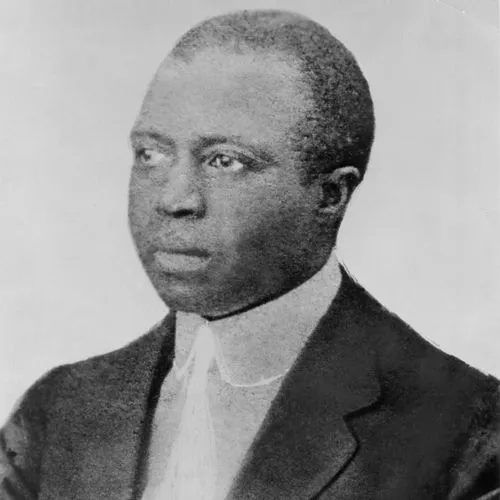
Scott Joplin was an American pianist and composer regarded as one of the founding figures of ragtime. Active in the late nineteenth and early twentieth centuries, he helped popularise a musical style characterised by syncopated rhythms and piano compositions. His works Maple Leaf Rag and The Entertainer became landmarks of American music. The composer of the opera Treemonisha, he also sought recognition for ragtime as a sophisticated musical form. Rediscovered during the 1970s, his work has had a lasting influence on the history of popular music.
Details
- Type
- Music
- Countries
- 🇺🇸 United States
- Genres
- Ragtime
- Albums
- 30
Synopsis
Scott Joplin
Glossary terms: Accompaniment, Author / songwriter, Classical music, Composer, Composition, Contribution, Ensemble, Harmony, Jazz, Melody, Opera, Piano, Rhythm, Row / record, Score, Springing, Staff / stave, Story
Trailer
Watch the trailer
Overview
Presentation
Scott Joplin was an African American pianist and composer born in Texas, probably between 1867 and 1868, who died in New York City on April 1, 1917. His exact date and place of birth remain uncertain. Raised in the Texarkana area, he learned piano as a child and received instruction from musician Julius Weiss, who introduced him to European classical traditions. After performing with travelling ensembles, he settled in Sedalia, Missouri, where he became involved in the local music scene. In 1899, the publication of Maple Leaf Rag by John Stark brought him national recognition and helped popularise ragtime among amateur and professional pianists.
After moving to St. Louis, Joplin composed several works that became standards of the repertoire, including The Easy Winners (1901), Elite Syncopations (1902), The Entertainer (1902) and The Cascades (1904). Nicknamed the “King of Ragtime”, he developed a piano style combining syncopated melodies, structured forms and elaborate harmonies. He regarded ragtime as more than entertainment: his compositions reflected an ambition to establish the genre as music worthy of careful study and interpretation. His instructional publication School of Ragtime (1908) illustrated this approach.
Joplin also pursued ambitions in opera. Following A Guest of Honor (1903), whose score has been lost, he composed Treemonisha, which he published at his own expense in 1911. Set within a rural African American community, the opera explores education, superstition and emancipation. Despite his efforts, Joplin was unable to secure a fully staged production during his lifetime. Weakened by illness, he died in 1917 as ragtime's popularity was beginning to decline.
His music experienced a major revival during the 1970s, notably through pianist Joshua Rifkin's recordings, a staged production of Treemonisha in 1972 and the film The Sting (1973), whose soundtrack incorporated several of his compositions. In 1976, Joplin received a special posthumous Pulitzer Prize citation recognising his contribution to American music.
Key Takeaways
Scott Joplin helped define classical piano ragtime, a style built on the contrast between a steady left-hand accompaniment and syncopated accents in the right-hand melody. Drawing on African American musical traditions and European musical forms, his work is distinguished by carefully written compositions rather than a purely improvisational approach.
His significance extends beyond his most familiar piano pieces. By advocating ambitious composition and writing for the operatic stage, Joplin contributed to the recognition of African American composers during an era of racial segregation. Ragtime, of which he remains a major representative, also played an important role in the development of American popular music and the emergence of jazz.
Conclusion
Scott Joplin profoundly influenced ragtime by establishing an enduring piano repertoire and seeking to expand the genre's artistic possibilities. Underappreciated for many years after his death, his music is now recognised as part of America's musical heritage.
Did You Know?
- Birth: probably between 1867 and 1868 in Texas; the exact date and location are uncertain.
- Death: April 1, 1917, in New York City, United States.
- Nickname: “King of Ragtime”.
- First major success: Maple Leaf Rag (1899), published by John Stark in Sedalia.
- Signature compositions: The Easy Winners (1901), Elite Syncopations (1902), The Entertainer (1902), The Cascades (1904), Bethena (1905) and Solace (1909).
- Music education: School of Ragtime (1908), a collection of exercises and performance guidance.
- Operas: A Guest of Honor (1903), whose score is lost, and Treemonisha, published in 1911.
- Rediscovery: a major ragtime revival during the 1970s, supported by recordings from Joshua Rifkin.
- Cinema: The Entertainer regained widespread popularity through the film The Sting (1973).
- Recognition: a special posthumous Pulitzer Prize citation in 1976 for his contribution to American music.
Link graph
Open in the full graphLoading the graph…
Only the strongest links are shown.
View the list ({count})
Discography
Discography (30)


