Frédéric Chopin (1810–1849) was a Polish composer and pianist, and a leading figure of Romantic music. Often described as the 'poet of the piano', he devoted most of his compositions to the instrument, transforming its expressive and technical possibilities. His musical language combines lyricism, harmonic refinement and influences from Polish folk traditions. His Nocturnes, Études, Preludes, Mazurkas, Polonaises and Ballades form an essential part of the piano repertoire, distinguished by personal expression and remarkable melodic richness.
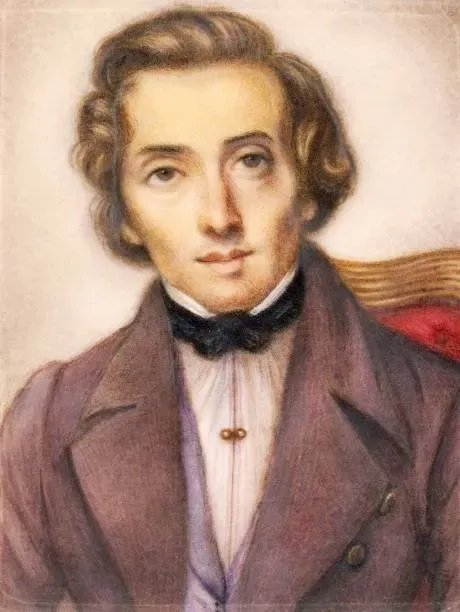
Frédéric Chopin
Under his fingers, the piano becomes a voice capable of expressing every shade of emotion.
Details
- Type
- Music
- Countries
- 🇵🇱 Poland
- Genres
- Classical, Romantic music
- Albums
- 3
Synopsis
Frédéric Chopin
Glossary terms: Ballade, Chamber music, Classical music, Composer, Composition, Fundamental, Harmonic (overtone), Harmony, ISO / sensitivity, Piano, Rhythm, Romanticism, Romanticism, Rubato, Technique, Tempo, Traditional music
Trailer
Watch the trailer
Overview
Presentation
Frédéric Chopin (1810–1849) was a Polish composer and pianist, recognized as one of the central figures of Romantic music. Born in Żelazowa Wola, near Warsaw, he demonstrated exceptional piano abilities from childhood and studied composition under Józef Elsner. After leaving Poland in 1830, he settled in Paris in 1831, establishing himself as a composer, performer and piano teacher.
Unlike many composers of his generation, Chopin devoted almost his entire creative output to the piano. His compositions explore the instrument's tonal variety, rhythmic flexibility and harmonic possibilities. His musical language combines European classical traditions with Romantic sensitivity, drawing particularly on Polish folk dances.
Key Points
Chopin profoundly transformed nineteenth-century piano composition. His Nocturnes develop an intimate, singing quality, while his Études combine technical challenges with musical invention. His Preludes explore a wide range of atmospheres, from introspective meditation to dramatic intensity.
His Mazurkas and Polonaises reflect his attachment to Polish musical culture. His four Ballades expanded the possibilities of instrumental narrative, while his sonatas and two piano concertos demonstrate his command of larger musical structures. His use of rubato and harmonic innovations had a lasting influence on subsequent generations.
Conclusion
Frédéric Chopin holds a fundamental position in the history of piano music and Romanticism. By transforming pianistic forms, techniques and expression, he developed a distinctive musical language that influenced Liszt, Fauré, Debussy and numerous later composers.
Did You Know?
- Birth: traditionally dated March 1, 1810, in Żelazowa Wola, although his baptismal record indicates February 22. He died October 17, 1849, in Paris.
- Paris: based in the French capital from 1831, he became closely involved with Romantic artistic and literary circles.
- Repertoire: he composed primarily for solo piano, alongside two concertos and several chamber works.
- Polish influences: mazurkas and polonaises occupy a central position in his compositions.
- Performance: his approach to rubato, characterized by expressive rhythmic flexibility, became a defining feature of his style.
Link graph
Open in the full graphLoading the graph…
Only the strongest links are shown.
View the list ({count})
Discography
Discography (3)


