This Taoist classic presents the Way as the elusive principle from which beings arise. It recommends simplicity, withdrawal and non-action in order to recover a power attuned to the natural course of things.
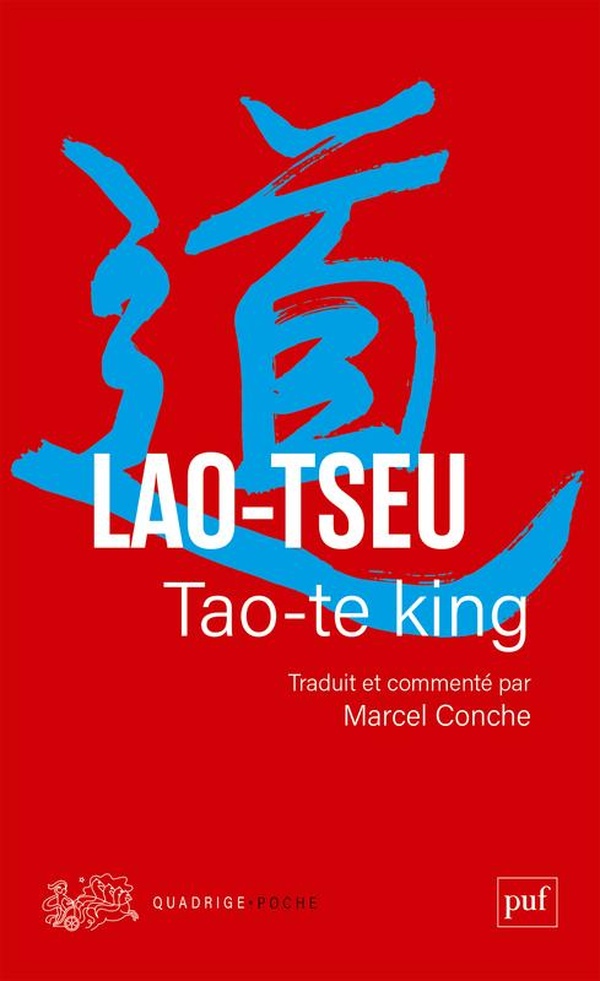
Book
2025
Poetry
Philosophy
Tao Te Ching: The Book of the Way and Its Virtue
道德經
- PUF Publisher
- Lao Tseu Author
This Taoist classic presents the Way as the elusive principle from which beings arise
Details
- Type
- Book
- Release
- 2025-01-02
- Original title
- 道德經
- Countries
- Chine
- Original language
- Chinese
- Genres
- Poetry, Philosophy
- Platforms
- Volumes
- 1
- Status
- Completed
- ISBN
- 9782130878414
- Information verified on
- 14 octobre 2026
Synopsis
Tao Te Ching: The Book of the Way and Its Virtue
Overview
Overview
Published in the Quadrige collection by Presses universitaires de France in 2025, the Tao-te king is one of the foundational texts of Chinese philosophy and Taoism. Traditionally attributed to Lao Tseu, or Laozi, it is also known as the Dao de jing, generally translated as The Book of the Way and Virtue. Its composition and transmission remain subjects of debate, with historical research placing the formation of the text several centuries before the Common Era.
Organised into 81 short chapters, the work brings together reflections expressed through aphorisms, paradoxes and poetic imagery. At the heart of this philosophy lies the Tao, the Way, the fundamental principle from which beings and the transformations of the world arise. Rather than attempting to define this principle, the text invites readers to understand how to live and act in harmony with it.
This approach raises questions about human behaviour, desires, ambitions and forms of authority. The Tao-te king values simplicity, flexibility and humility while developing the concept of wu wei, generally translated as "non-action". This does not mean absolute inactivity, but rather a way of acting without imposing excessive will upon the natural course of things.
This edition presents the French translation and commentary by Marcel Conche, a philosopher specialising in ancient thought. His work accompanies the text's sometimes enigmatic formulations and clarifies their philosophical significance. It provides an introduction to the essential concepts of Taoism while preserving the concise and suggestive character of the original work.
Key Takeaways
The Tao-te king develops a philosophy based on the relationships between opposites. Fullness and emptiness, strength and weakness, action and rest are not regarded as simply opposing realities, but as interdependent dimensions. This way of thinking encourages the pursuit of balance rather than domination.
Water, in particular, plays an important role in the text. Flexible and capable of adapting to the shapes it encounters, it becomes an image of quiet strength and effectiveness without coercion. This conception applies both to individual conduct and to the exercise of power: the ideal ruler acts with restraint and avoids unnecessarily disturbing the natural order of things.
Another distinctive feature of the work lies in its writing. The Tao-te king is not a philosophical treatise built around a continuous argument. Its chapters favour short formulations, often open to several interpretations. Marcel Conche's commentary plays an essential role here, explaining the ideas and apparent contradictions without erasing their complexity.
Conclusion
The Tao-te king occupies a central place in the history of Chinese philosophy. Through its reflections on the Way, virtue, simplicity and non-action, it presents a conception of wisdom attentive to the transformations of the world and the limits of human will. Marcel Conche's annotated translation conveys this philosophy alongside explanations that connect an ancient text to fundamental questions about existence and human conduct.
Good to Know
The edition published by Presses universitaires de France on January 2, 2025, in the Quadrige Poche collection, reproduces Marcel Conche's translation and commentary, originally published by PUF in 2003 in the Perspectives critiques collection.
Marcel Conche (1922–2022) was a French philosopher whose work focused particularly on ancient philosophy, nature and wisdom. His approach to the Tao-te king reflects his interest in major philosophical traditions and different ways of understanding existence.
The traditional attribution of the text to Lao Tseu is not a historical certainty. Ancient manuscripts discovered in China show that the work underwent several stages of transmission and reorganisation. Its customary division into 81 chapters corresponds to the classical form of the text, without necessarily reflecting its earliest organisation.