What principles make it possible to understand a confrontation and gain an advantage over an opponent? In Treatise on the Five Rings, also known as Go Rin no Sho, Miyamoto Musashi presents his conception of strategy based on his experience as a Japanese sword master. Divided into five books devoted to Earth, Water, Fire, Wind, and Void, the work examines the foundations of the martial way, swordsmanship, the rhythms of combat, and the methods of competing schools. Musashi emphasizes training, observation, precision of movement, and the importance of never becoming confined to a rigid technique. He connects the principles applicable to individual duels with those governing larger confrontations, while placing particular importance on self-mastery and discernment. The treatise thus presents a strategic philosophy in which victory depends as much on understanding circumstances as on physical skill.
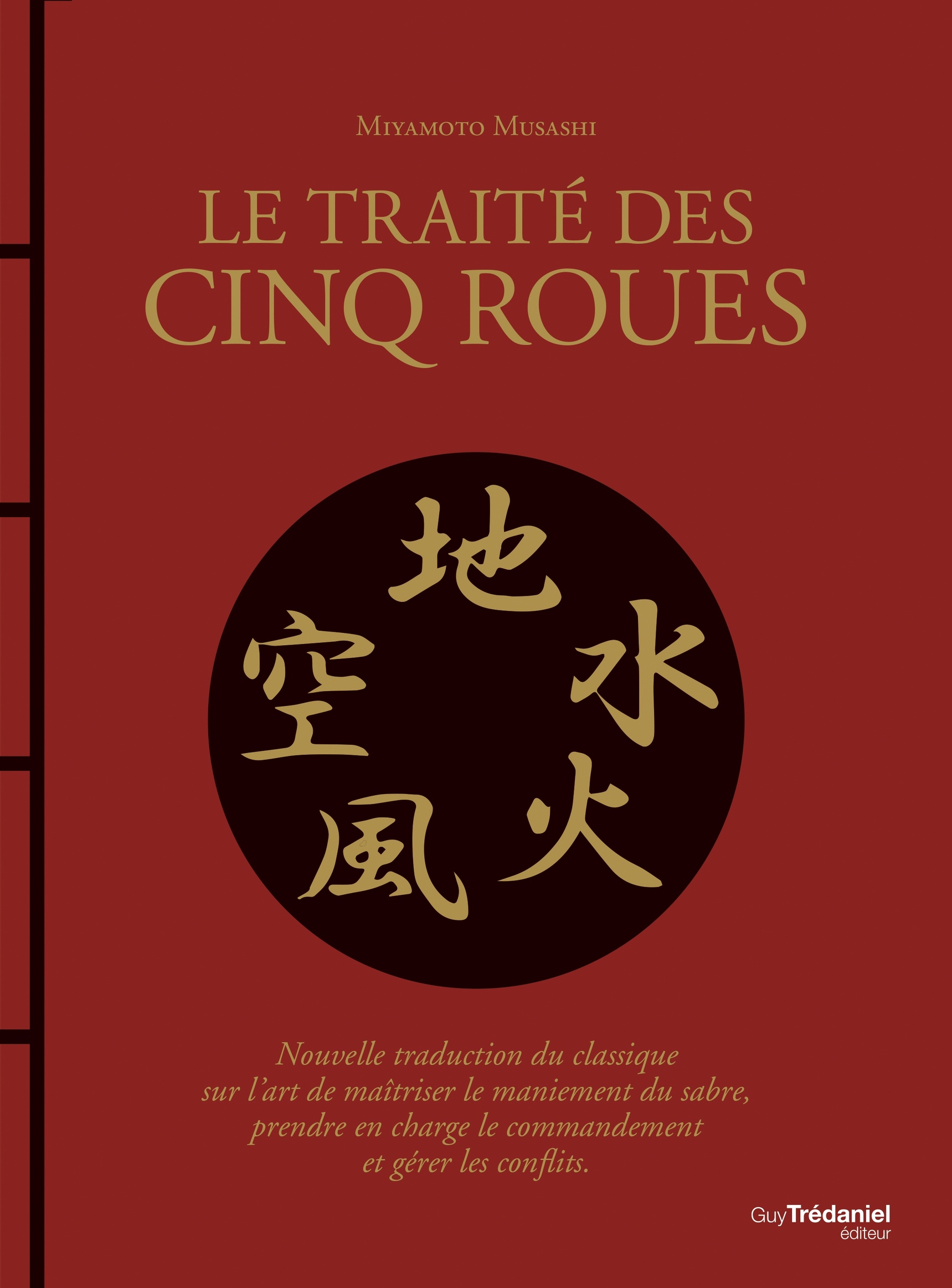
Miyamoto Musashi: Treatise on the Five Rings, Go Rin no Sho
- Createspace Independent Publishing Platform Publisher
- Miyamoto Musashi Author
The sword alone is not enough: one must also understand when, how, and why to strike.
Details
- Type
- Book
- Original language
- Japanese
- Genres
- Philosophy
- ISBN
- 9781974581153
- Information verified on
- October 14, 2026
Synopsis
Miyamoto Musashi: Treatise on the Five Rings, Go Rin no Sho
Glossary terms: Anticipation, Author, Book, Critique, Decision, Editorial, Habit, Intention, ISBN, Knowledge, Martial arts, Method, Necessity, Observation, Paperback, Part, Precision, Publication, Publishing, Reflection, Simile, Strategy, Technique, Text, Title, Tracking (type), Training, Treatise, Verse line, Work
Overview
Overview
In Treatise on the Five Rings, Miyamoto Musashi conveys the principles of strategy he developed throughout his career as a warrior and sword master. Known by its Japanese title Gorin-no-sho or Go Rin no Sho, this work belongs to the tradition of martial treatises from seventeenth-century Japan. Musashi presents the strategic way as a discipline extending beyond a simple knowledge of combat techniques. Physical skill, observation, mastery of rhythm, and decision-making must work together to enable effective action. The text draws on experience and training rather than the mechanical application of abstract rules. This French edition, published by CreateSpace Independent Publishing Platform, presents the treatise in a form distinct from editions supplemented with commentaries and other writings by Musashi.
The work is divided into five books named after Earth, Water, Fire, Wind, and Void. The Book of Earth establishes the foundations of strategy and explains the general principles of Musashi's school. The author notably compares the strategist to a master carpenter, who must know the tools, understand the materials, and organize the work according to the requirements of each situation. This comparison highlights the need to acquire practical knowledge of the means available. Musashi also emphasizes the importance of methodical training, through which movements and decisions gradually become the expression of deep understanding rather than mere habits.
The Book of Water develops the principles of swordsmanship and the combatant's adaptability. Water represents flexibility: it assumes different forms while retaining its essential properties. Musashi examines posture, gaze, sword grip, movement, and different ways of engaging an opponent. His teachings favor readiness and precision over attachment to a particular position. He also introduces elements of his school of combat, associated with the use of both long and short swords. Mastery does not consist in reproducing a technique regardless of context, but in understanding how to employ it at the appropriate moment.
In the Book of Fire, the discussion focuses on the actual conduct of combat. Musashi studies initiative, the advantages of terrain, changes in rhythm, and methods for unsettling an opponent. One of his central concerns is recognizing the favorable moment before the enemy can impose their own intentions. He examines different ways of gaining the upper hand, interrupting an attack, or altering the dynamics of a confrontation. The author also draws parallels between individual duels and battles involving numerous combatants: despite their differences in scale, these encounters share fundamental principles of observation, coordination, and the exploitation of circumstances.
The Book of Wind is devoted to a critical examination of competing schools. Musashi considers methods that prioritize particular weapons, specific postures, or speed as fundamental principles of victory. He maintains that a technique can become a weakness when applied without discernment. Studying rival traditions therefore makes it possible to understand their limitations while clarifying what distinguishes his own approach. This perspective emphasizes the importance of not confusing loyalty to a method with a genuine understanding of strategy. To act effectively, one must recognize the opponent's characteristics without becoming trapped by one's own habits.
The treatise concludes with the Book of Void, devoted to the culmination of strategic mastery. Musashi distinguishes true emptiness from mere ignorance: failing to understand something does not mean having attained superior knowledge. Void refers to a clarity acquired through study and experience, when the combatant is no longer hindered by confusion, prejudice, or hesitation. This final section gives a philosophical dimension to the preceding teachings without separating them from their martial purpose. Strategy emerges as a practice requiring continuous training, until observation and action can naturally respond to circumstances.
Key Takeaways
Strategy depends on a comprehensive understanding of confrontation. Musashi does not reduce victory to strength or technical skill. He considers terrain, rhythm, the opponent's intentions, and the timing of action to be essential factors. Mastery requires perceiving how these elements interact rather than examining them in isolation.
Discipline and training are essential to mastery. Strategic principles must be assimilated through regular practice. Repetition develops precise movements, sounder judgment, and an ability to react without relying on laborious reasoning during combat.
Adaptation takes precedence over technical rigidity. No posture or method guarantees victory in every situation. Combatants must adjust their approach according to circumstances, just as water adapts to the shape of its container. Flexibility therefore becomes a condition of effectiveness.
Mastery of rhythm makes it possible to seize the initiative. Musashi places great importance on choosing the favorable moment, anticipating developments, and disrupting an opponent's rhythm. Understanding the pace of combat makes it possible to create imbalances and maintain the advantage.
Knowledge of other schools encourages discernment. A critical examination of competing methods helps reveal the limitations of specialized techniques and acquired habits. For Musashi, understanding what others do also provides a means of clarifying the foundations of one's own strategy.
Void should not be confused with an absence of knowledge. The final book presents a state of understanding in which principles have been sufficiently integrated to allow action without confusion. This mastery results from experience, study, and continuous work on perception and judgment.
Conclusion
With Treatise on the Five Rings, Miyamoto Musashi brings together a reflection on strategy in which combat serves both as a field of application and as an object of study. The five books organize a progression from the fundamental principles of the martial way to an understanding of rhythm, the opponent, and the conditions necessary for controlled action.
The work reflects a conception of victory grounded in observation, training, and adaptation. Although its teachings have subsequently been applied to negotiation, leadership, and decision-making, their original formulation remains closely connected to martial arts. Musashi's thought rests on the idea that no technique can replace a concrete understanding of the situation in which it is used.
Good to Know
- Miyamoto Musashi (c. 1584–1645) was a Japanese sword master, strategist, painter, and calligrapher. His life spanned the transition between the wars of the late sixteenth century and the lasting establishment of Tokugawa rule.
- The Japanese title Go Rin no Sho (五輪書) is generally translated into English as The Book of Five Rings, The Book of Five Wheels, or Treatise on the Five Rings. These titles refer to the same work.
- The French edition published by CreateSpace Independent Publishing Platform is listed under ISBN 9781492232810. Bibliographic catalogs date it to 2013 and describe it as a paperback volume.
- CreateSpace was an independent publishing and print-on-demand platform. This edition should be distinguished from publications by Guy Trédaniel, which offer different editorial presentations of the text, sometimes accompanied by illustrations or supplementary writings.
- The treatise consists of five sections: the Book of Earth, devoted to the foundations of strategy; the Book of Water, devoted to swordsmanship; the Book of Fire, devoted to combat; the Book of Wind, devoted to other schools; and the Book of Void, devoted to the ultimate understanding of the strategic way.
- Musashi is associated with the Niten Ichi-ryū school, whose teachings notably include the simultaneous use of a long sword and a short sword. His conception of strategy is not, however, limited to this technical characteristic.
- The Gorin-no-sho was composed during the final years of Musashi's life and transmitted in 1645 to his disciple Terao Magonojō. The text belongs to the transmission of martial teachings rather than to literary publication in the modern sense.
- The imagery of the five elements used to organize the treatise has parallels in Japanese Buddhist cosmology. Musashi employs it as a structure for distinguishing the different areas of his strategic teachings.
- The Gorin-no-sho is sometimes compared with Sun Tzu's The Art of War because of their shared emphasis on observation, preparation, and anticipation. However, the two texts belong to different historical contexts and offer distinct approaches to strategy.
Link graph
Open in the full graphLoading the graph…
Only the strongest links are shown.