The monk Tripitaka embarks on a long journey to India to bring sacred Buddhist scriptures back to China. To cross lands inhabited by demons, spirits and supernatural creatures, he is aided by three companions: Sun Wukong, the powerful Monkey King, Zhu Bajie and Sha Seng. Together, they face numerous trials in a quest combining adventure, wisdom and redemption.
Book
2014
Adventure
Fantasy
Martial arts
Fei: Journey to the West
西游记
- Éditions Fei Publisher
- Wu Cheng'en Author
The legendary epic of the Monkey King and his companions, adapted into 36 volumes of traditional Chinese comics.
Details
- Type
- Book
- Release
- 2014-10-24
- Original title
- 西游记
- Countries
- Chine
- Genres
- Adventure, Fantasy, Martial arts
- Platforms
- Volumes
- 36
- Status
- Completed
- ISBN
- 9782359661996
- Information verified on
- 13 octobre 2026
Synopsis
Fei: Journey to the West
Overview
Overview
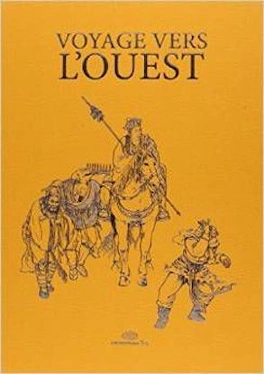
Published in France by Les Éditions Fei in 2014, Voyage vers l'ouest brings together an illustrated adaptation of one of the Four Great Classical Novels of Chinese literature. Attributed to Wu Cheng'en in the 16th century, the original story, known as Xiyou ji, draws on Buddhist traditions, mythology and Chinese folk tales.
The story follows the monk Tripitaka, who is tasked with travelling to India to bring sacred Buddhist scriptures back to China. His journey, as spiritual as it is perilous, takes him through territories inhabited by demons, spirits and deities. Three companions accompany him on this quest: Sun Wukong, the Monkey King with extraordinary powers, Zhu Bajie, a former celestial being with a pig-like appearance, and Sha Seng, a repentant warrior. Each has their own strengths, weaknesses and reasons for undertaking the pilgrimage.
The narrative unfolds through encounters and trials that test their courage, loyalty and ability to cooperate. Sun Wukong's impulsiveness contrasts particularly with Tripitaka's patience and discipline, creating a central relationship in an adventure where supernatural battles coexist with humour and moral lessons.
This edition presents the epic in 36 lianhuanhua volumes, a traditional form of Chinese comics combining successive illustrations with short narrative texts.
Key Takeaways
Voyage vers l'ouest is a major work of Chinese literary heritage, whose influence extends far beyond the borders of its country of origin. Its world combines fantastic adventures, religious beliefs and satire of human behaviour, while the characters' journey gradually becomes a reflection on self-control, friendship and the pursuit of wisdom.
Sun Wukong is one of the story's defining figures. Rebellious, cunning and gifted with exceptional power, he embodies both freedom and the need to learn to control his impulses. His development accompanies that of the group, whose differences become a strength when facing the dangers of the journey.
The lianhuanhua adaptation is another distinctive feature of this edition. This format highlights the visual richness of the creatures, landscapes and mythological battles while preserving the novel's episodic progression. It also introduces readers to a Chinese storytelling tradition that holds an important place in the history of comics.
Conclusion
Across its 36 volumes, Voyage vers l'ouest offers an illustrated adaptation of a foundational epic of Chinese culture. Combining supernatural adventures, humour and a spiritual quest, this edition opens the door to the world of Sun Wukong and his companions while preserving the original work's essential themes: redemption, perseverance, friendship and wisdom.
Good to Know
The French edition, published on October 24, 2014, contains 2,879 black-and-white pages, divided into 36 small landscape-format volumes. The cloth-covered box set also includes an A2-sized map tracing the mythical stages of the journey and an introductory booklet.
The French translation was produced by Nicolas Henry and Si Mo. The foreword was written by Vincent Durand-Dastès, a specialist in Chinese literature and lecturer at INALCO.
The character of Sun Wukong has profoundly influenced Asian popular culture and inspired numerous literary, cinematic and video game adaptations. His influence can notably be seen in the creation of Son Goku, the protagonist of Dragon Ball.