How can we cultivate virtue and build a society founded on justice and harmony? In The Wisdom of Confucianism, four foundational texts of the Confucian tradition explore the relationships between personal cultivation, moral conduct, and government. The Great Learning connects self-improvement with harmony within the family and the state, while The Doctrine of the Mean examines the principles of just and balanced conduct. The Analects transmit teachings attributed to Confucius concerning benevolence, education, and human responsibilities. Finally, Mencius extends this reflection by addressing human nature, virtue, and the duties of rulers. Brought together in a single volume, these texts present the different dimensions of a philosophy in which individual development and social harmony are inseparable.
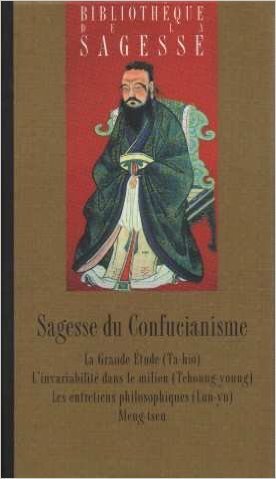
Confucius: The Wisdom of Confucianism
- France Loisirs Publisher
- Confucius Author
From self-mastery to the art of government, wisdom begins with virtue.
Details
- Type
- Book
- Original language
- Chinese
- Genres
- Philosophy
- ISBN
- 9782724283440
- Information verified on
- 14 octobre 2026
Synopsis
Confucius: The Wisdom of Confucianism
Overview
Overview
The Wisdom of Confucianism brings together four foundational texts of the Chinese philosophical tradition, known collectively as the Four Books or Sìshū. Published by France Loisirs in the Bibliothèque de la sagesse collection, this volume contains The Great Learning, The Doctrine of the Mean, The Analects, and Mencius. These works, originating from different stages in the development of Confucianism, share a concern with moral cultivation, human relationships, and political responsibility. Their inclusion in a single volume makes it possible to move beyond the teachings attributed directly to Confucius and explore the subsequent development of his philosophical tradition.
The Great Learning, or Daxue, establishes a close connection between personal cultivation and the organization of society. It presents moral development as the starting point of a process that gradually extends to the family, government, and the wider human world. Knowledge, sincerity of intention, and upright conduct are therefore parts of a common endeavor. Political order cannot be permanently separated from the moral qualities of individuals, since the ability to govern others first requires the cultivation of oneself.
The Doctrine of the Mean, or Zhongyong, develops the pursuit of just, balanced, and consistent conduct. Although frequently associated with the idea of a golden mean, the text does not simply recommend avoiding extremes: it examines how to act appropriately in different circumstances while remaining faithful to moral principles. Sincerity, harmony, and the relationship between human nature and the proper way of life occupy a central place in this investigation. Wisdom emerges as an inner disposition that must be expressed consistently through behavior.
The Analects, or Lúnyǔ, transmit the sayings and conversations attributed to Confucius. Through exchanges with his disciples and brief observations, the philosopher addresses benevolence, learning, righteousness, and respect for ritual propriety. The figure of the exemplary person, or junzi, embodies the ideal of conduct grounded in virtue rather than privilege. Confucian thought thus connects family responsibilities, education, and the exercise of authority, emphasizing the influence of personal example on moral development and social harmony.
The fourth text, Mencius, presents the teachings of a philosopher who extends and develops the Confucian tradition. He places particular importance on human nature and the moral dispositions present within each individual. According to Mencius, human beings possess initial tendencies toward goodness, particularly compassion, which must be cultivated to develop into genuine virtues. This conception also has political implications: power should be exercised with humanity and respond to the needs of the people. The legitimacy of government therefore depends on its ability to preserve the conditions necessary for a just society.
Together, these four texts demonstrate how Confucian wisdom connects individual development with collective responsibility. Education, sincerity, benevolence, and justice are not separate concerns but complementary elements of a common understanding of human existence. Personal morality establishes the foundations of healthy human relationships, while political authority should reflect the demands of virtue. The collection thus provides a structured perspective on Confucianism, from its educational principles to its social and political implications.
Key Takeaways
Personal cultivation forms the foundation of social order. The Great Learning establishes a continuity between self-improvement, family harmony, and government. The transformation of society begins with sincerity of intention, knowledge, and the moral integrity of its members.
Wisdom requires balance and consistency. The Doctrine of the Mean presents the middle way as the pursuit of appropriate conduct, grounded in sincerity and discernment. Harmony does not mean eliminating every difference, but acting with moderation and consistency in the circumstances of human existence.
Virtue must be expressed through human relationships. The Analects emphasize benevolence, respect for ritual propriety, and learning. The exemplary person is distinguished by moral qualities and the treatment of others rather than by wealth or social position.
Human nature and government are connected through morality. Mencius develops the idea that human tendencies toward goodness must be cultivated. This reflection extends to politics, where compassion, justice, and concern for the people become essential conditions of legitimate authority.
Conclusion
With The Wisdom of Confucianism, four Chinese classics are brought together around a common question: how can an individual's moral qualities contribute to the development of a just society? From personal education to political responsibility, these texts present a conception of wisdom in which virtue, sincerity, and benevolence guide human relationships.
The collection also reveals the diversity of the Confucian tradition. Teachings attributed to Confucius appear alongside texts that develop questions concerning human nature, the middle way, and the foundations of political authority. Their combination illustrates the gradual formation of a philosophical tradition that profoundly shaped Chinese thought and education.
Good to Know
- The Wisdom of Confucianism is an English rendering of the French cover title Sagesse du confucianisme, an edition published by France Loisirs in the Bibliothèque de la sagesse collection. Its extended French bibliographic title is Les quatre livres : les Sse-chou ou les Quatre livres de philosophie morale et politique de la Chine.
- The volume contains four distinct works: The Great Learning (Daxue), The Doctrine of the Mean (Zhongyong), The Analects (Lúnyǔ), and Mencius (Mèngzǐ).
- The edition reproduces a French translation from Chinese by Guillaume Pauthier, accompanied by an introductory note, a presentation, and annotations prepared by Guy Rachet.
- Not all four texts were written by Confucius. The Analects transmit sayings attributed to him, while the other works belong to the tradition developed by his disciples and successors. Mencius is associated with the philosopher of the same name.
- The Four Books were established as a reference collection within the Neo-Confucian tradition, particularly through the work of Zhu Xi. They played a major role in classical education and the training of Chinese scholars.
- Unlike editions containing only The Analects, this volume explores several complementary dimensions of Confucianism, particularly moral cultivation, the pursuit of harmony, human nature, and political philosophy.