What determines a person's true worth, and how can we cultivate harmonious relationships with others? In Words of Confucius, a selection of sayings and aphorisms presents the essential principles of Confucian wisdom. Compiled by sinologist Cyrille J.-D. Javary, these teachings place friendship, righteousness, benevolence, and courage at the center of moral life. They remind us that true nobility does not depend on birth or social rank, but on personal qualities and the way we treat others. Through brief reflections accompanied by historical engravings, the book highlights a philosophy rooted in everyday life, in which personal cultivation contributes to harmony in human relationships.
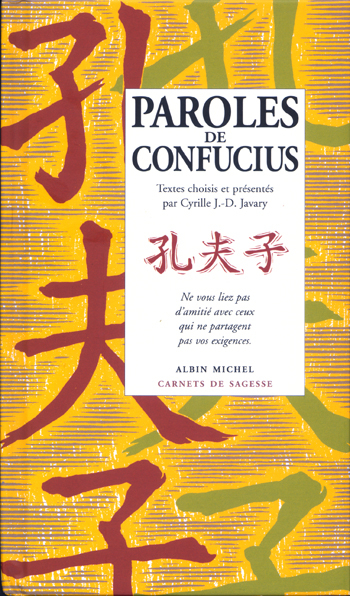
Book
Philosophy
Confucius: Words of Confucius
- Albin-Michel, Editions Publisher
- Confucius Author
True nobility comes not from birth, but from the way we treat others.
Details
- Type
- Book
- Original language
- Chinese
- Genres
- Philosophy
- ISBN
- 9782226148971
- Information verified on
- 14 octobre 2026
Synopsis
Confucius: Words of Confucius
Overview
Overview
Words of Confucius brings together a selection of sayings and aphorisms from the Confucian tradition, presented by sinologist Cyrille J.-D. Javary. Published in the Carnets de sagesse collection by Albin Michel, the book offers a concise and illustrated introduction to the teachings of the Chinese philosopher. Unlike the Analects, which transmit the complete classical text, this collection focuses on selected sayings that illuminate the fundamental principles of a philosophy devoted to human conduct and social relationships.
One of its central themes is the distinction between social status and genuine moral nobility. In Confucian thought, a person's worth cannot be measured solely by birth, wealth, or position in society. It depends above all on personal qualities and the ability to act with integrity. Wisdom therefore emerges as a process of inner cultivation, through which individuals learn to move beyond their immediate interests and develop honorable and respectful conduct.
This moral requirement finds particular expression in benevolence and consideration for others. Confucianism places fundamental importance on humaneness, understood as a disposition to recognize the needs of others and encourage balanced relationships. Friendship, sincerity, and respect are concrete expressions of this moral orientation. Wisdom does not therefore consist in pursuing a truth detached from everyday existence, but in gradually improving the quality of human relationships.
The collection also emphasizes righteousness and moral courage. Acting justly requires remaining faithful to one's principles, even when circumstances make doing so difficult. Courage is not limited to strength or boldness: it acquires moral significance when accompanied by discernment and the determination to do what is right. These qualities contribute to the formation of an exemplary person, capable of promoting social harmony through conduct rather than the assertion of authority.
A distinctive feature of this edition is the combination of philosophical sayings and historical illustrations. The selected reflections are accompanied by engravings depicting scenes of everyday life, landscapes, and calligraphy. This presentation connects the teachings with their cultural environment and emphasizes their roots in ordinary human experience. The collection offers an exploration of Confucian thought through individual fragments without attempting to reproduce the complete structure of the classical texts.
Key Takeaways
True nobility rests on moral qualities. Confucius distinguishes personal worth from privileges associated with birth or social rank. Righteousness, sincerity, and consideration for others define a form of greatness expressed through actions rather than titles.
Wisdom develops through human relationships. Friendship, respect, and benevolence occupy a central place in the selected teachings. Personal improvement is inseparable from collective life: it should help reduce conflict and encourage behavior grounded in reciprocity.
Courage must be guided by justice. Courageous behavior does not necessarily possess moral value when it lacks discernment. From a Confucian perspective, righteousness helps guide decisions and preserve personal principles in difficult circumstances.
Brief sayings provide a means of transmitting wisdom. By emphasizing sentences and aphorisms, the collection presents teachings closely connected to everyday behavior. Their combination with historical engravings situates these reflections within Chinese culture.
Conclusion
With Words of Confucius, the principles of Confucian wisdom are presented through a selection of reflections on moral nobility, benevolence, friendship, and courage. The book highlights a conception of philosophy in which human worth develops through personal cultivation and the quality of relationships with others.
The selection of sayings and their accompanying illustrations give this collection an identity distinct from complete editions of the Analects. It presents the teachings attributed to Confucius in a condensed form, focusing on the attitudes and qualities that contribute to harmony in collective life.
Good to Know
- Words of Confucius is an English rendering of the French editorial title Paroles de Confucius, a collection published by Albin Michel in the Carnets de sagesse series. It is not an independent work written under that title by Confucius.
- The selection and presentation of the texts were prepared by Cyrille J.-D. Javary, a sinologist specializing in Chinese thought, particularly known for his work on the I Ching (Yi Jing).
- The book brings together sayings and aphorisms, accompanied by historical engravings depicting scenes of everyday life, landscapes, and calligraphy.
- The collection draws on the tradition of the Analects of Confucius (Lúnyǔ) but does not reproduce the complete classical text.
- The concept of ren (仁), often translated as "humaneness" or "benevolence," occupies an essential place in Confucian thought. It connects personal cultivation with the quality of relationships between human beings.