Kant : Analytic of the Beautiful
In this part of the Critique of the Power of Judgement, Kant examines aesthetic judgement. Beauty gives pleasure without concept or interest while laying claim to a distinctive form of universality.
- Philosophy
PANACHES Culture · Works
Discover films, animation, series, anime, documentaries, live, manga, BD, comics, books, games, music, then explore their associated studios, tools and articles.
14 works
In this part of the Critique of the Power of Judgement, Kant examines aesthetic judgement. Beauty gives pleasure without concept or interest while laying claim to a distinctive form of universality.
Kant studies the faculty of judging through beauty, the sublime and the organization of life. Aesthetic judgment claims a common validity without relying on a determined concept; teleological judgment thinks of natural beings as ends. The work thus seeks a passage between nature and freedom.
“The moral law is holy (inviolable). Man is undoubtedly very far from holiness, but the humanity in his person must be holy for him. In all of creation, whatever one wants, and whatever one has power over, can also be used simply as a means; man alone, and with him every reasonable creature, is end in himself. He is, in fact, thanks to the autonomy of his freedom, the subject of the moral law, which is holy. It is p…
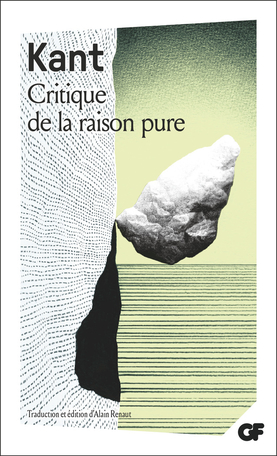
The Critique of Pure Reason revolutionized our relationship to knowledge. The Introduction from 1787 reproduced in the present edition is the royal road to enter this cathedral work. The text offers a powerful definition of the overall objective of Critique: to trace the boundaries of human knowledge. But the stakes are even greater. It is a question of determining the destiny of metaphysics, whether to place it bac…
These essays examine progress, cosmopolitanism, peace and humanity’s political destiny. Kant looks for a rational guiding thread in the conflict-ridden course of history.
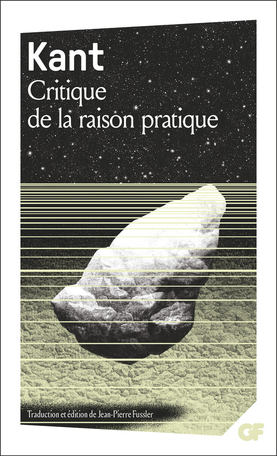
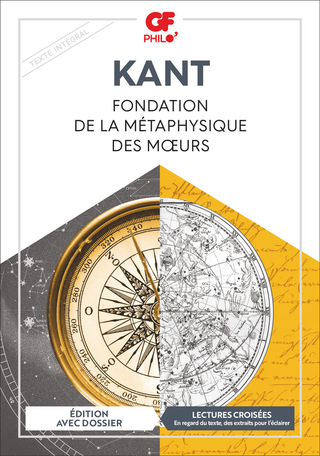
What are the Foundations of the Metaphysics of Morals and the Critique of Practical Reason about? On the foundation of moral discourse, of a coherent discourse, absolutely valid for all beings endowed with reason, binding on everything that is finite and reasonable. It is not a question of morality in the traditional sense of the term, of a system of rules of conduct for concrete situations, of precise prescriptions…
Kant presents the general rules of the use of understanding and reason. The manual distinguishes the logical form of thought from its contents and describes the operations of concept, judgment and reasoning.
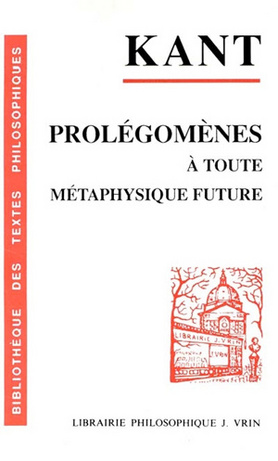
Kant presents in a more accessible form the central problem of the Critique of Pure Reason: how is synthetic a priori knowledge possible? By examining the conditions of mathematics, physics and metaphysics, he clarifies the limits of reason and the foundations of his critical philosophy.
A small treatise on philosophical theology, and not strictly biblical, this is how Kant presented his work to the theologian Matern Reuss in 1793. This work deals with natural religion as conceived by the philosopher Konisgberg, that is to say a religion above all rational and reasonable. Its object is in fact the faith of man which is based solely on reason: a faith in which every man could and should rediscover, b…
Kant applies the principles of his moral philosophy to law and virtue. The Doctrine of Law analyzes the external conditions allowing the freedom of each person to coexist with that of others; The Doctrine of Virtue sets out the duties that the subject gives to himself, towards himself and towards others.
Towards Perpetual Peace appeared in 1795. The work, which was a great success, closed a movement to rationalize the law which determined universal norms for peace without regard for the cultural or religious identity of the parties involved. It thus continues the movement of legal theologians who had to reflect on the legal aspects of the conquest of America, where most historians of international law trace the syst…
These texts explore the relationship between body experience, mental life and knowledge of the human being. They shed light on how Kant articulates nature, sensitivity and autonomy.
The early masterpiece of Marx and Engels, the Manifesto marks a turning point in the history of the labour movement: briefly tracing the origins of the class struggle, Marx and Engel's also wanted to equip the working class with a programme that gave scientific and lasting foundations to any revolutionary action. The result was this brief work, which was broadcast worldwide and whose first edition was born in 1848. …
"In this book, J'études the capitalist mode of production and the relations of production and exchange which correspond to it. [...] This is not the more or less complete development of the social antagonisms that the natural laws of capitalist production generate, but of these laws themselves, tendencies that manifest themselves and are realized with the necessity of iron. At first glance, the commodity appeared to…