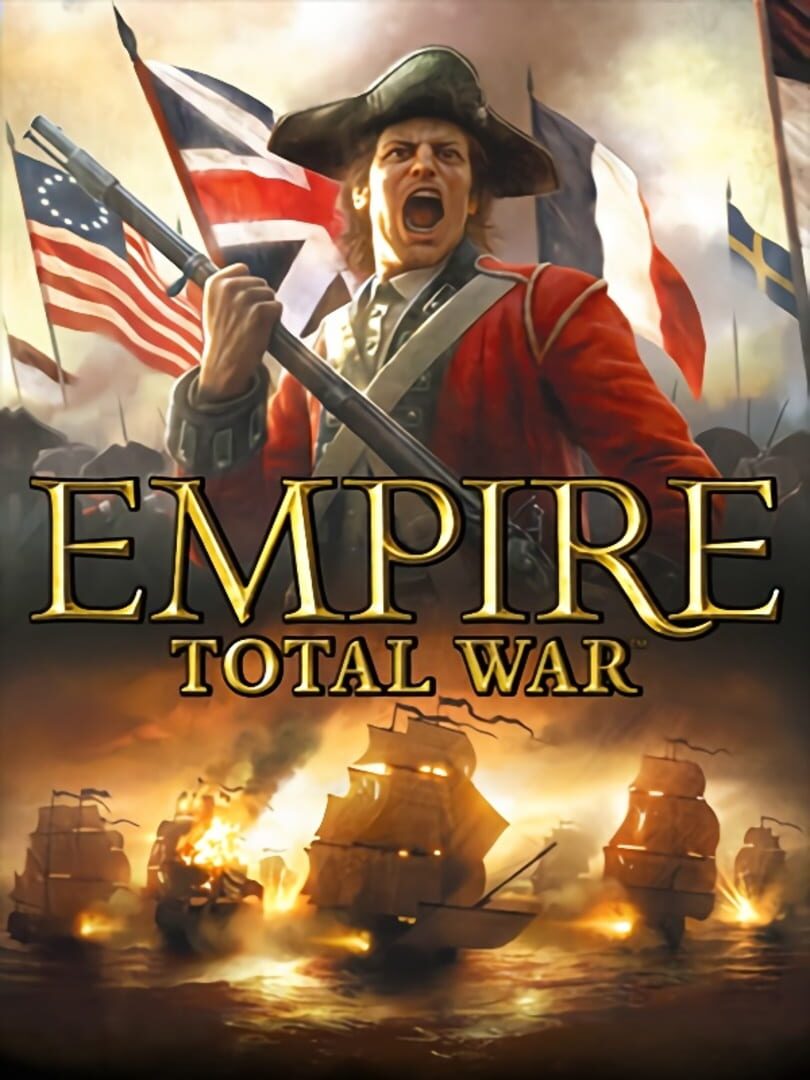
Total War: Empire takes the series into an age of global conquest and military transformation. For the first time, command individual ships and entire fleets in fully three-dimensional naval battles. Wind, weather conditions, cannon fire and boarding actions determine the outcome of engagements. On land, the growing importance of muskets and artillery transforms battlefield formations and tactics. The turn-based strategic campaign introduces expanded systems for trade, diplomacy and espionage. From the European powers to territories across the Americas and India, extend your influence and take part in the rise of new empires.
Video game
2009
Fantasy
Historical
Strategy
Tactical
Real-time strategy
4X
Total War: Empire
- Creative Assembly Developer
- Feral Interactive Publisher
- Sega Publisher
In the age of gunpowder and great fleets, conquest crosses the oceans.
Details
- Type
- Video game
- Release
- March 3, 2009
- Countries
- 🇬🇧 United Kingdom
- Genres
- Fantasy, Historical, Strategy, Tactical, Real-time strategy, 4X
- Platforms
- PC, Mac, Linux, Mobile
- Engine
- TW Engine 3
- Game modes
- Single player, Multiplayer, Co-operative
Synopsis
Total War: Empire


Trailer
Watch the trailer
Overview
Presentation
Developed by Creative Assembly and published in part by Sega, Total War: Empire, originally marketed as Empire: Total War, is a strategy game released on March 3, 2009. The fifth main installment in the series, it takes place during the 18th century, an era of colonial expansion, commercial rivalry, and military and political change. Its Grand Campaign begins in 1701 and spans three geographical theaters: Europe, the Americas and India. Players lead one of eleven major playable powers, including France, Great Britain, Prussia and the Ottoman Empire. The traditional Total War formula combines turn-based state management with real-time tactical battles.
Imperial management revolves around developing provinces, infrastructure and commercial networks. Players administer taxation, maintain armies, construct ports and negotiate with foreign powers. Maritime routes and distant trading regions are essential to economic growth: protecting merchant fleets or disrupting enemy commerce can significantly affect a nation's revenue. Diplomacy allows alliances and agreements, while various agents conduct intelligence, influence and sabotage operations. A technology tree introduces research into military, agricultural, industrial and philosophical advances. Scientific institutions contribute to the development of both the armed forces and wider society.
Political systems add another layer to the campaign. Players can manage government ministers and must monitor dissatisfaction among different social classes. Severe unrest may lead to a revolution, allowing players to support either the established government or the rebels. Changes of government affect administration and diplomatic relations. Territorial management also includes facilities located outside provincial capitals, such as farms, mines and educational institutions, which can be improved or attacked independently. Disrupting these installations can weaken a region without capturing its main settlement.
On land, real-time battles reflect the increasing importance of gunpowder weapons. Line infantry fight with muskets, artillery weakens enemy formations from a distance, and cavalry plays an important role in charges and flanking maneuvers. Terrain, firing range, reloading times and morale affect tactical decisions. Units can use certain environmental protections and establish field defenses, while sieges involve attacking and defending fortified positions.
The game's major innovation is its fully three-dimensional real-time naval combat, which replaces the automatic resolution of sea battles found in previous installments. Players command sailing warships whose speed and maneuverability depend on wind conditions. Different ammunition types can damage hulls, sails or crews. Ships can also close with their opponents and initiate boarding actions, leading to hand-to-hand combat between sailors. The game additionally features a story-driven campaign called Road to Independence, focusing on the formation of the United States, historical battles and multiplayer engagements. A cooperative or competitive two-player campaign mode was also developed as a beta feature after the initial release.
Key Highlights
- A campaign spanning several continents: Europe, the Americas and India are connected through military and commercial rivalries.
- Political and economic management: taxation, trade, diplomacy, technological development and revolutions influence national growth.
- Gunpowder warfare: muskets, cannons, infantry formations and cavalry reshape land battles.
- Fully controllable naval engagements: wind, maneuvering, cannon fire and boarding actions determine battles at sea.
- Technological progression: scientific advances improve infrastructure and military capabilities.
- Multiple campaigns and battle modes: the Grand Campaign, Road to Independence, historical battles and multiplayer.
Conclusion
Total War: Empire expands the series' strategic formula into an era when rivalries between states extended across several continents. Trade routes, political transformations and technological advances influence the power of individual factions. The introduction of real-time naval combat complements land warfare and makes control of the seas a central element of military and economic strategy.
Did You Know?
- The Grand Campaign begins in 1701 and features eleven playable powers across the European, American and Indian theaters.
- Empire: Total War was the first installment in the series to feature directly controlled three-dimensional naval battles. Earlier naval engagements were resolved automatically.
- Fleets can contain up to twenty ships, with different ammunition types and the ability to target specific parts of enemy vessels.
- The Road to Independence campaign follows stages in the formation of the United States. It is separate from the main imperial campaign.
- Revolutions can change a nation's form of government. Players may choose to support either the rebels or the existing authorities.
- The Warpath Campaign downloadable content introduces a North American campaign with five playable Indigenous factions. The Definitive Edition includes this campaign and several additional unit packs.
- The multiplayer campaign beta, introduced after the game's original release, became accessible to all owners of the PC edition on January 16, 2025, without requiring an access code.
- Feral Interactive released an adaptation for iOS and Android on November 21, 2024, featuring redesigned interfaces and touchscreen controls.
Link graph
Open in the full graphLoading the graph…
Only the strongest links are shown.