Presentation
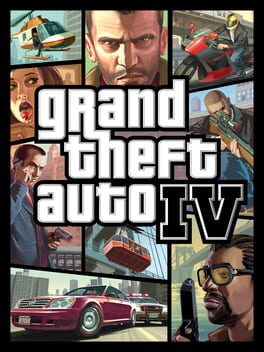
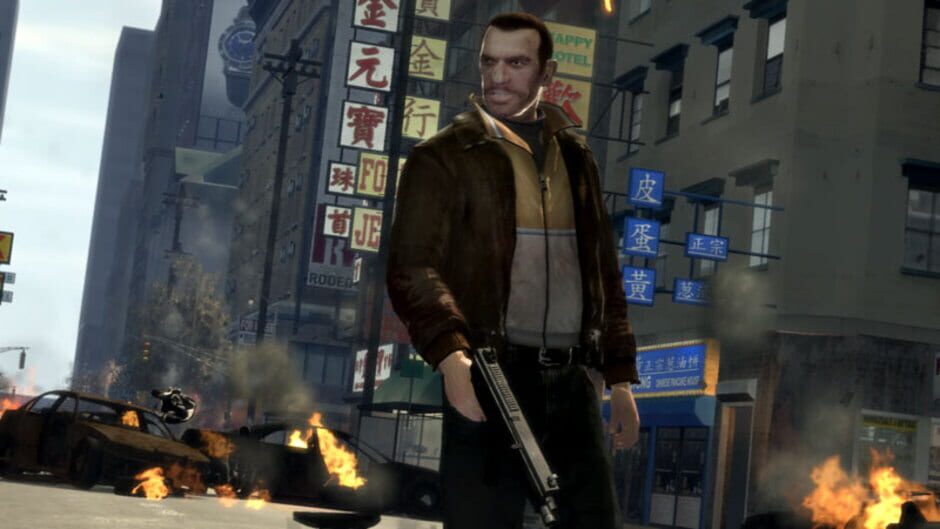
Grand Theft Auto IV marks an important break from Grand Theft Auto: San Andreas. Rockstar North retains the idea of a large open city where the player can drive, fight, complete missions or simply explore, but reduces the geographical scale in order to concentrate more detail within Liberty City. This new version of the city is strongly inspired by New York and its surroundings, with several districts possessing their own architecture, traffic patterns and social identity.
Broker, Dukes, Bohan and Algonquin evoke different parts of New York, while Alderney extends the urban environment toward an area inspired by New Jersey. Bridges and initial restrictions limit access to certain parts of the map before story progression gradually opens them. The world is smaller than San Andreas, but its density, narrow streets, businesses, traffic and countless details give it a particularly strong presence.
Driving plays a major role in this new direction. Vehicles carry more weight, suspension reacts strongly to changes of direction and weight transfer makes cornering more demanding. Collisions are also more pronounced. This approach can feel heavy compared with later entries, but it contributes to giving Liberty City a physical consistency that matches the overall tone of the game.
The same sense of weight appears in the animations. The use of Euphoria physics allows characters to react dynamically to impacts, falls and collisions rather than relying entirely on predefined animations. Gunfights consequently gain a distinctive brutality, while traffic accidents can produce unpredictable situations.
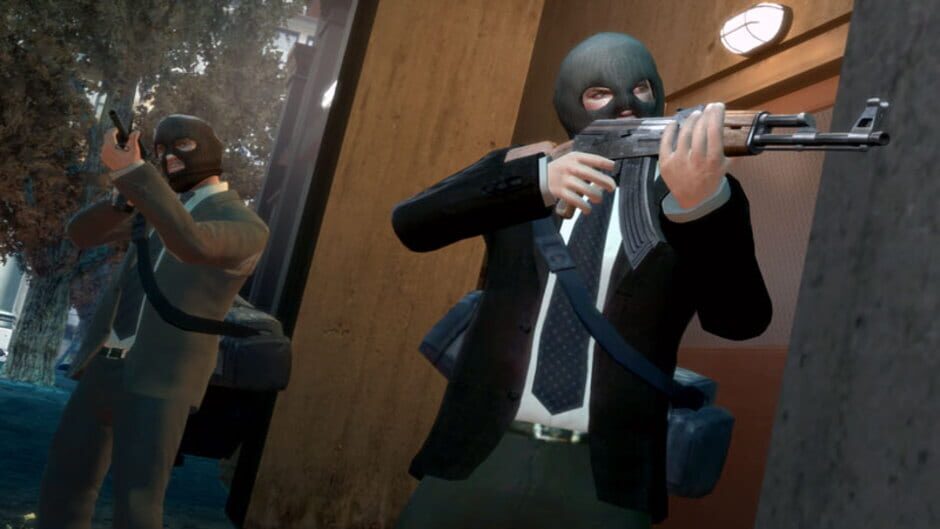
Combat also adopts a much more structured cover system. Niko can press against walls, vehicles and other elements of the environment, move between cover positions and fire without fully exposing himself. Weapons remain immediate and recognizable, but encounters require more attention to positioning than in previous 3D entries.
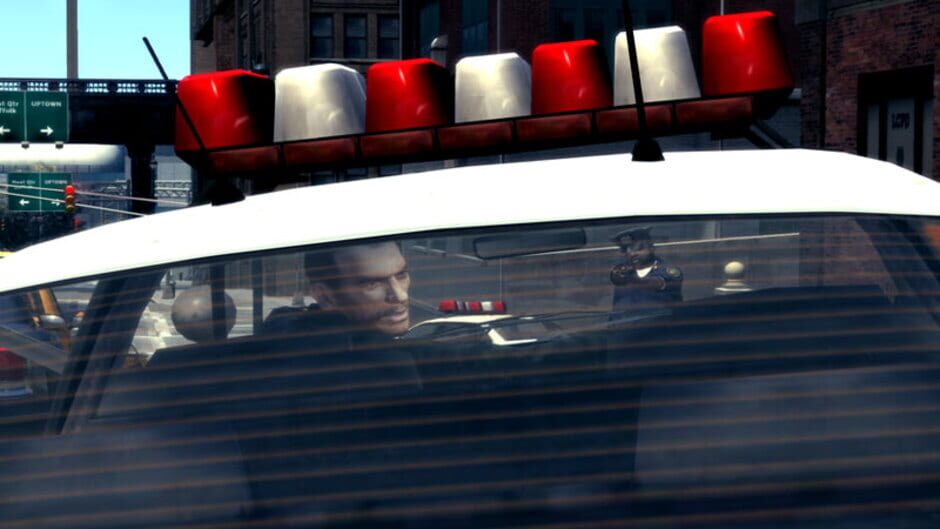
Liberty City retains the freedom associated with Grand Theft Auto. The player can steal vehicles, provoke the police, use taxis and public transport, visit different establishments or simply explore the city without immediately following a mission. The mobile phone, however, becomes a new central tool: it is used to contact characters, receive missions, arrange meetings, call certain services and maintain Niko’s relationships.
Friendships and personal relationships have a more visible role. Roman, Little Jacob, Brucie and Packie can propose activities outside missions. Maintaining some of these relationships can unlock specific advantages, but these meetings mainly help create the impression that the characters have lives beyond criminal contracts.
Roman naturally plays a particularly important role. Despite his initial lies, he represents for Niko the possibility of a different life and remains one of his main emotional connections to a world outside violence. Their relationship mixes irritation, loyalty and affection, giving the story a much more personal dimension than a simple rise through Liberty City’s criminal hierarchy.
This direction is reflected in the overall tone. Social satire remains omnipresent through radio stations, advertisements, television, the Internet and conversations, but Niko’s story is noticeably more melancholic. Immigration, poverty, war trauma, betrayal and the impossibility of completely erasing the past occupy an important place beneath the series’ familiar humor.
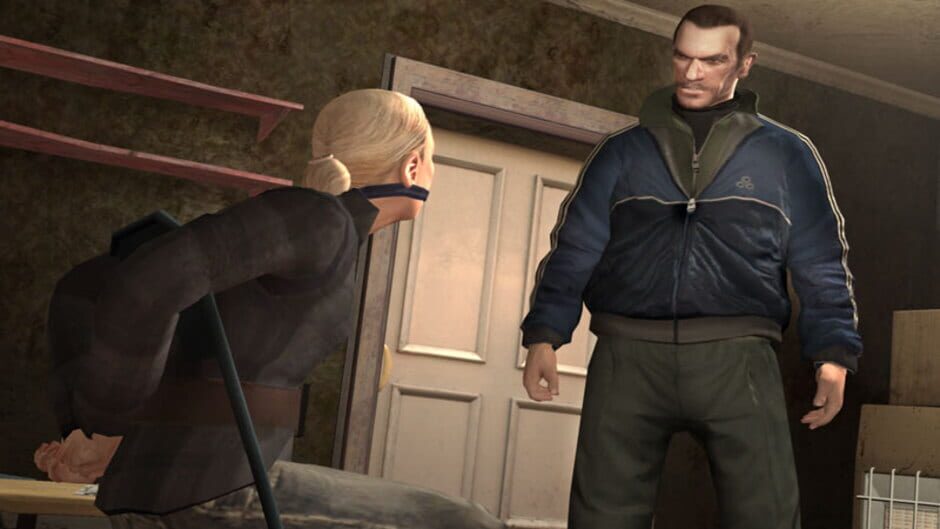
The game also introduces several moral decisions during the campaign. Some allow the player to spare or execute characters, while others more directly alter later missions and consequences. These choices do not turn GTA IV into an RPG, but they reinforce the idea that Niko repeatedly has to decide whether to continue pursuing revenge or attempt to move away from it.
This ambiguity largely defines the character. Niko regularly criticizes the greed and violence of Liberty City, yet he accepts a considerable number of criminal jobs himself. The game does not really try to resolve that contradiction; it becomes part of his portrait, that of a man who fully understands the brutality of the world he participates in while continuing to use it to reach his own goals.
The technical evolution also serves the presentation of the city. The day-night cycle, weather, traffic, pedestrians and variety of animations make the streets behave more organically, while radio stations and television programs extend the satire beyond the main missions. Liberty City therefore becomes almost a second protagonist, capable of being fascinating, absurd and deeply hostile at the same time.
The world of Grand Theft Auto IV is extended through two standalone episodes using the same city and taking place alongside Niko’s story. The Lost and Damned follows Johnny Klebitz, a member of The Lost motorcycle gang, while The Ballad of Gay Tony adopts the perspective of Luis Lopez, associate of nightclub entrepreneur Tony Prince. Several characters and events overlap across the three stories, showing the same conflicts from very different social environments.
What to remember
- A new version of Liberty City inspired by New York, more compact than the world of San Andreas but especially dense and detailed.
- Niko Bellic, a former soldier who comes to the United States to join his cousin Roman while searching for a man connected to his past.
- A darker tone dealing with immigration, trauma, revenge and the contradictions of the American dream.
- Heavier, more physical driving combined with dynamic animation systems using Euphoria technology.
- A gunplay system built more heavily around cover and positioning.
- The mobile phone and relationships with other characters as important elements of daily life and progression.
- Several narrative decisions that confront Niko with the consequences of revenge, loyalty and his own choices.
- Two complementary stories, The Lost and Damned and The Ballad of Gay Tony, which expand Liberty City through the perspectives of Johnny Klebitz and Luis Lopez.
Conclusion
Grand Theft Auto IV chooses concentration over accumulation. After the enormous playground of San Andreas, Rockstar North builds a smaller city that pays much closer attention to the behavior of vehicles, characters and streets. Liberty City feels like an environment where every journey belongs to a metropolis already in motion before the player even arrives.
This direction profoundly changes the feel of the game. Driving requires more anticipation, bodies react to impacts, gunfights genuinely rely on cover and Niko seems physically subject to the same world as everyone else. Some of these mechanics may now feel slower or less flexible than those of Grand Theft Auto V, but they directly contribute to the identity of this entry.
The story follows the same logic. Niko does not come to Liberty City to build a criminal empire or conquer the city. He is trying to live with a past that continues to shape his decisions, even as the need to protect Roman and earn money repeatedly draws him back toward violence. His intelligence, cynicism and self-awareness make that contradiction more visible than with many previous protagonists in the series.
Relationships with Roman, Little Jacob, Packie and the other characters also give more weight to the time between missions. Some phone calls and invitations can become repetitive, but they strengthen the sense that Niko gradually belongs to a human network rather than simply moving through a succession of mission-givers.
Grand Theft Auto IV therefore occupies a distinctive place in the series. Its city, physics systems and writing favor a darker form of realism without abandoning Rockstar’s characteristic satire. The Lost and Damned and The Ballad of Gay Tony then complete that portrait by showing that the same Liberty City can produce very different stories depending on the people trying to survive within it.
Good to know
- Grand Theft Auto IV was developed by Rockstar North and published by Rockstar Games.
- The game was released on April 29, 2008, for PlayStation 3 and Xbox 360, followed by a PC release later that year.
- Liberty City is a fictional reinterpretation of New York and its surrounding areas, organized around several major districts.
- Niko Bellic is the main protagonist, while his cousin Roman is one of the central characters in his story.
- The game uses NaturalMotion’s Euphoria behavioral animation technology, later employed in several other Rockstar productions.
- The Lost and Damned follows Johnny Klebitz and The Ballad of Gay Tony follows Luis Lopez; their stories take place alongside Niko’s and intersect with it several times.
- Grand Theft Auto IV: The Complete Edition brings together the main game, The Lost and Damned and The Ballad of Gay Tony.