Once united around the Tower of Eternity, the world of Atreia was shattered by a war against the Balaur. The cataclysm split the planet into two opposing lands: Elysea, bathed in light, and Asmodae, plunged into darkness. The player chooses to join the Elyos or the Asmodians before ascending as a Daeva, an immortal being capable of spreading their wings. Between exploration, faction warfare and the struggle against the Balaur, their journey leads to the Abyss, where all three forces fight for control of Atreia.
Video game
2008
Action
Adventure
Fantasy
RPG
Strategy
Open world
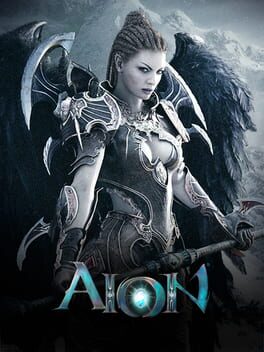
AION
- Gameforge Publisher
- NCSOFT Developer
- NCSOFT Publisher
- Noviy Disk Publisher
Spread your wings and fight for the Elyos or Asmodians in an MMORPG where PvE, PvP and aerial battles come together.
Details
- Type
- Video game
- Release
- 2008-11-25
- Genres
- Action, Adventure, Fantasy, RPG, Strategy, Open world
- Platforms
- PC
- Engine
- CryEngine
- Game modes
- Massively Multiplayer Online (MMO)
Synopsis
AION
Trailer
Watch the trailer
Overview
Presentation
AION is an MMORPG developed by NCsoft whose world is built around a shattered realm, two rival factions and heroes capable of fighting in the skies.
Atreia was once structured around the Tower of Eternity, before a war against the Balaur triggered a cataclysm. The world was then split into two parts: Elysea, the bright homeland of the Elyos, and Asmodae, the darker domain of the Asmodians.
The player chooses one of these two factions and begins the adventure as a mortal. Progression quickly leads to Ascension, transforming the character into a Daeva and granting the ability to spread their wings.
Flight is one of AION's defining features. In areas where it is allowed, it makes vertical movement possible, provides access to certain positions and allows direct combat in the air. Flight time is limited, however, and must be managed during exploration and battle.
Combat uses a real-time MMORPG system based on skills, positioning and class specialization. Characters gradually learn new abilities, improve their equipment and can expand their toolkit through Stigmas.
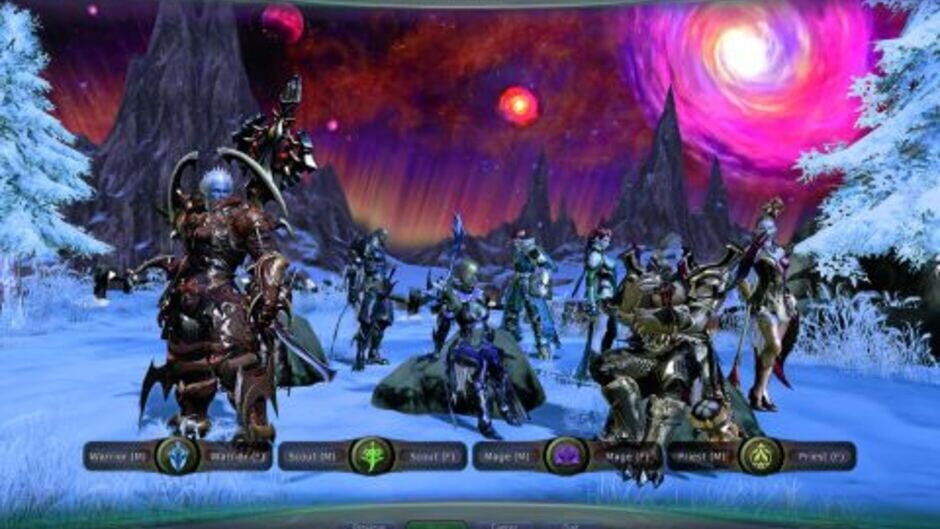
In its original structure, AION featured four archetypes that developed into eight specialized classes: Gladiator, Templar, Assassin, Ranger, Sorcerer, Spiritmaster, Cleric and Chanter. The game's many updates later introduced additional class and progression options.
PvE content includes quests, open areas, bosses, instances and dungeons designed for both solo players and groups.
The Abyss also plays a major role. This region located between the two halves of Atreia combines exploration, monsters, military objectives and battles between Elyos and Asmodians.
AION therefore develops a PvPvE approach in which two player factions can fight each other while also facing Balaur forces and other game-controlled creatures.
Fortress sieges are one of the most important forms of these conflicts. Large groups can attempt to capture or defend strategic positions in order to gain various advantages for their faction.
Players can also join Legions, the game's equivalent of guilds, to organize group activities, progression and participation in faction warfare.
Crafting, gathering, equipment upgrades and visual customization complement this progression in an MMO that has received numerous expansions and major transformations since launch.
Key points
- A fantasy MMORPG developed by NCsoft.
- A world called Atreia, shattered by an ancient cataclysm.
- Two playable factions: Elyos and Asmodians.
- The Balaur form a third major force in the conflict.
- The player becomes a winged Daeva.
- Flight is used for exploration and certain battles.
- Ground-based and aerial combat.
- Progression built around classes, skills and equipment.
- Stigmas expand a character's abilities.
- Eight specialized classes formed the original class system.
- Quests, bosses, PvE instances and dungeons.
- The Abyss combines PvE with faction warfare.
- A PvPvE system involving both players and Balaur.
- Large-scale fortress sieges.
- Legions allow players to form long-term groups.
Conclusion
AION builds its identity around the conflict between Elyos and Asmodians in a world literally split in two.
Becoming a Daeva and gaining wings adds another dimension to exploration and combat, especially in the Abyss, where aerial battles, PvE objectives and faction warfare come together.
Over the course of its many updates, the game has changed considerably, but flight, factions, the Balaur, specialized classes and fortress battles remain the most distinctive elements of the AION experience.
Good to know
AION is developed by NCsoft.
The game launched in South Korea on November 25, 2008, before arriving in the West in 2009. The European release took place on September 25, 2009 for PC.
The title is also known by its original full name, Aion: The Tower of Eternity.
The original version of AION uses CryEngine.
The game was initially sold with a subscription, before switching to a free-to-play model in Europe in February 2012.
In Europe, the current version of AION is operated by Gameforge, while NC remains the original developer behind the franchise.
Character creation allows players to choose between the Elyos and the Asmodians, two peoples whose territories, appearance and history reflect the two sides of Atreia.
The Abyss is particularly associated with PvPvE encounters, aerial combat and fortress sieges.
The original game has received numerous expansions and updates adding regions, classes, instances, progression systems and new conflicts.
AION Classic is a separate version designed to recreate an experience closer to the game's earlier years. It launched in Europe on April 25, 2023 and continues to evolve separately from the Live version.
This entry focuses on the overall identity of AION, Atreia, the Daevas, factions, flight, the Abyss and the game's main PvE/PvP systems, without detailing every expansion and change introduced since 2008.