Presentation
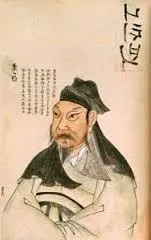
Li Bai (李白), also romanized as Li Po or Li Bo, was a Chinese poet of the Tang dynasty, born in 701 and deceased in 762. Alongside Du Fu, he is regarded as one of the greatest figures of the golden age of Chinese poetry. His writing is distinguished by a flourishing imagination, remarkable freedom of expression, and particular sensitivity to landscapes, emotions, and the mysteries of existence. In his verses, mountains seem to reach the heavens, rivers become images of passing time, and the moon accompanies solitary travelers. Beneath this immediately captivating beauty lies a meditation on the human condition, the desire for freedom, and the fragility of happiness. His extraordinary poetic talent earned him the title “Poet Immortal,” while the image of an immortal banished to the human world became an enduring part of his legend.
Li Bai's poetry combines classical literary traditions with an often daring personal expression. He especially favored ancient-style verse, which allowed considerable rhythmic freedom, but also mastered shorter forms and compositions associated with traditional Chinese musical poetry. His poems evoke the pleasures of wine, reunions between friends, the sorrow of separation, journeys, and wonder before the natural world. Daoism occupies an important place in his imagination, particularly through the pursuit of detachment, fascination with hermits, and the desire to escape social constraints. Yet this sensibility did not exclude political ambition or concern about responsibilities toward the wider world.
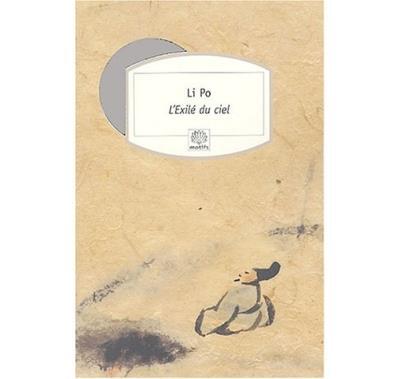
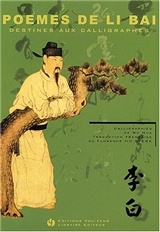
The French collections L'Exilé du ciel and Poèmes destinés aux calligraphes provide access to different aspects of his poetic legacy. The former highlights his independent, wandering, and sometimes melancholy personality, while the latter emphasizes the close relationship between Chinese poetry and calligraphy. Within this tradition, the choice of characters, the rhythm of the lines, and their written arrangement contribute to a shared aesthetic experience. Li Bai's poems, frequently brief yet rich in imagery and literary allusion, are particularly suited to this dialogue between writing and visual art. Their transmission across centuries and languages demonstrates a rare capacity to express emotions that transcend cultural boundaries in only a few lines.
Career
Li Bai's origins remain uncertain. Several traditions place his birth in the region of Suyab, in Central Asia, now part of Kyrgyzstan, while other interpretations favor a birthplace within China. Sources agree more firmly that he spent his childhood in Sichuan, where his family settled while he was still young. He grew up in an environment that allowed him to acquire a literary education and become familiar with classical Chinese writings. Biographical traditions also describe his interest in swordsmanship, Daoist practices, and tales of immortals. During his youth, he developed a strong attraction to travel, preferring the discovery of landscapes and encounters with different people to the more conventional paths of an administrative career.
Around 725, Li Bai left Sichuan and embarked on extensive journeys throughout the Tang empire. He met scholars, officials, hermits, and poets while seeking recognition for his talent and hoping to obtain a position from which he could serve the state. His reputation grew through his literary achievements and independent personality. In 742, he was summoned to Chang'an, the imperial capital, where he enjoyed the favor of Emperor Xuanzong and received a literary appointment associated with the Hanlin Academy. His experience at court lasted only about two years. The demands of official life and tensions within the imperial environment were difficult to reconcile with his temperament. After leaving Chang'an, he resumed his travels. In 744, he met Du Fu, establishing a relationship of mutual admiration and friendship that became celebrated in Chinese literary history.
The final period of his life was marked by the political upheaval of the An Lushan Rebellion, which began in 755 and devastated the Tang dynasty. Li Bai entered the service of Prince Yong, whose military activities brought him into conflict with the imperial government. Following the prince's defeat, the poet was arrested and sentenced to exile in Yelang, in the empire's southwest. However, he received a pardon in 759, before reaching his destination, and regained his freedom. His final years were spent around the Yangtze River, under circumstances made difficult by political instability and illness. He died in 762, probably at Dangtu, in present-day Anhui province. Later traditions surrounded his death with fantastic stories, including the legend that he drowned while trying to grasp the moon's reflection in the water. This tale belongs to his literary mythology rather than to established historical biography.
Key Facts
- The “Poet Immortal”: Li Bai is associated with an exceptionally free imagination in which earthly landscapes merge with celestial imagery and Daoist ideas of immortality. His celebrated title reflects admiration for a poetic vision that appears to transcend the ordinary limits of human existence.
- The moon, wine, and solitude: these recurring motifs express the joy of friendship, homesickness, emotional separation, and the desire to escape social pressures. Their meanings change from poem to poem, often combining celebration with melancholy.
- A celebrated friendship with Du Fu: the two major Tang poets met in 744. Their literary sensibilities differed: Li Bai is traditionally associated with imaginative energy and freedom, while Du Fu is particularly admired for his attention to human suffering and historical events.
- Poetry and calligraphy: in classical Chinese culture, poetry and calligraphy are closely connected artistic traditions. Li Bai's compositions have been copied and interpreted by generations of calligraphers, bringing together the visual beauty of characters, the movement of the brush, and the musical qualities of verse.
- A worldwide legacy surrounded by legend: several hundred poems attributed to Li Bai have survived. Translated into numerous languages, his poetry has influenced writers, painters, and musicians far beyond China. His adventurous life also inspired legendary stories that must be distinguished from verifiable history.