Dale Carnegie : How to Stop Worrying and Start Living
Dale Carnegie proposes concrete methods to reduce anxiety, analyse problems in hindsight and act on what depends on oneself. Examples illustrate each principle.
- Essay
- Self-help

PANACHES Culture · Works
Discover films, animation, series, anime, documentaries, live, manga, BD, comics, books, games, music, then explore their associated studios, tools and articles.
11 works
Dale Carnegie proposes concrete methods to reduce anxiety, analyse problems in hindsight and act on what depends on oneself. Examples illustrate each principle.
Our relationships with others are crucial to our quality of life!Easy contact is a powerful engine of success: to be sought for its human qualities, to create sympathy, to pass on its ideas, to motivate, to correct without ruining a working relationship... It learns! This book, useful for all ages and in all trades, will give you all the advice to develop quality human relations, necessary for professional and perso…
To overcome the fear that bothers a group, to be listened to, to appreciate, to be able to captivate its listeners, is learnt. To train to communicate well, the Carnegie methods remain the most effective.
Do you want to increase your personal and professional success?In this practical and concrete guide, with principles that are easy to implement, you will learn to:• identify your leadership skills,• build relationships of trust,•communicate more effectively,• motivate others,•work as a team,•create a leadership dynamic,•get more respect and success.Go to action!Apply these simple but fundamental techniques, they wil…
"An exciting journey to the country of emotions to discover unexplored feelings. The traditional conception of intelligence neglects an essential part of human behavior: emotional reactions. IQ is not the only criterion; there is another form of intelligence, emotional intelligence, which can be stimulated and developed from childhood. Refusing to listen to emotions can lead to general instability, while self-contro…
"A few years ago, with "Emotional intelligence", Daniel Goleman made us discover the prominent role of emotions. Today, it is on the crucial importance of attention and the priority to give him that he insists. Daniel Goleman gives the keys to train his brain to remain attentive, in the same way that one maintains his muscles by an adequate gymnastics. An intelligent practice of development that can both make us mor…
In his world best seller, "Emotional Intelligence", Daniel Goleman defended a revolutionary thesis: success depends less on the intellectual quotient than on the ability to understand, master and cultivate the emotions that are within us. Today he extends his field of research to the field of our relations with others. He makes us penetrate the arcanes of neurosciences in a clear and living way. Feeding many example…
How can we distinguish truth from falsehood and build knowledge on solid foundations? In Discourse on the Method, René Descartes begins with a conviction: reason is naturally shared by all human beings, but using it properly requires a rigorous method. Through an account of his intellectual journey, he questions received knowledge and proposes four rules for guiding thought with order and discernment. This investiga…
"Erotikos" is the original title of this dialogue, which is a philosophical discussion on love: can we reconcile love and marriage? In Thespies, Plutarch, young bride, meets his friends to discuss the subject of love and relations between men and women. They end up making the apologies of the god Eros.
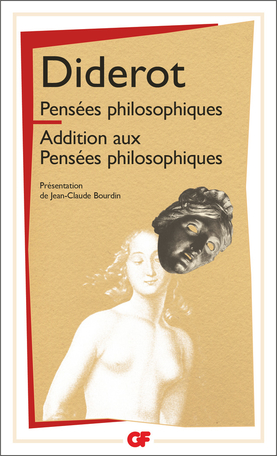
Written in 1746, without author's name, and immediately condemned to fire by the Paris Parliament, the Philosophical Thoughts take part in Christianity, and beyond all revealed religions: or faith is compatible with human reason and religions must accept doubt and criticism and reform themselves to join "natural religion"; or it is not, and how to admit then that God demand men to sacrifice their reason for him? Thi…
We know that Diderot assumed his role as a moralist and that he praised Greuze, among other things, because his painting educated and edited the viewer, giving him lessons of virtue. Although he fears that beauty as goodness often hurts, little is already necessary, in the Treaty of Beau, that Diderot associates the beautiful, except with the useful and the true, at least to the good (the Holy Trinity of the moral c…