Overview
Apple Music is Apple’s music streaming service. It provides access to more than 100 million tracks, ad-free, with albums, singles, playlists, radio stations, music videos, personalized recommendations and editorial content.
Unlike Spotify, Deezer or YouTube Music, Apple Music does not offer a permanent free ad-supported tier. The service mainly relies on a paid subscription, with a trial period for new users and several plans depending on the user profile.
Its positioning strongly emphasizes listening quality. The catalog is available in Lossless using the ALAC codec, up to 24-bit/192 kHz Hi-Res Lossless for compatible tracks, and part of the catalog is offered in Spatial Audio with Dolby Atmos.
Apple Music is not limited to audio quality, however. The service also brings together a synchronized library across devices, offline listening, synchronized lyrics, editorial playlists, Apple Music radio stations, discovery features, Apple Music Sing and a dedicated application for classical music.
Although it belongs to the Apple ecosystem, the service is not restricted to Apple devices. Apple Music also works on Android, Windows, Web browsers, smart TVs, game consoles, Sonos and various compatible audio devices.
Features
More than 100 million tracks and a strong editorial approach
Apple Music offers a catalog of more than 100 million songs, complemented by music videos, playlists, radio stations and themed selections.
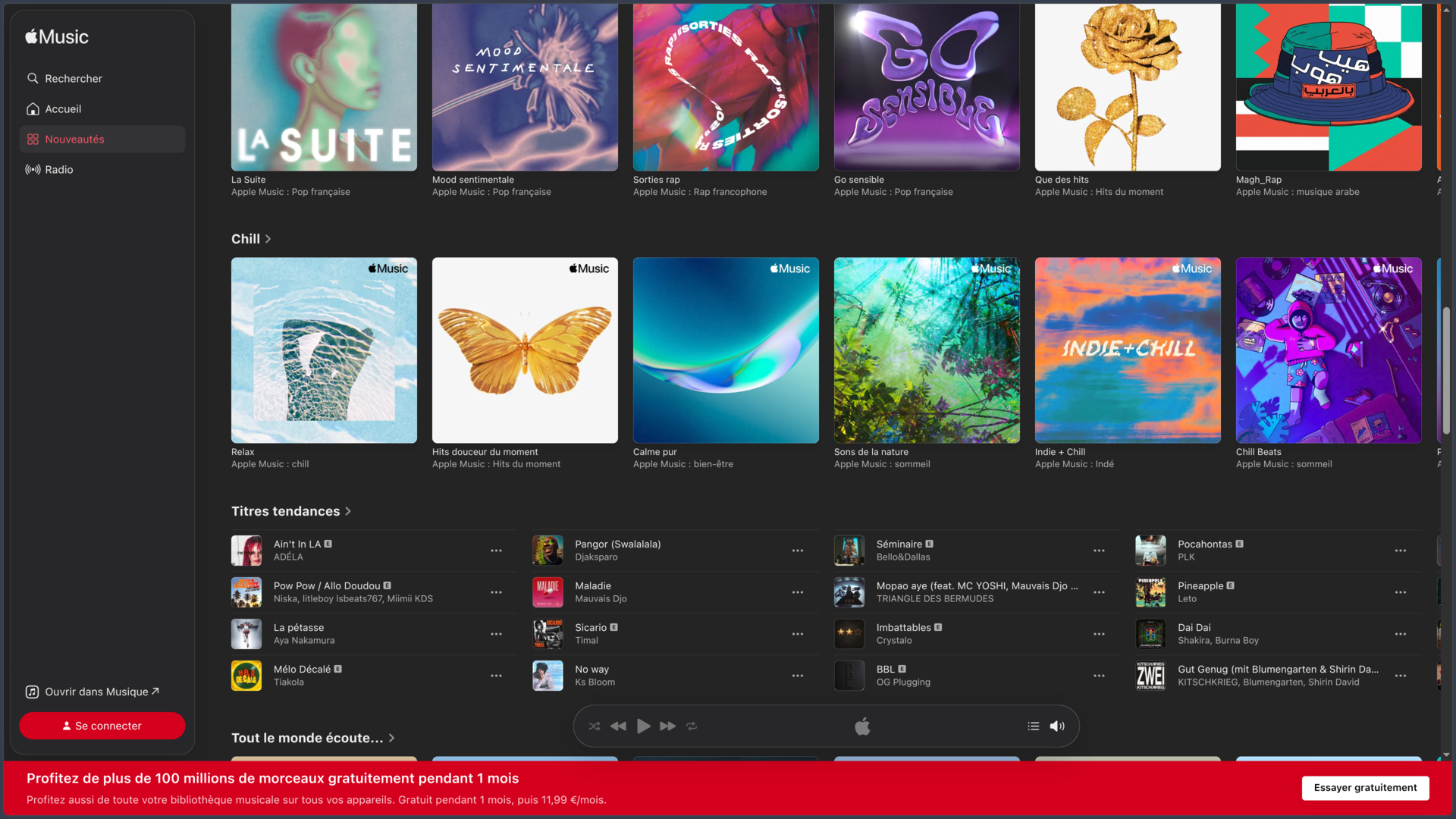
Recommendations combine listening history, liked tracks, followed artists and selections curated by Apple Music’s editorial teams. The service therefore places as much emphasis on algorithmic discovery as on playlists created by specialists.
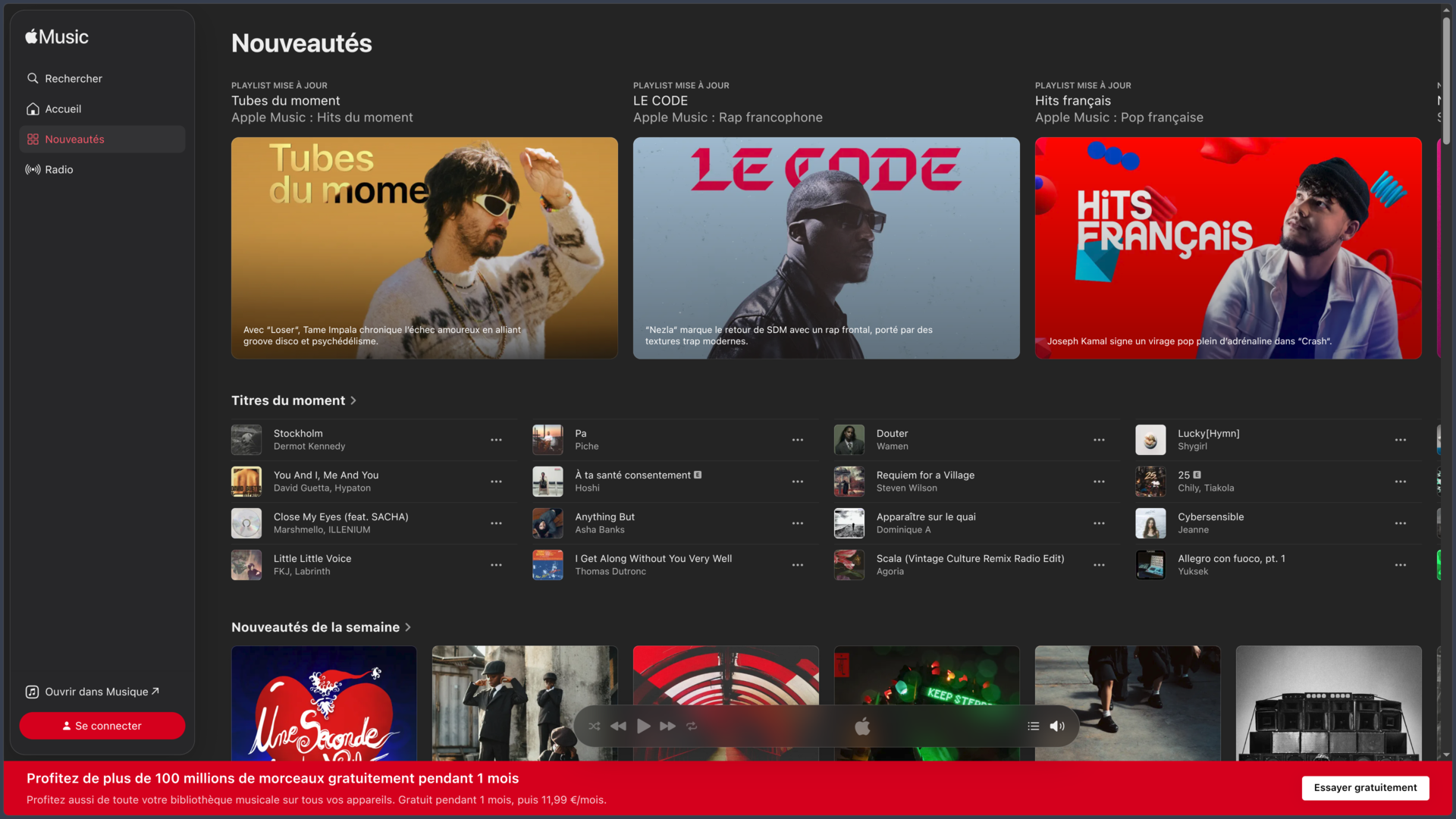
The application separates several uses: listening to new releases, exploring genres, starting a station from an artist or track, browsing editorial selections or returning to a personal library.
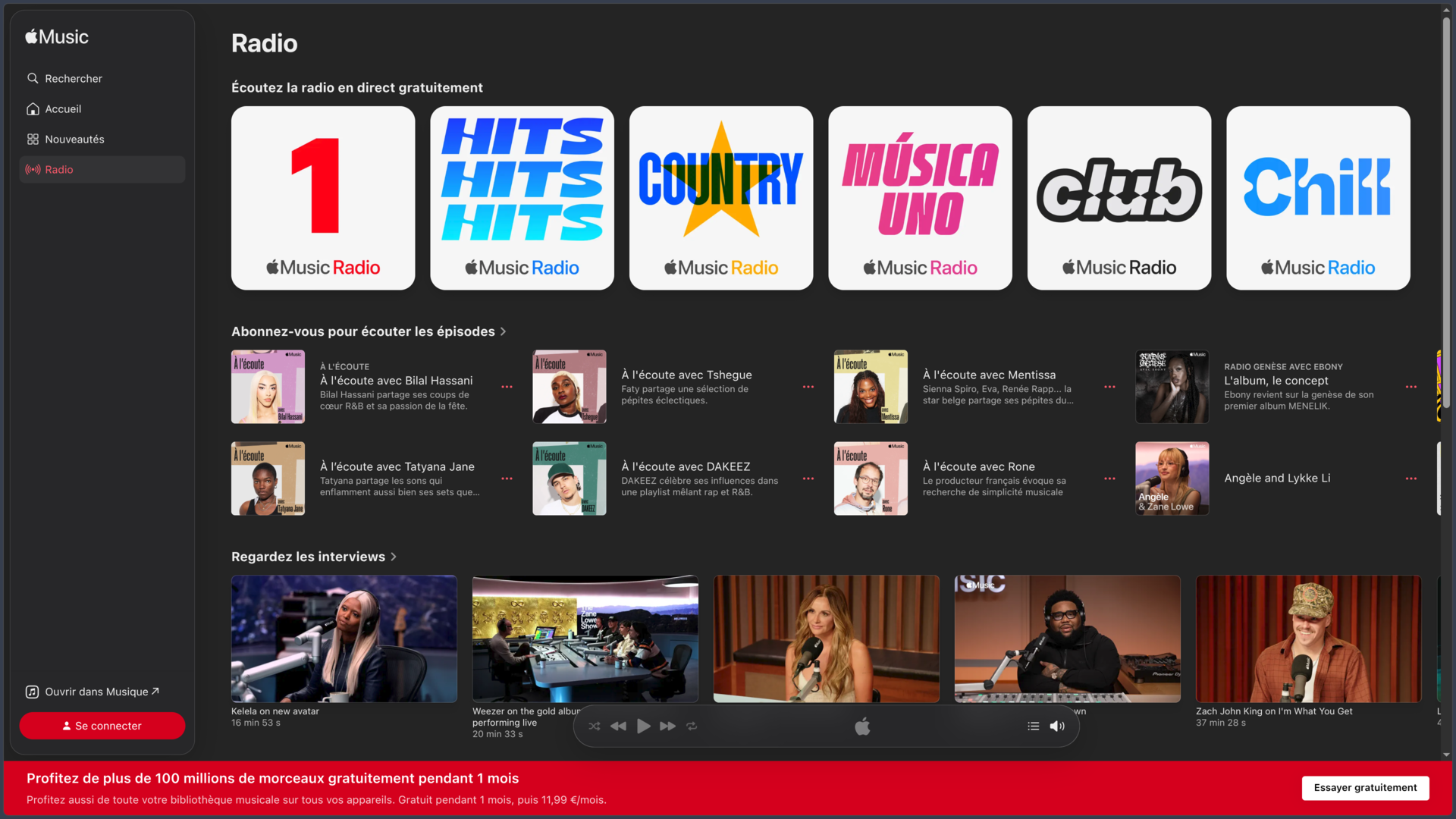
Apple Music also offers radio stations and content hosted by artists, DJs or editorial teams. The goal is therefore not only to provide a huge searchable catalog, but also to guide listening.
Lossless and Hi-Res Lossless included in the subscription
One of Apple Music’s main advantages is that Lossless quality is not reserved for a more expensive plan.
Apple uses its ALAC — Apple Lossless Audio Codec. Most of the catalog is available in lossless audio, ranging from CD quality at 16-bit/44.1 kHz up to 24-bit/192 kHz Hi-Res Lossless for compatible tracks.
Several quality levels can be selected depending on the device and connection. Hi-Res audio, however, requires equipment capable of taking full advantage of it. On an iPhone, iPad or certain computers, an external digital-to-analog converter may be required to reach the highest resolutions.
Lossless audio also uses significantly more bandwidth and storage space than standard compressed files. It is therefore possible to configure quality separately for Wi-Fi, mobile networks and downloads.
Spatial Audio with Dolby Atmos
Apple Music also includes Spatial Audio with Dolby Atmos at no extra cost.
Compatible albums and tracks are identified directly in the application. With suitable hardware, Atmos mixing creates a wider sound space around the listener rather than a simple left-right stereo presentation.
The feature works notably on iPhone, iPad, Mac, Android and Windows, although available capabilities depend on the hardware used. Certain AirPods and Beats headphones can automatically enable Dolby Atmos, while other headphones may require the setting to be activated manually.
Devices compatible with dynamic head tracking can go further by maintaining the soundstage in a virtual space when the listener turns their head.
Not every track in the catalog has a Dolby Atmos version, however, and a spatial mix is different from a stereo Lossless version: the two features serve different purposes.
Synchronized library and personal collection
Apple Music does not work only around streaming playlists. Users can build a real music library containing albums, artists, tracks, playlists and personal songs.
With Sync Library enabled, changes appear across other devices connected to the same Apple Account.
The service can also integrate a personal music collection. iCloud Music Library can store up to 100,000 personal tracks, excluding purchases made through the iTunes Store.
When Apple recognizes a track already available in its catalog, it can be matched with the corresponding version. Other files remain available with their original quality within the limits of the service.
This approach is particularly useful for preserving imported CDs, older digital collections, rare albums or tracks unavailable on Apple Music while still using a single library across several devices.
Downloads and offline listening
Tracks, albums and playlists added to the library can be downloaded to a device for listening without an Internet connection.
This feature is included in the subscription and works with the synchronized library. An album added from one device can therefore appear on other devices using the same account and then be downloaded locally where needed.
The selected audio format has a major impact on storage usage. A library downloaded in Hi-Res Lossless requires significantly more space than one using standard AAC.
Downloads from the subscription remain tied to Apple Music, however: they are not purchased music files that users can freely keep after ending the subscription.
Lyrics, translation and Apple Music Sing
Apple Music displays time-synchronized lyrics for many tracks.
Apple is also developing lyric translation and phonetic pronunciation. In 2026, translation has been expanded across several languages, including English and French, making it easier to follow songs without necessarily understanding the original language.
Apple Music Sing turns certain compatible tracks into a karaoke-like experience. Users can reduce the volume of the lead vocals while keeping the instrumental accompaniment and follow the lyrics in time with the music.
Sing availability depends on the device and the track used. On Dolby Atmos tracks, enabling Sing temporarily disables Atmos playback.
AutoMix and transitions between tracks
Apple Music now offers AutoMix, a feature that analyzes songs in order to create more natural transitions between them.
Unlike a simple crossfade using the same duration every time, AutoMix can adapt the transition to the tempo and characteristics of each track.
The feature is designed to make certain playlists or queues feel more continuous, with an approach closer to transitions performed by a DJ.
It is not available everywhere, however. Apple notably indicates that AutoMix is not supported on Intel-based Macs, Android or the Apple Music app for Windows, even though those platforms can use other service features.
Apple Music Classical included in the subscription
Apple offers a second music experience with Apple Music Classical, included at no extra cost with compatible Apple Music subscriptions.
This application is specifically designed to handle the particularities of classical music: the same work may exist in hundreds of recordings with different conductors, soloists, ensembles, catalogs and opus numbers.
Apple Music Classical therefore provides search and navigation organized around composers, works, performers, orchestras and recordings.
The classical catalog exceeds 5 million tracks and also supports Spatial Audio and Hi-Res Lossless up to 24-bit/192 kHz for compatible content.
Apple Music and Classical share part of the library. An album or playlist added in Classical can therefore be found in Apple Music on other devices.
Classical has dedicated applications for iPhone, iPad and Android and can also be used through the Web.
Transferring a library from another service
Apple now directly provides a system for transferring from certain third-party streaming services.
Users can select a compatible service and ask Apple Music to search for matches between their existing tracks and playlists and the Apple catalog.
Matches found are added automatically. When several versions seem possible, Apple Music may ask the user to confirm the proposed track.
Transfer is available notably from iPhone, iPad, Android and the Web player.
This reduces one of the main obstacles to switching platforms: having to manually recreate years of playlists and saved tracks.
Availability well beyond Apple devices
Apple Music is naturally integrated into iPhone, iPad, Mac, Apple Watch, Apple TV, HomePod and CarPlay, but the service is no longer limited to this environment.
An official app is available on Android and Windows. The Web player also provides access to the catalog and library from a browser without installing an application.
Apple Music is also available on various smart TVs, game consoles, speakers and compatible devices, including Sonos, Amazon Echo, Google Nest, PlayStation and Xbox depending on the region and device.
Some features remain specific to Apple hardware or are not identical across all platforms. It is therefore important to distinguish general service availability from features such as AutoMix, Sing, Dolby Atmos or Hi-Res Lossless.
Three main subscription plans in France
Apple Music does not offer a permanent free plan for full catalog listening.
| Plan | Current price in France | Use |
|---|---|---|
| Student | €6.99/month | Eligible student after verification |
| Individual | €11.99/month | One user |
| Family | €19.99/month | Up to six people in total |
The first month is currently free for eligible new individual subscriptions.
Apple also regularly offers longer promotions with certain devices. Purchasing an eligible Apple or Beats audio device may, for example, provide access to three free months, subject to the offer conditions.
The Family plan allows each member to keep their own library, recommendations and listening history.
Apple Music is also included in certain Apple One plans, which bundle several Apple services within one subscription.
Use cases
Listening in Lossless without paying for an extra audiophile tier
For someone who owns wired headphones, a DAC or a Hi-Fi setup, Apple Music provides access to a large part of its catalog in Lossless without requiring a more expensive subscription tier.
Users can choose a quality level suited to their equipment while keeping a lighter configuration for mobile listening.
This makes Apple Music particularly attractive compared with services that sometimes reserve their best audio quality for a more expensive plan.
Combining streaming with an older music collection
A user can keep tracks from CDs, previous purchases or personal files while benefiting from the Apple Music catalog.
Library synchronization makes it possible to find this collection across several devices without constantly separating personal files from streaming tracks.
For someone with a large music collection built before streaming became dominant, this continuity may be more valuable than a platform entirely centered on its own catalog.
Exploring classical music seriously
Apple Music Classical provides an environment better suited to people searching for a specific work rather than simply a track title.
A listener can search for a composer, work, conductor, orchestra or soloist and then compare different recordings.
For classical music listeners, this level of structure creates a real difference compared with streaming interfaces mainly designed around contemporary albums and artists.
Switching from another service without rebuilding every playlist
The integrated transfer system makes it possible to recover tracks and playlists from compatible services.
This makes it easier to genuinely compare Apple Music with Spotify, Deezer or other platforms: users can reconstruct a large part of their Apple Music library before deciding whether they really want to switch.
Matches are not necessarily perfect, but the system avoids rebuilding everything manually.
Using the same service across Apple, Windows and Android
Someone using an iPhone but working on a Windows PC can install the Apple Music app on their computer and recover the same library.
A household combining iPhone, iPad and Android phones can also use the same Family subscription without requiring every member to own an Apple device.
Apple Music remains more deeply integrated with Apple hardware, but it is therefore no longer necessary to live exclusively inside that ecosystem to use the service properly.
Conclusion
Apple Music stands out less because of the raw number of tracks — now comparable with other major platforms — than because of the combination of audio quality, personal library, multi-device integration and specialized services.
Lossless and Hi-Res Lossless are included directly in the subscription, as is Dolby Atmos. This policy makes audio quality much easier to understand than a succession of plans where each level unlocks a different codec.
The synchronized library also preserves a philosophy inherited from iTunes: users can combine the service catalog with their own files instead of completely abandoning their personal collection.
Apple Music Classical adds real specialization for a genre that is particularly poorly suited to conventional streaming metadata, while Sing, translated lyrics, AutoMix and editorial playlists enrich everyday listening.
The main compromise remains economic: there is no true free Apple Music plan. After the trial, access to the catalog requires a subscription. The most advanced features also sometimes depend on the device used, and the experience naturally remains more complete on Apple hardware.
For users looking for a very large catalog, Lossless at no extra cost, strong integration with a personal music collection and a particularly polished experience on Apple devices, Apple Music remains one of the most complete streaming offers currently available.
Points to consider
-
Apple Music does not offer a permanent free plan for its full catalog. After the trial period, a paid subscription is required.
-
In France, the subscription currently costs €11.99/month for an individual plan, €6.99/month for students and €19.99/month for the Family plan.
-
The first month is free for eligible new subscriptions, while certain Apple or Beats devices may qualify for longer promotional periods.
-
More than 100 million tracks are available ad-free, with offline downloads included in the subscription.
-
Most of the catalog is available in Lossless ALAC, from 16-bit/44.1 kHz up to 24-bit/192 kHz for compatible Hi-Res content.
-
Hi-Res Lossless may require an external DAC and suitable hardware. Simply using Bluetooth headphones does not provide the full benefit of a Hi-Res signal.
-
Dolby Atmos is included at no extra cost, but not every track is available in Spatial Audio and the result depends on the hardware used.
-
Apple Music can synchronize up to 100,000 personal tracks in iCloud Music Library, excluding iTunes Store purchases.
-
Apple Music Classical is included at no extra cost with Student, Individual and Family plans and provides a classical catalog of more than 5 million tracks.
-
Apple Music works on Android, Windows and the Web, although certain features remain limited to specific Apple devices or are not available identically on every platform.
-
AutoMix is currently unavailable on Android, Windows and Intel-based Macs, even though Apple Music itself works on those systems.
-
Tracks downloaded from the Apple Music catalog remain tied to the subscription. They are not purchased files that can be freely kept after cancellation.