How can we distinguish dreams from reality, and how far can we trust our certainties? In The Butterfly Dream, Zhuangzi explores the major questions of Daoist philosophy through thirty-three chapters composed of anecdotes, dialogues, parables, and aphorisms. The work takes its title from a story in which the philosopher dreams that he is a butterfly, only to question, upon awakening, the boundary between these two forms of existence. This inquiry opens a reflection on the relativity of perspectives, the limitations of knowledge, inner freedom, and the constant transformations of the world. Combining humor, paradoxes, and real or imaginary characters, the texts question social conventions, the pursuit of power, and the judgments that confine human experience within rigid categories. This edition brings together, in Jean-Jacques Lafitte's French translation, all thirty-three chapters of the Zhuangzi preserved by tradition.
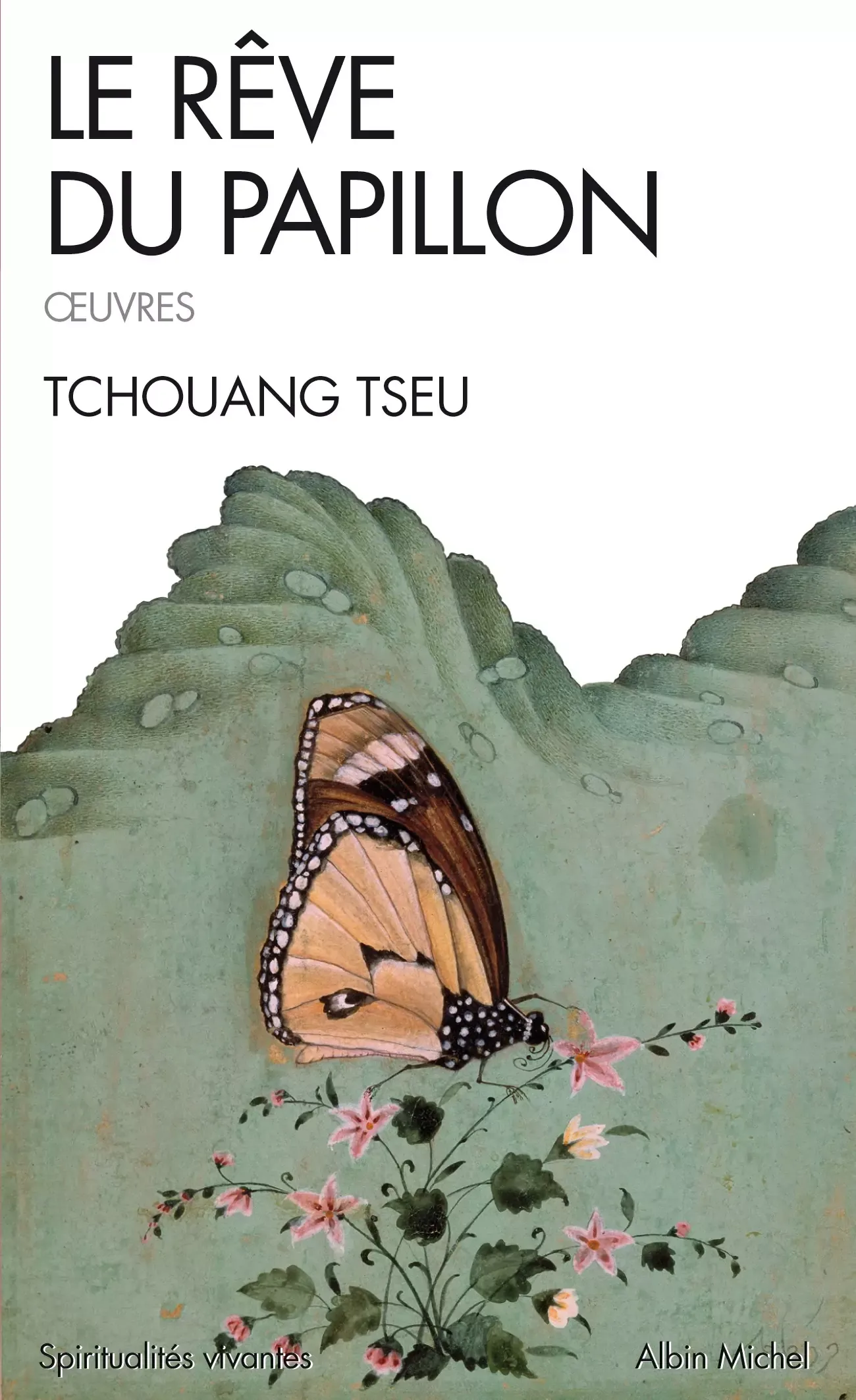
Zhuangzi: The Butterfly Dream
- Albin Michel Publisher
- Tchouang Tseu Author
A man dreams he is a butterfly. When he awakens, which of the two was truly dreaming?
Details
- Type
- Book
- Countries
- 🇨🇳 China
- Original language
- Chinese
- Genres
- Philosophy
- ISBN
- 2226068767
- Information verified on
- October 14, 2026
Synopsis
Zhuangzi: The Butterfly Dream
Glossary terms: Aphorism, Attention, Certainty, Chapter, Character, Consciousness, Convention (manga convention), Dialogue, Editorial, Existence, Exterior / EXT., Humor, Identity, Knowledge, Mise en scène / staging, Narrative, Parable, Paradox, Part, Philosophy, Point of view, Reflection, Story, Text, Theme, Title, Tracking (type), Transformation, Typesetting, Work, Wu wei
Overview
Overview
In The Butterfly Dream, Zhuangzi, also known as Chuang Tzu, develops a reflection on the nature of reality, human freedom, and the transformations of the world. Published by Albin Michel in a French translation by Jean-Jacques Lafitte, this volume brings together the thirty-three chapters of the Zhuangzi preserved by Chinese tradition. Unlike collections of quotations or selected passages, it presents the complete transmitted text of this major work of philosophical Daoism. Its composition combines allegorical narratives, imaginary dialogues, moral observations, and paradoxical arguments. Rather than presenting a uniform doctrine, it multiplies perspectives in order to question human certainties and ways of living.
The story that gives the volume its title, the butterfly dream, appears in the second chapter. Zhuangzi recounts dreaming that he was a butterfly, free and happy, with no awareness of his human identity. Upon awakening, a question remains: was he a man who had dreamed of being a butterfly, or a butterfly dreaming of being a man? This anecdote goes beyond a simple inquiry into the illusions of sleep. It challenges the boundaries we establish between states of consciousness, identities, and experiences. The text thus invites reflection on the limitations of our perspective and the difficulty of claiming definitive knowledge of reality.
This questioning runs throughout the reflections on language, knowledge, and human values. The Zhuangzi shows that distinctions between true and false, great and small, useful and useless often depend on particular situations and perspectives. Dialogues feature characters defending contradictory positions, while parables reveal the sometimes absurd consequences of rigid judgments. The story of Cook Ding, whose perfectly mastered movements follow the natural joints of an ox, illustrates a form of knowledge that does not depend solely on abstract rules. Experience, attention, and harmony with circumstances become essential dimensions of understanding.
The work also places considerable importance on spontaneity and inner freedom. The pursuit of honors, political ambition, and excessive attachment to social conventions can divert human beings from a life attuned to their nature. Several stories contrast artificial behavior imposed from outside with a more flexible way of acting that responds to the natural course of things. This orientation is connected to the concept of wu wei, often translated as "non-action," which does not mean immobility or passivity, but action freed from unnecessary interference. Wisdom therefore does not consist in controlling every event: it requires recognizing the possibilities offered by circumstances and avoiding constant resistance to them.
The themes of life, death, and transformation extend this philosophy. In a world where everything changes, oppositions that human beings consider definitive may lose their apparent certainty. Death, aging, and reversals of fortune are understood within a broader natural process. The stories encourage a form of detachment that should not be confused with indifference, but that makes it possible to accept transformations without becoming trapped in permanent resistance. Through its humor, surprising imagery, and diversity of voices, The Butterfly Dream presents a philosophy in which wisdom takes the form of openness to the world rather than a collection of unchanging certainties.
Key Takeaways
The butterfly dream questions the boundaries between identity and reality. By challenging the apparently obvious distinction between the dreamer and the person who awakens, Zhuangzi shows that our perception depends on the position from which we experience the world. This parable is a central expression of his reflections on knowledge and transformation.
Human truths are often connected to particular perspectives. Distinctions between useful and useless, right and wrong, or great and small can change according to circumstances. The Zhuangzi does not simply oppose one opinion to another: it questions the claim that fixed categories can be imposed on a constantly changing reality.
Freedom requires detachment from artificial constraints. Social ambitions, conventions, and the constant pursuit of recognition can restrict human existence. Daoist stories value a more spontaneous form of conduct, capable of responding to circumstances without becoming trapped by unsuitable expectations or rules.
Knowledge can emerge through practice attuned to the nature of things. Through characters who master a gesture or activity with seemingly effortless skill, the work explores understanding developed through experience and attention. This approach highlights the limitations of purely abstract reasoning and the value of responding sensitively to circumstances.
The transformations of life belong to the natural order. Birth, death, success, and failure are not immutable states. By understanding existence as a continuous process of change, Zhuangzi encourages a more flexible relationship with events and a form of inner freedom that does not depend on the world's stability.
Conclusion
With The Butterfly Dream, Zhuangzi's philosophy unfolds through a wide variety of stories that question human certainties, values, and behavior. Dreams, humor, and paradox become ways of exploring the limitations of knowledge and challenging the oppositions that ordinarily structure our perception of reality.
The work occupies a fundamental place in the history of Daoism and Chinese thought. Its composite nature brings together several philosophical approaches around shared questions concerning nature, freedom, and transformation. Wisdom appears less as the possession of definitive truth than as the ability to understand circumstances, place judgments in perspective, and live without unnecessarily resisting the natural course of things.
Good to Know
- Zhuangzi, also transcribed as Chuang Tzu or Zhuang Zhou, was a Chinese philosopher traditionally placed in the fourth century BCE. Reliable historical information about his life remains limited.
- The Butterfly Dream is a French translation of all 33 chapters of the Zhuangzi in its traditionally transmitted form. It is therefore not simply a collection of aphorisms or a thematic selection like Aphorisms and Parables.
- The work is divided into three sections: the seven Inner Chapters, the fifteen Outer Chapters, and the eleven Miscellaneous Chapters. The first group is traditionally associated with Zhuangzi himself, while the others reflect multiple philosophical developments and influences.
- The 33-chapter version of the Zhuangzi is particularly associated with the editorial work of Guo Xiang, a third-century Chinese thinker and commentator who reorganized a previously more extensive textual tradition. The precise authorship of individual passages remains a subject of historical research.
- The famous butterfly dream appears at the end of the second chapter, devoted to the equalization of things. The story of Cook Ding, another major episode, appears in the third chapter and illustrates mastery acquired through attentive practice.
- The French translation by Jean-Jacques Lafitte was published by Albin Michel in 1994, in the Spiritualités vivantes collection. A paperback edition appeared in 2008 in the Espaces Libres collection.
- Characters appearing in the stories include Confucius, Laozi, and numerous imaginary figures. Their presence often serves a philosophical purpose: these dialogues should not systematically be understood as records of historical encounters.
Link graph
Open in the full graphLoading the graph…
Only the strongest links are shown.