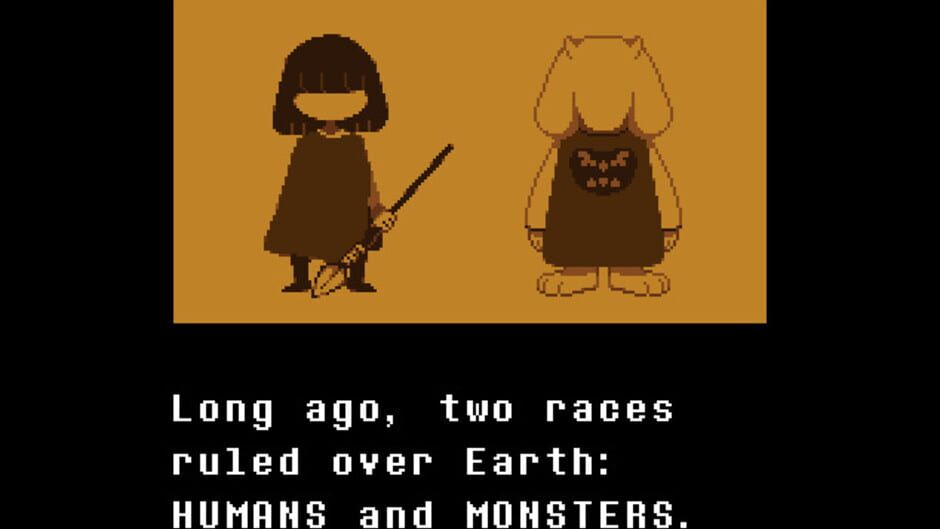
Long ago, humans and monsters lived peacefully on Earth. One day, war broke out between the two races. After a prolonged conflict, humanity emerged victorious and used magic to imprison the monsters beneath the surface. In the year 201X, a young child climbs Mount Ebott, a mountain from which, according to legend, no visitor returns. Seeking shelter from the rain, the child enters a cave and discovers an enormous opening in the ground. Moving closer to examine it, the child falls into the depths below. This is where the story begins.
Video game
2015
Adventure
Comedy
Drama
Horror
Fantasy
RPG
Puzzle
Indie
Undertale
- 8-4 Publisher
- tobyfox Developer
- tobyfox Publisher
In this underground world, fighting isn't your only choice.
Details
- Type
- Video game
- Release
- September 15, 2015
- Countries
- 🇺🇸 United States
- Genres
- Adventure, Comedy, Drama, Horror, Fantasy, RPG, Puzzle, Indie
- Platforms
- PlayStation 4, Xbox One, Nintendo Switch, PC, Mac, Linux, PS Vita
- Engine
- GameMaker: Studio
- Game modes
- Single player
Synopsis
Undertale



Trailer
Watch the trailer
Overview
Presentation
Created primarily by Toby Fox, Undertale is an independent role-playing game released on September 15, 2015. Developed using GameMaker: Studio, it features a two-dimensional presentation inspired by classic Japanese RPGs while challenging several of their conventions. The adventure follows a human child who falls into an underground world inhabited by monsters. Players explore this environment from a top-down perspective, travel through different areas, solve puzzles and encounter creatures with distinctive personalities. Dialogue plays a central role: behind their sometimes unusual appearances, the inhabitants express themselves through conversations combining humor, awkwardness, uncertainty and emotion.
The game's defining feature is its combat system, which does not require players to use violence. During encounters, four commands are available: FIGHT, ACT, ITEM and MERCY. FIGHT initiates an attack using a timing challenge in which stopping a moving cursor at the right moment increases damage. ACT offers interactions specific to the monster being encountered, including examining, talking, complimenting or performing actions suited to its personality. These choices can alter a monster's behavior and create opportunities to end the encounter peacefully. MERCY allows players to spare an opponent when the necessary conditions have been fulfilled, while items restore health or provide equipment. Each encounter therefore becomes a challenge whose solution does not depend exclusively on offensive strength.
Defensive phases introduce another mechanic: during enemy attacks, players control a small heart representing the protagonist's soul, moving it within a limited area to avoid projectiles. These sequences draw upon bullet hell games, which emphasize dodging complex patterns of attacks and obstacles. Individual opponents use distinctive attack sequences, while certain battles change movement rules or the properties of the heart itself. Encounters consequently combine RPG menus, observation and real-time reflexes. The decision to attack or spare opponents also affects character progression: defeating enemies through violence can award experience, whereas peaceful solutions follow a different approach.
Beyond individual battles, player decisions influence the development of the adventure. Monsters may respond differently depending on previous actions, and the story can reach different conclusions. Relationships formed throughout the journey therefore carry importance comparable to character statistics in traditional role-playing games. Puzzles, exploration and save points structure progression, while the writing also examines familiar player habits, including expectations surrounding combat, experience points, replaying a game and interpreting moral choices. Rather than enforcing a single approach, the game makes responsibility for those decisions part of its narrative design.
The visual style uses deliberately simple pixel art, alternating colorful exploration environments, minimalist battle screens and expressive character portraits. The soundtrack, composed by Toby Fox, accompanies different situations with electronic, melodic and orchestral arrangements, frequently incorporating recurring musical motifs. Temmie Chang also contributed to the game's visual identity through illustrations and animation. Humor, sometimes deliberately absurd, coexists with more serious passages, while the mechanics available to players reinforce the themes explored by the narrative.
Key Highlights
- An RPG where violence is optional: encounters can be resolved through attacks, conversation or sparing opponents.
- Combat combining strategy and reflexes: turn-based menus alternate with real-time projectile-dodging sequences.
- Interactions tailored to individual monsters: the ACT command allows players to examine opponents and adapt their responses.
- Choices that shape the adventure: decisions made during encounters affect character reactions and possible conclusions.
- Exploration and puzzles: environments, objects, dialogue and interactive challenges support progression.
- A distinctive audiovisual identity: pixel art, expressive characters and Toby Fox's soundtrack combine humor with emotion.
Conclusion
Undertale reworks several role-playing conventions by presenting combat as a situation that can be resolved without eliminating opponents. Its battle system connects dialogue choices with dodging mechanics and character progression, while accumulated decisions influence the unfolding narrative. Exploration, writing and music contribute to an experience in which relationships with other characters are an essential part of gameplay.
Did You Know?
- Development was primarily handled by Toby Fox, who also wrote the story, programmed the game and composed its soundtrack. Several artists and collaborators contributed to its creation.
- A Kickstarter campaign held from June 24 to July 24, 2013, raised $51,124 from 2,398 backers, exceeding its original $5,000 goal.
- The combat commands FIGHT, ACT, ITEM and MERCY provide different ways to approach encounters. Peaceful resolutions depend on the behavior and specific conditions of individual monsters.
- During enemy attacks, the heart representing the protagonist's soul can sometimes change color, introducing different movement rules.
- Save points appear as yellow stars. They allow players to record their progress and generally restore health.
- Temmie Chang contributed illustrations, animation, environmental artwork and the game's logo.
- Initially released for PC and Mac, Undertale later arrived on Linux in 2016, PlayStation 4 and PS Vita in 2017, Nintendo Switch in 2018 and Xbox in 2021.
Link graph
Open in the full graphLoading the graph…
Only the strongest links are shown.